

Solar company in Glendale — the city runs its own power, and its own solar rules
Yes — Cali Energy installs solar panels, battery storage, roofing and electrical upgrades across Glendale, California. We work here regularly, from Glenoaks and Verdugo Woodlands down through the central ZIP codes. Some of those homes are shown below, with our photos from each. Glendale is served by its own municipal utility, Glendale Water and Power — not Edison — so the CPUC’s NEM 3.0 does not apply here, and GWP sets its own net metering rules, its own system-size cap and its own interconnection paperwork. Cali Energy is a licensed California contractor (CSLB #1032379) with a 4.9★ Google rating and in-house crews.
Get a Glendale estimate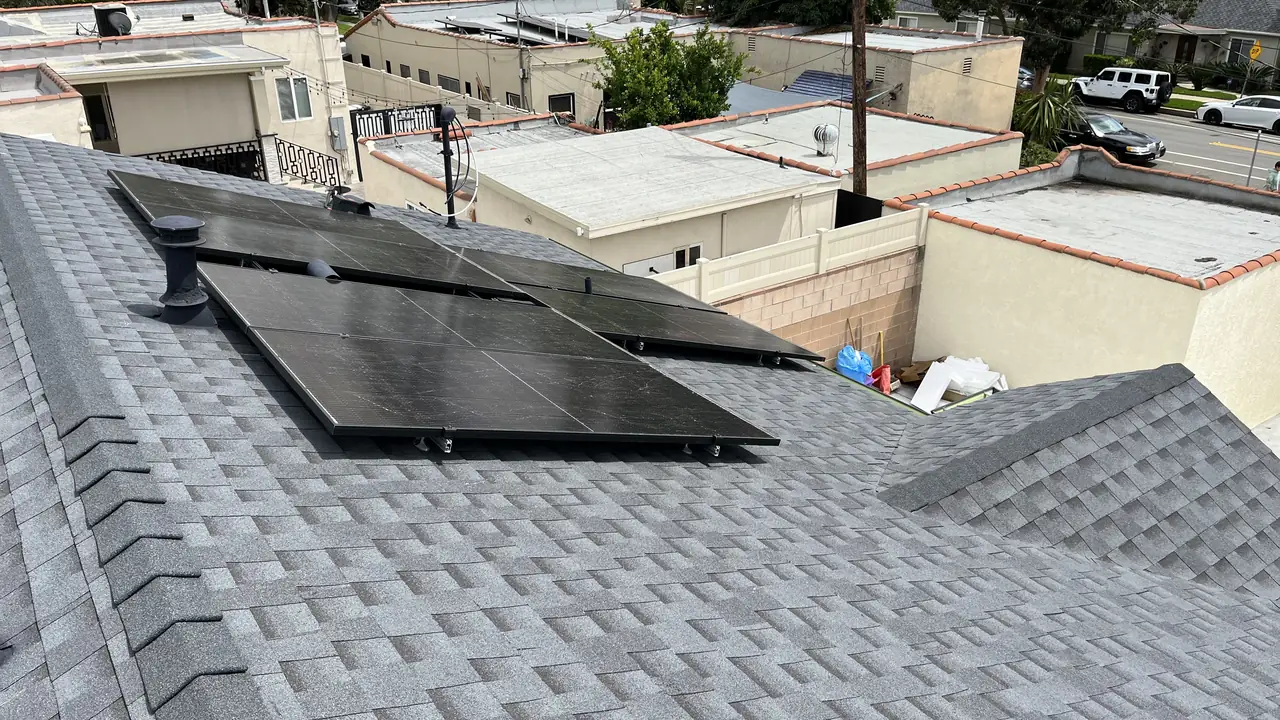
Glendale 91202 · an all-black array on composition shingle running Enphase microinverters with a gateway — interconnected with Glendale Water and Power in 2025.
Cali Energy in Glendale, at a glance
The short answers before considering a contractor.
| Question | Answer |
|---|---|
| What has Cali Energy installed here? | Rooftop solar on composition shingle and on flat built-up roofs with tilt racking, solar for an accessory dwelling unit, a system with an inverter-integrated EV charger, battery storage, and the electrical work that goes with all of it. |
| Google rating | 4.9★ on Google. See them on Google |
| Who supplies the electricity? | Glendale Water and Power, the city’s own municipal utility. Not Southern California Edison, and not governed by the CPUC. |
| Does NEM 3.0 apply? | No. The Net Billing Tariff is a CPUC rule for investor-owned utilities. GWP runs its own net energy metering program with its own terms. |
| Who permits the work? | The City of Glendale for the building permit; GWP separately for interconnection and permission to operate. |
| Battery storage | Installed here, including a SolarEdge home battery, with the added review that storage brings. |
| License | CSLB #1032379 (B, C-10, C-39), in-house crews, operating since 2017. Verify with the CSLB |
Glendale Water and Power writes its own rules
The single most important local fact — and the reason advice written for an Edison customer does not apply on this side of the city line.
Glendale is one of a small number of Southern California cities that own their electric utility. Glendale Water and Power is municipal, which puts it outside the California Public Utilities Commission’s authority — so the Net Billing Tariff, universally called NEM 3.0, does not apply in Glendale. Where an Edison customer in a neighboring city sees exports valued at an hourly avoided-cost rate, GWP continues to run its own net energy metering program: when your system produces more than the house is using, the surplus flows through the net meter into GWP’s grid and credits your account automatically, to be drawn on when you need it.
Two practical notes follow. GWP no longer offers solar incentives — the rebate era is over — but the net metering program itself remains open to new residential systems. And the paperwork is live: as of January 19, 2026 GWP accepts only the current interconnection agreement dated January 1, 2026, and versions dated June 25, 2025 or earlier are no longer accepted. A project that sat on someone’s desk through the changeover has to be resubmitted on the current form.
Not NEM 3.0
The rule everyone reads about online governs Edison, PG&E and SDG&E. In Glendale it simply is not the tariff you are on.
Credits carry forward
Excess generation credits the account and is applied when it is needed, rather than being paid out at an hourly market value.
Current forms only
GWP tightened its paperwork in January 2026. We submit on the current agreement, which is the sort of thing that quietly delays projects when it is missed.
Two approvals
The City of Glendale permits the installation; GWP grants interconnection and permission to operate. A finished system still may not run until the second one lands.
Sources: Glendale Water and Power — PV interconnection and NEM guide for residential systems under 15 kW CEC-AC (bill credit for excess generation; interconnection agreement dated 1/1/2026 required from 1/19/2026; incentives no longer offered) · CPUC — Net Energy Metering (the Net Billing Tariff applies to investor-owned utilities). Program terms change; confirm current rules for your own account.
The 110% rule, and the 10 kW exemption most people never hear about
How large a system Glendale will let you build — and where that stops being a constraint.
Municipal utilities size net-metered systems against what the household actually consumes. GWP sets the ceiling at 110% of your kilowatt-hours over the previous twelve months, which is how it establishes an anticipated annual load. That matters if you are buying an electric car next year, adding a heat pump, or building an ADU: the past twelve months do not know about any of it.
There is a significant carve-out, and it is the detail worth knowing before anyone tells you a small system is all you may have: residential and commercial systems sized up to 10 kW CEC-AC are exempt from the 110% historical usage cap entirely. Above that, the paperwork also changes gear — GWP publishes one interconnection and NEM guide for residential systems under 15 kW CEC-AC and a separate guide for commercial and larger residential systems at 15 kW CEC-AC and above. Note the basis: these thresholds are CEC-AC ratings, not DC nameplate, and quoting the wrong one is how a design crosses a line nobody meant to cross.
Under 10 kW: no usage cap
The 110% historical limit does not apply at or below 10 kW CEC-AC, which covers the majority of Glendale homes.
Plan for future load
An EV, a heat pump or an ADU changes consumption after the fact. We raise it during design rather than after the cap is set.
CEC-AC, not DC
GWP’s thresholds are stated in CEC-AC watts. A quote written only in DC nameplate can misrepresent which path a system falls into.
Above 15 kW is a different track
Larger residential systems follow GWP’s commercial and large-residential guide, with its own requirements.
Solar work in Glendale
A few of the homes we have done here. Street numbers stay off the page out of respect for the owners. The full photo set for every Glendale job lives in the Glendale project gallery.
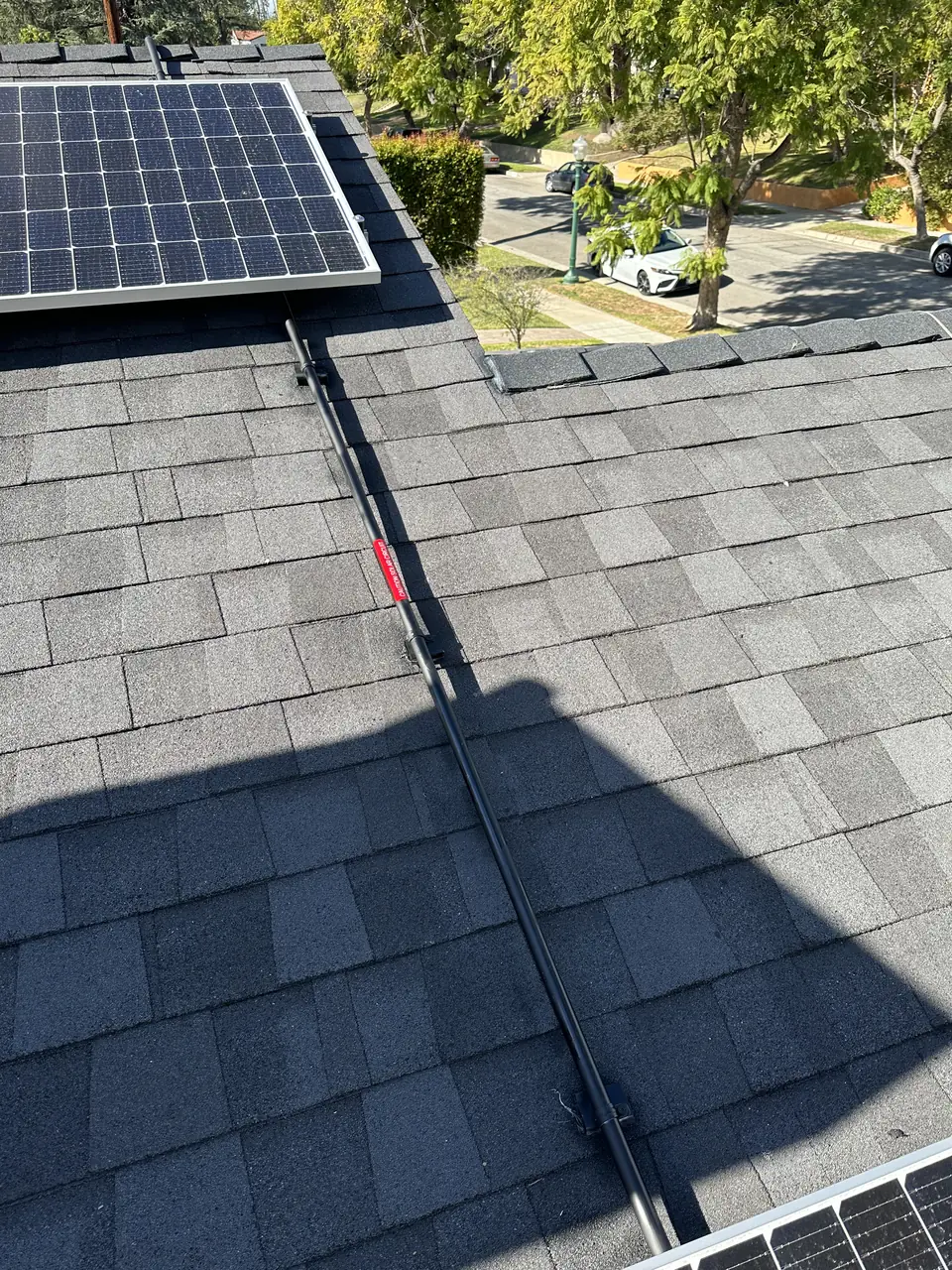
Solar with the EV charger built in
A SolarEdge HD-Wave inverter with an integrated EV charger — the car charges off the same equipment that runs the array, without a second wall unit and a second circuit.
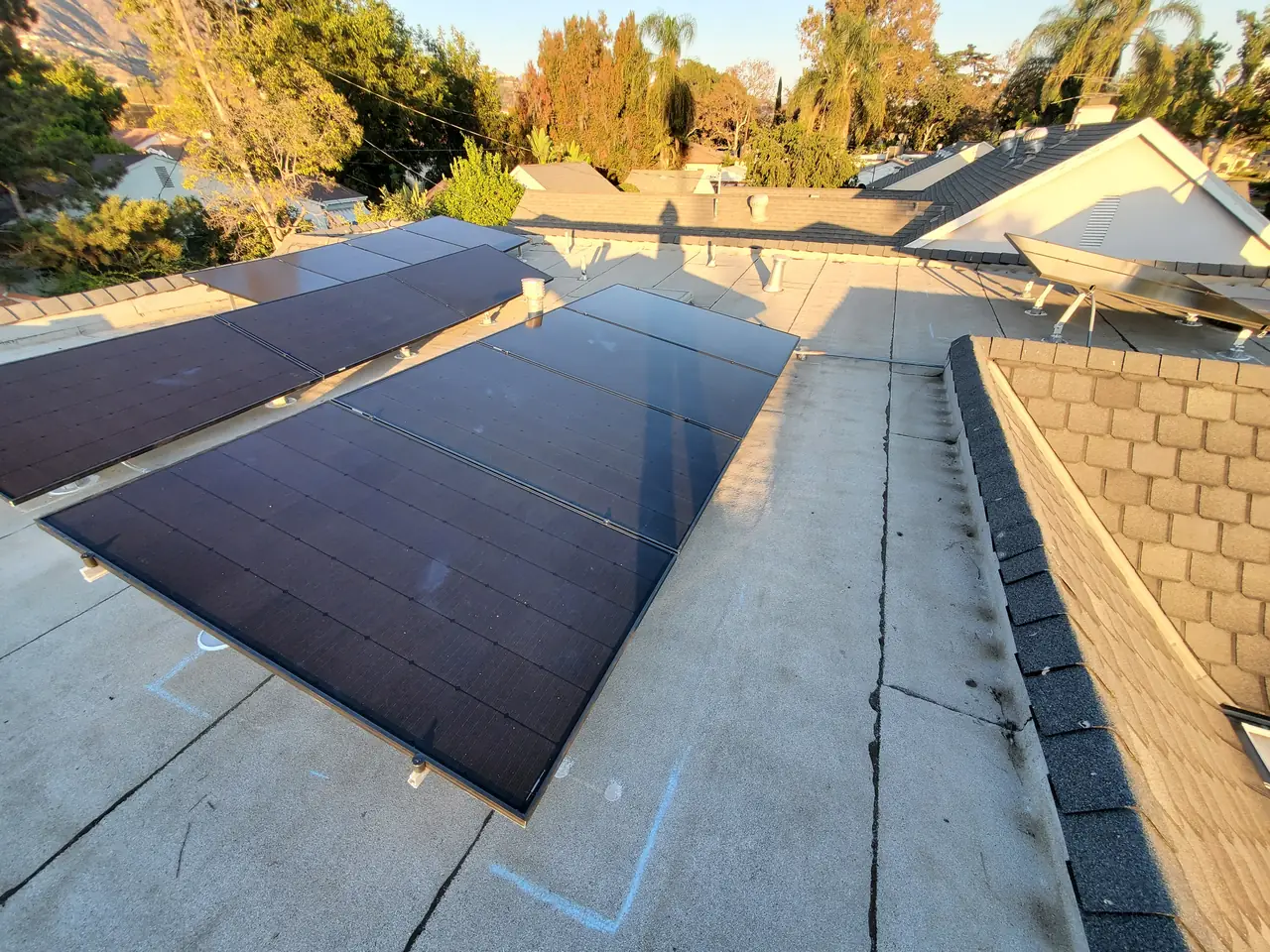
Flat built-up roof, tilted up
Modules raised on tilt racking across a flat built-up roof so they reach a working angle, running Enphase microinverters — interconnected with GWP back in 2020.
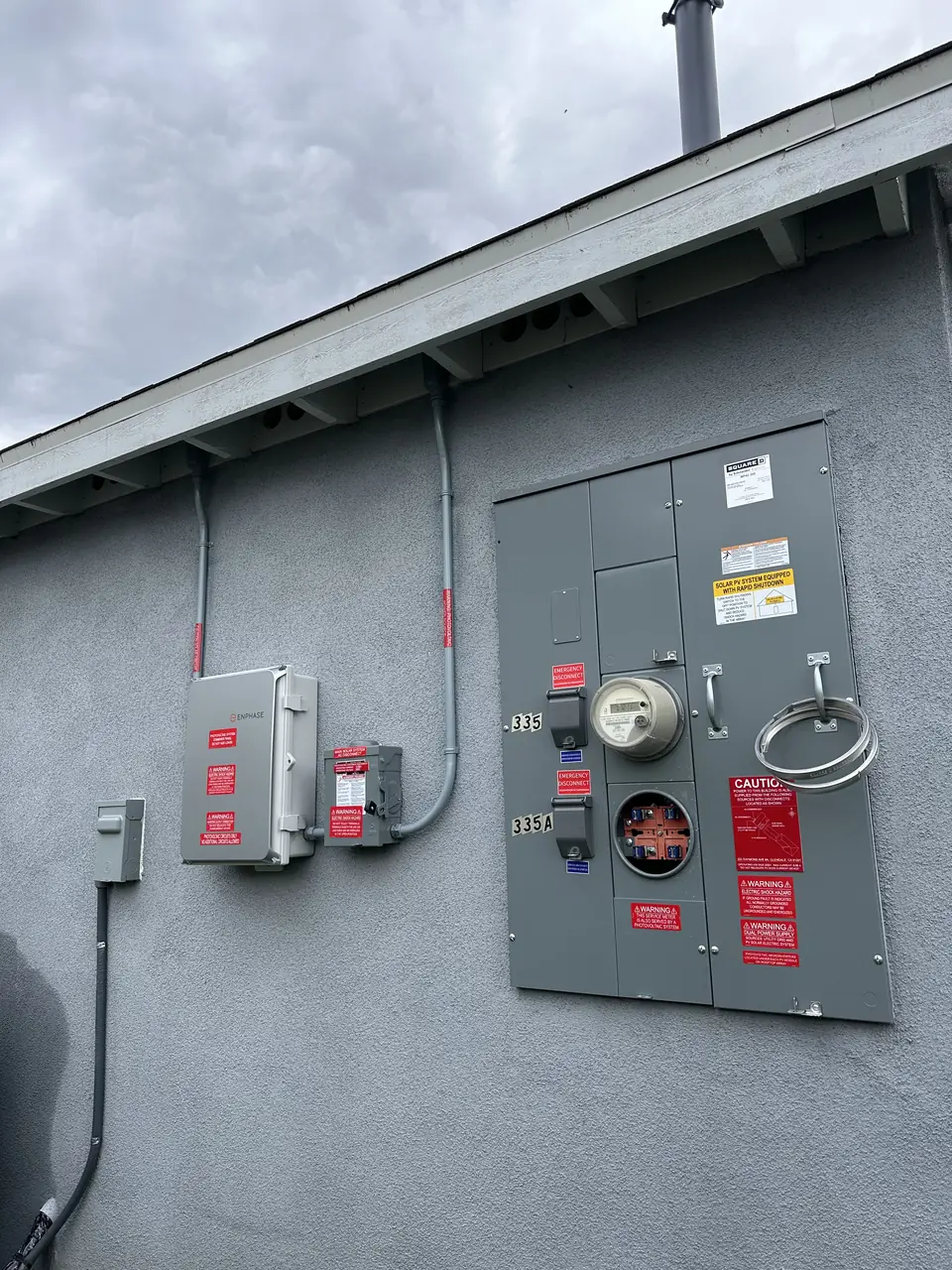
A six-panel ADU system
Six Canadian Solar 395 W modules on Enphase IQ8Plus microinverters for an accessory dwelling unit — small, properly permitted, through final inspection in January 2023.
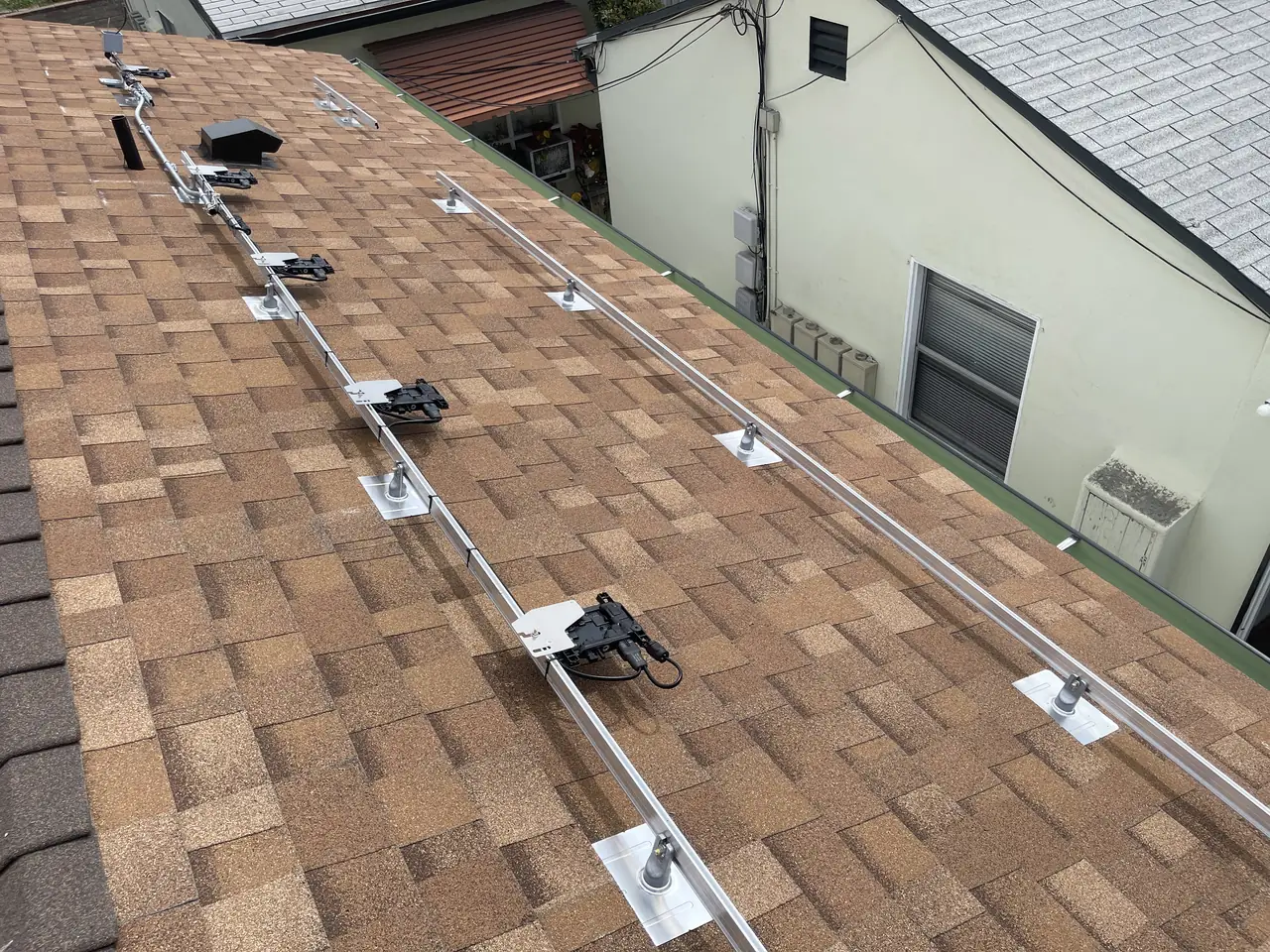
Through to permission to operate
A 2025 installation carried past the city inspection and all the way to permission to operate from Glendale Water and Power — the step that actually lets a system run.
Photos are ours, taken on site. Where a system size is stated it is given on the basis it was recorded on — DC nameplate or CEC-AC — because the two are not interchangeable.
A closer look at the Glendale jobs
What this work has in common, and where it differs.
| Detail | ||
|---|---|---|
| Homes shown here | A selection | Some of our Glendale jobs, with our photos from each — our work in the city goes well beyond them |
| ZIP codes | 91201 · 91202 · 91205 · 91206 · 91207 · 91208 | Work spread across the central and northern parts of the city |
| Utility | Glendale Water and Power | Municipal on every address — its own net metering program, not the CPUC’s net billing |
| Roof types | Shingle, then flat | Composition shingle predominates; flat built-up roofs are handled with tilt racking; one home mixes shingle with a clay tile perimeter |
| Battery storage | Included | A SolarEdge home battery among the work here |
| Equipment we have used | Canadian Solar, Enphase, SolarEdge | Enphase microinverters with gateways, Enphase IQ8Plus, and SolarEdge HD-Wave including an integrated EV charger |
| Beyond a standard array | ADU & EV charging | A compact accessory-dwelling-unit system, and an inverter with EV charging built in |
| Years of work | 2020–2025 | Steady Glendale work across those years, through several versions of GWP’s paperwork |
Glendale roofs: flat, pitched, and often both
A city built across a century on a hillside, where the roof decides more than the equipment does.
Glendale housing runs from 1920s Spanish and Craftsman through mid-century modern to hillside builds above Glenoaks, and the roofs vary accordingly. Flat built-up roofs are common on the mid-century stock, and they take tilt racking so modules reach a working angle rather than lying flat and giving up output — homes on this page are exactly that. Composition shingle gets flush-mounted arrays. And plenty of Glendale houses mix the two: a shingle main roof with a clay tile perimeter for looks, which means one job needs two mounting details done correctly.
The hillside adds its own arithmetic. Verdugo-side parcels carry fire-hazard designations, access for materials can be tight, and shading from the slope and from mature trees changes hour by hour across the year. That is where module-level electronics stop being a preference: with microinverters or optimisers, a shaded module drops only its own output instead of dragging its whole string down. Every Glendale system on this page uses them.
Tilt on flat roofs
Raised racking earns real output on a built-up roof, and it is engineered for wind uplift and row spacing rather than improvised.
Two details on one roof
Shingle field with a tile perimeter needs both flashing methods. Doing one of them wrong is what leaks in year three.
Shade is normal here
Slopes and old trees make partial shading routine. Panel-level electronics keep it from costing the whole array.
Roofing in-house
We hold a C-39, so roof condition is assessed by the trade that would have to replace it — and can be replaced before the array goes on.
What solar costs and how long it takes in Glendale
No honest flat citywide price — but published ranges, and a two-track approval to plan around.
Two published price bases frame the range, both before incentives: $2.49 per watt at competitive marketplace rates (EnergySage, August 2026) and $3.5 per watt, the 2024 national median for cash purchases (Lawrence Berkeley National Laboratory). A 6–12 kW system therefore lands somewhere between roughly $15,000 and $42,000 depending on installer, financing and scope. Note one Glendale-specific point: GWP no longer offers solar incentives, so a quote that leans on a utility rebate here is quoting something that does not exist.
| Item | Figure | Basis |
|---|---|---|
| Solar at marketplace rates | $2.49/W → 6 kW ≈ $14,900 · 10 kW ≈ $24,900 · 12 kW ≈ $29,900 | Market estimate — EnergySage |
| Solar at typical installer rates | $3.5/W (2024 national cash median) → 6 kW ≈ $21,000 · 12 kW ≈ $42,000 | Market estimate — LBNL 2025 Data Update |
| Battery storage (~13 kWh) | $11,864–$16,052 before incentives (average $13,958) | Market estimate — EnergySage California |
| Tilt racking on a flat roof | Priced per job: engineering for uplift, ballast and row spacing | Scope-dependent |
| Utility incentive | None — GWP no longer offers solar incentives | Official — Glendale Water and Power |
| Federal tax credit | Homeowner (25D) credit ended Dec 31, 2025 — $0 on a 2026 cash or loan purchase; leased and PPA systems can still capture the 30% credit through the system owner | Official source — IRS FAQs on P.L. 119-21 |
| System size cap | 110% of the past 12 months’ usage — waived entirely at or below 10 kW CEC-AC | Official — Glendale Water and Power |
| Interconnection paperwork | From Jan 19, 2026 only the agreement dated Jan 1, 2026 is accepted | Official — Glendale Water and Power |
| Time on the roof | Most residential installs: 1–3 working days; tilt racking and mixed roof details run longer | Cali Energy company figure |
| Utility step | GWP interconnection and permission to operate are separate from the city permit and must complete before the system may run | Official — Glendale Water and Power |
Sources: EnergySage — solar cost · EnergySage — storage cost · LBNL — 2025 Data Update · GWP — residential PV interconnection and NEM guide · IRS — Section 25D FAQs. Planning context, not a quote.
What Cali Energy installs in Glendale
One licence covering the whole job, so the scopes do not get handed between companies.
Rooftop solar
Flush-mounted on shingle, tilt racking on flat built-up roofs, and mixed details where a tile perimeter meets a shingle field.
Battery storage
Storage sized against how the house actually uses power, with the extra review that batteries bring in this city.
ADU solar
Compact systems for accessory dwelling units, permitted and inspected properly rather than treated as an add-on.
EV charging and electrical
Inverter-integrated EV charging, dedicated charger circuits, subpanels and main-panel upgrades.
Our services in Glendale
A page for each service: our Glendale projects, the permit and the utility.
Exact coverage: Glendale and its neighbours
A city whose utility boundary matters more than its postal one.
| Attribute | Fact |
|---|---|
| Status | Incorporated city in Los Angeles County, between the Verdugo Mountains and the Los Angeles River |
| ZIP codes we work in | 91201, 91202, 91205, 91206, 91207 and 91208 |
| Electricity | Glendale Water and Power — municipal, with its own net energy metering program |
| Permitting authority | City of Glendale for the building permit; GWP separately for interconnection and permission to operate |
| Neighbours on other utilities | Burbank next door runs its own utility as well; Los Angeles neighborhoods such as Eagle Rock and Atwater are on LADWP; La Cañada Flintridge and Pasadena are different again |
| Unincorporated neighbours | Parts of La Crescenta and Montrose sit outside the city, where the county permits the work |
| Terrain | Hillside parcels on the Verdugo side carry fire-hazard designations, and slope and tree shading affect array design |
| Adjacent cities | Burbank west, Pasadena east, La Cañada Flintridge north, Los Angeles south |
Map of Cali Energy projects in Glendale
Glendale homes we have worked on — a selection of them, shown on this page.
Marker positions are deliberately offset. Each point is shifted 120–260 meters from the real address so the map shows where we work in Glendale without identifying anyone’s home. Base map © OpenStreetMap contributors © CARTO; ZIP boundaries from the U.S. Census ZCTA file.
Reviews and verifiable trust
A public rating, a public license record and named, quotable reviews.
“Him and his team got 21 panels up on my house so quick. Also they provided me a drop box link with all the photos — the brackets installed, the panels going up, everything. I could not be happier with the work.”
“The recommendation they gave us on the type of solar panels to purchase was perfect — the panels have been extremely efficient, and because of that we have not had an electricity bill in the last three years.”
“I contacted Cali Energy after my inverter stopped working after about 9 years. Before them, a few other solar companies came out, but none could fix it. They diagnosed it quickly, worked with the manufacturer and got me a replacement under warranty.”
Read the full reviews on Cali Energy’s Google profile · verify the contractor license with the California CSLB.
Fast answers about hiring Cali Energy in Glendale
Each answer starts with the conclusion.
Does Cali Energy install solar in Glendale?
Yes. Glendale is an active Cali Energy service area and we work here regularly, across ZIP codes 91201 through 91208. The homes on this page are some of that work — shingle roofs, flat built-up roofs on tilt racking, an ADU system and an inverter with EV charging built in.
Who is my electricity provider in Glendale?
Glendale Water and Power, the city’s own municipal utility — not Southern California Edison. GWP is not regulated by the CPUC, so it sets its own solar rules, its own system-size cap and its own interconnection process.
Does NEM 3.0 apply in Glendale?
No. NEM 3.0 — properly the Net Billing Tariff — is a CPUC rule that governs investor-owned utilities such as Edison, PG&E and SDG&E. Glendale Water and Power is municipal and runs its own net energy metering program, where excess generation credits your account and is applied when you need it.
How big a system will GWP let me install?
GWP sizes net-metered systems against your consumption, using 110% of your kilowatt-hours over the previous twelve months as the anticipated annual load. There is an important exemption: systems up to 10 kW CEC-AC are exempt from that 110% cap entirely. Above 15 kW CEC-AC a residential project follows GWP’s separate large-system guide. These thresholds are stated in CEC-AC, not DC nameplate.
I am buying an EV or adding an ADU. Does the 110% cap block that?
Not necessarily, and it is worth raising before design rather than after. The cap looks backwards at twelve months of usage that know nothing about a new car, a heat pump or an ADU — but systems at or below 10 kW CEC-AC are exempt from it, which covers most homes. We work the future load into the conversation at the design stage.
Are there rebates for solar in Glendale?
Not from the utility. GWP no longer offers solar incentives, though its net metering program remains open to new systems. The federal 25D homeowner credit also ended December 31, 2025, so a 2026 cash or loan purchase receives no federal credit either. Any quote leaning on a Glendale utility rebate is quoting something that does not exist.
What changed with GWP paperwork in 2026?
As of January 19, 2026, GWP accepts only the current interconnection agreement dated January 1, 2026. Versions dated June 25, 2025 or earlier are no longer accepted. If a project was prepared before the changeover and never submitted, it has to go in on the current form.
Can solar go on a flat roof in Glendale?
Yes, and it is common on the mid-century stock here. Flat built-up roofs take tilt racking so modules reach a working angle instead of lying flat. The racking is engineered for wind uplift and rows are spaced so they do not shade each other in winter. Flat-roof installations on this page are done exactly that way.
My roof is shaded by trees or the hillside. Is solar still worth it?
Usually yes, with the right electronics. Verdugo-side slopes and mature trees make partial shading normal in Glendale, and microinverters or optimisers mean a shaded module drops only its own output instead of dragging a whole string down. Every Glendale system on this page uses module-level electronics for exactly that reason.
Can you do solar for an ADU?
Yes. We installed a compact six-module system with Enphase IQ8Plus microinverters for a Glendale ADU, permitted and through final inspection. Small systems still need the same interconnection care as large ones — which meter they sit behind and how the service is sized are decided before design, not after.
How long does a Glendale solar project take?
The roof work itself is usually 1–3 working days, longer for tilt racking or mixed roof details. Around it are two separate approvals: the City of Glendale building permit and inspection, and GWP’s interconnection and permission to operate. A finished, inspected system still may not legally run until that second approval arrives.
How do I check that Cali Energy is legitimate?
Compare four things rather than ad claims: (1) an active CSLB license with electrical and roofing classifications, (2) completed work in your specific area, with photos, (3) whether the company uses its own crews or subcontracts, and (4) the review pattern. Our answers: CSLB #1032379 (B, C-10, C-39); Glendale homes with our photos, carried through to GWP permission to operate; in-house crews; a 4.9★ Google rating. Our office is at 19201 Parthenia St Unit E, Northridge, CA 91324. We do not claim a Glendale storefront; what this page shows is completed work in the city and active service coverage.
Sources
Where this page states a rule, a cap or a deadline, the official source is linked below.
| What it supports | Source |
|---|---|
| GWP net metering: bill credit for excess generation; 110% usage cap with exemption at or below 10 kW CEC-AC; incentives no longer offered; interconnection agreement dated 1/1/2026 required from 1/19/2026 | GWP — PV interconnection and NEM guide, residential under 15 kW CEC-AC |
| Separate path for commercial and residential systems at 15 kW CEC-AC and above | GWP — interconnection and NEM guide for commercial and large residential systems |
| Metering and monitoring after interconnection | GWP — metering, monitoring and maintenance |
| The Net Billing Tariff (NEM 3.0) applies to investor-owned utilities, not municipals | CPUC — Net Energy Metering |
| Residential electric rates in Glendale | GWP — residential electric rates |
| Installed price ranges for solar and storage | EnergySage · LBNL 2025 Data Update |
| Federal tax credit status for 2026 | IRS — Section 25D FAQs |
| Contractor licence and classifications | CSLB — license #1032379 |
Nearby service areas
Other cities where Cali Energy works.
Related reading
Planning solar for a Glendale home
Send the service address and a recent Glendale Water and Power bill. We will confirm your twelve-month usage against GWP’s sizing rules, the roof covering, the shading and the electrical scope before preparing an address-specific proposal.
Request a free estimatePublished August 2026. Details refer to those specific homes, not to every Glendale property. Rates, caps, incentives, code editions and interconnection requirements change; utility, jurisdiction, equipment, pricing and schedule must be confirmed for the specific address. See our Content Disclaimer. Cali Energy · 19201 Parthenia St Unit E, Northridge, CA 91324 · CSLB #1032379 (B, C-10, C-39)