

Solar company in Covina — when the roof runs out, the patio can carry the rest
Yes — Cali Energy installs solar panels, battery storage, roofing and electrical upgrades in Covina, California. We work here regularly across 91722, 91723 and 91724, on composition shingle, tile and flat roofs. Some of those homes are shown below, with our photos from each. One of them is worth naming up front: where the roof alone could not carry the system, part of the array went onto patio-level mounting on concrete instead. Covina also sits on Southern California Edison directly — unlike Monrovia, Claremont and several neighbours, it is not part of a community energy program, so one company supplies and delivers your power. Cali Energy is a licensed California contractor (CSLB #1032379) with a 4.9★ Google rating and in-house crews.
Get a Covina estimate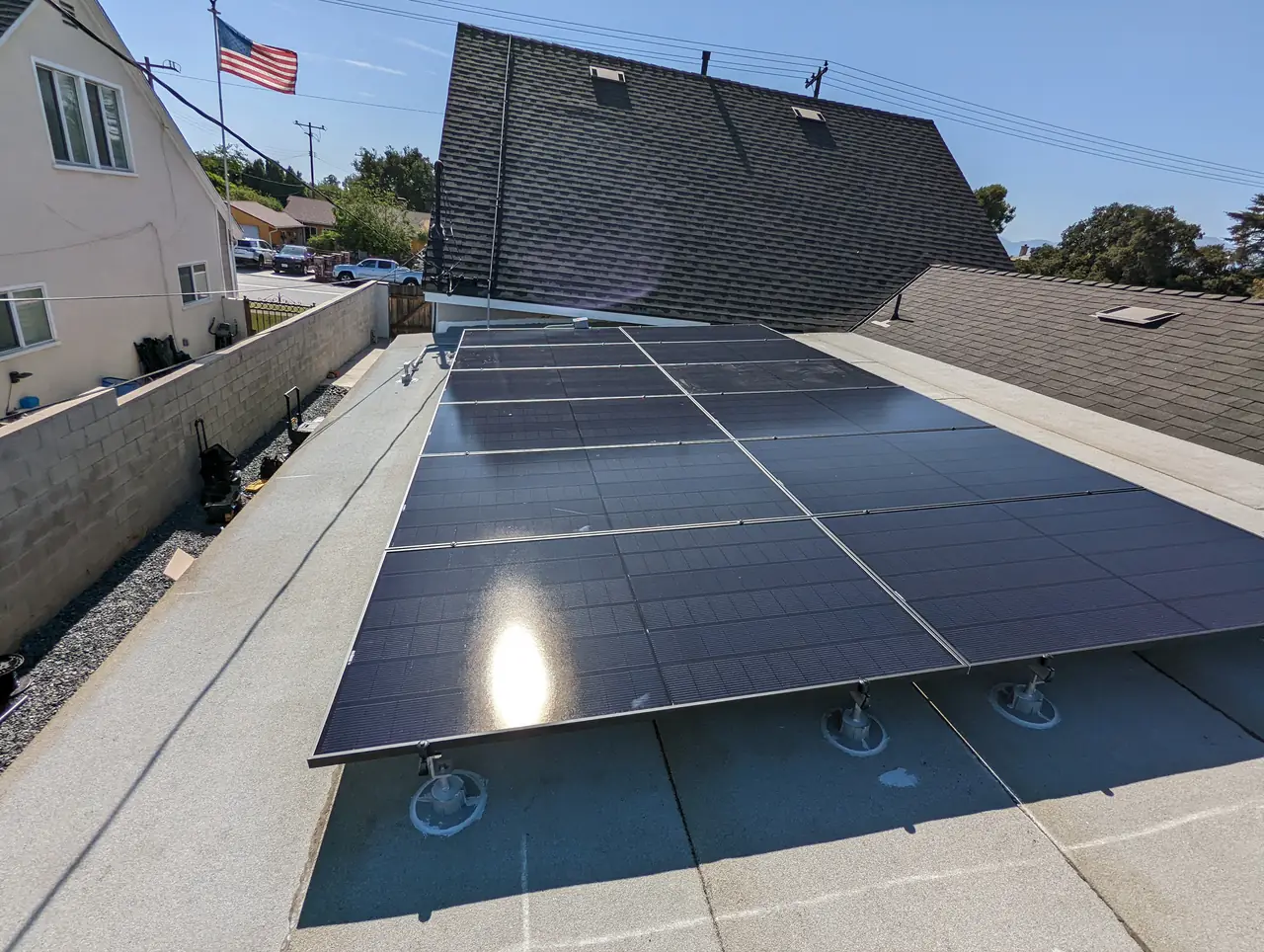
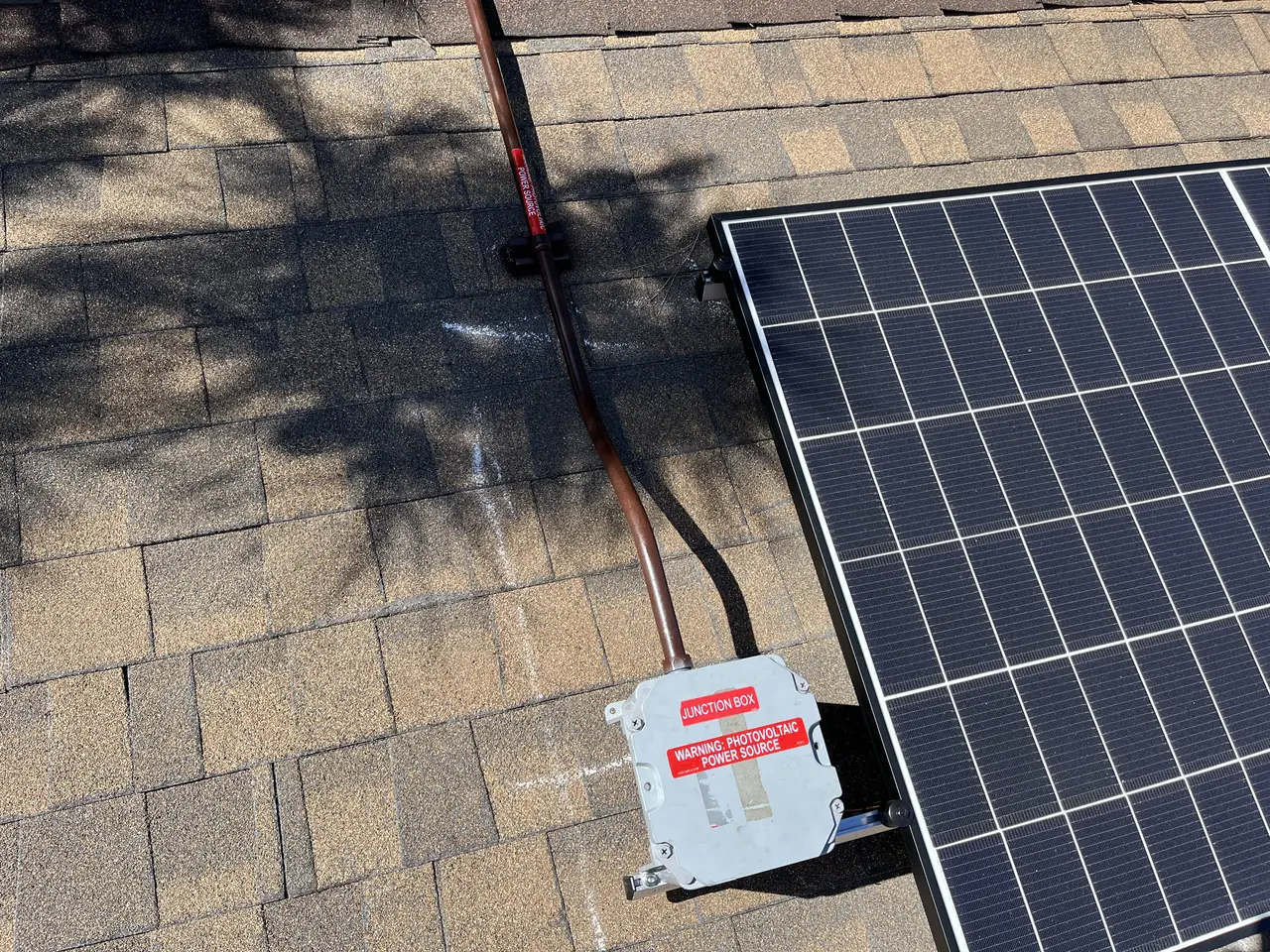
Covina 91724 · an Enphase microinverter system split between the roof and patio-level mounting on concrete — final inspection August 2022.
Cali Energy in Covina, at a glance
The short answers before considering a contractor.
| Question | Answer |
|---|---|
| What has Cali Energy installed here? | Rooftop solar on composition shingle, barrel and S-tile and flat membrane roofs; arrays split across several roof faces; tilt-up rows on a flat roof; and a system combining roof mounting with patio-level mounting on concrete. |
| Google rating | 4.9★ on Google. See them on Google |
| Who supplies the electricity? | Southern California Edison, directly. Covina is not part of Clean Power Alliance or any other community energy program, so generation and delivery come from the same company. |
| Who permits the work? | The City of Covina Building Division, plus a separate Edison interconnection process. |
| Does NEM 3.0 apply? | Yes. New solar customers in Edison territory are on the Solar Billing Plan, where exports earn an hourly avoided-cost value rather than the retail rate. |
| What if my roof is too small or shaded? | Ground and patio-level mounting is a real option here, and we have built it — it is engineered and permitted rather than improvised. |
| License | CSLB #1032379 (B, C-10, C-39), in-house crews, operating since 2017. Verify with the CSLB |
When the roof runs out
Most solar pages assume the roof is the whole answer. On one Covina home it was not, and there is a proper way to handle that.
Roofs run out for ordinary reasons: too many faces broken up by dormers and vents, the good planes pointing the wrong way, shade from a neighbour’s tree, or simply not enough square footage for the household’s consumption. The usual response is to shrink the system and say nothing. On a Covina job we did the other thing: the array was split between the roof and patio-level mounting on a concrete slab, running Enphase microinverters, and taken through final inspection in August 2022.
Ground and patio mounting is not a shortcut — it is a different structure with its own engineering. The frame carries wind uplift with nothing above it to shelter it; it needs a foundation or ballast the slab can actually take; the run back to the service equipment is longer, so conductors are sized for voltage drop; and it is permitted as its own scope rather than tucked into a rooftop application. Done properly it opens options a roof-only quote cannot: a south-facing frame where the roof faces east and west, clear of the shade that limits the roof, and easy to reach for cleaning and service.
What it is not is automatic. It needs the space, it needs the setbacks, and it costs more per watt than a straightforward roof mount. We say which case a property is in before proposing anything.
Engineered, not improvised
A ground or patio frame is designed for wind uplift and anchored properly, then permitted and inspected on its own terms.
Orientation you choose
Unlike a roof, a frame can face where the sun actually is — useful when the roof planes point east and west.
Longer runs, real losses
Distance to the service equipment is an engineering input. Conductors are sized for voltage drop rather than guessed at.
Only where it fits
It needs space and setbacks and costs more per watt. We tell you if the property does not suit it.
Solar work in Covina
A few of the homes we have done here. Street numbers stay off the page out of respect for the owners. The full photo set for every Covina job lives in the Covina project gallery.
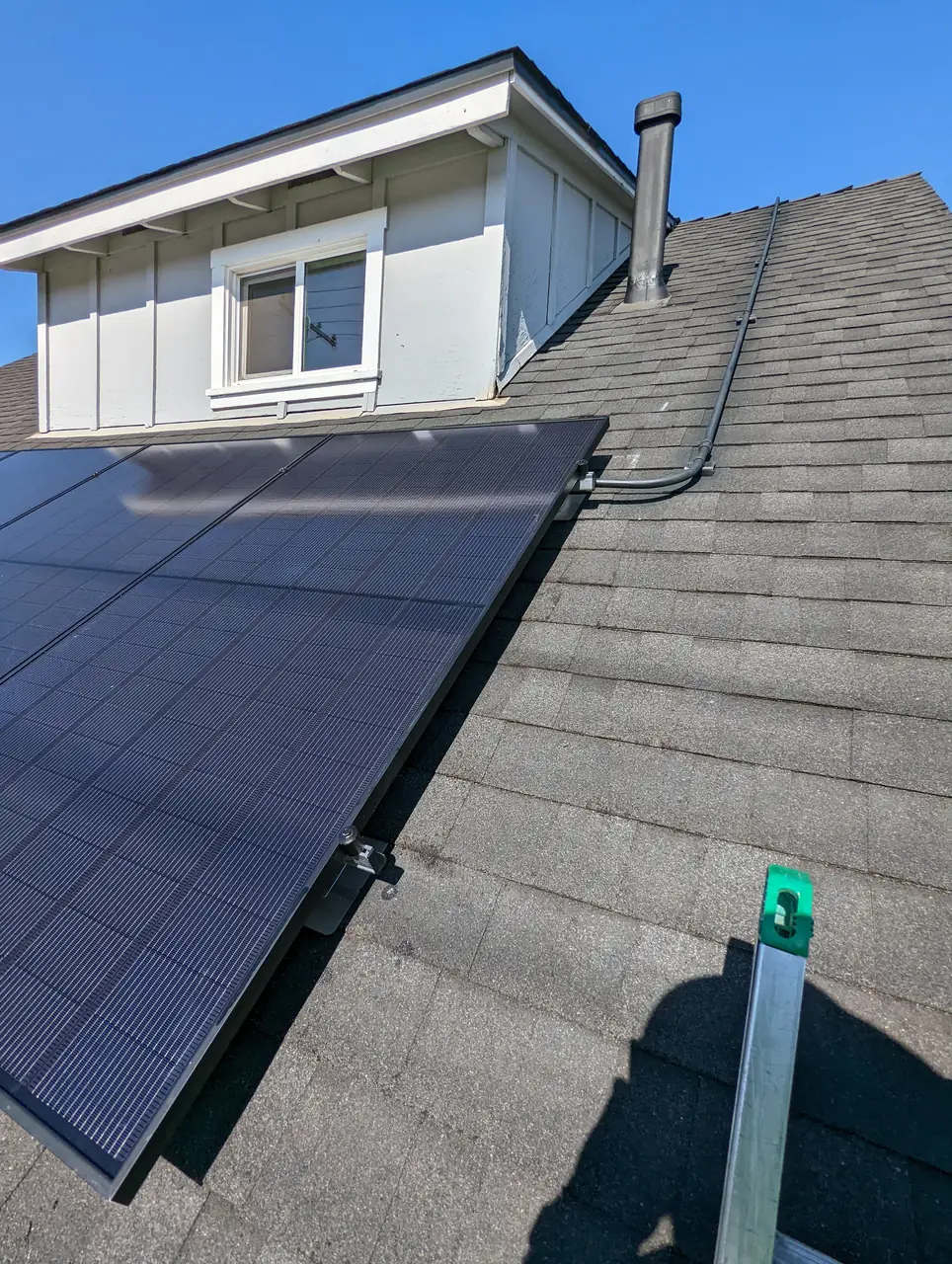
Roof and patio combined
An Enphase microinverter system split between the roof and patio-level mounting on concrete — the answer when the roof alone cannot carry what the household needs.
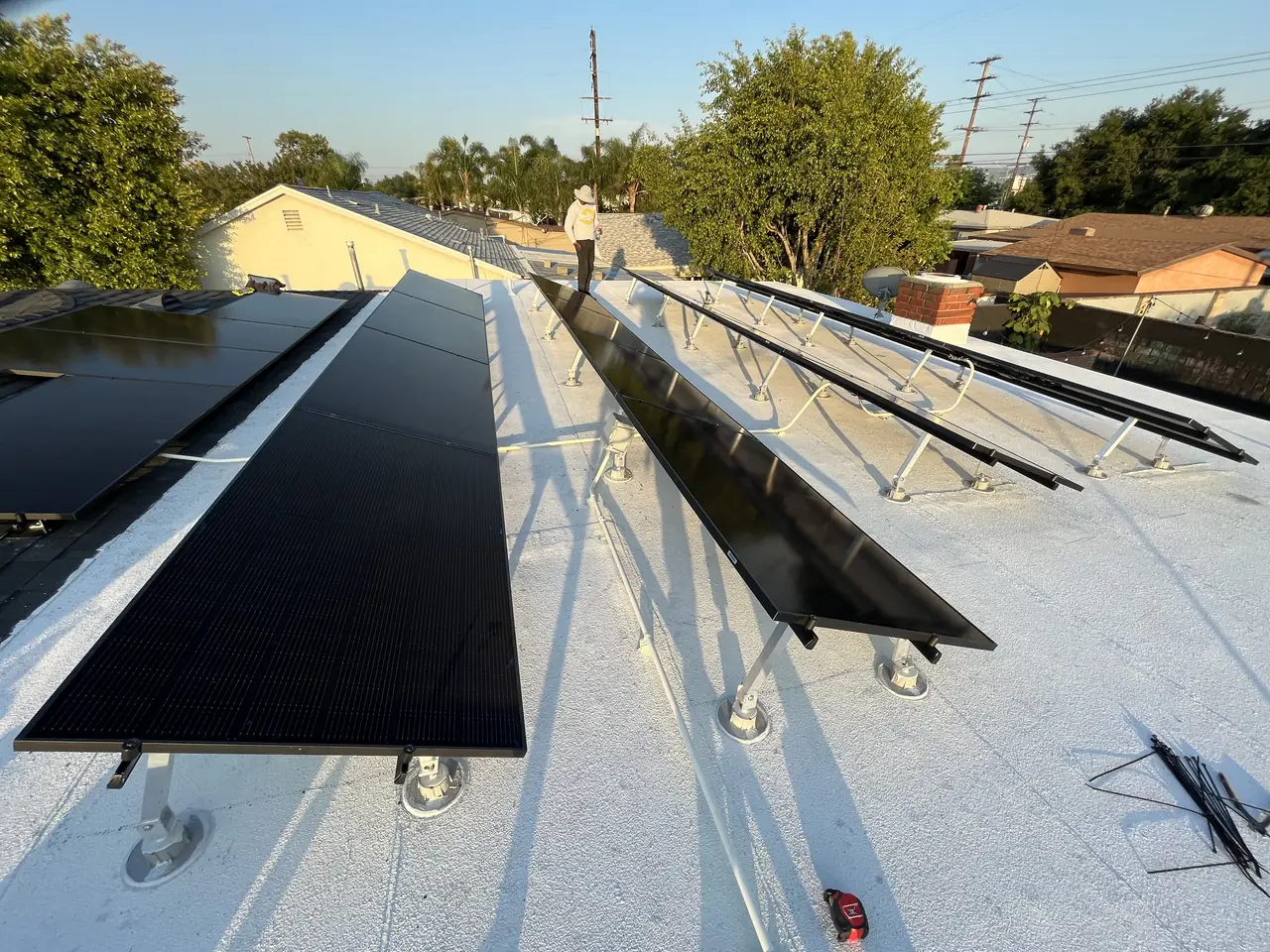
Tilt-up rows on a membrane roof
Raised rows across a white-membrane flat roof, angled to reach useful output and spaced so one row does not shade the next.
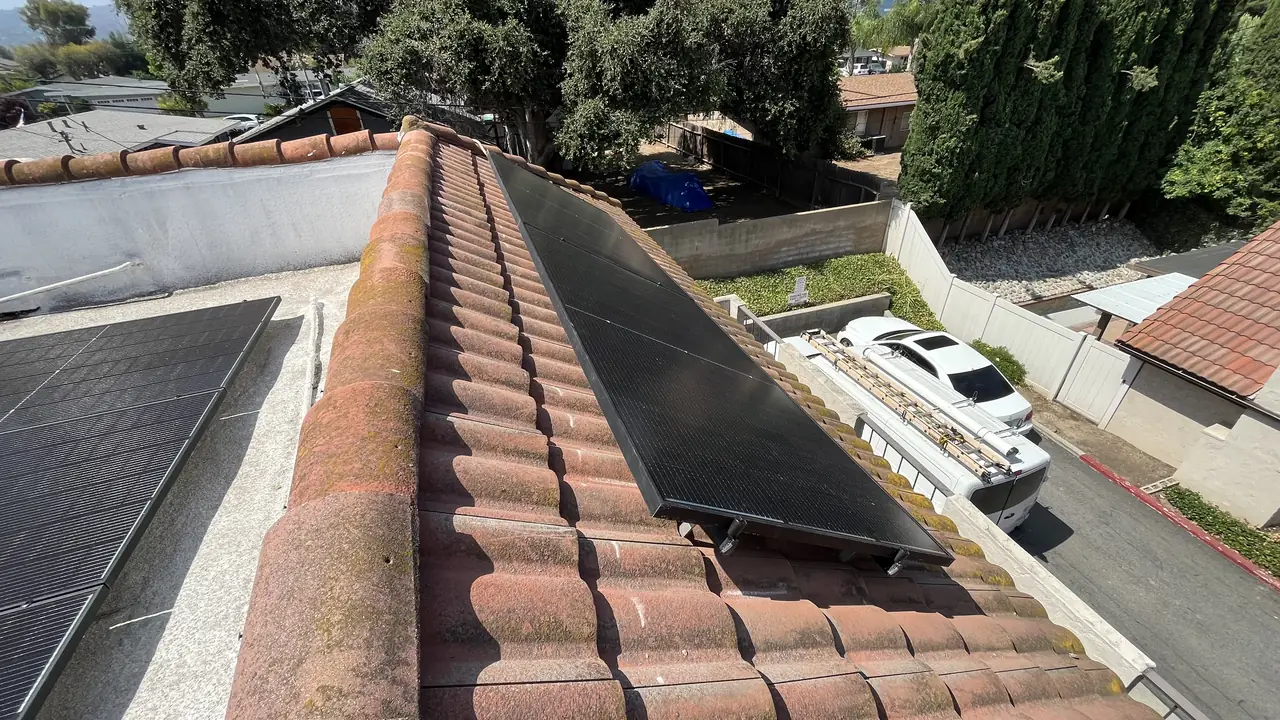
Tile roof, plus a flat section
Mostly barrel and S-tile with one array on the adjacent flat section — two mounting methods on a single property, each detailed for its own covering.
8.51 kW on shingle
A straightforward composition-shingle installation from 2022 — the everyday Covina case, and the one most homes here fall into.
Photos are ours, taken on site. Where a system size is stated it is given on the basis it was recorded on — DC nameplate or CEC-AC — because the two are not interchangeable.
A closer look at the Covina jobs
What this work has in common, and where it differs.
| Detail | Value | Notes |
|---|---|---|
| Homes shown here | A selection | Some of our Covina jobs, with our photos from each — our work in the city goes well beyond them |
| ZIP codes | 91722 · 91723 · 91724 | Work spread across all three, with most of it in 91724 and 91722 |
| Roof types | Shingle, then tile and flat | Composition shingle predominates; barrel and S-tile and white-membrane flat roofs make up the rest |
| Utility | SCE, directly | Southern California Edison supplies and delivers — Covina is not in a community energy program |
| Mounting | Flush, tilt-up and ground | Flush on pitched roofs, tilt-up rows on flat membrane, and patio-level mounting on concrete where the roof was not enough |
| Inverters | Enphase | Microinverters where arrays split across several faces — common on this housing stock |
| Typical layout | Multiple faces | Several of these homes carry panels across three or more roof planes rather than one clean rectangle |
| Years of work | 2021–2023 | Steady San Gabriel Valley work across those years |
Edison, without a middle layer
A simpler arrangement than most of our service area — and worth knowing when you compare advice with a neighbour.
Across much of Los Angeles and Ventura counties a community choice program now buys the electricity while Edison delivers it, which splits the bill into a generation line and a delivery line credited by two different organizations. Covina is not one of those cities. Edison’s own list of community choice partners covers neighbours such as Monrovia, Claremont, Arcadia, Temple City and Whittier — but not Covina. Here Edison both supplies and delivers, and the bill has one provider behind it.
What does not change is the export rule. New solar customers in Edison territory have been on the Solar Billing Plan — the tariff commonly called NEM 3.0 — since April 15, 2023, where energy sent back earns an hourly avoided-cost value rather than the retail rate. So the design goal here is the same as everywhere in Edison country: match production to what the house actually uses, and treat storage as the way to hold the evening rather than selling the midday cheaply.
One provider, one bill
No separate generation supplier to track. Simpler than the arrangement in neighboring cities.
Solar Billing Plan applies
Exports earn an hourly avoided-cost value, not retail. Self-consumption is where the value sits.
Check the approval date
Systems approved before April 15, 2023 remain on the older terms for their eligibility period — worth confirming on a resale home.
Storage is the lever
Moving production into the evening is what recovers value the export rate no longer pays for.
Sources: SCE — community choice aggregation partners (list of participating cities) · CPUC — Net Energy Metering (Solar Billing Plan for SCE customers from April 15, 2023). Program membership changes; confirm what your own account is on.
Three coverings, three methods
Covina housing spans several eras, and the roof decides the approach more than the equipment does.
Composition shingle is the default and the most straightforward — flush mounting with flashed penetrations. Barrel and S-tile need profile-specific hardware, a layout that follows the tile course, and replacement tiles on site, because some will crack on an older roof. Flat membrane roofs take tilt-up rows so the modules reach a working angle, engineered for wind uplift and spaced so rows do not shade each other in winter — and detailed so the membrane keeps doing its waterproofing job.
One property here has two of those on the same house: mostly tile, with an array on an adjacent flat section. That is normal in this housing stock, and it means one job needs two sets of details done correctly. It is also why several of these systems run microinverters — when an array is split across three or more faces, each module needs to produce and report on its own rather than following the weakest plane.
Shingle
Flush mounting with flashed penetrations — the quickest install of the three.
Tile
Profile-specific hardware, layout from the tile course, replacement tiles carried as standard.
Flat membrane
Tilt-up rows engineered for uplift, spaced for winter sun, detailed so the membrane stays intact.
Split arrays
Three or more faces is common here, which is exactly where module-level electronics earn their cost.
What solar costs and how long it takes in Covina
No honest flat citywide price — but published ranges and a clear sequence.
Two published price bases frame the budget, both before incentives: $2.49 per watt at competitive marketplace rates (EnergySage, August 2026) and $3.5 per watt, the 2024 national median for cash purchases (Lawrence Berkeley National Laboratory). A 6–12 kW system therefore lands somewhere between roughly $15,000 and $42,000 depending on installer, financing and scope. Tile work, tilt-up racking and any ground or patio structure are priced into the job rather than bolted on afterwards.
| Item | Figure | Basis |
|---|---|---|
| Solar at marketplace rates | $2.49/W → 6 kW ≈ $14,900 · 8 kW ≈ $20,000 · 10 kW ≈ $24,900 | Market estimate — EnergySage |
| Solar at typical installer rates | $3.5/W (2024 national cash median) → 6 kW ≈ $21,000 · 10 kW ≈ $35,000 | Market estimate — LBNL 2025 Data Update |
| Battery storage (~13 kWh) | $11,864–$16,052 before incentives (average $13,958) | Market estimate — EnergySage California |
| Ground or patio mounting | Priced per job: frame engineering, foundation or ballast, longer conductor runs — more per watt than a roof mount | Scope-dependent |
| Tile and tilt-up racking | Priced per job: profile-specific hardware, uplift engineering, slower install | Scope-dependent |
| Federal tax credit | Homeowner (25D) credit ended Dec 31, 2025 — $0 on a 2026 cash or loan purchase; leased and PPA systems can still capture the 30% credit through the system owner | Official source — IRS FAQs on P.L. 119-21 |
| Time on the roof | Most residential installs: 1–3 working days; tile, tilt-up and ground scopes run longer | Cali Energy company figure |
| Permit | City of Covina Building Division | Official — City of Covina |
| Utility step | Edison interconnection is separate and must complete before the system may operate | Official — SCE |
Sources: EnergySage — solar cost · EnergySage — storage cost · LBNL — 2025 Data Update · IRS — Section 25D FAQs. Planning context, not a quote.
What Cali Energy installs in Covina
One licence covering the whole job, so the scopes do not get handed between companies.
Rooftop solar
Flush on shingle, profile-specific hardware on tile, tilt-up rows on flat membrane, with microinverters on split arrays.
Ground and patio mounting
Engineered frames where the roof cannot carry the system — permitted and inspected as their own scope.
Battery storage
Under the Solar Billing Plan storage is what holds the evening. Sized to the circuits worth keeping alive.
Roofing and electrical
Roof replacement under our own C-39 when the covering will not outlast the array, plus panel upgrades and EV circuits.
Exact coverage: Covina and its neighbours
A San Gabriel Valley city surrounded by others with different arrangements.
| Attribute | Fact |
|---|---|
| Status | Incorporated city in the eastern San Gabriel Valley, Los Angeles County |
| ZIP codes we work in | 91722, 91723 and 91724 |
| Electricity | Southern California Edison, supplying and delivering — no community choice program here |
| Export rules | Solar Billing Plan for new systems, in effect since April 15, 2023 |
| Permitting authority | City of Covina Building Division |
| Neighbours on a different arrangement | Monrovia, Claremont, Arcadia, Temple City and Whittier buy generation through Clean Power Alliance while Edison delivers |
| Unincorporated neighbours | Charter Oak and parts of the surrounding area are unincorporated and permitted by Los Angeles County |
| Adjacent cities | West Covina and Baldwin Park to the west, Glendora and San Dimas to the east, Azusa to the north |
Map of Cali Energy projects in Covina
Covina homes we have worked on — a selection of them, shown on this page.
Marker positions are deliberately offset. Each point is shifted 120–260 meters from the real address so the map shows where we work in Covina without identifying anyone’s home. Base map © OpenStreetMap contributors © CARTO; ZIP boundaries from the U.S. Census ZCTA file.
Reviews and verifiable trust
A public rating, a public license record and named, quotable reviews.
“I shopped around extensively before choosing Cali Energy — they weren’t the cheapest, but every question got a straight answer.”
“Great company, they handled everything professionally. I’ve wanted solar panels for a long time, and after I got the quote it was an easy decision.”
“Him and his team got 21 panels up on my house so quick. Also they provided me a drop box link with all the photos — the brackets installed, the panels going up, everything.”
Read the full reviews on Cali Energy’s Google profile · verify the contractor license with the California CSLB.
Fast answers about hiring Cali Energy in Covina
Each answer starts with the conclusion.
Does Cali Energy install solar in Covina?
Yes. Covina is an active Cali Energy service area and we work here regularly across 91722, 91723 and 91724. The homes on this page include shingle, tile and flat-membrane roofs, tilt-up rows, and a system split between the roof and patio-level mounting on concrete.
Who is my electricity provider in Covina?
Southern California Edison, directly. Covina is not part of Clean Power Alliance or any other community choice program, so Edison both supplies the generation and delivers it. Several neighboring cities — Monrovia, Claremont, Arcadia, Temple City and Whittier among them — do buy generation through a community program, which is why advice from a neighbour may not match your bill.
Does NEM 3.0 apply in Covina?
Yes. As an Edison customer you are on the Solar Billing Plan if your system was approved after April 15, 2023 — exports earn an hourly avoided-cost value rather than the retail rate. Systems approved before that date stay on the older net metering terms for the rest of their eligibility period, which is worth confirming when buying a home with solar already installed.
My roof is too small or too shaded. What are the options?
Ground or patio-level mounting, where the property has the space. On a Covina job here the array was split between the roof and patio-level mounting on concrete, running Enphase microinverters. A frame can face where the sun actually is, sit clear of roof shade, and is easy to reach for cleaning — but it is engineered for wind uplift, needs a proper foundation or ballast, and costs more per watt than a roof mount. We say plainly whether a property suits it.
Is a ground-mounted array permitted differently?
Yes — it is its own scope, with structural engineering, setbacks and its own inspection, rather than something folded into a rooftop application. The Edison interconnection process is the same. Doing it properly is what keeps it from becoming a problem at inspection or in the first strong wind.
Can solar go on a flat roof here?
Yes. Flat membrane roofs take tilt-up rows so modules reach a working angle instead of lying flat, engineered for wind uplift and spaced so rows do not shade each other in winter. One of the homes on this page is exactly that, on a white-membrane roof where the membrane detailing matters as much as the racking.
My roof has several faces. Does that hurt production?
Less than it used to. Splitting an array across three or more planes is common on this housing stock, and microinverters mean each module produces and reports independently rather than the whole string following the weakest plane. Several of the systems here run exactly that arrangement for that reason.
Do I need a battery in Covina?
It is worth pricing. Under the Solar Billing Plan the evening kilowatt-hour you avoid buying is worth considerably more than the midday one you export, and storage is what moves production into that window. It also covers outages. Whether it pays depends on your usage pattern, which is why the proposal starts from your Edison bill.
Who issues the permit?
The City of Covina Building Division for addresses inside the city. Charter Oak and some nearby pockets are unincorporated and permitted by Los Angeles County instead. Either way Edison’s interconnection is a separate step that must complete before the system may legally operate.
How long does a Covina solar project take?
The roof work itself is usually 1–3 working days, longer for tile, tilt-up racking or a ground-mounted frame. Around it sit the city permit and inspection and Edison’s interconnection, which runs on its own schedule and has to finish before the system may operate.
What does solar cost in Covina?
There is no honest flat citywide price, but published rates frame it: $2.49 per watt at marketplace rates and $3.5 per watt as the 2024 national cash median, putting a 6–10 kW system at roughly $15,000–$35,000 before incentives. Tile, tilt-up racking and ground mounting each add scope and are priced with the job. The federal 25D homeowner credit ended December 31, 2025, so a 2026 cash or loan purchase gets no federal credit.
How do I check that Cali Energy is legitimate?
Compare four things rather than ad claims: (1) an active CSLB license with electrical and roofing classifications, (2) completed work in your specific area, with photos, (3) whether the company uses its own crews or subcontracts, and (4) the review pattern. Our answers: CSLB #1032379 (B, C-10, C-39); Covina homes with our photos; in-house crews; a 4.9★ Google rating. Our office is at 19201 Parthenia St Unit E, Northridge, CA 91324. We do not claim a Covina storefront; what this page shows is completed work in the city and active service coverage.
Sources
Where this page states a rule or a tariff, the official source is linked below.
| What it supports | Source |
|---|---|
| Which cities buy generation through a community choice program — Covina is not among them | SCE — community choice aggregation partners |
| Solar Billing Plan applies to new SCE solar customers from April 15, 2023 | CPUC — Net Energy Metering |
| Interconnection requirements for customer generation | SCE — generating your own power |
| City permitting inside the city limits | City of Covina — Building Division |
| Permitting for surrounding unincorporated areas | LA County Public Works — Building and Safety |
| Installed price ranges for solar and storage | EnergySage · LBNL 2025 Data Update |
| Federal tax credit status for 2026 | IRS — Section 25D FAQs |
| Contractor licence and classifications | CSLB — license #1032379 |
Nearby service areas
Other cities where Cali Energy works.
Related reading
Planning solar for a Covina home
Send the service address and a recent Edison bill. We will confirm the roof planes and covering, the shade, whether ground or patio mounting makes sense for your property, and the electrical scope before preparing an address-specific proposal.
Request a free estimatePublished August 2026. Details refer to those specific homes, not to every Covina property. Rates, incentives, program membership, code editions and permit requirements change; utility, jurisdiction, equipment, pricing and schedule must be confirmed for the specific address. See our Content Disclaimer. Cali Energy · 19201 Parthenia St Unit E, Northridge, CA 91324 · CSLB #1032379 (B, C-10, C-39)