

Solar company in Sherman Oaks — where the trees are protected and the shade is the design problem
Yes — Cali Energy installs solar panels, battery storage, roofing and electrical upgrades in Sherman Oaks, Los Angeles. We work here regularly across 91401, 91403 and 91423, and much of it is recent. Some of those homes are shown below, with our photos from each. The neighborhood is named for its oaks, and that is the whole design brief: mature trees shade these roofs, and in Los Angeles oaks, sycamores and black walnuts are legally protected — you cannot simply cut one down to make room for panels. So the array is designed around the shade instead. Every address is on LADWP, which still credits exports at the retail rate. Cali Energy is a licensed California contractor (CSLB #1032379) with a 4.9★ Google rating and in-house crews.
Get a Sherman Oaks estimate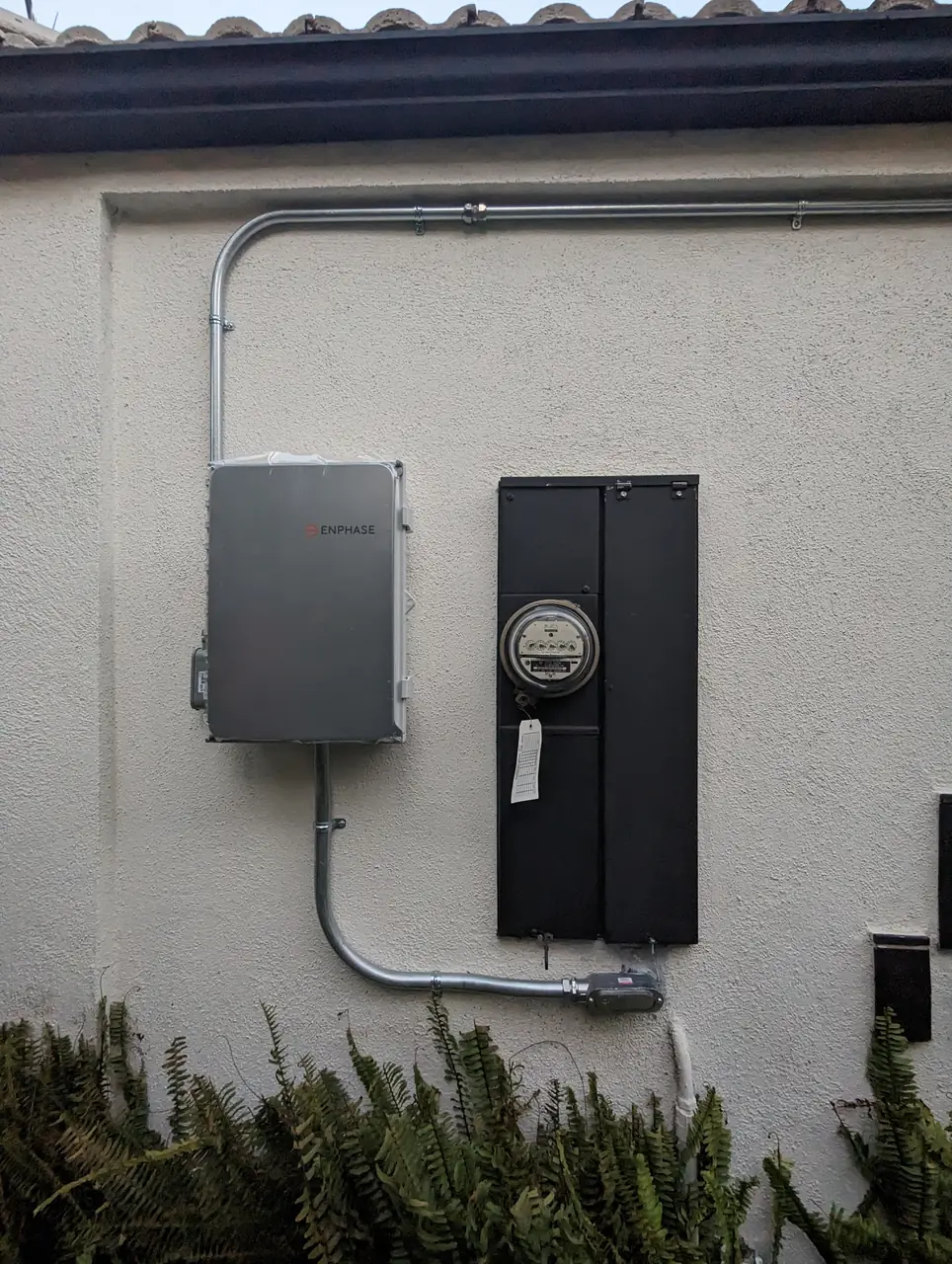
Sherman Oaks 91401 · 16.8 kW DC · forty-two Q CELLS 400 W modules on Enphase IQ8+ microinverters — the largest array on this page, on a roof with the open area to carry it.
Cali Energy in Sherman Oaks, at a glance
The short answers before considering a contractor.
| Question | Answer |
|---|---|
| What has Cali Energy installed here? | Rooftop solar from 3.25 kW to a forty-two module 16.8 kW array, on composition shingle, tile and flat roofs, with microinverters throughout because partial shade is the norm. |
| Google rating | 4.9★ on Google. See them on Google |
| Who supplies the electricity? | The Los Angeles Department of Water and Power — a municipal utility outside CPUC jurisdiction, still crediting exports at the retail rate. |
| Who permits the work? | The Los Angeles Department of Building and Safety (LADBS), plus a separate LADWP interconnection process. |
| Can I remove a tree that shades my roof? | Not freely. Under the city’s protected tree ordinance, native oaks, western sycamore and Southern California black walnut need a permit — and removal often requires planting four replacements. |
| What does that mean for the design? | The array is laid out around the shade, with module-level electronics so a shaded panel does not drag its neighbours down. |
| License | CSLB #1032379 (B, C-10, C-39), in-house crews, operating since 2017. Verify with the CSLB |
You probably cannot cut down that oak
The local rule that decides what is even possible on a shaded Sherman Oaks roof — and one most homeowners discover far too late.
Los Angeles protects specific native trees by ordinance. The list covers oaks indigenous to California — including the Valley Oak (Quercus lobata) and California Live Oak (Quercus agrifolia), but not scrub oak — along with Western Sycamore (Platanus racemosa) and Southern California Black Walnut (Juglans californica). A tree is protected once it measures at least four inches across at 54 inches above the ground, which is a modest tree, not a landmark specimen.
The protection is broader than most people assume. It bans not just removal but anything likely to kill the tree — damage from heavy machinery, toxic substances, fire, or excavation around the roots. Getting permission means applying to the city’s Urban Forestry Division, usually with a tree expert’s report, and in many cases planting four comparable protected trees on the same lot as replacements.
So “we will just take the tree out” is not a solar plan in this neighborhood. It may be illegal, it is certainly slow, and the replacement requirement can cost more than the panels the shade was blocking. The workable answer is to treat the shade as a fixed condition and design around it — which is exactly why the systems we have installed here range from 3.25 kW to 16.8 kW: the usable, unshaded roof sets the size, not the homeowner’s ambition or the roof’s total area.
Four inches is the threshold
Protection starts at four inches across, measured 54 inches up. Plenty of ordinary garden trees qualify.
Harm counts, not just felling
Root excavation, machinery damage and toxic treatment fall under the same ban. Careless site work is a violation.
Four replacements
Where a permit is granted, replanting four comparable protected trees on the same lot is a common condition.
Trim, do not gamble
Even pruning can cross the line if it endangers the tree. Anything substantial belongs with a qualified arborist, not a solar crew.
Source: Los Angeles Municipal Code §46.00 — Protected Tree and Shrub Regulations (protected species and the four-inch diameter threshold at 54 inches; ban on removal, relocation and acts likely to cause death; permit through the Urban Forestry Division; replacement planting) · City Planning — protected tree ordinance. Confirm current requirements for your own parcel before any tree work.
Designing around shade instead of fighting it
Partial shade is normal here. It changes the layout and the electronics, not the feasibility.
Shade does not fall evenly. It moves across a roof through the day and shifts again between summer and winter as the sun’s angle changes, so a plane that is clear at noon in July can be under a canopy at three in the afternoon in November. The old string-inverter arrangement handled this badly: modules wired in series were held back by whichever one was worst lit, so a single shaded panel dragged its whole string down.
Module-level electronics changed that, which is why every Sherman Oaks system on this page uses microinverters. Each module converts its own output and reports independently, so a panel in shade costs only its own production. It also means the array can be split across several small clear areas rather than needing one large unbroken plane — the difference between a workable system and no system at all on a heavily treed lot.
The design work is therefore about honest assessment: which planes are genuinely clear, for how many hours, at which times of year, and what that adds up to across twelve months. We would rather propose a smaller array that performs as promised than a large one whose estimate quietly assumes shade that is actually there.
Per-module conversion
Microinverters mean a shaded panel costs only its own output rather than holding back a whole string.
Split across clear areas
Several small unshaded sections can carry an array where one big plane is not available.
Shade moves with the season
Winter sun sits low and canopies reach further. The assessment covers the year, not the day of the visit.
Honest production numbers
An estimate that ignores real shading is a promise that will not be kept. We model what is actually there.
Solar work in Sherman Oaks
A few of the homes we have done here. Street numbers stay off the page out of respect for the owners. The full photo set for every Sherman Oaks job lives in the Sherman Oaks project gallery.
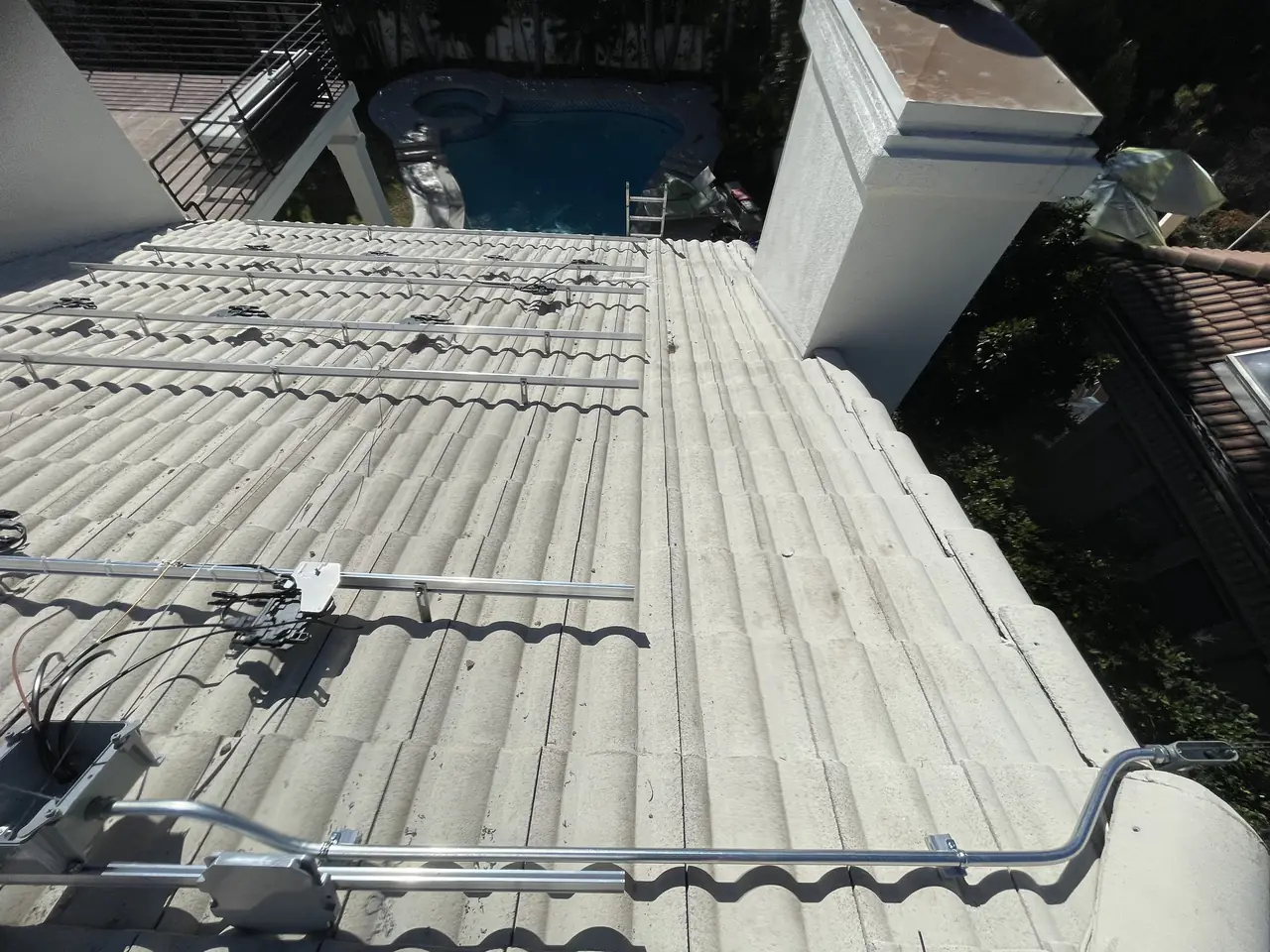
16.8 kW on forty-two modules
Forty-two Q CELLS 400 W modules on Enphase IQ8+ microinverters, on a tile roof with the clear area to justify it — the upper end of what this neighborhood allows.
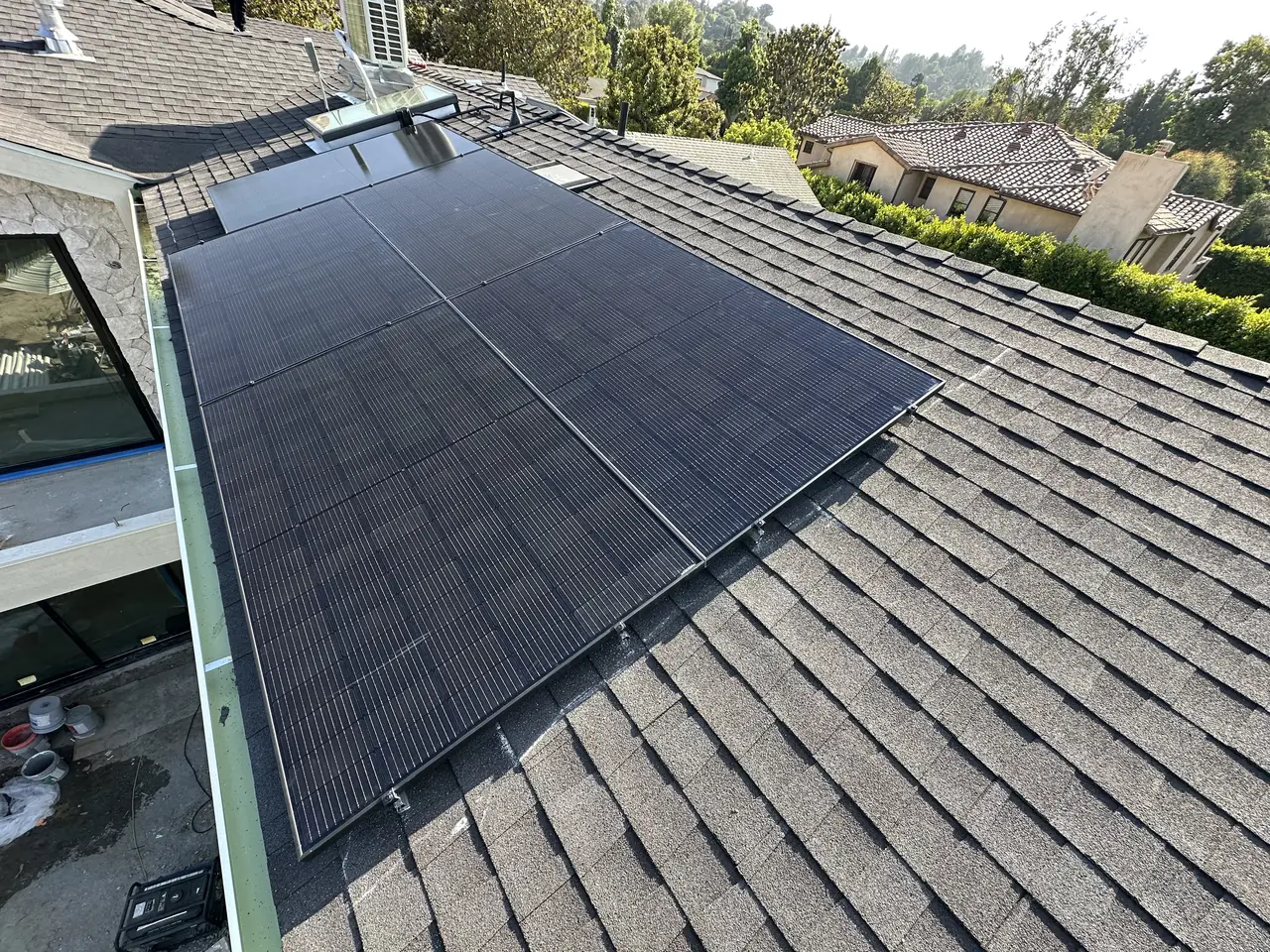
4.6 kW on ten modules
Ten Aptos 460 W modules on Enphase IQ7A microinverters — a compact 2025 array where high-output panels make the most of a limited clear area.
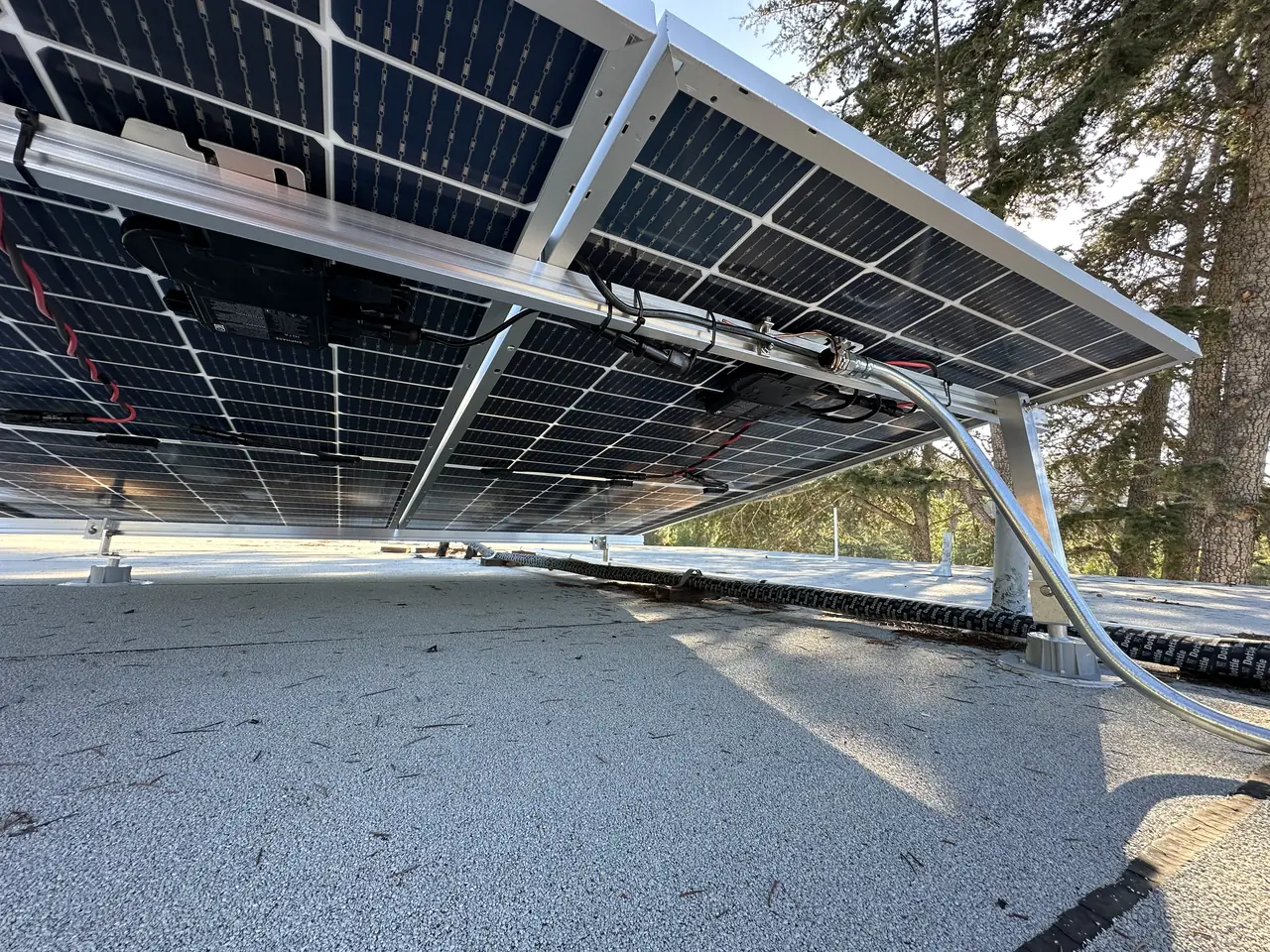
5.18 kW on a flat roof
A twelve-module Enphase system on a flat roof — the mid-century architecture south of the boulevard brings more of these than most of the Valley.
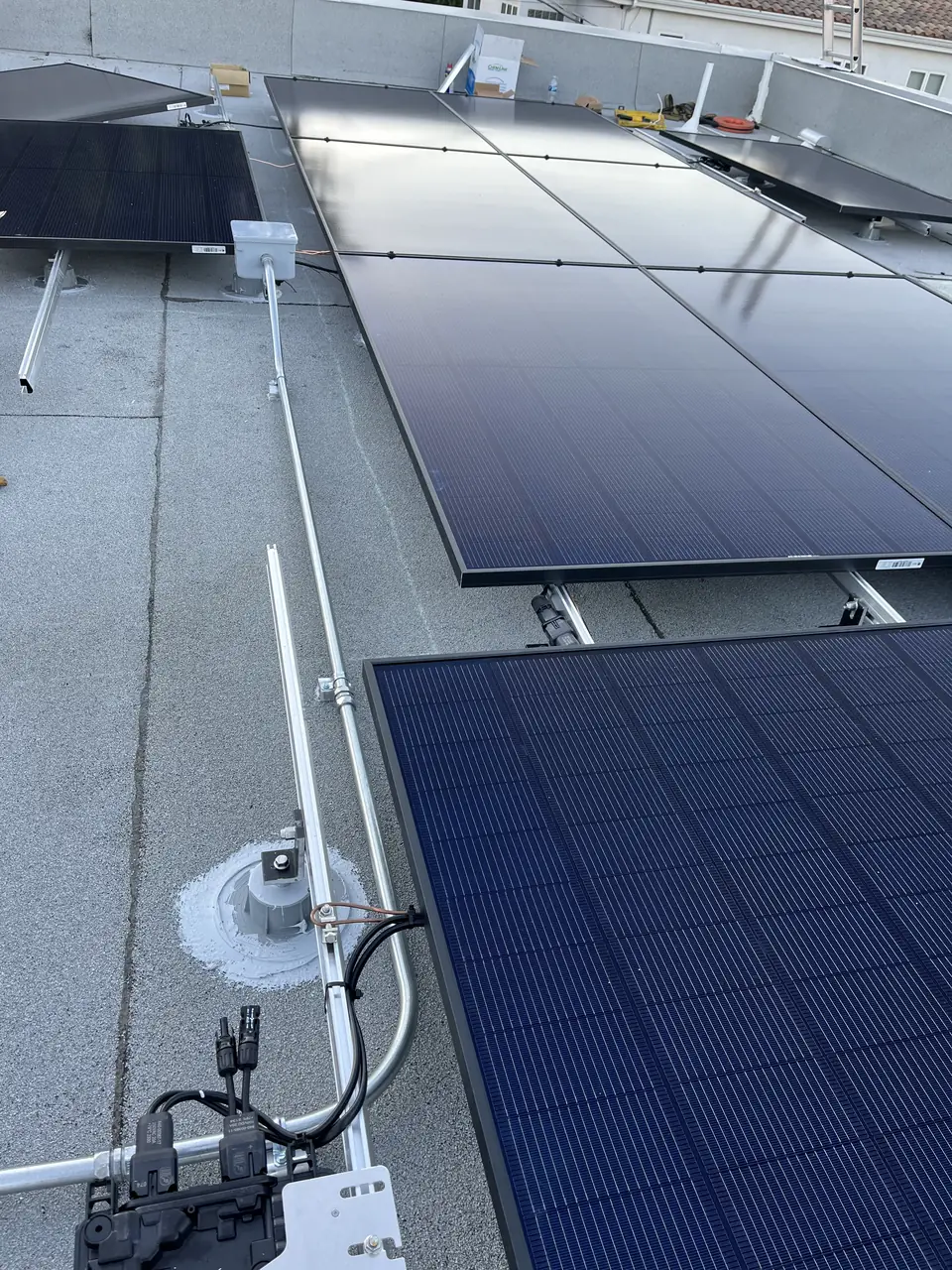
5.16 kW, sized to what is clear
Another 2025 flat-roof system on the hillside side of the neighborhood, sized to the roof area that actually gets sun rather than to the roof.
Photos are ours, taken on site. Sizes are stated on the basis they were recorded on — DC nameplate or CEC-AC — because the two are not interchangeable.
A closer look at the Sherman Oaks jobs
What this work has in common, and where it differs.
| Detail | Value | Notes |
|---|---|---|
| Homes shown here | A selection | Some of our Sherman Oaks jobs, with our photos from each — our work in the area goes well beyond them |
| ZIP codes | 91401 · 91403 · 91423 | Both sides of Ventura Boulevard, with most of this work in 91403 and 91423 |
| System sizes | 3.25–16.8 kW | Stated on the basis each was recorded on; several sit in the 3–5 kW range because that is what the clear roof allowed |
| Utility | LADWP | Retail-rate net metering on every one, with recent systems switched on through 2024 and 2025 |
| Roof types | Shingle, flat and tile | Composition shingle predominates; flat roofs are common on the mid-century stock south of the boulevard |
| Inverters | Enphase throughout | IQ7A and IQ8+ microinverters — module-level conversion is the default here because partial shade is the norm |
| Equipment we have used | Q CELLS, Aptos | Q CELLS 400 W and Aptos 460 W modules; higher-output panels earn their place where clear area is limited |
| What sets the size | Usable roof | Unshaded area and roof geometry, not total square footage — which is why the range here is so wide |
LADWP: retail-rate credit and the 10 kW line
Two rules that shape a Sherman Oaks project more than the equipment does.
NEM 3.0 does not apply
LADWP is municipal, so the CPUC’s Net Billing Tariff does not govern it. Exports here are still credited against the retail rate rather than an hourly avoided-cost value.
Which helps a small array
On a shaded lot where the system has to be modest, retail-rate crediting means what it does export still carries full value.
The fast track ends at 10 kW
Under 10 kW CEC-AC with no battery and no panel upgrade, approval runs roughly 2–5 days with the meter set 1–2 weeks later. Larger systems add an engineering site visit of 1–3 weeks.
Two approvals
LADBS signs off the installation; LADWP sets the net meter and issues the permission-to-operate email. A finished system may not run until the second arrives.
Sources: LADWP — net energy metering rates · LADWP — solar programs (Guide to Electric Service, p. 22, for the stage timings) · CPUC — Net Energy Metering. Program terms change; confirm current rules for your own account.
What solar costs and how long it takes in Sherman Oaks
No honest flat price for a neighborhood — especially where the usable roof varies this much.
The systems we have installed here run from 3.25 to 16.8 kW, and that range is the honest answer: on a treed lot the clear area decides the size. Two published price bases frame the budget, both before incentives: $2.49 per watt at competitive marketplace rates (EnergySage, August 2026) and $3.5 per watt, the 2024 national median for cash purchases (Lawrence Berkeley National Laboratory). A 4–10 kW system therefore lands somewhere between roughly $10,000 and $35,000 depending on installer, financing and scope; smaller arrays cost proportionally less, though fixed costs raise the per-watt figure as the system shrinks.
| Item | Figure | Basis |
|---|---|---|
| System sizes we have installed here | 3.25 – 16.8 kW | Our installations |
| Solar at marketplace rates | $2.49/W → 4 kW ≈ $10,000 · 6 kW ≈ $14,900 · 10 kW ≈ $24,900 | Market estimate — EnergySage |
| Solar at typical installer rates | $3.5/W (2024 national cash median) → 4 kW ≈ $14,000 · 10 kW ≈ $35,000 | Market estimate — LBNL 2025 Data Update |
| Battery storage (~13 kWh) | $11,864–$16,052 before incentives (average $13,958) | Market estimate — EnergySage California |
| Tree work | Not part of a solar quote — protected species need a city permit and often four replacement plantings | Official — LAMC §46.00 |
| Federal tax credit | Homeowner (25D) credit ended Dec 31, 2025 — $0 on a 2026 cash or loan purchase; leased and PPA systems can still capture the 30% credit through the system owner | Official source — IRS FAQs on P.L. 119-21 |
| Time on the roof | Most residential installs: 1–3 working days | Cali Energy company figure |
| LADBS permit | Express e-permit for qualifying systems: issued online, often same day | Official process — LADBS |
| LADWP path | Under 10 kW CEC-AC without battery or panel upgrade: approval 2–5 days, meter set 1–2 weeks. Otherwise add an engineering site visit of 1–3 weeks | Official — LADWP Guide to Electric Service, p. 22 |
Sources: EnergySage — solar cost · EnergySage — storage cost · LBNL — 2025 Data Update · IRS — Section 25D FAQs. Planning context, not a quote.
What Cali Energy installs in Sherman Oaks
One licence covering the whole job, so the scopes do not get handed between companies.
Rooftop solar
Layouts built around shade on shingle, tile and flat roofs, with microinverters throughout and high-output modules where clear area is scarce.
Battery storage
Backup sized to the circuits worth keeping alive — planned knowing storage moves the project onto LADWP’s longer path.
Roofing with solar
Roof condition assessed by our own roofing side under a C-39, and replaced first when it will not outlast the array.
Electrical and EV charging
Main-panel upgrades, subpanels and EV charger circuits, quoted with the array rather than discovered later.
Exact coverage: Sherman Oaks and its edges
A neighborhood split by a boulevard and shaded by its own name.
| Attribute | Fact |
|---|---|
| Status | Neighborhood of the City of Los Angeles, in the southern San Fernando Valley |
| ZIP codes | 91401, 91403 and 91423 |
| Electricity | LADWP for every address — retail-rate net metering, no CPUC net billing |
| Permitting authority | Los Angeles Department of Building and Safety (LADBS) |
| Trees | Native oaks, western sycamore and Southern California black walnut are protected by city ordinance from four inches in diameter |
| Terrain | South of Ventura Boulevard the ground rises into the Santa Monica Mountains, where slope, access and fire-hazard designations apply |
| Adjacent — same utility | Encino, Van Nuys, Studio City and Valley Glen are all City of LA addresses on LADWP |
| What we check first | Which roof planes are clear across the year, the roof covering, and the service equipment |
Map of Cali Energy projects in Sherman Oaks
Sherman Oaks homes we have worked on — a selection of them, shown on this page.
Marker positions are deliberately offset. Each point is shifted 120–260 meters from the real address so the map shows where we work in Sherman Oaks without identifying anyone’s home. Base map © OpenStreetMap contributors © CARTO; ZIP boundaries from the U.S. Census ZCTA file.
Reviews and verifiable trust
A public rating, a public license record and named, quotable reviews.
“I spoke with several companies before choosing this one, and they were by far the most fair and honest. They didn’t try to oversell me on a bigger system than I needed.”
“Cali Energy did a great job from their proposal through installation and in the years since with follow up monitoring of our system.”
“The recommendation they gave us on the type of solar panels to purchase was perfect — the panels have been extremely efficient, and because of that we have not had an electricity bill in the last three years.”
Read the full reviews on Cali Energy’s Google profile · verify the contractor license with the California CSLB.
Fast answers about hiring Cali Energy in Sherman Oaks
Each answer starts with the conclusion.
Does Cali Energy install solar in Sherman Oaks?
Yes. Sherman Oaks is an active Cali Energy service area and we work here regularly across 91401, 91403 and 91423, including several systems in 2025. The homes on this page range from 3.25 kW to a forty-two module 16.8 kW array, all on Enphase microinverters because partial shade is normal here.
Can I remove a tree that shades my roof?
Usually not without a permit. Los Angeles protects native oaks (including Valley Oak and California Live Oak, but not scrub oak), Western Sycamore and Southern California Black Walnut once they measure four inches across at 54 inches above ground. The ordinance bans removal, relocation and anything likely to kill the tree — including root excavation and machinery damage. A permit goes through the city’s Urban Forestry Division and often requires planting four comparable trees on the same lot.
What about just trimming the branches?
Light pruning is one thing; heavy cutting is another. The ordinance covers acts likely to cause the death of a protected tree, so substantial work on one is not something a solar crew should improvise. Where trimming is the right answer, it belongs with a qualified arborist who knows what the ordinance permits — and we plan the array on the assumption that the canopy stays.
Is solar still worth it on a shaded lot?
Frequently yes, at a size the roof can honestly support. Microinverters mean each module converts its own output, so a shaded panel costs only its own production rather than dragging a whole string down, and the array can be split across several small clear areas. That is why systems here run from 3.25 kW upward — the clear roof sets the size, and a smaller system that performs as promised beats a large one whose estimate ignores the trees.
How do you assess shade?
Across the year, not on the day of the visit. Shade moves through the day and shifts between seasons as the sun’s angle changes — a plane clear at noon in July can be under canopy at three in the afternoon in November. We identify which planes are genuinely clear, for how many hours and in which months, and model production from that rather than from roof area.
Who is my electricity provider in Sherman Oaks?
The Los Angeles Department of Water and Power. Sherman Oaks is inside the City of Los Angeles, so every address is served by LADWP rather than Southern California Edison — which changes how solar is credited.
Does NEM 3.0 apply in Sherman Oaks?
No. NEM 3.0 — properly the Net Billing Tariff — is a CPUC rule for investor-owned utilities such as Edison and PG&E. LADWP is municipal and is not governed by it, so exported energy here is still credited against the retail rate. On a shaded lot where the array has to be modest, that keeps the value of what it does export intact.
Can solar go on a flat roof here?
Yes, and the mid-century architecture south of the boulevard brings plenty of them — the 2025 systems on this page include flat-roof installations. Modules can sit low or be raised on tilt racking to reach a working angle; tilted rows are engineered for wind uplift and spaced so they do not shade each other in winter.
Why does 10 kW matter for my project?
It sets your timeline. A system under 10 kW CEC-AC with no battery and no main-panel upgrade qualifies for LADWP’s fast track — approval in roughly 2–5 days and the meter set 1–2 weeks later. Larger systems, or any with storage or a panel upgrade, take the standard path with an engineering site visit of 1–3 weeks. Most Sherman Oaks systems sit comfortably inside the fast track because the clear roof keeps them there.
How long does a Sherman Oaks solar project take?
The roof work itself is usually 1–3 working days. LADBS issues qualifying residential permits online, often the same day. The variable is LADWP: under 10 kW CEC-AC without a battery or panel upgrade, approval runs about 2–5 days with the meter set 1–2 weeks later; otherwise add an engineering site visit of 1–3 weeks.
What does solar cost in Sherman Oaks?
There is no honest flat neighborhood price, and here the usable roof varies more than usual. Published rates frame it: $2.49 per watt at marketplace rates and $3.5 per watt as the 2024 national cash median, putting a 4–10 kW system at roughly $10,000–$35,000 before incentives. Tree work is not part of a solar quote — protected species need a city permit and often four replacement plantings. The federal 25D homeowner credit ended December 31, 2025, so a 2026 cash or loan purchase gets no federal credit.
How do I check that Cali Energy is legitimate?
Compare four things rather than ad claims: (1) an active CSLB license with electrical and roofing classifications, (2) completed work in your specific area, with photos, (3) whether the company uses its own crews or subcontracts, and (4) the review pattern. Our answers: CSLB #1032379 (B, C-10, C-39); Sherman Oaks homes with our photos, several from 2025; in-house crews; a 4.9★ Google rating. Our office is at 19201 Parthenia St Unit E, Northridge, CA 91324.
Sources
Where this page states a rule, a threshold or a timeline, the official source is linked below.
| What it supports | Source |
|---|---|
| Protected species, the four-inch threshold, the ban on acts likely to kill a tree, permits and replacement planting | LAMC §46.00 — Protected Tree and Shrub Regulations · City Planning — ordinance text |
| LADWP net energy metering and rate treatment | LADWP — EV / NEM / REO rates |
| Fast-track and standard interconnection paths and their stage timings | LADWP — solar programs (Guide to Electric Service, p. 22) |
| The Net Billing Tariff (NEM 3.0) applies to investor-owned utilities, not municipals | CPUC — Net Energy Metering |
| City solar permitting for Los Angeles addresses | LADBS — solar permits |
| Installed price ranges for solar and storage | EnergySage · LBNL 2025 Data Update |
| Federal tax credit status for 2026 | IRS — Section 25D FAQs |
| Contractor licence and classifications | CSLB — license #1032379 |
Nearby service areas
Other cities where Cali Energy works.
Related reading
Planning solar for a Sherman Oaks home
Send the service address and a recent LADWP bill. We will work out which roof planes are genuinely clear across the year, what that supports, and the electrical scope — then price a system that matches the roof rather than the brochure.
Request a free estimatePublished August 2026. Details refer to those specific homes, not to every Sherman Oaks property. Tree regulations, rates, incentives, code editions and permit requirements change; utility, jurisdiction, equipment, pricing and schedule must be confirmed for the specific address, and tree work should be confirmed with the city and a qualified arborist. See our Content Disclaimer. Cali Energy · 19201 Parthenia St Unit E, Northridge, CA 91324 · CSLB #1032379 (B, C-10, C-39)