

Solar company in Burbank with local homes, BWP rules and photos
Yes — Cali Energy installs solar panels, roofing and electrical upgrades in Burbank, California. We work in Burbank regularly — across 91501, 91502, 91505 and 91506, all served by Burbank Water and Power, the city’s own municipal utility. Some of those homes are shown below, with our photos from each. A number of those jobs involved an accessory dwelling unit, and flat roofs are common here. Cali Energy is a licensed California contractor (CSLB #1032379) with a 4.9★ Google rating and in-house crews.
Get a Burbank estimate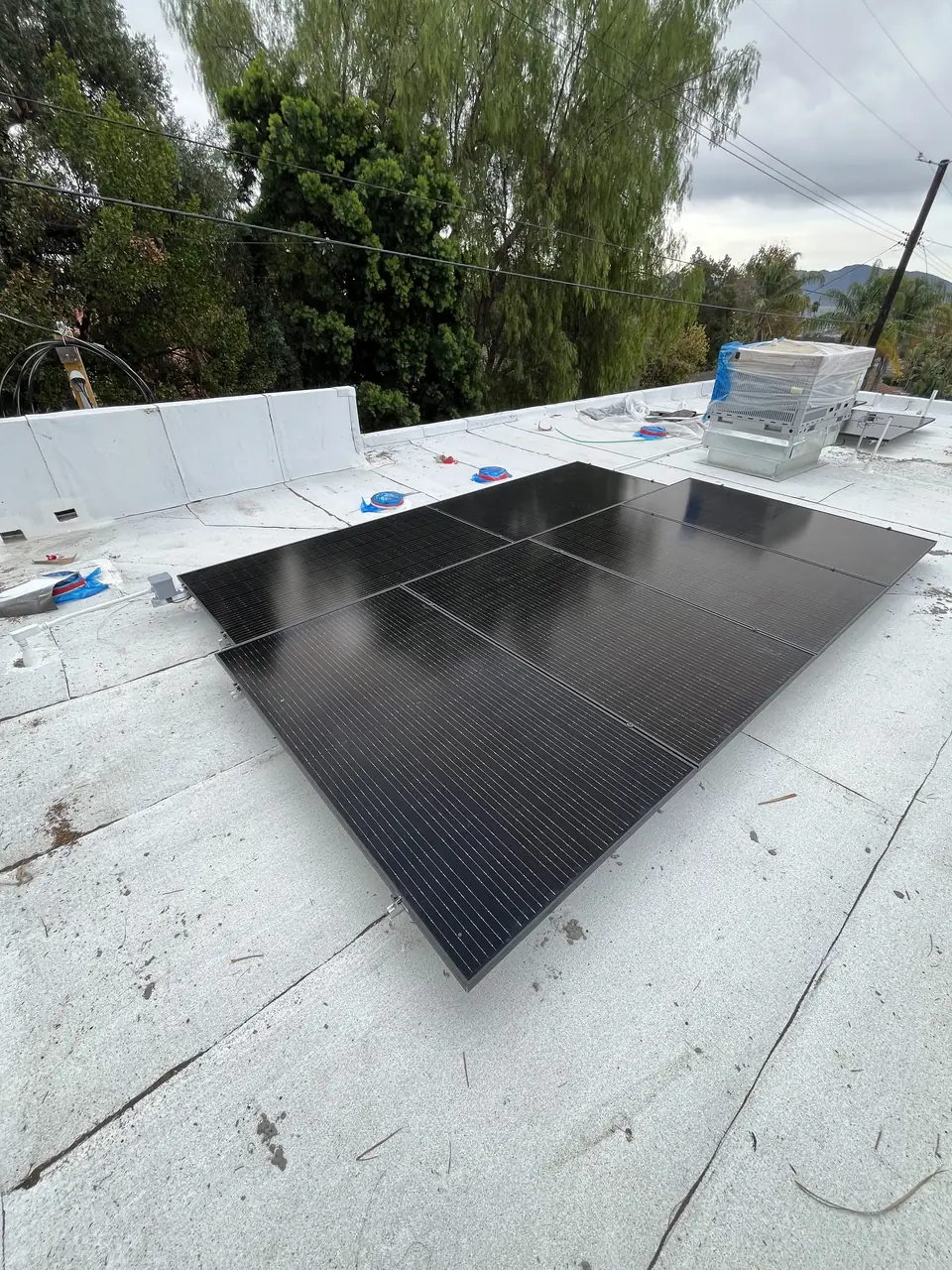
Burbank 91501 · 9.72 kW DC · 24 Q CELLS 405 W panels · Enphase IQ8M microinverters · flat white-membrane roof · one Burbank Water and Power meter serving the main house and an ADU · permission to operate August 2025.
Cali Energy in Burbank, at a glance
The short, verifiable answers before considering a contractor.
| Question | Answer |
|---|---|
| What has Cali Energy installed here? | Rooftop solar with the associated electrical work, on both pitched and flat roofs. |
| Google rating | 4.9★ on Google. See them on Google |
| Electric utility | Burbank Water and Power, the city’s own municipal utility. |
| Who permits the work? | The City of Burbank — an incorporated city with its own building department, not Los Angeles County or LADBS. |
| BWP approvals | Permission to operate in May and August 2025, plus an interconnection in January 2026. |
| Battery storage | Installed and interconnected in Burbank as elsewhere — and worth a close look now that BWP pays a per-kWh rebate. |
| License | CSLB #1032379 (B, C-10, C-39), in-house crews, operating since 2017. Verify with the CSLB |
Burbank changed its solar rules on January 1, 2026
The single most consequential local fact, and one most homeowners here have not heard: Burbank Water and Power is a municipal utility, so it sets its own tariff — and it just moved to net billing.
Burbank City Council approved a Solar Net Billing program on January 14, 2025, and it took effect on January 1, 2026. The trigger is the permit application date: a system whose permit application was filed before January 1, 2026 stays on legacy net energy metering even if it is built later, while anything applied for from that date is credited for exports at BWP’s avoided cost of energy rather than at the retail rate. Because BWP is owned by the City of Burbank and governed by its Council, this is Burbank’s own successor tariff — legally separate from the CPUC’s NEM 3.0, which applies to Southern California Edison, PG&E and SDG&E customers and not here.
BWP’s adopted export rates make the scale concrete: 11.86¢/kWh summer on-peak, 8.25¢ summer mid-peak, 7.02¢ summer off-peak and 6.96¢ in the non-summer months, built from three years of historical market energy prices plus the market value of renewable energy credits. Set that against the retail side of the same tariff — 35.62¢ summer on-peak and 22.77¢ mid-peak — and the arithmetic is stark: a kilowatt-hour used in the house is worth roughly three times one sent to the grid.
One honest caveat about that 11.86¢ figure. BWP’s summer on-peak window is 4pm to 7pm on weekdays, by which time a rooftop array is past its daily peak, so most exported energy lands in mid-peak and off-peak hours and earns nearer seven to eight cents. Reaching the on-peak rate consistently means shifting energy into the evening — that is a battery, not a bigger array. The avoided-cost rate is also reviewed each year with the fee schedule and can move either way: unlike the CPUC’s NEM 3.0, which locks export values for nine years, nothing here is fixed for the life of the system.
“Cali Energy was our general contractor and they handled a ton of work for us. They built an ADU, did the electrical and the solar.”
“Him and his team got 21 panels up on my house so quick. Also they provided me a drop box link with all the photos — the brackets installed, the panels going up, everything. I could not be happier with the work.”
“I like that they are a local solar installation company based here in Northridge, not a sales office somewhere else.”
Read the full reviews on Cali Energy’s Google profile · verify the contractor license with the California CSLB. Review excerpts are quoted verbatim from public Google reviews; reviewer locations are not always stated, so no Burbank attribution is claimed.
Solar work in Burbank
A few of the homes we have done here. Street numbers stay off the page out of respect for the owners. The full photo set for every Burbank job lives in the Burbank project gallery.
9.72 kW for a house and its ADU
Twenty-four Q CELLS 405 W modules on Enphase IQ8M microinverters, powering the main house and the accessory dwelling unit on a single Burbank Water and Power meter. Permission to operate came through in August 2025.
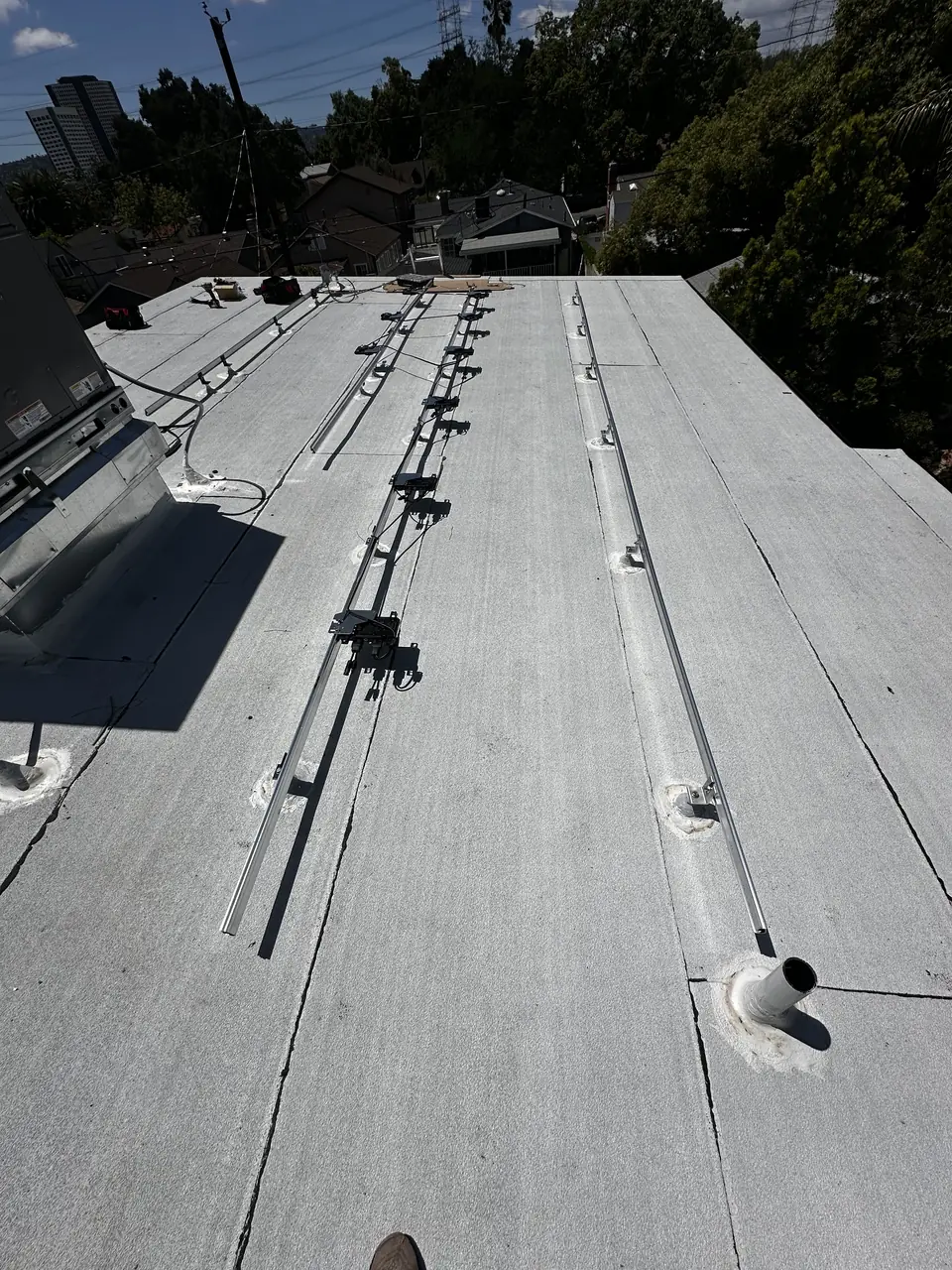
4.0 kW on a flat roof
Nine Canadian Solar 445 W modules on Enphase IQ8A microinverters — a compact array on a flat roof, interconnected with BWP in January 2026 under the new rules.
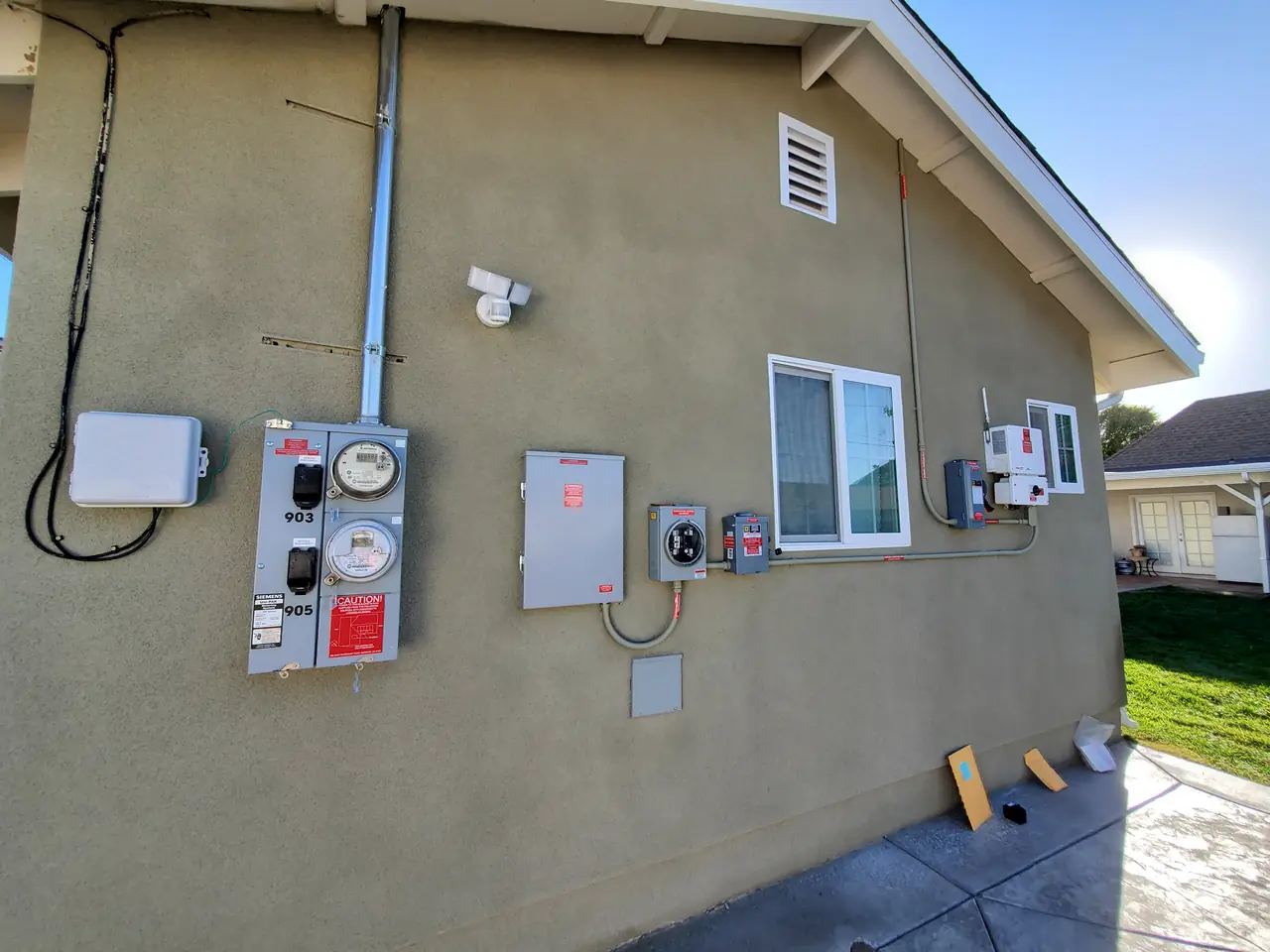
3.7 kW on REC modules
Ten REC 370 W modules — the smaller end of what a Burbank roof takes, and a reminder that a system is sized to the bill rather than to the roof area.
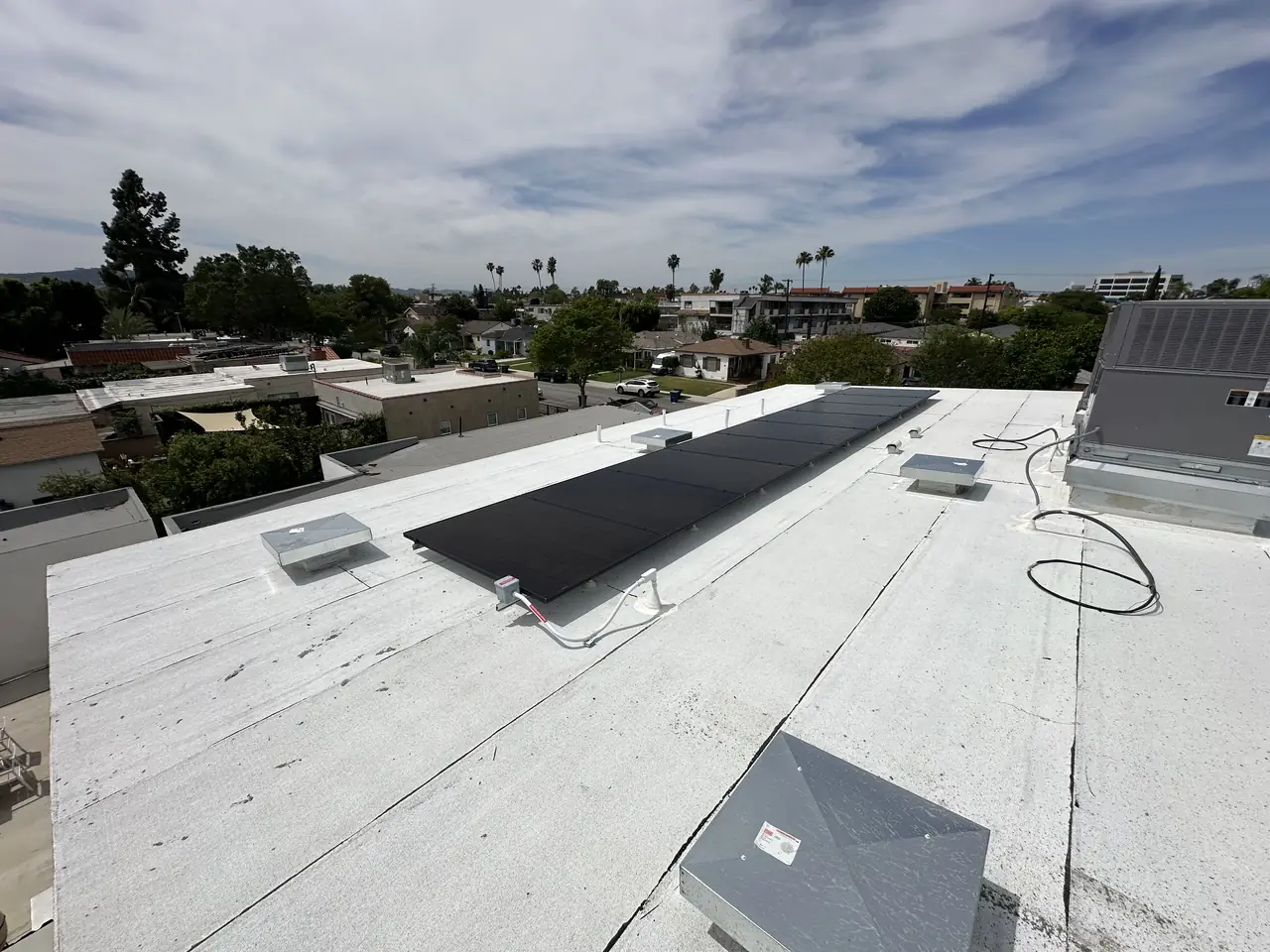
Canadian Solar with Enphase
Another nine-module Canadian Solar array on Enphase IQ8A microinverters, where each module produces and reports independently.
Photos are ours, taken on site. Where a system size is stated it is given on the basis it was recorded on — DC nameplate or CEC-AC — because the two are not interchangeable.
A closer look at the Burbank jobs
What this work has in common, and where it differs.
| Detail | Value | Notes |
|---|---|---|
| Homes shown here | A selection | Some of our Burbank jobs, with our photos from each — our work in the city goes well beyond them |
| ZIP codes | 91501 · 91502 · 91505 · 91506 | Work spread across the city, from the hillside side down to the flats |
| System sizes | 3.7–9.72 kW | DC nameplate on the jobs recorded that way |
| Utility | Burbank Water and Power | Municipal on every address — its own tariff, its own interconnection, its own permission to operate |
| Roof types | Flat and pitched | Flat and low-slope roofs are common here, including a white-membrane roof |
| Equipment we have used | Q CELLS, Canadian Solar, REC | With Enphase IQ8M and IQ8A microinverters throughout |
| Beyond a standard array | ADU on one meter | A main house and its accessory dwelling unit served by a single BWP meter |
| Recent work | Through 2026 | Including an interconnection completed in January 2026, after the tariff change |
An ADU on one meter changes the arithmetic
Burbank has a lot of accessory dwelling units, and how they are metered decides how the solar is sized.
An ADU can sit behind its own meter or share the main house’s. On a Burbank job here, a single Burbank Water and Power meter serves both — so a 9.72 kW array offsets the combined consumption of the house and the unit rather than two separate accounts. That is usually the better outcome: one interconnection, one set of paperwork, and the whole property’s usage sitting under one tariff.
It also raises questions worth settling before design. Whether the service can carry both loads plus the array. Whether a separate meter would be required for a rental arrangement. And which side of the meter any future battery would sit on. Those answers come before the panel layout, not after.
One meter, one system
Where the ADU shares the main meter, a single array can offset both. Fewer approvals and one tariff to track.
Service capacity first
House plus ADU plus solar is a real load question. We check the panel and the service before drawing anything.
New build or conversion
A garage conversion and a ground-up ADU carry different electrical scope. The design follows the actual construction.
Plan for storage
Which side of the meter a future battery sits on is easier to decide now than to change later.
Flat roofs, and what they need
Burbank’s mid-century and small-lot housing brings more flat and low-slope roofs than most of the Valley.
A flat roof does not stop a solar system; it changes how it is mounted. Modules can lie close to the surface or be raised on tilt racking to reach a working angle, and each choice has consequences: tilted rows catch wind, so the racking and its attachments are engineered for uplift and rows are spaced so they do not shade each other in winter. On a white-membrane roof, penetrations and flashing are handled so the membrane keeps doing its job — the membrane is the waterproofing, and it is unforgiving of improvised detail.
Because roofing is in-house under our C-39, the condition of the covering is assessed by the trade that would have to replace it. If a roof is near the end of its life we say so before the array goes on rather than after you have paid twice.
Tilt or flush
Raised racking gains output; flush mounting keeps a low profile. Which one fits depends on the roof, the structure and the exposure.
Membrane detail matters
On a membrane roof the waterproofing is the membrane itself. Attachments and flashing are detailed to it, not bodged through it.
Wind uplift
Tilted arrays are engineered for uplift with proper attachment counts and ballast rather than copied from a pitched-roof detail.
Roof age decides sequence
If the covering is close to done, replacing it first is cheaper than lifting a new array later.
Under the new BWP rules, storage does more work
What the January 2026 change means for whether a battery earns its place.
Exports are worth less
Under Burbank’s Solar Net Billing, energy sent back earns an avoided-cost value rather than the retail rate. Energy the house consumes itself is worth considerably more.
Shift, do not sell
A battery moves midday production into the evening, which is exactly where the value now sits. That is the core case for storage here.
Backup is separate
Keeping the house running through an outage is a different benefit from tariff arithmetic, and it is worth pricing on its own terms.
Size it to the loads
“Backup” means different things. We go through the panel schedule and decide which circuits stay alive rather than selling a number.
What solar costs and how long it takes in Burbank
No honest flat citywide price — but published ranges and a fast permit path.
Two published price bases frame the range, both before incentives: $2.49 per watt at competitive marketplace rates (EnergySage, August 2026) and $3.5 per watt, the 2024 national median for cash purchases (Lawrence Berkeley National Laboratory). A 6–12 kW system therefore lands somewhere between roughly $15,000 and $42,000 depending on installer, financing and scope. Tilt racking, membrane detailing and any panel upgrade are priced into the job rather than added later.
| Item | Figure | Basis |
|---|---|---|
| Solar at marketplace rates | $2.49/W → 6 kW ≈ $14,900 · 10 kW ≈ $24,900 · 12 kW ≈ $29,900 | Market estimate — EnergySage |
| Solar at typical installer rates | $3.5/W (2024 national cash median) → 6 kW ≈ $21,000 · 12 kW ≈ $42,000 | Market estimate — LBNL 2025 Data Update |
| Battery storage (~13 kWh) | $11,864–$16,052 before incentives (average $13,958) | Market estimate — EnergySage California |
| Flat roof with tilt racking | Priced per job: engineering for uplift, ballast, row spacing and membrane detail | Scope-dependent |
| Federal tax credit | Homeowner (25D) credit ended Dec 31, 2025 — $0 on a 2026 cash or loan purchase; leased and PPA systems can still capture the 30% credit through the system owner | Official source — IRS FAQs on P.L. 119-21 |
| Time on the roof | Most residential installs: 1–3 working days | Cali Energy company figure |
| City permit | Qualifying residential rooftop solar is issued through the city’s automated online path | Official — City of Burbank |
| Utility step | BWP interconnection and permission to operate are separate from the permit and must complete before the system may run | Official — Burbank Water and Power |
Sources: EnergySage — solar cost · EnergySage — storage cost · LBNL — 2025 Data Update · IRS — Section 25D FAQs. Planning context, not a quote.
Permits: the city issues, the utility authorizes
Two separate approvals, and only one of them is quick.
Automated city permit
Qualifying residential rooftop solar is issued through the city’s automated online path rather than a plan-check queue. It is rarely what holds a project up.
Inspection still applies
An instant permit is not a lighter standard. Attachment, conduit and labelling are inspected, so they have to be right the first time.
BWP is its own track
Interconnection and permission to operate come from Burbank Water and Power separately. A finished, inspected system still may not legally run until that arrives.
Storage adds review
Battery systems bring their own requirements alongside the array, and we schedule for them rather than treating them as a surprise.
Exact coverage: Burbank and its neighbours
A city with its own utility, surrounded by three others.
| Attribute | Fact |
|---|---|
| Status | Incorporated city in Los Angeles County, between the Verdugo Mountains and the Los Angeles River |
| ZIP codes we work in | 91501, 91502, 91505 and 91506 |
| Electricity | Burbank Water and Power — municipal, with its own solar tariff and interconnection |
| Permitting authority | City of Burbank; qualifying residential solar issued through the automated online path |
| Neighbours on other utilities | Glendale runs its own utility as well; North Hollywood, Sun Valley and Sunland are Los Angeles addresses on LADWP |
| Cross the line, change the rules | Move one street out of the city and the tariff, the interconnection process and the permit counter all change together |
| Terrain | Hillside parcels on the Verdugo side carry fire-hazard designations affecting access and siting |
Fast answers about hiring Cali Energy in Burbank
Each answer starts with the conclusion and includes the evidence — or the limitation — needed to use it accurately.
Does Cali Energy install solar in Burbank?
Yes. Burbank is an active Cali Energy service area. We work here regularly, across ZIP codes 91501, 91502, 91505 and 91506 — the homes on this page are some of that work, with our photos from each and Burbank Water and Power approvals behind them.
Did Burbank change its solar net metering rules?
Yes. Burbank City Council approved a Solar Net Billing program on January 14, 2025, effective January 1, 2026. The trigger is the permit application date: applications filed from January 1, 2026 go onto net billing, where exports earn Burbank Water and Power’s avoided cost of energy — roughly 7 to 12 cents per kWh — instead of the retail rate. A permit application filed before that date keeps legacy net energy metering even if the system is built later. BWP is a municipal utility owned by the City of Burbank, so this is its own tariff and is separate from the CPUC’s NEM 3.0 that governs SCE customers.
Who is the electric utility in Burbank, and why does it matter?
Burbank Water and Power, the city’s own municipal utility, which has served Burbank since 1913. It matters because the rules change at the city line: cross east into Glendale and it is Glendale Water and Power; cross west or south into North Hollywood, Sun Valley or the Los Angeles side of Toluca Lake and it is LADWP, permitted by LADBS. A “Toluca Lake” address in particular can fall on either side, so the utility is confirmed from the service address before design.
Can solar cover a house and an ADU on one meter?
Yes, and Cali Energy has done exactly that in Burbank. On one Burbank job we ran a single Burbank Water and Power meter serving both the main house and the ADU, so a 9.72 kW DC array was sized against the combined load under one interconnection. Where the ADU is metered separately it is its own utility customer and needs its own application — which is why the meter configuration is confirmed with BWP before a system is quoted.
Can solar go on a flat roof in Burbank?
Yes — flat and low-slope roofs are common on our Burbank work, including white-membrane roofs. Flat roofs change three things: attachments must be flashed into the membrane rather than screwed through shingles, the tilt angle becomes a design decision balancing production against wind load and row spacing, and roof condition should be settled before the array goes on rather than after.
How much does solar cost in Burbank?
There is no honest flat citywide price, but the local systems shown here give a realistic frame. Published market rates run $2.49 to $3.5 per watt before incentives, and Cali Energy’s recorded Burbank systems are mostly compact: a 2.67 kW ADU array lands around $6,600–$9,300, a 4 kW system around $10,000–$14,000, and the largest system shown here — 9.72 kW serving a house and its ADU — around $24,200–$34,000. The federal Section 25D credit ended December 31, 2025, so a 2026 cash or loan purchase gets no federal credit.
How fast is a solar permit in Burbank?
Often immediate. The City of Burbank offers instant online permits for roof-mounted residential solar and battery systems up to 38.4 kW through a Symbium partnership; larger, multi-family or commercial projects need conventional plan review. The permit is only half the job: Burbank Water and Power runs a separate interconnection track and finishes by installing a performance meter and running a safety test, and the system may not operate until that is done.
Is my Burbank home in a fire hazard zone?
It depends on the parcel, and the split is sharp. Roughly 3,565 acres of Burbank — about a third of the city — is Very High Fire Hazard Severity Zone, concentrated in the hillside neighborhoods along the Verdugo foothills; flatland areas such as Magnolia Park carry no such designation. Where it applies, Chapter 7A construction standards govern the roof assembly, including Class A roofing. Check a specific address with CAL FIRE’s official lookup.
I already have solar in Burbank — will adding a battery change my rate?
It can, and this is the most expensive detail to get wrong. Homes with solar permitted before January 1, 2026 are grandfathered on legacy net energy metering, but BWP’s published FAQ states that grandfathering ends when anything requires a new interconnection agreement, naming adding battery storage to an existing solar system, adding panels that increase system size, and a change of property ownership. Because that page is not fully current in other respects, confirm the rule with BWP in writing before changing a system. The battery rebate is generous, but for an already-solar home it has to be weighed against moving from retail-rate net metering onto avoided-cost net billing. Cali Energy models both before recommending anything.
Does Burbank offer a solar or battery rebate?
Not for solar panels, but Burbank Water and Power pays a substantial battery rebate: $530 per kWh for customers not eligible for the federal tax credit, or $275 per kWh for those who received it, on the first 100 kWh of capacity and capped at $27,500. The battery must be at least 5 kWh, paired with solar, and set to discharge at least 80% of its capacity daily during the afternoon peak. BWP also offers EV charger rebates of $500 (smart) or $200 (standard) and a $750 panel-upgrade rebate alongside a charger. Funds are limited and applications can be waitlisted, so confirm availability with BWP.
Does Cali Energy install batteries in Burbank?
Yes. We install and interconnect battery storage in Burbank, and with BWP paying a per-kWh rebate and crediting exports at avoided cost, it is the upgrade worth modeling first. You can see storage work on our Altadena and West Hills pages too.
Is Cali Energy licensed?
Yes. Cali Energy holds California contractor license CSLB #1032379 with B (General Building), C-10 (Electrical) and C-39 (Roofing) classifications and has operated since 2017 with in-house crews. The record is public and can be verified with the CSLB.
How do I choose a solar company in Burbank?
Check four things that can be verified rather than advertised: an active CSLB license with electrical and roofing classifications; completed work in the city itself, with photos; whether crews are in-house or subcontracted; and — specific to Burbank — whether the contractor has actually run interconnections through Burbank Water and Power rather than only SCE or LADWP, because the municipal utility has its own process. Cali Energy’s answers: CSLB #1032379 (B, C-10, C-39); Burbank homes with our photos; in-house crews; BWP approvals on record.
Is Cali Energy located in Burbank?
Cali Energy serves Burbank from its office at 19201 Parthenia Street Unit E, Northridge, CA 91324. The company does not claim a Burbank storefront; the local presence shown on this page is completed work and active service coverage.
Sources and methodology
Where this page states a rule, a tariff or a deadline, the official source is linked below.
| What it supports | Source | Status |
|---|---|---|
| Solar Net Billing: Council approval, effective date, avoided-cost credit | Burbank Water and Power — Solar Net Billing | Official source |
| Interconnection sequence, meter spot, performance meter | BWP — Solar Installer Instructions | Official source |
| Battery and EV charger rebates | BWP — Battery Storage Program (10-year term, early-termination fee, net-cost cap) · BWP — EV charger rebate | Official source |
| Adopted avoided-cost export rates | City of Burbank — adopted fee schedule (Solar Net Billing Rate) | Official source |
| Solar resource for Burbank | Global Solar Atlas (World Bank / Solargis) | Modeled estimate |
| Instant online solar permits up to 38.4 kW | City of Burbank — Community Development, solar | Official source |
| NEM 3.0 applies to the investor-owned utilities, not BWP | CPUC — Net Energy Metering / Net Billing | Official source |
| Fire hazard severity zones in Burbank | CAL FIRE — Fire Hazard Severity Zone lookup | Official source |
| Housing age and single-family share | U.S. Census Bureau — ACS 2024 5-year, tables B25034/B25035 | Official source |
| Rancho district and urban horse keeping | City of Burbank — Rancho Neighborhood Specific Plan | Official source |
| Installed cost and battery cost ranges | EnergySage — LA solar cost · LBNL — 2025 Data Update | Market estimate |
| Federal 25D credit ended Dec 31, 2025 | IRS — FAQs on P.L. 119-21 | Official source |
| License, classifications and rating | CSLB license record · Google Business Profile | Official source / company-wide figure |
Utility programs, rates, code editions and city procedures change — confirm current requirements before relying on them. Cost figures are published market data for the Los Angeles region, not Cali Energy quotes.
Our services in Burbank
A page for each service: our Burbank projects, the permit and the utility.
Nearby service areas
Other cities where Cali Energy works.
Related reading
Planning solar for a Burbank home or ADU
Send the service address and a recent Burbank Water and Power bill. Cali Energy will confirm how the property is metered, the city permit path, the roof type and the electrical scope before preparing an address-specific proposal.
Request a free estimatePublished August 13, 2026. Details refer to those specific homes, not to every Burbank home. Rates, incentives, code editions, permit requirements and program terms change; utility, jurisdiction, equipment, pricing and schedule must be confirmed for the specific address. See our Content Disclaimer. Cali Energy · 19201 Parthenia St Unit E, Northridge, CA 91324 · CSLB #1032379 (B, C-10, C-39)