

NEM 3.0 — the Net Billing Tariff — explained for California homeowners
If you are buying solar in California in 2026, the single most important rule to understand is the Net Billing Tariff (NEM 3.0) — the plan SCE bills under the name Solar Billing Plan. It changed what your utility pays for the power your panels send back to the grid, and it is the reason batteries now sit at the center of almost every good solar design. Below are the actual export prices SCE publishes, how long they are locked, who the rule applies to, and what it does to your payback.
Get a free estimate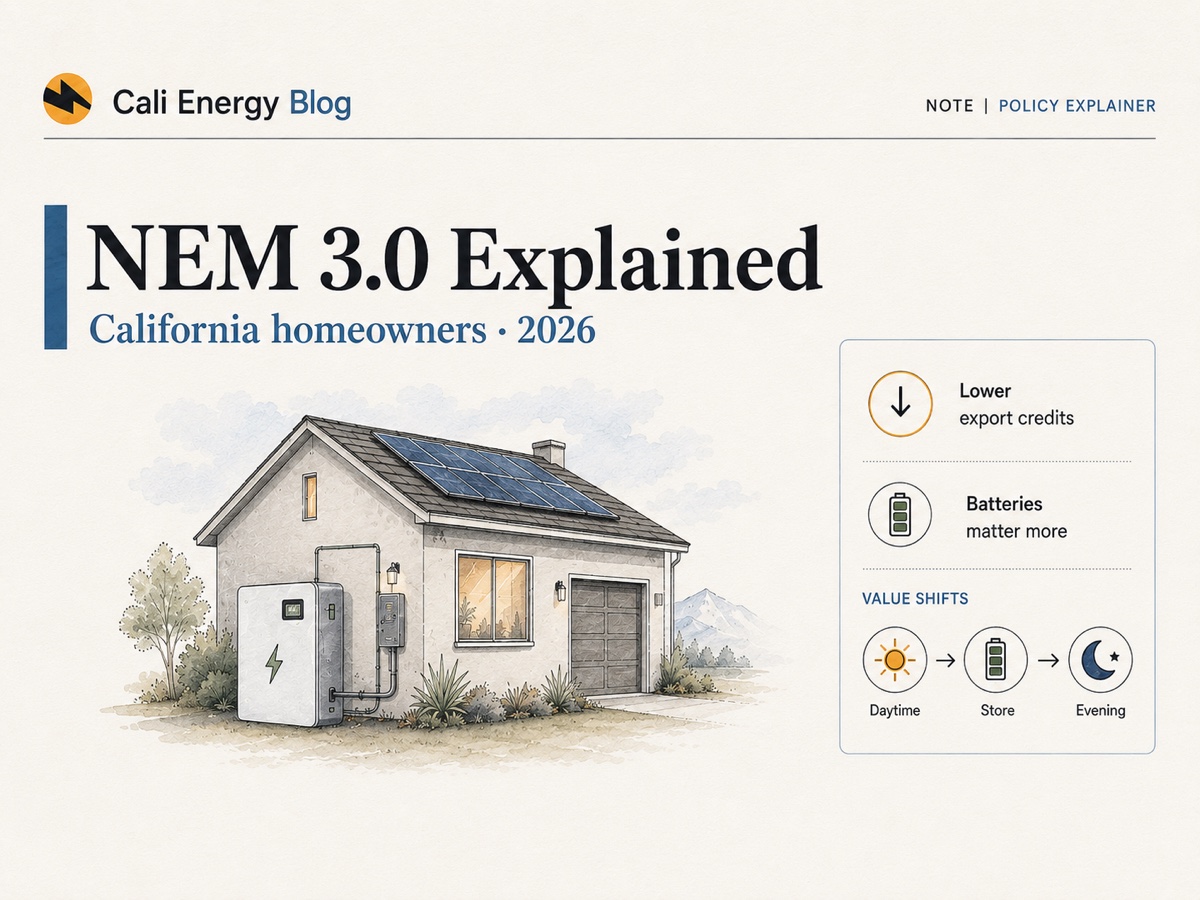
What is the Net Billing Tariff (NEM 3.0)?
California's third-generation net metering rule for investor-owned utilities.
The Net Billing Tariff (NEM 3.0) is the successor to net energy metering that the California Public Utilities Commission (CPUC) adopted in Decision D.22-12-056 on December 15, 2022. It applies to customers who submit an interconnection application on or after April 15, 2023 (CPUC, Net Billing Tariff).
The core idea is a shift in how your utility values the solar power you export. Under the older rules, exported energy was credited at roughly the retail rate. Under the Net Billing Tariff, exports are credited at the utility's avoided cost — closer to wholesale — using the CPUC's Avoided Cost Calculator. That value changes by hour, day, and month, so a kilowatt-hour you export at 1 p.m. in April is worth far less than one you export at 7 p.m. in September.
Two names matter when you go looking for this on your own bill. SCE does not call it “NEM 3.0” — it calls the plan the Solar Billing Plan, and the credit for exported energy appears as an Energy Export Credit (EEC) line. And the tariff is not yours indefinitely: the CPUC guarantees the original customer who interconnects under the Net Billing Tariff the use of that tariff for nine years, where a NEM 2.0 customer was allowed twenty years from the date of interconnection.
Who does NEM 3.0 apply to (and who is exempt)?
This is the most misunderstood part of the policy. The Net Billing Tariff applies only to the three large investor-owned utilities (IOUs):
Covered by NEM 3.0
SCE (Southern California Edison), PG&E (Pacific Gas & Electric), and SDG&E (San Diego Gas & Electric). If you are a Cali Energy customer in most of the LA basin outside the DWP footprint, you are on SCE — so NEM 3.0 governs your solar. (CPUC)
NOT covered by NEM 3.0
Municipal utilities — including LADWP, Burbank Water & Power (BWP), and Glendale Water & Power (GWP). Munis are not regulated by the CPUC and set their own net metering rules. LADWP customers, for example, still operate under DWP's own program, not NEM 3.0.
What one exported kilowatt-hour is actually worth
SCE publishes the average value of an exported kilowatt-hour by season, by time of day, and by the year your system started service.
| Year you started solar | Summer daytime 6 a.m.–4 p.m. | Summer evening 4–9 p.m. | Summer overnight 9 p.m.–6 a.m. | Winter daytime | Winter evening | Winter overnight |
|---|---|---|---|---|---|---|
| 2023 | $0.05 | $0.23 | $0.07 | $0.03 | $0.05 | $0.04 |
| 2024 | $0.05 | $0.23 | $0.07 | $0.03 | $0.05 | $0.04 |
| 2025 | $0.06 | $0.21 | $0.12 | $0.03 | $0.09 | $0.10 |
| 2026 | $0.06 | $0.21 | $0.12 | $0.03 | $0.10 | $0.10 |
SCE counts June through September as summer and October through May as winter. The figures are averages SCE publishes for each window; the tariff itself prices every hour separately, and a weekday differs from a weekend. Source: SCE — Solar Billing Plan.
Read down a row rather than across the table, because the row is what you get. For new Solar Billing Plan customers SCE locks these prices for nine years, set by the year you began solar with SCE. Someone buying a house that already has solar takes the current year’s prices instead of the seller’s.
A second credit sits on top of those values: the Energy Export Bonus Credit, set in SCE’s tariff by the year your system received permission to operate — 4.0¢ per kWh for 2023, 3.2¢ for 2024, 2.4¢ for 2025, 1.6¢ for 2026 and 0.8¢ for 2027 (9.3¢ down to 1.9¢ for income-qualified “equity” customers), fixed for nine years (SCE Schedule NBT). Systems that start in 2028 or later get none, and neither does a buyer of a home with an existing system. For a 2026 start it lifts a summer midday export from 6¢ to about 7.6¢. It also behaves differently from the ordinary credit: an Energy Export Credit cannot be applied to non-bypassable charges, fixed fees such as the Base Services Charge, or taxes, whereas the bonus credit may offset non-bypassable charges.
Export it or keep it — the same kWh, priced twice
Take a household that started solar in 2026 and take a single kilowatt-hour on a July day. Exported at 1 p.m., SCE credits $0.06, plus the $0.016 bonus credit for a 2026 start — about $0.076 in all. Bought back at that same hour on TOU-D-4-9PM, it costs about 34¢. Keeping that kilowatt-hour instead of exporting it is therefore worth about 4.5 times as much.
Exported at 6 p.m. the same day, the credit is $0.21 plus $0.016 — about $0.23. Buying that kilowatt-hour back inside the 4–9 p.m. peak costs about 58¢, so keeping it is worth about 2.6 times as much. Once the nine-year bonus period ends the gap widens again, to roughly 5.7× at midday and 2.8× in the evening.
That single comparison is the whole argument for storage under this tariff, and it is why oversizing an array no longer pays the way it did. Retail prices are from SCE’s published plan rates, tabulated in our Los Angeles electricity rates guide.
What changed vs NEM 2.0?
Three big shifts: how exports are valued, when they are valued, and what strategy wins.
1. Export value dropped sharply. Under NEM 2.0, exported energy was credited at close to the full retail rate (minus small non-bypassable charges). Under NEM 3.0, exports are valued at avoided cost from the CPUC's Avoided Cost Calculator. On SCE's published schedule an exported kilowatt-hour is worth 3¢ to 21¢ depending on the season and the hour, against a retail price for that same kilowatt-hour of roughly 34¢ to 58¢. The drop is therefore not one number: it is deepest at midday in winter and shallowest on a summer evening.
2. Export value became time-varying. The Avoided Cost Calculator produces hundreds of distinct hourly export prices across the year. Midday exports — when solar floods the grid — are worth very little. A handful of hours on hot late-summer evenings are worth a great deal. This is exactly opposite to when rooftop solar naturally overproduces.
3. The winning strategy changed. Under NEM 2.0, oversizing a panel array and "banking" credits at retail value made sense. Under NEM 3.0, the value is in self-consumption — using your own solar directly and storing the excess to discharge during expensive evening peak hours rather than exporting it cheaply.
NEM 2.0 vs NEM 3.0: side-by-side
How the two tariffs compare on the six things that decide your bill.
Net Billing comparison
NEM 2.0 (grandfathered) vs NEM 3.0 (new applications on/after Apr 15, 2023). Figures are approximate and vary by plan, season, and hour.
Sources: CPUC Net Billing Tariff · CPUC Net Energy Metering and Net Billing · SCE Solar Billing Plan
Why batteries now matter under NEM 3.0
The logic is simple once you see the timing mismatch. Solar panels produce most of their power at midday — exactly when the grid is saturated and export credits are lowest. Household demand peaks in the evening, when SCE's time-of-use rates are highest. On the SCE TOU-D-4-9PM plan, summer weekday peak (4–9 p.m.) runs around 58¢/kWh, and on TOU-D-5-8PM the 5–8 p.m. peak reaches roughly 74¢/kWh (SCE Residential Rate Plans).
A battery bridges that gap. It stores your cheap midday solar and discharges it during the expensive evening peak, so you avoid buying grid power at 58–74¢ instead of exporting it for pennies. That "avoided purchase" is where the real savings live under the Net Billing Tariff — not in export checks. Batteries also provide backup during outages, which is a real benefit in fire-prone and PSPS-affected parts of Southern California.
Battery costs can sometimes be partially offset through the Self-Generation Incentive Program (SGIP), though SGIP is not a single fixed rebate — it has multiple categories and step-downs. The high-value equity and equity-resiliency tiers reach roughly $1.00–$1.10/Wh, but most SGIP budgets (General Market, Equity, and Equity Resiliency) closed to new applications at the end of 2025, and the remaining income-qualified tier is largely reserved or waitlisted (SelfGenCA program metrics). Standard residential rebates are much smaller, and funding status changes frequently, so treat any SGIP number as approximate and confirm your eligibility before counting on it for your project.
What NEM 3.0 does to your payback
Honestly: it lengthens it. The export half of the return shrank — a kilowatt-hour that was once credited near the retail price now earns between 3¢ and 21¢ — so the return has to come from self-consumption instead.
How long that takes depends on the household, and in 2026 one change moved the number more than the tariff did: the 30% federal credit ended for systems placed in service after December 31, 2025. Running our own scenarios for an LA-area home puts cash payback at roughly 10 to 13 years, with the loss of that credit accounting for two to four years of it on its own — the workings are in our is solar worth it in 2026 guide.
A battery moves both sides of that ratio at once: it adds cost up front, and it captures the evening value the panels can no longer export profitably. Whether it shortens or lengthens payback for you turns on how much of your usage falls in the expensive evening hours, which is why the answer comes from running your own load rather than from a rule of thumb.
Solar still saves money in California: the state's average residential price is about 34.74¢/kWh against a U.S. average of 18.34¢ (EIA, June 2026). But under this tariff the design that saves the most is solar sized for self-consumption plus a right-sized battery.
Timing, grandfathering, and the expired federal credit
If you submitted a complete interconnection application by April 14, 2023 and finished the project within three years, you are on NEM 2.0 with a 20-year grandfathering period measured from your PTO date. Routine maintenance and modest changes do not touch it. What does put it at risk is a large expansion: the system can grow by no more than 1 kW or 10% of its original size, whichever is greater; past that, the extra panels must be connected separately as non-export, or the whole system moves onto NEM 3.0. Adding a battery keeps NEM 2.0, except a battery funded through SGIP with a reservation accepted on or after June 4, 2024, outside its equity budgets (SCE and PG&E tariffs). Our NEM 2.0 grandfathering guide walks the line in detail. New systems interconnecting today fall under NEM 3.0 — where the guarantee runs nine years, not twenty.
One more critical 2026 change: the federal Residential Clean Energy Credit (the 30% ITC) is no longer available for homeowner-owned residential systems placed in service after December 31, 2025 (IRS). If you were counting on a 30% tax credit to shorten your payback, that math has changed — factor it in before signing anything.
Bottom line for California homeowners
The Net Billing Tariff (NEM 3.0) did not kill residential solar — it changed the winning strategy. Exports are now worth roughly a quarter of what they were, and they are worth the most exactly when your panels produce the least. The response is not to abandon solar; it is to design for self-consumption and pair panels with storage, especially on high evening-peak SCE rate plans. And remember: if your address is on LADWP, Burbank, or Glendale, none of NEM 3.0 applies to you — those munis have their own rules, and the analysis is different.
Cali Energy (Northridge, CSLB #1032379) designs both SCE/NEM 3.0 and municipal-utility systems with in-house crews, and models your actual rate plan before recommending a size. If you want a straight, no-hype breakdown for your specific utility and usage, call +1 (323) 844-7777.
Frequently asked
Does NEM 3.0 apply to LADWP customers?
When did NEM 3.0 take effect?
What is my SCE bill calling this? I don't see "NEM 3.0" anywhere
How much is an exported kilowatt-hour actually worth under NEM 3.0?
How long am I locked into NEM 3.0?
Can export credits wipe out my whole electric bill?
Do I need a battery under NEM 3.0?
Does adding panels to my old system move me to NEM 3.0?
Is solar still worth it in California under NEM 3.0?
Did the federal solar tax credit change too?
Related reading
Sources & methodology
Figures on this page come from the primary sources below and, where noted, from Cali Energy calculations using the stated assumptions. Rates, incentives, and program terms change; each was verified September 29, 2026.
- CPUC — Net Billing Tariff (NEM 3.0)
- CPUC — Net Energy Metering and Net Billing Tariff
- SCE — Solar Billing Plan (Energy Export Credit values)
- SCE — Solar glossary (EEC, EEBC, non-bypassable charges)
- SCE — Time-Of-Use Residential Rate Plans
- IRS — Residential Clean Energy Credit
- EIA — Electric Power Monthly (avg residential price, June 2026)
- SelfGenCA — SGIP Program Metrics
- SCE — Schedule NBT, Net Billing Tariff (ACC Plus Adder / Energy Export Bonus Credit rates by vintage, Sheet 7)
- SCE — Schedule NEM-ST, Net Energy Metering Successor Tariff (NEM 2.0 legacy provisions)
- PG&E — Electric Schedule NEM2 (NEM 2.0 legacy provisions)
Not sure how NEM 3.0 affects your bill?
We'll model your actual utility and rate plan — SCE, LADWP, Burbank, or Glendale — and show you whether solar plus storage pays off for your home. No hype, just numbers. Call +1 (323) 844-7777.
Get a free estimatePrepared by Cali Energy, September 29, 2026. This article is for general educational purposes only and is not legal, tax, financial, engineering, or utility advice. Rates, incentives, codes, permit requirements, equipment specifications, prices, and program terms may change; figures and timelines are estimates, not guarantees. Confirm current requirements with the applicable utility, AHJ, program administrator, manufacturer, or a licensed professional. See our Content Disclaimer. Cali Energy · 19201 Parthenia St, Unit E, Northridge, CA 91324 · CSLB #1032379 (B, C-10, C-39)