

Solar company in Woodland Hills — the hottest place in the county, and what that does to a solar array
Yes — Cali Energy installs solar panels, battery storage, roofing and electrical upgrades in Woodland Hills, Los Angeles. We work here regularly, across 91364 and 91367, on systems from 4.76 kW up to a forty-four module array. Some of those homes are shown below, with our photos from each. Woodland Hills holds the highest temperature ever officially recorded in Los Angeles County — 121°F — and that is not trivia here: extreme heat drives the summer bill up and pushes panel output down at the same time, which changes how a system should be designed. Every address is on LADWP, which still credits exports at the retail rate. Cali Energy is a licensed California contractor (CSLB #1032379) with a 4.9★ Google rating and in-house crews.
Get a Woodland Hills estimate
Woodland Hills 91364 · 14.96 kW DC · forty-four Q CELLS Q.PEAK DUO 340 W modules on Enphase IQ7+ microinverters, installed in 2022.
Cali Energy in Woodland Hills, at a glance
The short answers before considering a contractor.
| Question | Answer |
|---|---|
| What has Cali Energy installed here? | Rooftop solar from 4.76 kW up to a forty-four module 14.96 kW system, on Q CELLS modules with Enphase microinverters, plus the electrical work that goes with them. |
| Google rating | 4.9★ on Google. See them on Google |
| Who supplies the electricity? | The Los Angeles Department of Water and Power — a municipal utility outside CPUC jurisdiction, still crediting exports at the retail rate. |
| Who permits the work? | The Los Angeles Department of Building and Safety (LADBS), plus a separate LADWP interconnection process. |
| What makes Woodland Hills different? | Heat. This is the hottest officially recorded spot in the county, so summer cooling load is high and module output is suppressed at exactly the same hours. |
| Where are you based? | Northridge, a short drive across the Valley — not a call center in another county. |
| License | CSLB #1032379 (B, C-10, C-39), in-house crews, operating since 2017. Verify with the CSLB |
Solar panels produce less when they are hot — and this is where they get hottest
The physical fact behind every honest Woodland Hills estimate, and the one most quotes never mention.
On 6 September 2020 the weather station in Woodland Hills recorded 121°F — the highest official temperature ever measured in Los Angeles County, breaking the 119°F set in July 2006. The National Weather Service noted it was also the highest ever recorded across Ventura, Santa Barbara and San Luis Obispo counties. That is the environment a rooftop array here works in.
Modules are rated in a laboratory at a cell temperature of 25°C (77°F). In the real world a panel on a Valley roof in August runs far hotter than the air around it, and output falls as it heats: datasheets state a temperature coefficient of roughly −0.3% of rated power per °C above that reference for modern modules. Do the arithmetic and a hot afternoon costs a meaningful share of nameplate — not a defect, just physics that a proposal built purely on nameplate watts quietly ignores.
What follows is design, not resignation. Mounting height matters: a flush array with an air gap beneath it runs cooler than one pressed against the roof, and cooler means more output. Module choice matters: coefficients differ between products, and it is a specification worth comparing rather than assuming. Module-level electronics matter, because heat rarely arrives evenly across a roof. And the estimate itself should be built from expected real-world conditions rather than from the laboratory figure on the box.
Nameplate is a laboratory number
Rated watts assume a 25°C cell. A Woodland Hills roof in August is nothing like that, and an honest estimate says so.
Air gap under the array
Mounting that lets air move beneath the modules keeps cell temperature down, and cooler cells produce more.
Compare the coefficient
Temperature coefficient is on every datasheet and differs between modules. In this climate it deserves the same attention as efficiency.
Heat is uneven
Roof planes heat differently through the day. Microinverters let each module perform on its own instead of following the worst one.
Sources: National Weather Service via reporting on the 6 September 2020 record (121°F at Woodland Hills, the highest official reading in Los Angeles County, previous record 119°F in July 2006) · NREL PVWatts, which models cell temperature rather than assuming laboratory conditions. Temperature coefficients are stated on each module’s datasheet; confirm the figure for the equipment actually proposed.
Solar work in Woodland Hills
A few of the homes we have done here. Street numbers stay off the page out of respect for the owners. The full photo set for every Woodland Hills job lives in the Woodland Hills project gallery.
14.96 kW on forty-four modules
Forty-four Q CELLS Q.PEAK DUO 340 W modules on Enphase IQ7+ microinverters — the largest array on this page, and the kind of system a high summer cooling load asks for.
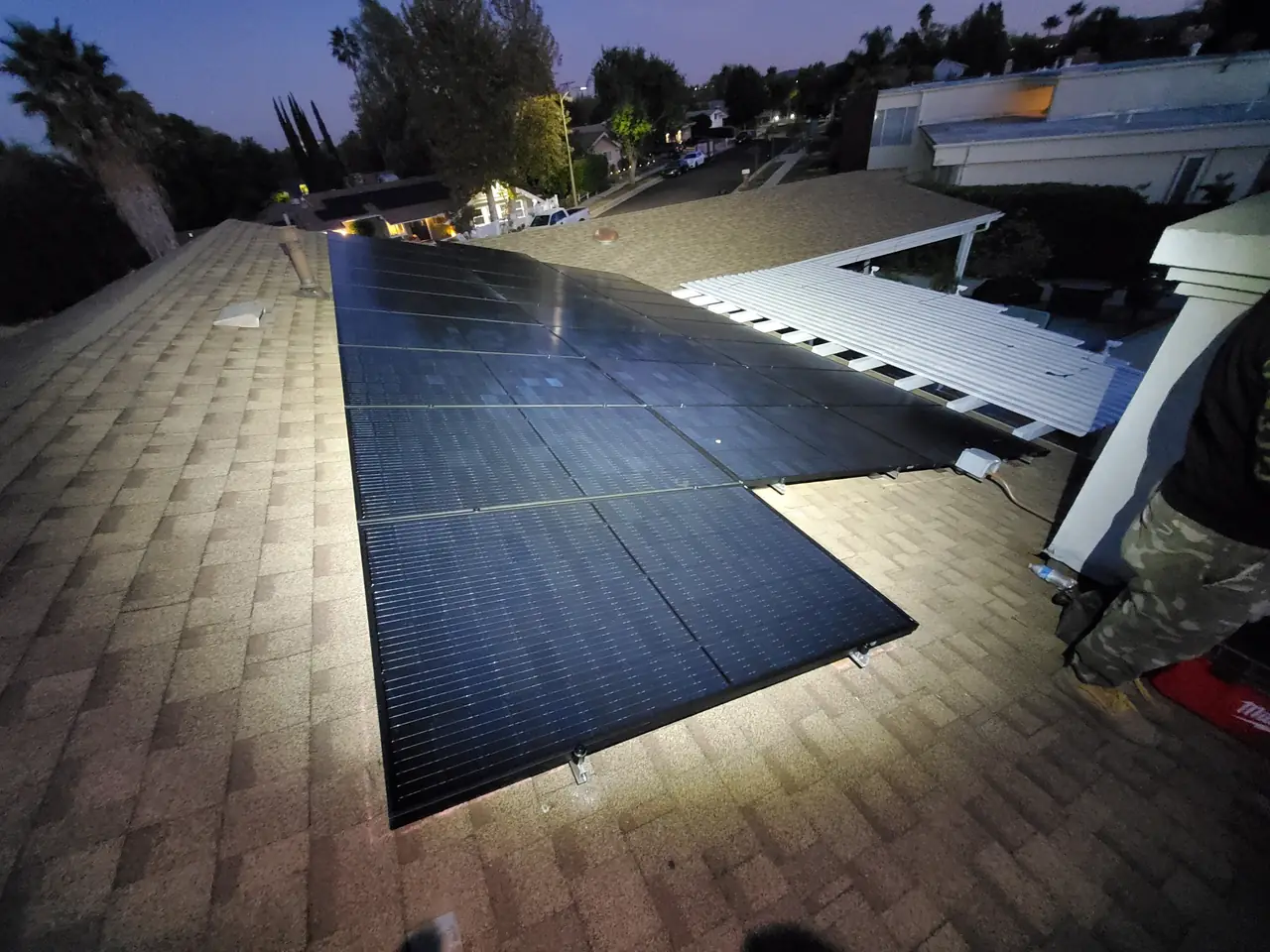
12.9 kW CEC-AC
A large rooftop system carried through LADWP’s standard approval path — well above the 10 kW CEC-AC line where the fast track ends.
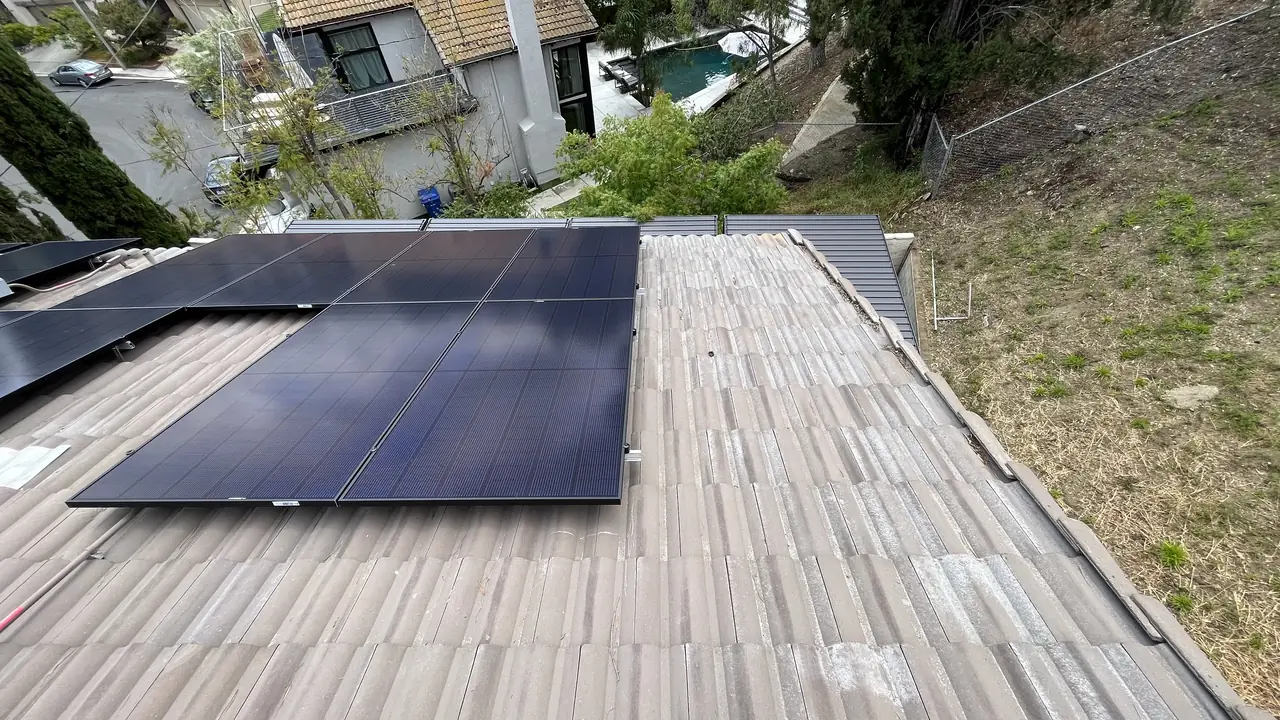
Nineteen modules on IQ8+
Q CELLS 400 W modules on Enphase IQ8+ microinverters, so every panel produces and reports independently as roof temperatures shift through the afternoon.
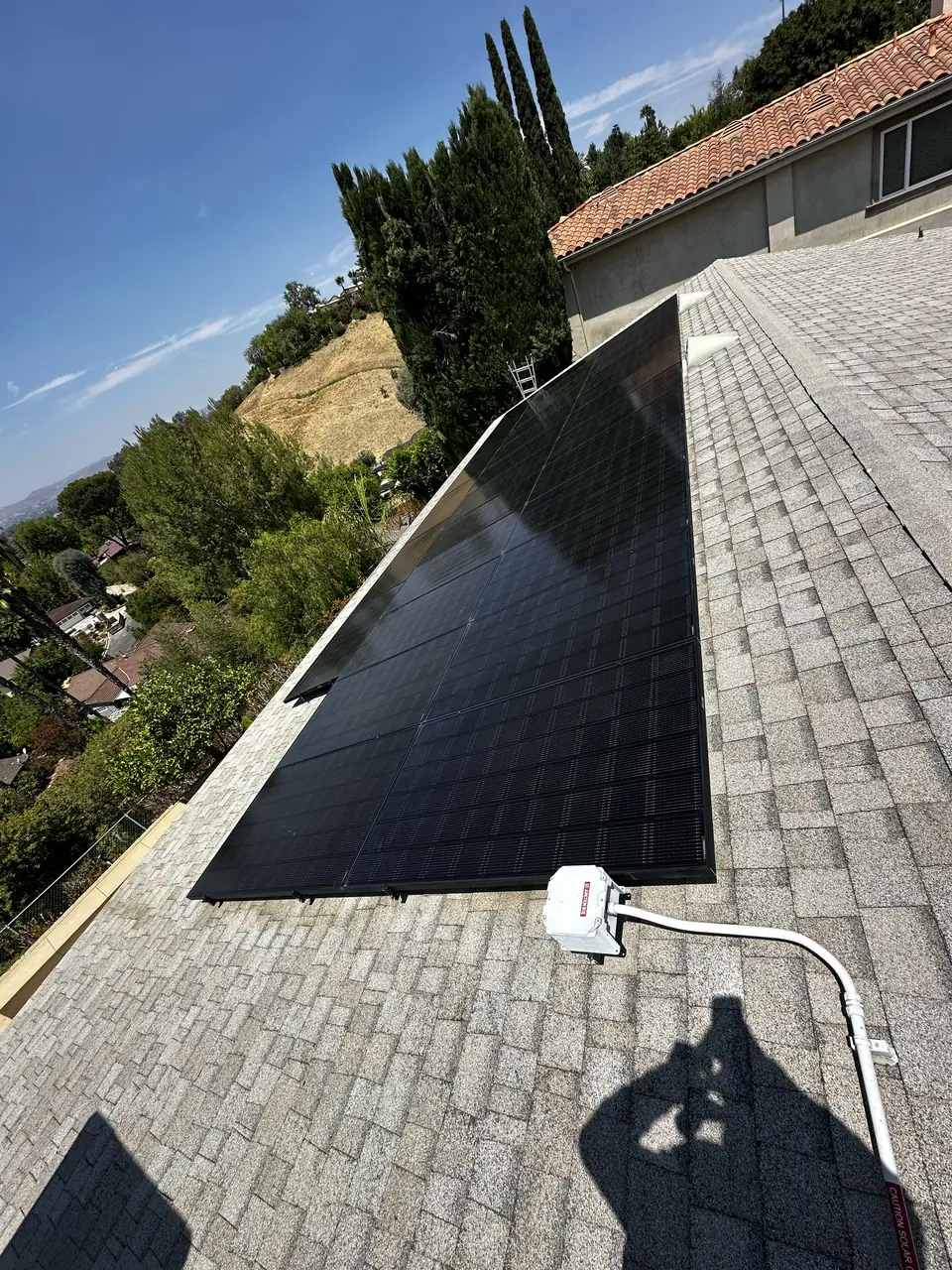
9.6 kW, inside the fast track
A system sized just under LADWP’s 10 kW CEC-AC threshold — which keeps it on the utility’s quicker approval path.
Photos are ours, taken on site. Sizes are stated on the basis they were recorded on — DC nameplate or CEC-AC — because the two are not interchangeable.
A closer look at the Woodland Hills jobs
What this work has in common, and where it differs.
| Detail | Value | Notes |
|---|---|---|
| Homes shown here | A selection | Some of our Woodland Hills jobs, with our photos from each — our work in the area goes well beyond them |
| ZIP codes | 91364 & 91367 | Both sides of the neighborhood, from the boulevard down toward the hills |
| System sizes | 4.76–14.96 kW | Stated on the basis each was recorded on; the largest is DC nameplate across forty-four modules |
| Utility | LADWP | Retail-rate net metering on every one, with systems switched on from 2019 through 2023 |
| Equipment we have used | Q CELLS, Enphase | Q.PEAK DUO 340 W and 400 W modules with Enphase IQ7+ and IQ8+ microinverters throughout |
| Why microinverters | Uneven heat and shade | Roof planes heat and shade differently through a Valley afternoon; module-level electronics keep one plane from setting the pace |
| Approval paths | Both sides of 10 kW | A 9.6 kW system sits inside LADWP’s fast track; a 12.9 kW one took the standard path with an engineering site visit |
| Years of work | 2019–2023 | Steady Woodland Hills work across those years |
Size for August, not for the annual average
In a climate like this one the summer curve is the design, and the yearly total is just a summary of it.
Air conditioning is the largest single load most Woodland Hills homes have, and it runs hardest in exactly the months when module output is suppressed by heat. An estimate built on annual averages hides that collision: the array looks adequate across the year while falling short in the weeks that actually hurt. We build the picture from twelve months of LADWP billing history and look specifically at the summer peaks — how high they go, how long they last, and what is driving them.
Because LADWP still credits exports at the retail rate, the arithmetic is friendlier here than in Edison territory: energy the array sends out in a mild spring month carries real value against a fierce August bill, rather than being paid at an hourly avoided-cost rate. That makes a properly sized system — even a large one — hold its value across the year rather than only in the hours the house consumes directly.
Read the summer peaks
Twelve months of billing history shows how steep August really is. That is what the array is sized against.
Cooling equipment matters
The age and efficiency of the air conditioning changes the load more than any panel choice. It belongs in the conversation.
Retail credit carries the year
Spring surplus offsets summer deficit at retail value under LADWP, which is why annual sizing works here in a way it does not under net billing.
Attic and roof colour play a part
Roof surface and ventilation affect both the house’s cooling load and the array’s operating temperature. We look at both.
LADWP: retail-rate credit and the 10 kW line
Two rules that shape a Woodland Hills project more than the equipment does.
NEM 3.0 does not apply
LADWP is municipal, so the CPUC’s Net Billing Tariff does not govern it. Exports here are still credited against the retail rate rather than an hourly avoided-cost value.
The fast track ends at 10 kW
Under 10 kW CEC-AC with no battery and no panel upgrade, LADWP approves in roughly 2–5 days with the meter set 1–2 weeks later. Larger systems add an engineering site visit of 1–3 weeks — both cases appear on this page.
CEC-AC, not DC
The threshold is read in CEC-AC watts, not DC nameplate. A proposal written only in DC can look under the line while the utility reads it as over.
Batteries change the path
Adding storage moves a project onto the standard path regardless of array size — worth knowing when a battery is being considered late.
Sources: LADWP — net energy metering rates · LADWP — solar programs (Guide to Electric Service, p. 22, for the stage timings) · CPUC — Net Energy Metering. Program terms change; confirm current rules for your own account.
What solar costs and how long it takes in Woodland Hills
No honest flat price for a neighborhood — but published ranges and a schedule that turns on one threshold.
The systems we have installed here run from 4.76 to 14.96 kW, and the spread follows the cooling load rather than the roof. Two published price bases frame the budget, both before incentives: $2.49 per watt at competitive marketplace rates (EnergySage, August 2026) and $3.5 per watt, the 2024 national median for cash purchases (Lawrence Berkeley National Laboratory). A 6–12 kW system lands somewhere between roughly $15,000 and $42,000 depending on installer, financing and scope, and a large Woodland Hills array sits at the upper end because the summer bill asks for one.
| Item | Figure | Basis |
|---|---|---|
| System sizes we have installed here | 4.76 – 14.96 kW | Our installations |
| Solar at marketplace rates | $2.49/W → 8 kW ≈ $20,000 · 12 kW ≈ $29,900 · 15 kW ≈ $37,400 | Market estimate — EnergySage |
| Solar at typical installer rates | $3.5/W (2024 national cash median) → 8 kW ≈ $28,000 · 15 kW ≈ $52,500 | Market estimate — LBNL 2025 Data Update |
| Battery storage (~13 kWh) | $11,864–$16,052 before incentives (average $13,958) | Market estimate — EnergySage California |
| Heat allowance in estimates | Output modelled at expected cell temperature, not laboratory conditions | Modeling practice — NREL PVWatts |
| Federal tax credit | Homeowner (25D) credit ended Dec 31, 2025 — $0 on a 2026 cash or loan purchase; leased and PPA systems can still capture the 30% credit through the system owner | Official source — IRS FAQs on P.L. 119-21 |
| Time on the roof | Most residential installs: 1–3 working days; a forty-plus module array runs longer | Cali Energy company figure |
| LADBS permit | Express e-permit for qualifying systems: issued online, often same day | Official process — LADBS |
| LADWP path | Under 10 kW CEC-AC without battery or panel upgrade: approval 2–5 days, meter set 1–2 weeks. Otherwise add an engineering site visit of 1–3 weeks | Official — LADWP Guide to Electric Service, p. 22 |
Sources: EnergySage — solar cost · EnergySage — storage cost · LBNL — 2025 Data Update · IRS — Section 25D FAQs. Planning context, not a quote.
What Cali Energy installs in Woodland Hills
One licence covering the whole job, so the scopes do not get handed between companies.
Rooftop solar
Arrays from a handful of modules to forty-four, mounted so air can move beneath them, with module-level electronics for uneven heat and shade.
Battery storage
Backup for heat-wave outages, sized to the circuits worth keeping alive — planned knowing storage moves the project onto LADWP’s longer path.
Roofing with solar
Roof condition assessed by our own roofing side under a C-39, and replaced first when it will not outlast the array.
Electrical and EV charging
Main-panel upgrades, subpanels and EV charger circuits — frequently the real constraint on how much solar a house can take.
Our services in Woodland Hills
A page for each service: our Woodland Hills projects, the permit and the utility.
Exact coverage: Woodland Hills and its edges
The south-west corner of the Valley, where the heat collects.
| Attribute | Fact |
|---|---|
| Status | Neighborhood of the City of Los Angeles, at the south-west end of the San Fernando Valley |
| ZIP codes | 91364 and 91367 |
| Electricity | LADWP for every address — retail-rate net metering, no CPUC net billing |
| Permitting authority | Los Angeles Department of Building and Safety (LADBS) |
| Climate | The hottest officially recorded location in Los Angeles County, at 121°F in September 2020 |
| Terrain | The southern edge climbs into the Santa Monica Mountains, where fire-hazard designations and access affect the work |
| Adjacent — same utility | Canoga Park, West Hills, Tarzana and Winnetka are all City of LA addresses on LADWP |
| Adjacent — different rules | Over the hills to the south and west lie Calabasas and unincorporated county areas on Edison, where the export rules differ entirely |
Map of Cali Energy projects in Woodland Hills
Woodland Hills homes we have worked on — a selection of them, shown on this page.
Marker positions are deliberately offset. Each point is shifted 120–260 meters from the real address so the map shows where we work in Woodland Hills without identifying anyone’s home. Base map © OpenStreetMap contributors © CARTO; ZIP boundaries from the U.S. Census ZCTA file.
Reviews and verifiable trust
A public rating, a public license record and named, quotable reviews.
“Cali Energy delivered exactly when they said they would. The crew showed up on schedule, finished the installation without any surprises, and everything worked from day one.”
“Cali Energy did a great job from their proposal through installation and in the years since with follow up monitoring of our system. We have saved 1000s while contributing to lower carbon emissions.”
“I shopped around extensively before choosing Cali Energy — they weren’t the cheapest, but every question got a straight answer.”
Read the full reviews on Cali Energy’s Google profile · verify the contractor license with the California CSLB.
Fast answers about hiring Cali Energy in Woodland Hills
Each answer starts with the conclusion.
Does Cali Energy install solar in Woodland Hills?
Yes. Woodland Hills is an active Cali Energy service area and we work here regularly, across 91364 and 91367. The homes on this page range from 4.76 kW to a forty-four module 14.96 kW array, all on Q CELLS modules with Enphase microinverters. Our office is in Northridge, a short drive away.
Does the heat here reduce solar output?
Yes, and any honest estimate accounts for it. Modules are rated at a cell temperature of 25°C (77°F) in a laboratory, and output falls as they heat — datasheets typically state around −0.3% of rated power per °C above that reference. Woodland Hills recorded 121°F in September 2020, the highest official temperature in Los Angeles County history, so real-world cell temperatures here run well above the rating condition on summer afternoons.
Then is solar still worth it in this climate?
Very much so — the same heat that suppresses output is what drives the bill that solar offsets. Long, hot summers mean heavy air conditioning use, and the sunshine that comes with them is abundant. The point is not that heat cancels solar out; it is that the estimate should be modelled at expected operating temperature rather than at laboratory conditions, so the number you are shown is the number you get.
How do you reduce heat losses on the array?
Three levers. Mounting that leaves an air gap under the modules so they run cooler than a tight flush install. Module selection — temperature coefficient is a published datasheet figure and differs between products, so in this climate it is worth comparing alongside efficiency. And module-level electronics, because roof planes heat unevenly through the afternoon and microinverters let each module perform on its own rather than following the hottest or most shaded one.
What size system does a Woodland Hills home need?
It follows the summer curve, not an annual average. The systems we have installed here run from 4.76 to 14.96 kW, and the larger ones exist because cooling load is high. We start from twelve months of LADWP billing history and look specifically at how steep the August peaks are and what is driving them.
Who is my electricity provider in Woodland Hills?
The Los Angeles Department of Water and Power. Woodland Hills is inside the City of Los Angeles, so every address is served by LADWP rather than Southern California Edison — which changes how solar is credited.
Does NEM 3.0 apply in Woodland Hills?
No. NEM 3.0 — properly the Net Billing Tariff — is a CPUC rule for investor-owned utilities such as Edison and PG&E. LADWP is municipal and is not governed by it, so exported energy here is still credited against the retail rate. That matters in a climate like this one, because a spring surplus offsets a summer deficit at retail value.
Why does 10 kW matter for my project?
It sets your timeline. A system under 10 kW CEC-AC with no battery and no main-panel upgrade qualifies for LADWP’s fast track — approval in roughly 2–5 days and the meter set 1–2 weeks later. Larger systems take the standard path with an engineering site visit of 1–3 weeks. Both appear on this page: a 9.6 kW system inside the fast track and a 12.9 kW one above it.
Do I need a battery in Woodland Hills?
Not for tariff reasons — LADWP still credits exports at the retail rate, so storage is not needed to rescue export value. It is worth pricing for backup during heat-wave outages, when demand across the grid is at its highest and the house needs cooling most. Note that adding storage moves the project onto LADWP’s longer approval path.
How long does a Woodland Hills solar project take?
The roof work itself is usually 1–3 working days, and a forty-plus module array runs longer. LADBS issues qualifying residential permits online, often the same day. The variable is LADWP: under 10 kW CEC-AC without a battery or panel upgrade, approval runs about 2–5 days with the meter set 1–2 weeks later; otherwise add an engineering site visit of 1–3 weeks.
What does solar cost in Woodland Hills?
There is no honest flat neighborhood price, but published rates frame it: $2.49 per watt at marketplace rates and $3.5 per watt as the 2024 national cash median. An 8–15 kW system — the usual range for a house with a serious cooling load — lands at roughly $20,000–$52,500 before incentives depending on installer and financing. The federal 25D homeowner credit ended December 31, 2025, so a 2026 cash or loan purchase gets no federal credit. The estimate for your own home is free.
How do I check that Cali Energy is legitimate?
Compare four things rather than ad claims: (1) an active CSLB license with electrical and roofing classifications, (2) completed work in your specific area, with photos, (3) whether the company uses its own crews or subcontracts, and (4) the review pattern. Our answers: CSLB #1032379 (B, C-10, C-39); Woodland Hills homes with our photos; in-house crews; a 4.9★ Google rating. Our office is at 19201 Parthenia St Unit E, Northridge, CA 91324. We do not claim a Woodland Hills storefront; what this page shows is completed work in the neighborhood and active service coverage.
Sources
Where this page states a rule, a figure or a record, the official source is linked below.
| What it supports | Source |
|---|---|
| 121°F at Woodland Hills on 6 September 2020 — the highest official temperature recorded in Los Angeles County | National Weather Service reading, as reported |
| Modeling output at expected cell temperature rather than laboratory conditions | NREL — PVWatts |
| LADWP net energy metering and rate treatment | LADWP — EV / NEM / REO rates |
| Fast-track and standard interconnection paths and their stage timings | LADWP — solar programs (Guide to Electric Service, p. 22) |
| The Net Billing Tariff (NEM 3.0) applies to investor-owned utilities, not municipals | CPUC — Net Energy Metering |
| City solar permitting for Los Angeles addresses | LADBS — solar permits |
| Installed price ranges for solar and storage | EnergySage · LBNL 2025 Data Update |
| Federal tax credit status for 2026 | IRS — Section 25D FAQs |
| Contractor licence and classifications | CSLB — license #1032379 |
Nearby service areas
Other cities where Cali Energy works.
Related reading
Planning solar for a Woodland Hills home
Send the service address and twelve months of LADWP billing history — the summer peaks are what set the system size here. We will confirm the roof planes, shade, cooling load and electrical scope before preparing an address-specific proposal modelled at real operating temperature.
Request a free estimatePublished August 2026. Details refer to those specific homes, not to every Woodland Hills property. Rates, incentives, code editions and permit requirements change; utility, jurisdiction, equipment, pricing and schedule must be confirmed for the specific address. Module performance figures depend on the equipment actually proposed. See our Content Disclaimer. Cali Energy · 19201 Parthenia St Unit E, Northridge, CA 91324 · CSLB #1032379 (B, C-10, C-39)