

Solar company in Encino — big houses, big bills, and systems sized to match
Yes — Cali Energy installs solar panels, battery storage, roofing and electrical upgrades in Encino, Los Angeles. We work here regularly, on both sides of Ventura Boulevard — 91316 on the valley floor and 91436 up in the hills. Some of those homes are shown below, with our photos from each. Encino is a neighborhood where the electricity bill is the design brief: one home on this page runs about 18,600 kWh a year, roughly three times a typical California household, and it needed thirty modules to match. Every address here is on LADWP, which still credits exports at the retail rate. Cali Energy is a licensed California contractor (CSLB #1032379) with a 4.9★ Google rating and in-house crews, based nearby in Northridge.
Get an Encino estimate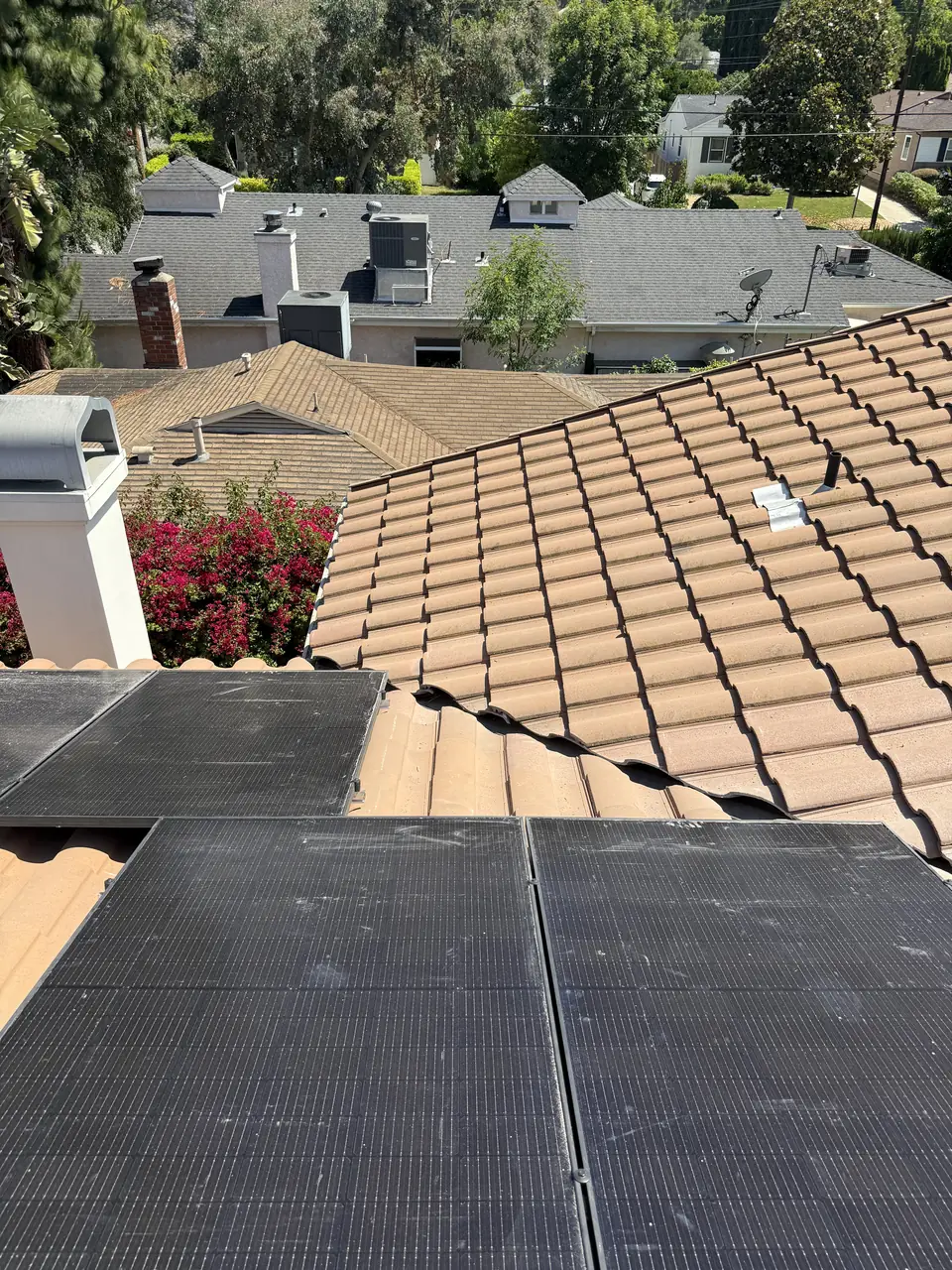
Encino 91316 · 12.3 kW DC · thirty 410 W modules on Enphase IQ8A microinverters, designed around roughly 18,600 kWh a year.
Cali Energy in Encino, at a glance
The short answers before considering a contractor.
| Question | Answer |
|---|---|
| What has Cali Energy installed here? | Rooftop solar on composition shingle and tile, from 4.8 kW up to a thirty-module 12.3 kW system; a new main service panel with meter work; and arrays designed around high daytime consumption. |
| Google rating | 4.9★ on Google. See them on Google |
| Who supplies the electricity? | The Los Angeles Department of Water and Power — a municipal utility outside CPUC jurisdiction, still crediting exports at the retail rate. |
| Who permits the work? | The Los Angeles Department of Building and Safety (LADBS), plus a separate LADWP interconnection process. |
| What makes Encino different? | Consumption. Large houses, pools, and long cooling seasons push annual usage well above the regional average, which is what drives system size here. |
| Where are you based? | Northridge, a short drive over the Valley — not a call center in another county. |
| License | CSLB #1032379 (B, C-10, C-39), in-house crews, operating since 2017. Verify with the CSLB |
In Encino the bill designs the system, not the roof
The most useful number in a proposal here is not the roof area — it is your annual kilowatt-hours.
One Encino home on this page consumes roughly 18,600 kWh a year. For scale, a typical California household sits nearer 6,000–7,000. That gap is what Encino looks like on paper: larger floor plans, more air conditioning through a long Valley summer, pool and spa equipment running daily, often a second refrigerator, sometimes a guest house, and increasingly one or two cars charging overnight. Matching that took thirty 410 W modules, 12.3 kW DC, on Enphase IQ8A microinverters.
The practical consequence is that a proposal built from roof geometry rather than consumption will be wrong here, in either direction. Undersize it and the array covers a fraction of the bill while the homeowner assumes it is covering most of it. Oversize it and you pay for production the house cannot use. We start from twelve months of LADWP billing history, identify what actually drives it, and size against that — which is why the systems we have installed in Encino run from 7.7 to 12.3 kW rather than one house-shaped default.
Pool equipment runs all day
A pool pump is one of the largest continuous loads a house has, and it runs in daylight — which is exactly when the array produces. That is the cleanest kind of solar offset there is.
Cooling is the summer peak
Valley summers put air conditioning at the center of the bill. Sizing follows the summer curve rather than an annual average.
Cars change the maths
An EV can add several thousand kilowatt-hours a year on its own. If one is coming, it belongs in the design now rather than in a second project later.
Guest houses and outbuildings
A second dwelling, a workshop or a detached garage carries its own load and sometimes its own subpanel. We look at the property, not just the main roof.
Solar work in Encino
A few of the homes we have done here. Street numbers stay off the page out of respect for the owners. The full photo set for every Encino job lives in the Encino project gallery.
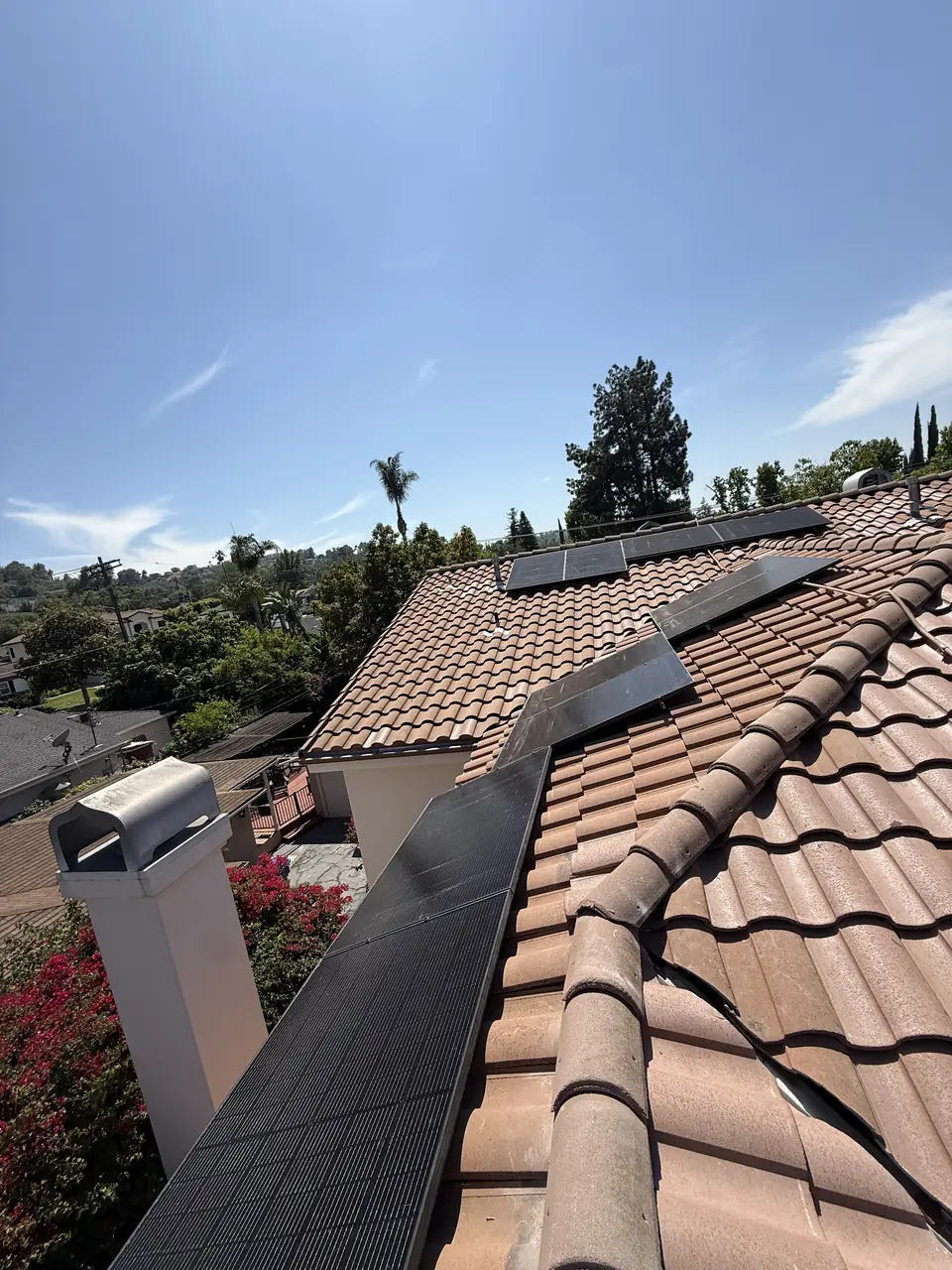
12.3 kW for an 18,600 kWh home
Thirty 410 W modules on Enphase IQ8A microinverters across a tile roof, sized against roughly 18,600 kWh a year — the largest array on this page and the clearest example of consumption-led design.
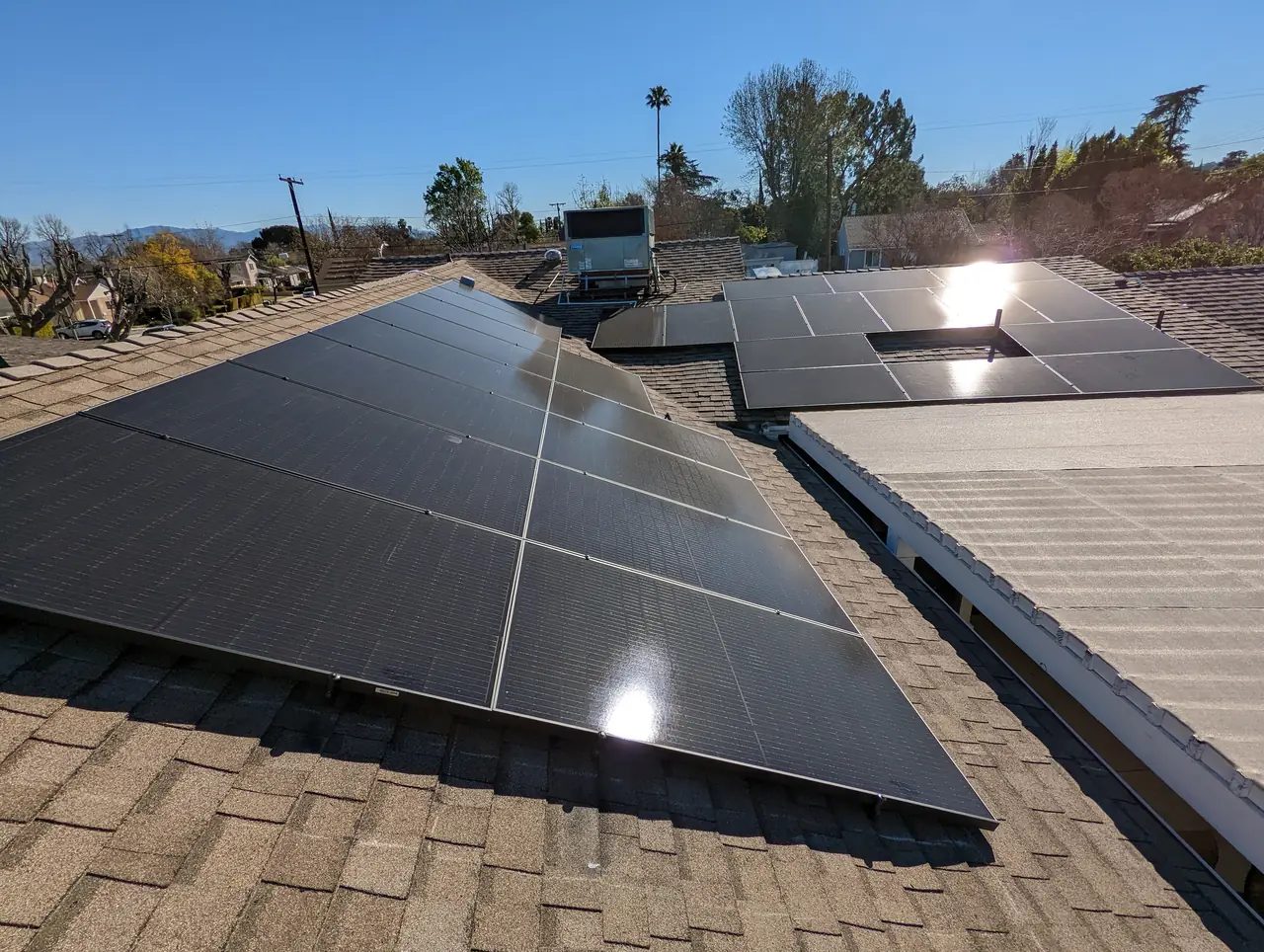
10.5 kW on twenty-eight modules
All-black Q CELLS Q.PEAK DUO 340 W modules on Enphase IQ7 microinverters — a clean rooftop layout where each module works independently.
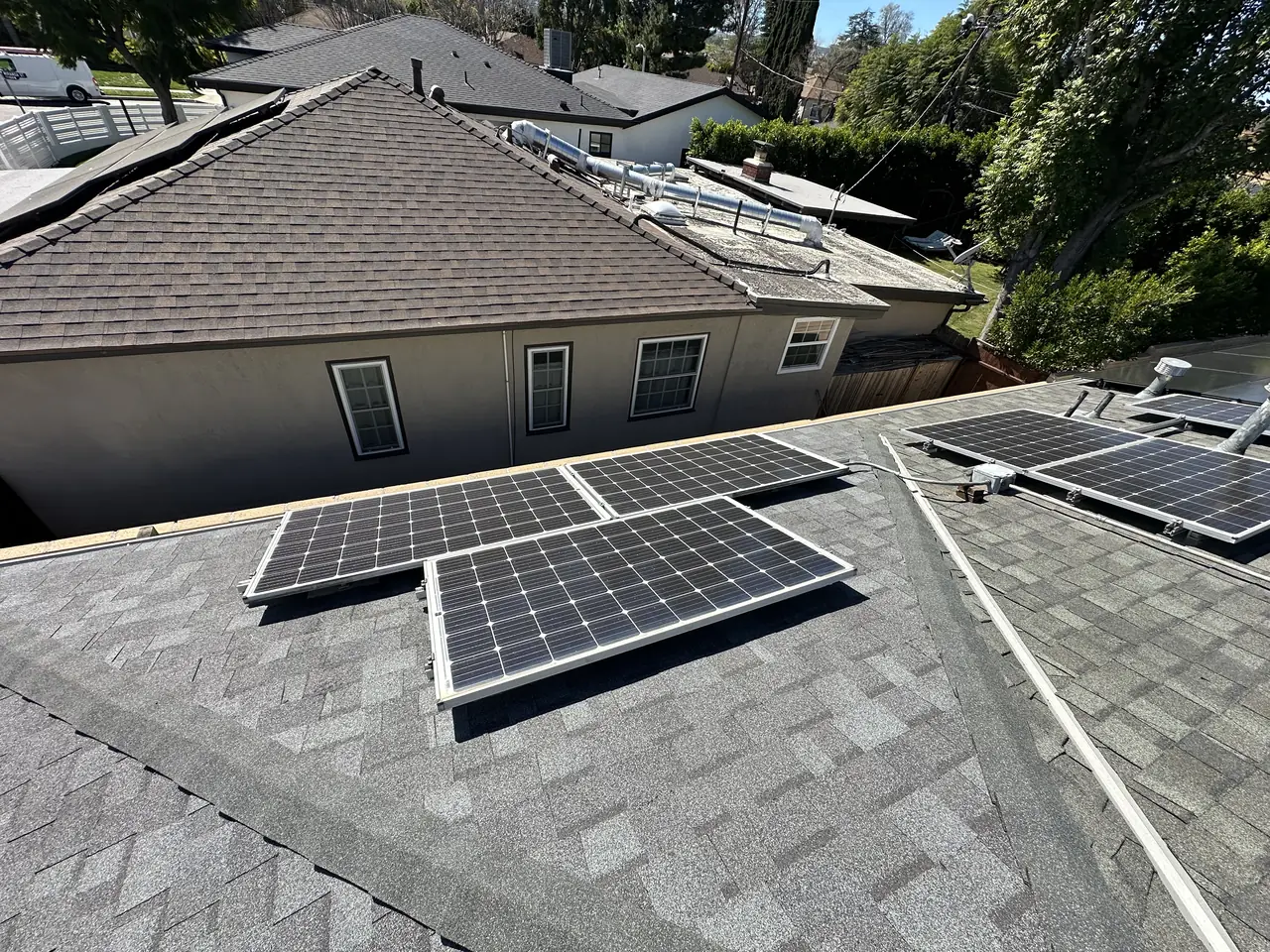
North slope, reverse-tilted
Modules on a north-facing plane set on reverse tilt so they pitch back toward the sun instead of giving up output — on Enphase IQ8A, where mixed orientations cost nothing across the rest of the array.
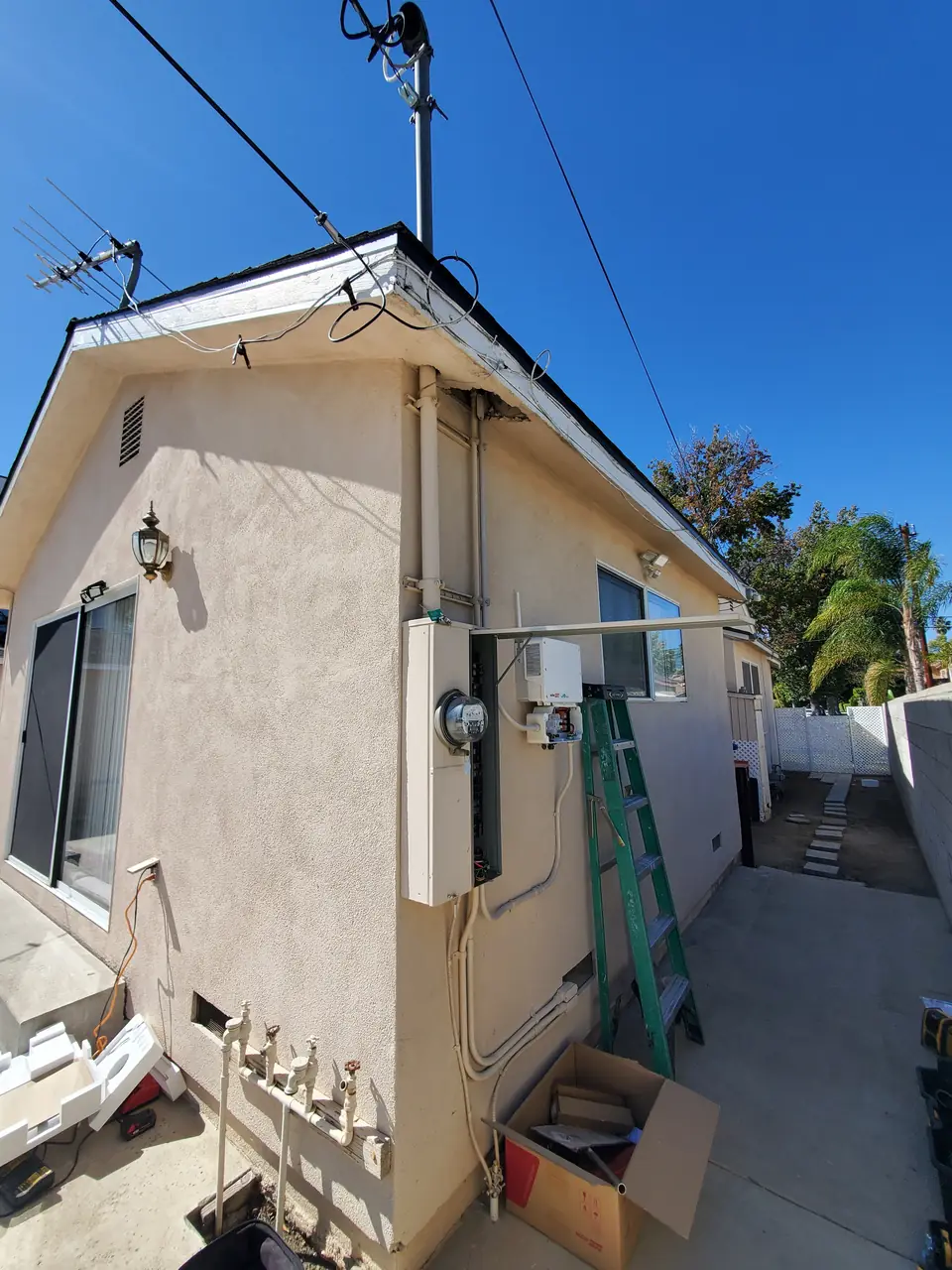
7.7 kW with a new service panel
An Encino Hills system that included a new main service panel and meter work — the electrical scope that decides what an older service can actually carry.
Photos are ours, taken on site. Sizes are stated on the basis they were recorded on — DC nameplate or CEC-AC — because the two are not interchangeable.
A closer look at the Encino jobs
What this work has in common, and where it differs.
| Detail | Value | Notes |
|---|---|---|
| Homes shown here | A selection | Some of our Encino jobs, with our photos from each — our work in the area goes well beyond them |
| ZIP codes | 91316 & 91436 | The valley floor north of Ventura Boulevard, and the hills south of it |
| System sizes | 4.8–12.3 kW | Stated on the basis each was recorded on; the largest is 12.3 kW DC, which is 12.05 kW CEC-AC |
| Annual usage matched | Up to ~18,600 kWh | Roughly three times a typical California household — the number that drove the largest design here |
| Utility | LADWP | Retail-rate net metering on every one, not the CPUC net billing that applies in Edison territory |
| Roof types | Shingle, then tile | Composition shingle predominates; tile appears on the larger properties |
| Equipment we have used | Q CELLS, Enphase | Q.PEAK DUO modules with Enphase IQ7 and IQ8A microinverters throughout |
| Beyond the array | Service panel work | A new main service panel with meter work on one hillside job |
| Design details | Reverse tilt | North-facing modules pitched back toward the sun rather than written off |
91436 and 91316 are not the same job
Ventura Boulevard is the dividing line, and it changes more than the address.
North of the boulevard, 91316 is largely valley-floor housing on regular lots — straightforward access, conventional roof shapes, and the usual mix of composition shingle and tile. South of it, 91436 climbs into the Encino Hills: larger parcels, steeper driveways, longer runs from the service equipment to the array, and roofs broken into more planes by the architecture. Hillside parcels also carry fire-hazard designations, which affect access, equipment siting and materials.
None of that stops a system; it changes how one is planned. Long conductor runs need sizing for voltage drop rather than guesswork. Split roof planes are where module-level electronics pay for themselves, because each module produces and reports on its own. And a driveway that a materials truck cannot reach is a scheduling fact, not a surprise for install day. Every Encino system on this page runs microinverters for exactly the first of those reasons.
Access is planned, not discovered
Steep or narrow driveways in the hills change how materials arrive and how long the job takes. We look before we schedule.
Long runs, real losses
Distance between the array, the inverter and the service equipment is an engineering input. Conductors are sized for it.
Many planes, module-level electronics
Complex rooflines are the normal case here. Microinverters keep one shaded or awkward plane from dragging the rest down.
Fire-hazard parcels
Hillside designations affect siting and materials. We check the parcel against the current maps before final design.
Source: CAL FIRE — fire hazard severity zones · City of Los Angeles ZIMAS for zoning and overlays on a specific parcel.
LADWP still credits exports at the retail rate
The rule that makes an Encino system a different proposition from one ten miles south.
NEM 3.0 does not apply
LADWP is municipal, so the CPUC’s Net Billing Tariff does not govern it. Exports here are credited against the retail rate rather than an hourly avoided-cost value.
Which raises the ceiling
On a high-consumption house, retail-rate crediting means a larger array keeps its value rather than running into a cliff. That is a real advantage in this neighborhood.
Systems are rated in CEC-AC
LADWP sizes interconnection in CEC-AC watts, not DC nameplate — the 12.3 kW DC system here is 12.05 kW CEC-AC, and it is the second figure the utility reads.
Above 10 kW takes longer
Systems over 10 kW CEC-AC, or any with a battery or panel upgrade, follow LADWP’s longer approval path with an engineering site visit — explained in full on our Granada Hills page.
Sources: LADWP — net energy metering rates · CPUC — Net Energy Metering (the Net Billing Tariff applies to investor-owned utilities) · LADWP — solar programs. Program terms change; confirm current rules for your own account.
What solar costs and how long it takes in Encino
No honest flat price for a neighborhood — but published ranges, and a system size that follows your bill.
The Encino systems we have installed run from 4.8 to 12.3 kW, and the spread is the point: size follows consumption. Two published price bases frame the budget, both before incentives: $2.49 per watt at competitive marketplace rates (EnergySage, August 2026) and $3.5 per watt, the 2024 national median for cash purchases (Lawrence Berkeley National Laboratory). A 6–12 kW system therefore lands somewhere between roughly $15,000 and $42,000 depending on installer, financing and scope — and a high-consumption Encino home usually sits at the upper end simply because it needs more array.
| Item | Figure | Basis |
|---|---|---|
| System sizes we have installed here | 4.8 – 12.3 kW | Our installations |
| Solar at marketplace rates | $2.49/W → 8 kW ≈ $20,000 · 10 kW ≈ $24,900 · 12 kW ≈ $29,900 | Market estimate — EnergySage |
| Solar at typical installer rates | $3.5/W (2024 national cash median) → 8 kW ≈ $28,000 · 12 kW ≈ $42,000 | Market estimate — LBNL 2025 Data Update |
| Battery storage (~13 kWh) | $11,864–$16,052 before incentives (average $13,958) | Market estimate — EnergySage California |
| Main service panel work | Priced per job: service size, busbar rating, meter position and utility coordination | Scope-dependent |
| Federal tax credit | Homeowner (25D) credit ended Dec 31, 2025 — $0 on a 2026 cash or loan purchase; leased and PPA systems can still capture the 30% credit through the system owner | Official source — IRS FAQs on P.L. 119-21 |
| Time on the roof | Most residential installs: 1–3 working days; tile, hillside access and panel work run longer | Cali Energy company figure |
| LADBS permit | Express e-permit for qualifying systems: issued online, often same day | Official process — LADBS |
| LADWP path | Under 10 kW CEC-AC with no battery or panel upgrade: approval 2–5 days, meter set 1–2 weeks. Larger systems add an engineering site visit of 1–3 weeks | Official — LADWP Guide to Electric Service, p. 22 |
Sources: EnergySage — solar cost · EnergySage — storage cost · LBNL — 2025 Data Update · IRS — Section 25D FAQs. Planning context, not a quote.
What Cali Energy installs in Encino
One licence covering the whole job, so the scopes do not get handed between companies.
Rooftop solar
Layouts for shingle and tile on complex rooflines, with reverse tilt where a plane faces the wrong way, sized against the bill rather than the roof.
Battery storage
Backup power for hillside outages, sized to the circuits worth keeping alive — and planned knowing it moves the project onto LADWP’s longer path.
Roofing with solar
Roof condition assessed by our own roofing side under a C-39, and replaced first when it needs to be.
Electrical and EV charging
New main service panels and meter work, subpanels for guest houses and outbuildings, and EV charger circuits.
Our services in Encino
A page for each service: our Encino projects, the permit and the utility.
Exact coverage: Encino and its edges
A Los Angeles neighborhood split by a boulevard and bounded by hills.
| Attribute | Fact |
|---|---|
| Status | Neighborhood of the City of Los Angeles, in the southern San Fernando Valley |
| ZIP codes | 91316 on the valley floor and 91436 in the hills south of Ventura Boulevard |
| Electricity | LADWP for every address — retail-rate net metering, no CPUC net billing |
| Permitting authority | Los Angeles Department of Building and Safety (LADBS) |
| Terrain | The 91436 side climbs into the Santa Monica Mountains, where fire-hazard designations, access and slope affect the work |
| Adjacent — same utility | Tarzana, Sherman Oaks, Van Nuys and Lake Balboa are all City of LA addresses on LADWP |
| Adjacent — different rules | Over the hills to the south are Beverly Hills and unincorporated county areas with their own arrangements |
| What we check first | Twelve months of usage, the roof planes and shade, access to the property, and the service equipment |
Map of Cali Energy projects in Encino
Encino homes we have worked on — a selection of them, shown on this page.
Marker positions are deliberately offset. Each point is shifted 120–260 meters from the real address so the map shows where we work in Encino without identifying anyone’s home. Base map © OpenStreetMap contributors © CARTO; ZIP boundaries from the U.S. Census ZCTA file.
Reviews and verifiable trust
A public rating, a public license record and named, quotable reviews.
“Got the Model 3 last year and figured solar had to happen so I wasn’t just paying LADWP to charge it. These guys handled the whole thing.”
“I spoke with several companies before choosing this one, and they were by far the most fair and honest. They didn’t try to oversell me on a bigger system than I needed.”
“The recommendation they gave us on the type of solar panels to purchase was perfect — the panels have been extremely efficient, and because of that we have not had an electricity bill in the last three years.”
Read the full reviews on Cali Energy’s Google profile · verify the contractor license with the California CSLB.
Fast answers about hiring Cali Energy in Encino
Each answer starts with the conclusion.
Does Cali Energy install solar in Encino?
Yes. Encino is an active Cali Energy service area and we work here regularly, in both 91316 and 91436. The homes on this page are some of that work, from a 4.8 kW system up to a thirty-module 12.3 kW array sized against roughly 18,600 kWh a year. Our office is in Northridge, a short drive away.
Who is my electricity provider in Encino?
The Los Angeles Department of Water and Power. Encino is inside the City of Los Angeles, so every address here is served by LADWP rather than Southern California Edison — which changes how solar is credited.
Does NEM 3.0 apply in Encino?
No. NEM 3.0 — properly the Net Billing Tariff — is a CPUC rule for investor-owned utilities such as Edison and PG&E. LADWP is municipal and is not governed by it, so exported energy in Encino is still credited against the retail rate. On a high-consumption home that materially improves the case for a larger array.
What size system does an Encino home need?
It depends on the bill, not the roof. The systems we have installed here run from 4.8 to 12.3 kW, and the largest was designed around roughly 18,600 kWh a year — about three times a typical California household. Pools, air conditioning, guest houses and EV charging are what push Encino usage up, so sizing starts from twelve months of LADWP billing history.
Will solar cover my pool pump?
It is one of the better matches there is. A pool pump is a large, steady load that runs during daylight — the same hours the array produces — so that consumption is offset directly rather than exported. We include pool and spa equipment in the load profile when sizing rather than treating it as an afterthought.
My roof faces the wrong way. Is solar still worth it?
Often yes. On an Encino job here the north-facing modules were set on reverse tilt, pitching them back toward the sun instead of writing the plane off. Combined with microinverters — where each module produces independently — mixed orientations cost far less than they used to.
Does a hillside address in 91436 change the project?
It changes the planning rather than the feasibility. Hillside parcels bring steeper access for materials, longer conductor runs that must be sized for voltage drop, roofs broken into more planes, and fire-hazard designations that affect siting and materials. We check the parcel and the access before scheduling, not on install day.
Will I need a new main service panel?
Sometimes, and it should be quoted from the start. One Encino job on this page included a new main service panel with meter work. Solar feeds the same busbar as the utility supply, and the code caps the combined supply a panel may take — so the service equipment is assessed before the array is designed, and any upgrade goes in the original proposal.
Do I need a battery in Encino?
Not for the same reason as an Edison customer. Because LADWP still credits exports at the retail rate, a battery here is bought mainly for backup power — which matters on the hillside side of the neighborhood — rather than to rescue export value. Note that adding storage moves the project onto LADWP’s longer approval path.
How long does an Encino solar project take?
The roof work itself is usually 1–3 working days, longer on tile or with difficult hillside access. LADBS issues qualifying residential permits online, often the same day. The variable is LADWP: under 10 kW CEC-AC with no battery or panel upgrade, approval runs about 2–5 days with the meter set 1–2 weeks later; larger systems add an engineering site visit of 1–3 weeks.
What does solar cost in Encino?
There is no honest flat neighborhood price, but published rates frame it: $2.49 per watt at marketplace rates and $3.5 per watt as the 2024 national cash median, putting an 8–12 kW system — the usual range here — at roughly $20,000–$42,000 before incentives. Encino homes often sit at the upper end simply because they need more array. The federal 25D homeowner credit ended December 31, 2025, so a 2026 cash or loan purchase gets no federal credit. The estimate for your own home is free.
How do I check that Cali Energy is legitimate?
Compare four things rather than ad claims: (1) an active CSLB license with electrical and roofing classifications, (2) completed work in your specific area, with photos, (3) whether the company uses its own crews or subcontracts, and (4) the review pattern. Our answers: CSLB #1032379 (B, C-10, C-39); Encino homes with our photos; in-house crews; a 4.9★ Google rating. Our office is at 19201 Parthenia St Unit E, Northridge, CA 91324. We do not claim an Encino storefront; what this page shows is completed work in the neighborhood and active service coverage.
Sources
Where this page states a rule, a threshold or a timeline, the official source is linked below.
| What it supports | Source |
|---|---|
| LADWP net energy metering and rate treatment | LADWP — EV / NEM / REO rates |
| Interconnection paths and their stage timings | LADWP — solar programs (Guide to Electric Service, p. 22) |
| The Net Billing Tariff (NEM 3.0) applies to investor-owned utilities, not municipals | CPUC — Net Energy Metering |
| City solar permitting for Los Angeles addresses | LADBS — solar permits |
| Fire hazard designation and zoning for a specific parcel | CAL FIRE — fire hazard severity zones · ZIMAS |
| Installed price ranges for solar and storage | EnergySage · LBNL 2025 Data Update |
| Federal tax credit status for 2026 | IRS — Section 25D FAQs |
| Contractor licence and classifications | CSLB — license #1032379 |
Nearby service areas
Other cities where Cali Energy works.
Related reading
Planning solar for an Encino home
Send the service address and twelve months of LADWP billing history — that is what actually sets the system size here. We will confirm the roof planes, the access, the shade and the electrical scope before preparing an address-specific proposal.
Request a free estimatePublished August 2026. Details refer to those specific homes, not to every Encino property. Rates, incentives, code editions and permit requirements change; utility, jurisdiction, equipment, pricing and schedule must be confirmed for the specific address. See our Content Disclaimer. Cali Energy · 19201 Parthenia St Unit E, Northridge, CA 91324 · CSLB #1032379 (B, C-10, C-39)