

Solar company in Porter Ranch — your HOA cannot say no, and here is exactly what it can say
Yes — Cali Energy installs solar panels, battery storage, roofing and electrical upgrades in Porter Ranch, Los Angeles. We work here constantly — several of the systems on this page were switched on in 2025 alone. Some of those homes are shown below, with our photos from each. Porter Ranch is master-planned HOA country, and that raises the question we hear on nearly every estimate: will the association allow it? California law answers plainly: an HOA cannot prohibit solar, its conditions may not add more than $1,000 or cut output more than 10%, and silence for 45 days counts as approval. Every address here is on LADWP, which still credits exports at the retail rate. Cali Energy is a licensed California contractor (CSLB #1032379) with a 4.9★ Google rating and in-house crews, based minutes away in Northridge.
Get a Porter Ranch estimate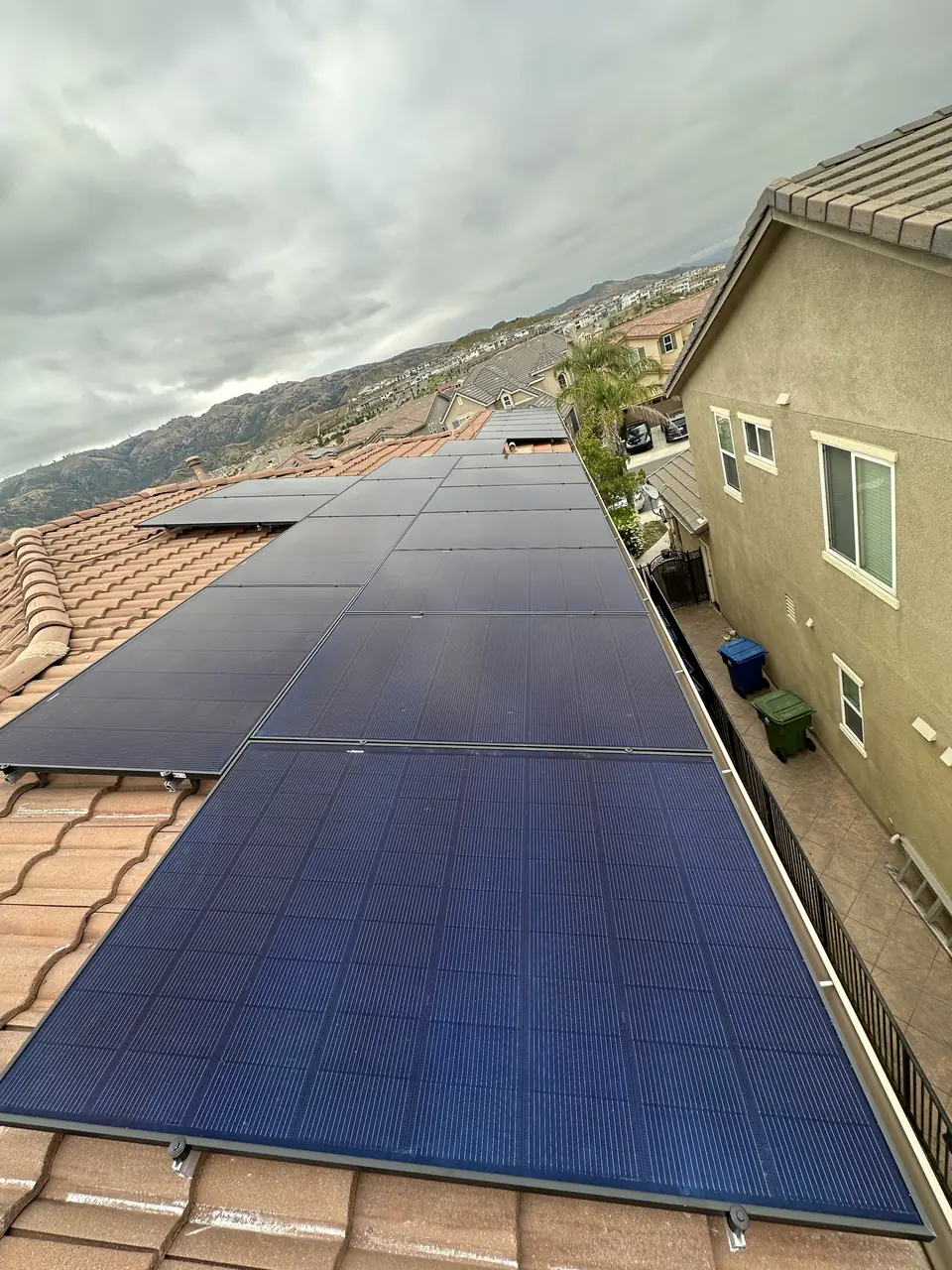
Porter Ranch 91326 · twenty-four REC Alpha Pure-R 410 W modules on a SolarEdge inverter — 9.84 kW DC on a tile roof, 2023.
Cali Energy in Porter Ranch, at a glance
The short answers before considering a contractor.
| Question | Answer |
|---|---|
| What has Cali Energy installed here? | Rooftop solar from 2.32 kW to 9.9 kW CEC-AC — several switched on in 2025 — on tile and shingle, with premium REC Alpha Pure-R modules, SolarEdge inverters and Enphase microinverters among the equipment. |
| Google rating | 4.9★ on Google. See them on Google |
| Who supplies the electricity? | The Los Angeles Department of Water and Power — a municipal utility outside CPUC jurisdiction, still crediting exports at the retail rate. |
| Who permits the work? | The Los Angeles Department of Building and Safety (LADBS), plus a separate LADWP interconnection process. An HOA review runs in parallel and cannot veto the project. |
| Will my HOA allow solar? | It has to. Under California Civil Code §714, a ban is void; conditions are capped at $1,000 in added cost or 10% lost output; and no written denial within 45 days means approved. |
| Is this the same as the Northridge page? | No — ZIP 91326 is shared, but this page covers the Porter Ranch side: HOA communities, newer construction and the hillside edge. Our Northridge page covers the rest of the ZIP and our home base. |
| License | CSLB #1032379 (B, C-10, C-39), in-house crews, operating since 2017. Verify with the CSLB |
What your HOA can and cannot do about solar
The Porter Ranch question, answered from the statute rather than from the association’s newsletter.
Porter Ranch was built as a master-planned community, and most of its neighborhoods sit under homeowners associations with architectural review. That worries people, and it should not. California’s Solar Rights Act — Civil Code §714 — makes any CC&R provision that effectively prohibits a solar energy system void and unenforceable. The association reviews; it does not veto.
What it may impose are reasonable restrictions, and the statute defines reasonable in numbers: conditions that add no more than $1,000 to the system’s cost and reduce its efficiency by no more than 10% against the proposed design. Ask for all-black modules on the street-facing plane? Usually fine — that is within the envelope. Demand the array move to a north-facing roof where it loses a third of its output? That is not a reasonable restriction, and it does not survive the statute.
The timeline has teeth too. If the association does not deny the application in writing within 45 days, it is deemed approved — unless it timely requested more information. And a homeowner who has to enforce these rights can recover actual damages, a civil penalty of up to $1,000, and attorney’s fees. In practice we prepare the HOA package alongside the permit set — datasheets, layout, renderings if the association wants them — and the two reviews run in parallel rather than one after the other.
A ban is void
CC&R language prohibiting solar is unenforceable under §714. The review is about appearance details, not permission.
The envelope is numeric
Up to $1,000 in added cost, up to 10% in lost output. Conditions beyond that are not “reasonable restrictions” in law.
45 days, then approved
No written denial within 45 days means the application is deemed approved — the clock works for you.
We run reviews in parallel
The HOA package goes in with the permit set, so the association’s clock and the city’s queue overlap instead of stacking.
Source: California Civil Code §714 (prohibitions void; reasonable restrictions capped at $1,000 added cost or 10% reduced efficiency for photovoltaic systems; deemed approval after 45 days without written denial; civil penalty and attorney’s fees available) · California’s Solar Rights Act — review of statutes and cases. Statutes change; confirm current law for your own association.
Solar work in Porter Ranch
A few of the homes we have done here. Street numbers stay off the page out of respect for the owners. The full photo set for every Porter Ranch job lives in the Porter Ranch project gallery.
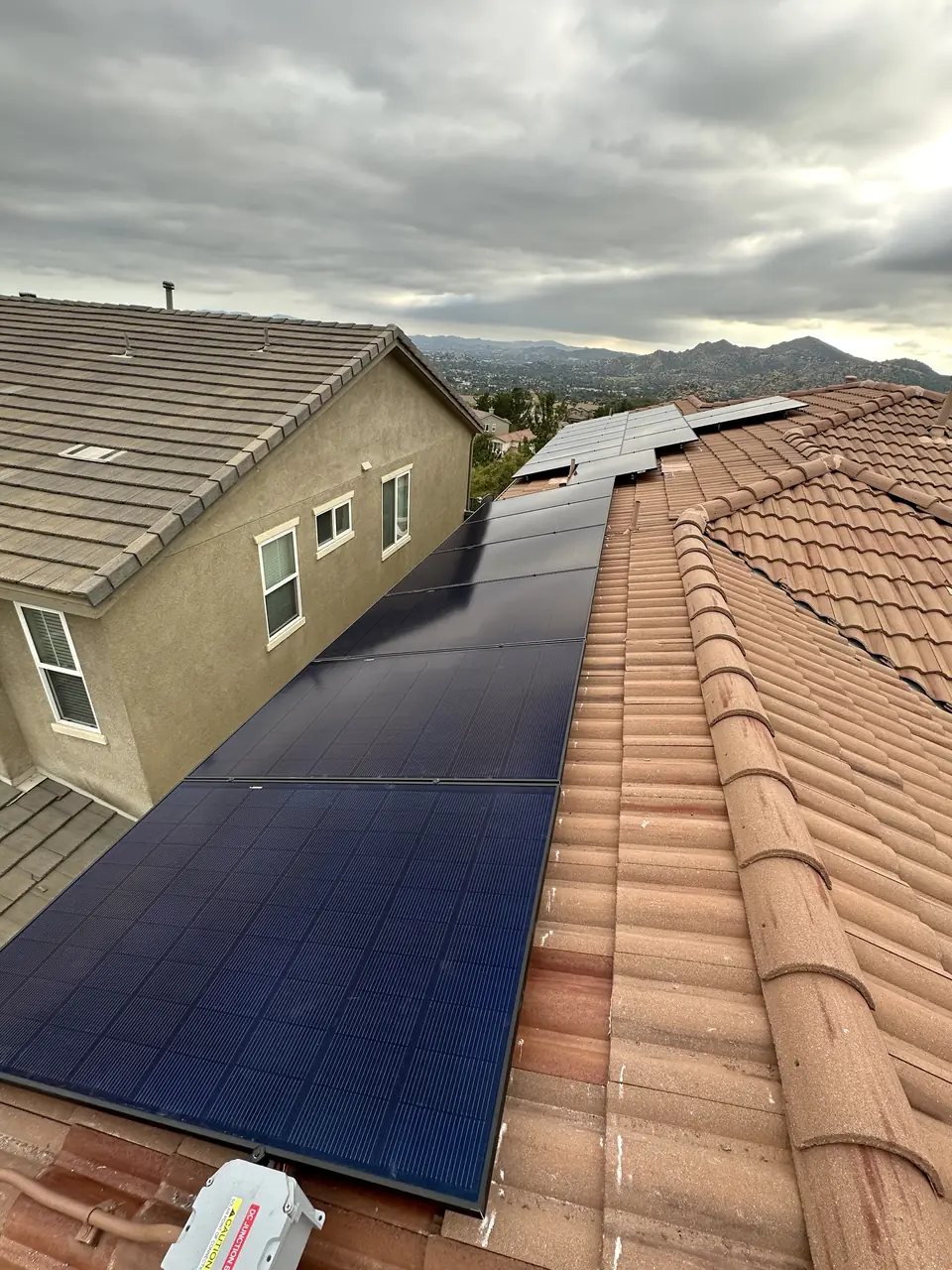
9.84 kW on REC Alpha
Twenty-four premium REC Alpha Pure-R 410 W modules on a SolarEdge inverter across a tile roof — high output per square meter, all-black, HOA-friendly.
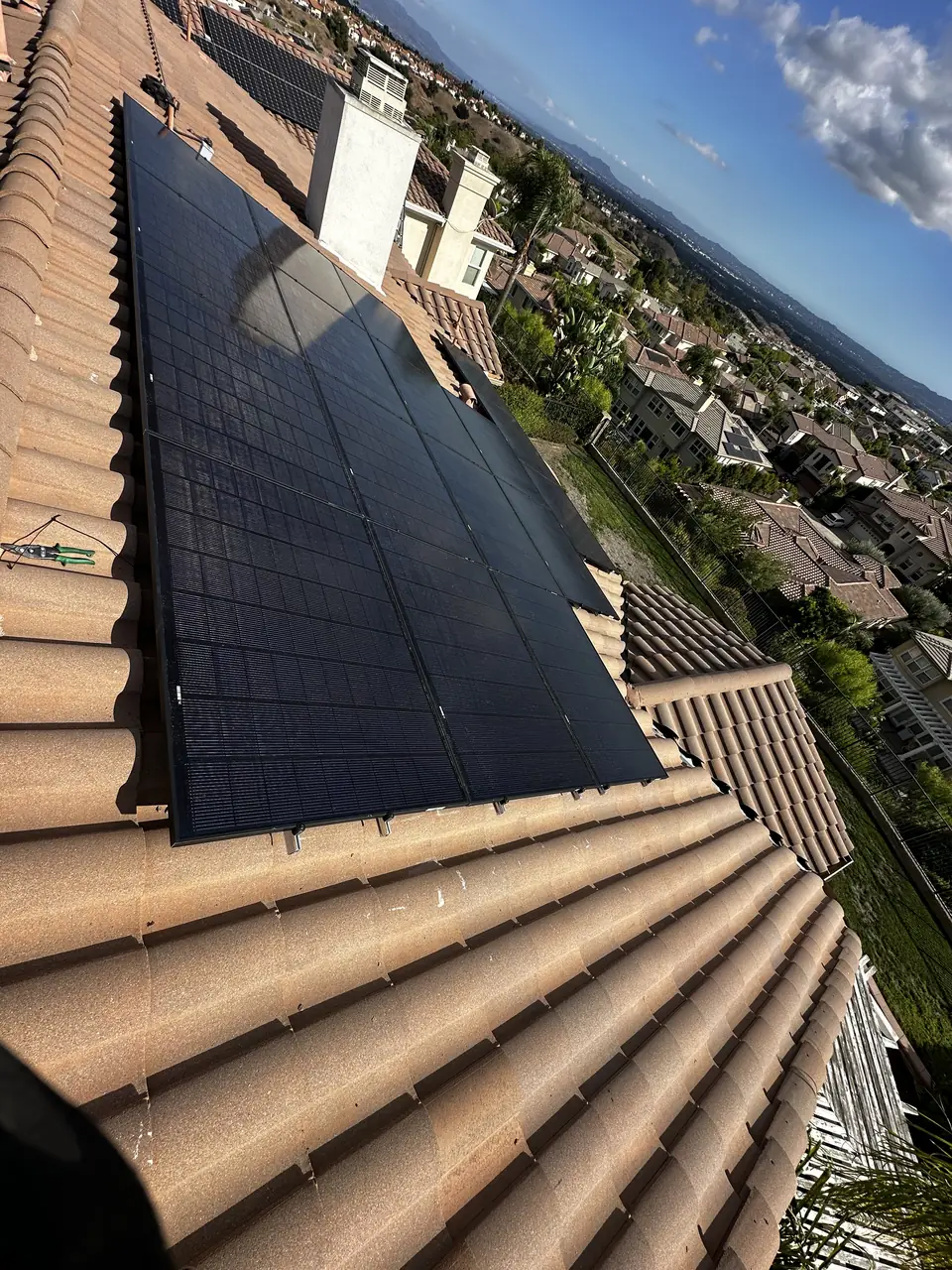
6.9 kW, switched on in 2025
Seventeen REC Alpha Pure-R 410 W modules on SolarEdge — one of several Porter Ranch systems we brought through to permission to operate in 2025.
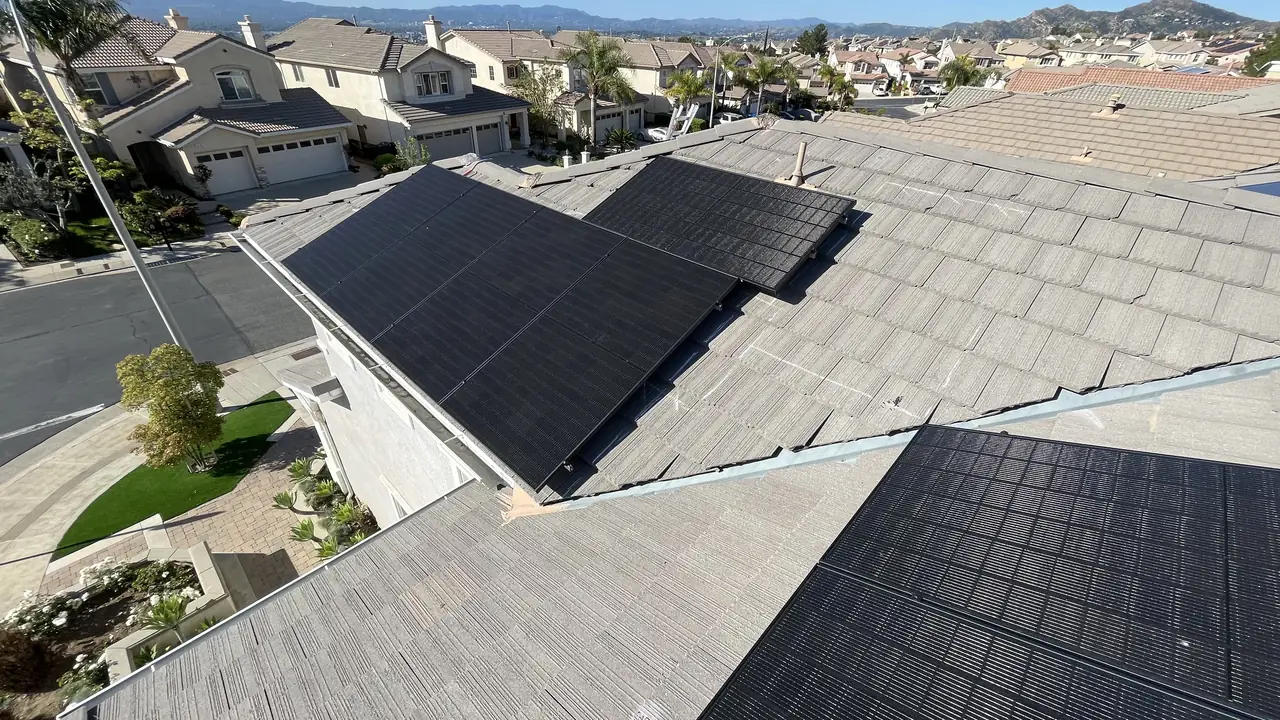
Twenty-two modules on Enphase
A 6.3 kW CEC-AC system on Enphase microinverters, where each module produces and reports on its own across the roof planes.
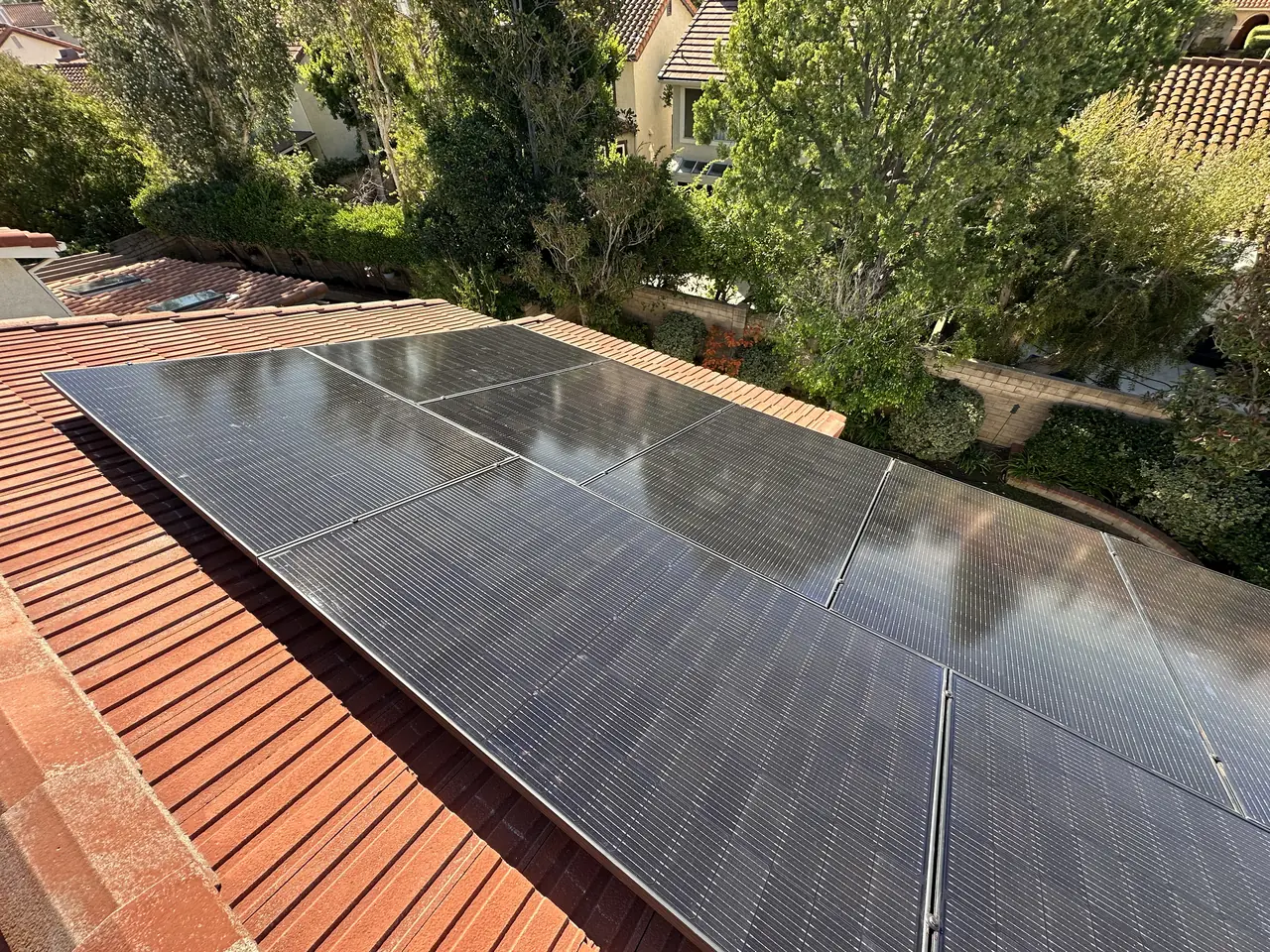
3.04 kW on nine Aptos 460s
A compact 2025 system using high-output Aptos 460 W modules — nine panels doing the work of twelve ordinary ones on a limited clear area.
Photos are ours, taken on site. Sizes are stated on the basis they were recorded on — DC nameplate or CEC-AC — because the two are not interchangeable.
A closer look at the Porter Ranch jobs
What this work has in common, and where it differs.
| Detail | Value | Notes |
|---|---|---|
| Homes shown here | A selection | Some of our Porter Ranch jobs, with our photos from each — our work in the area goes well beyond them |
| ZIP code | 91326 | Shared with Northridge; USPS lists Porter Ranch as the preferred name for it |
| System sizes | 2.32–9.9 kW CEC-AC | Including a cluster designed at 9.9, 9.84 and 9.43 — deliberately under the utility’s 10 kW line |
| Utility | LADWP | Retail-rate net metering on every one, with permission-to-operate dates from 2019 through 2025 |
| Roof types | Tile, prominently | The 1990s–2020s construction here favors concrete and S-tile; shingle appears on the rest |
| Equipment we have used | REC Alpha, Aptos, SolarEdge, Enphase | Premium REC Alpha Pure-R 410 W and Aptos 460 W modules, with SolarEdge inverters and Enphase microinverters |
| Recent activity | Strong | Several of the systems on this page were switched on in 2025 |
| HOA communities | Routine for us | Application packages prepared alongside the permit set, reviews run in parallel |
Why three of these designs stop just under 10 kW
Look at the sizes: 9.9, 9.84, 9.43. That is not coincidence — it is the LADWP threshold at work.
LADWP runs two approval paths, and the line between them is 10 kW CEC-AC. Under it — with no battery and no main-panel upgrade — a system takes the fast track: approval in roughly 2–5 days, meter set 1–2 weeks later. At or over it, the standard path adds an engineering site visit of 1–3 weeks before approval even starts.
Porter Ranch houses are large and their bills are serious, so designs naturally push toward the line. When the load calculation lands near 10 kW, there is a genuine decision to make: hold at 9.8–9.9 kW and connect weeks sooner, or cross the line for capacity the household will actually use and accept the longer path. Both are legitimate — what matters is that the choice is made knowingly, on the CEC-AC figure the utility reads, not discovered after the application goes in. Premium modules help here too: REC Alpha and Aptos 460s pack more watts into fewer panels, which is often what makes staying under the line possible without shrinking the coverage.
The line is CEC-AC
LADWP reads CEC-AC, not DC nameplate. The 9.84 kW DC system here sits differently on the two scales — we design to the one that counts.
Hold or cross — knowingly
Weeks of schedule against extra capacity is a real trade. We put it on the table instead of deciding it silently.
Premium modules buy headroom
Higher-wattage panels reach the same output with fewer of them — useful both for the threshold and for tight roofs.
Batteries change the path
Storage moves any project to the standard path regardless of size. Decided at design, not discovered later.
The hillside edge: fire zones and what they change
Porter Ranch backs onto the Santa Susana foothills, and the upper streets carry designations the flats do not.
The community’s northern neighborhoods climb toward open country, and parcels there sit in very high fire hazard severity zones. For solar that changes details rather than feasibility: equipment siting and clearances follow the fire-zone rules, vegetation management around ground equipment matters, and access for crews and materials on steep streets is planned rather than assumed. It is also the strongest local argument for battery backup — hillside areas are where public-safety outages and wind events land first, and because LADWP credits exports at retail, a Porter Ranch battery is bought for resilience rather than tariff arithmetic.
One more local fact worth stating plainly: this is the neighborhood of the Aliso Canyon gas storage facility, and energy independence is not an abstraction here. A rooftop system with storage is the most direct step a household can take toward it.
Fire-zone details
Clearances, siting and materials follow the designation. We check the parcel against current maps before design.
Backup earns its place
Hillside streets see outages first. Storage here is about resilience, and it is sized to the circuits that matter.
Access is planned
Steep streets and gated communities change logistics. That is a scheduling fact, not an install-day surprise.
Independence, concretely
Solar plus storage is the practical answer to a neighborhood that knows why energy resilience matters.
Sources: CAL FIRE — fire hazard severity zones · City of Los Angeles ZIMAS for the designation on a specific parcel.
What solar costs and how long it takes in Porter Ranch
No honest flat price for a neighborhood — but published ranges and a threshold that shapes the schedule.
The systems we have installed here run from 2.32 to 9.9 kW CEC-AC. Two published price bases frame the budget, both before incentives: $2.49 per watt at competitive marketplace rates (EnergySage, August 2026) and $3.5 per watt, the 2024 national median for cash purchases (Lawrence Berkeley National Laboratory). A 6–10 kW system — the usual Porter Ranch range — lands somewhere between roughly $15,000 and $35,000 depending on installer, financing and scope; premium modules sit toward the upper end of any range.
| Item | Figure | Basis |
|---|---|---|
| System sizes we have installed here | 2.32 – 9.9 kW CEC-AC | Our installations |
| Solar at marketplace rates | $2.49/W → 6 kW ≈ $14,900 · 8 kW ≈ $20,000 · 10 kW ≈ $24,900 | Market estimate — EnergySage |
| Solar at typical installer rates | $3.5/W (2024 national cash median) → 6 kW ≈ $21,000 · 10 kW ≈ $35,000 | Market estimate — LBNL 2025 Data Update |
| Battery storage (~13 kWh) | $11,864–$16,052 before incentives (average $13,958) | Market estimate — EnergySage California |
| HOA conditions | Capped by law at $1,000 in added cost or 10% in lost output; no written denial in 45 days means approved | Official — Civil Code §714 |
| Federal tax credit | Homeowner (25D) credit ended Dec 31, 2025 — $0 on a 2026 cash or loan purchase; leased and PPA systems can still capture the 30% credit through the system owner | Official source — IRS FAQs on P.L. 119-21 |
| Time on the roof | Most residential installs: 1–3 working days; tile runs longer | Cali Energy company figure |
| LADBS permit | Express e-permit for qualifying systems: issued online, often same day | Official process — LADBS |
| LADWP path | Under 10 kW CEC-AC without battery or panel upgrade: approval 2–5 days, meter set 1–2 weeks. Otherwise add an engineering site visit of 1–3 weeks | Official — LADWP Guide to Electric Service, p. 22 |
Sources: EnergySage — solar cost · EnergySage — storage cost · LBNL — 2025 Data Update · IRS — Section 25D FAQs. Planning context, not a quote.
What Cali Energy installs in Porter Ranch
One licence covering the whole job, so the scopes do not get handed between companies.
Rooftop solar
Tile-first layouts with premium high-output modules — all-black where the street-facing plane calls for it.
Battery storage
Resilience for the hillside edge, sized to the circuits worth keeping alive — and planned knowing it moves the project to the longer path.
HOA paperwork
The association package prepared with the permit set, so both reviews run at once and the 45-day clock works for you.
Roofing and electrical
Roof condition assessed under our own C-39, panel upgrades and EV circuits under our C-10.
Our services in Porter Ranch
A page for each service: our Porter Ranch projects, the permit and the utility.
Exact coverage: Porter Ranch and the shared ZIP
One index, two names — and a page for each side of it.
| Attribute | Fact |
|---|---|
| Status | Master-planned neighborhood of the City of Los Angeles, at the north-west edge of the San Fernando Valley |
| ZIP code | 91326 — USPS lists Porter Ranch as the preferred name, with Northridge acceptable; the index covers parts of both |
| Electricity | LADWP for every address — retail-rate net metering, no CPUC net billing |
| Permitting authority | Los Angeles Department of Building and Safety (LADBS); HOA architectural review runs in parallel and cannot veto |
| Housing | Master-planned communities from the 1990s through the 2020s, largely tile-roofed, many gated, most under associations |
| Terrain | The upper streets climb into the Santa Susana foothills, where very high fire hazard severity zones apply |
| Adjacent — same utility | Northridge, Granada Hills and Chatsworth are all City of LA addresses on LADWP |
| What we check first | The HOA’s review requirements, the fire-zone status, and the CEC-AC maths against the 10 kW line |
Map of Cali Energy projects in Porter Ranch
Porter Ranch homes we have worked on — a selection of them, shown on this page.
Marker positions are deliberately offset. Each point is shifted 120–260 meters from the real address so the map shows where we work in Porter Ranch without identifying anyone’s home. Base map © OpenStreetMap contributors © CARTO; ZIP boundaries from the U.S. Census ZCTA file.
Reviews and verifiable trust
A public rating, a public license record and named, quotable reviews.
“I shopped around extensively before choosing Cali Energy — they weren’t the cheapest, but every question got a straight answer.”
“Great company, they handled everything professionally. I’ve wanted solar panels for a long time, and after I got the quote it was an easy decision.”
“I like that they are a local solar installation company based here in Northridge, not a sales office somewhere else.”
Read the full reviews on Cali Energy’s Google profile · verify the contractor license with the California CSLB.
Fast answers about hiring Cali Energy in Porter Ranch
Each answer starts with the conclusion.
Does Cali Energy install solar in Porter Ranch?
Yes, constantly — several of the systems on this page were switched on in 2025 alone. We work across 91326 on tile and shingle roofs, with systems from 2.32 to 9.9 kW CEC-AC. Our office is in Northridge, minutes away.
Can my HOA block solar panels?
No. Under California Civil Code §714, any CC&R provision that effectively prohibits a solar energy system is void and unenforceable. The association may impose reasonable restrictions — defined in the statute as conditions adding no more than $1,000 to the cost or cutting output by no more than 10% — but it cannot say no.
What if the HOA just sits on my application?
The law anticipated that. If the association does not deny the application in writing within 45 days, it is deemed approved — unless it timely requested more information. We prepare the HOA package together with the permit set so the association’s clock runs in parallel with the city’s, not after it.
What can the HOA legitimately ask for?
Appearance details within the statutory envelope: all-black modules on street-facing planes, tidy conduit routing, equipment placement preferences. What it cannot do is force the array onto a worse roof orientation at a real output cost, demand changes that add more than $1,000, or slow-walk the approval past 45 days. Homeowners who have to enforce these rights can recover damages, a civil penalty and attorney’s fees.
Who is my electricity provider in Porter Ranch?
The Los Angeles Department of Water and Power. Porter Ranch is inside the City of Los Angeles, so every address is served by LADWP rather than Southern California Edison — which changes how solar is credited.
Does NEM 3.0 apply in Porter Ranch?
No. NEM 3.0 — properly the Net Billing Tariff — is a CPUC rule for investor-owned utilities such as Edison and PG&E. LADWP is municipal and is not governed by it, so exported energy here is still credited against the retail rate.
Why do several of your Porter Ranch systems land just under 10 kW?
Because that is where LADWP’s fast track ends. Three designs here came out at 9.9, 9.84 and 9.43 — large enough for serious Porter Ranch bills, small enough to connect in weeks rather than adding an engineering site visit. When the load maths pushes past 10 kW CEC-AC, we put the trade-off on the table: hold under the line and connect sooner, or cross it for capacity you will actually use.
My street is in a fire zone. Does that change the project?
It changes details, not feasibility. Hillside parcels in Porter Ranch sit in very high fire hazard severity zones, which affects equipment siting, clearances and materials — and it is the strongest local argument for battery backup, since those streets see outages first. We check the parcel’s designation before design.
Is my address Porter Ranch or Northridge?
ZIP 91326 covers parts of both, and USPS lists Porter Ranch as the preferred name with Northridge acceptable. For the work it makes no difference — same LADWP service, same LADBS permits. This page covers the Porter Ranch side of the index; our Northridge page covers the rest.
Do I need a battery in Porter Ranch?
Not for tariff reasons — LADWP still credits exports at retail. The case here is resilience: the hillside edge sees wind events and precautionary outages first, and this neighborhood knows better than most why energy independence matters. Note that storage moves the project onto LADWP’s longer approval path.
How long does a Porter Ranch solar project take?
The roof work itself is usually 1–3 working days, longer on tile. LADBS issues qualifying residential permits online, often the same day, and the HOA review runs in parallel with a 45-day ceiling. On the utility side, systems under 10 kW CEC-AC take LADWP’s fast track — approval in 2–5 days, meter set 1–2 weeks later.
How do I check that Cali Energy is legitimate?
Compare four things rather than ad claims: (1) an active CSLB license with electrical and roofing classifications, (2) completed work in your specific area, with photos, (3) whether the company uses its own crews or subcontracts, and (4) the review pattern. Our answers: CSLB #1032379 (B, C-10, C-39); Porter Ranch homes with our photos, several from 2025; in-house crews; a 4.9★ Google rating. Our office is at 19201 Parthenia St Unit E, Northridge, CA 91324, minutes away.
Sources
Where this page states a rule, a threshold or a statute, the official source is linked below.
| What it supports | Source |
|---|---|
| HOA prohibitions void; $1,000 / 10% caps on reasonable restrictions; 45-day deemed approval; penalties and fees | California Civil Code §714 |
| Background on the Solar Rights Act and its case law | California’s Solar Rights Act — statutes and cases |
| LADWP net energy metering and rate treatment | LADWP — EV / NEM / REO rates |
| Fast-track and standard interconnection paths and their stage timings | LADWP — solar programs (Guide to Electric Service, p. 22) |
| The Net Billing Tariff (NEM 3.0) applies to investor-owned utilities, not municipals | CPUC — Net Energy Metering |
| City solar permitting for Los Angeles addresses | LADBS — solar permits |
| Fire hazard designation for a specific parcel | CAL FIRE — fire hazard severity zones · ZIMAS |
| Installed price ranges for solar and storage | EnergySage · LBNL 2025 Data Update |
| Federal tax credit status for 2026 | IRS — Section 25D FAQs |
| Contractor licence and classifications | CSLB — license #1032379 |
Nearby service areas
Other parts of the Valley where Cali Energy works.
Related reading
Planning solar for a Porter Ranch home
Send the service address and a recent LADWP bill — and the name of your association if there is one. We will prepare the HOA package alongside the permit set, check the fire-zone status, and put the under-or-over-10 kW decision on the table before you commit to anything.
Request a free estimatePublished August 2026. Details refer to those specific homes, not to every Porter Ranch property. Statutes, rates, incentives, code editions and permit requirements change; utility, jurisdiction, HOA requirements, equipment, pricing and schedule must be confirmed for the specific address, and legal questions belong with an attorney. See our Content Disclaimer. Cali Energy · 19201 Parthenia St Unit E, Northridge, CA 91324 · CSLB #1032379 (B, C-10, C-39)