

Is Solar Still Worth It in California in 2026? An Honest Answer with Real Numbers
The honest answer is: usually yes, but not for everyone, and the math changed in 2026. The 30% federal tax credit expired for homeowner-owned systems on December 31, 2025, which lengthens payback for cash and loan buyers. At the same time, California's electricity rates are among the highest in the country, which pushes the other way. Below we run three real scenarios — a LADWP home, an SCE home with a battery, and a low-usage home where solar may not pay off — with the assumptions stated plainly.
Get a free estimate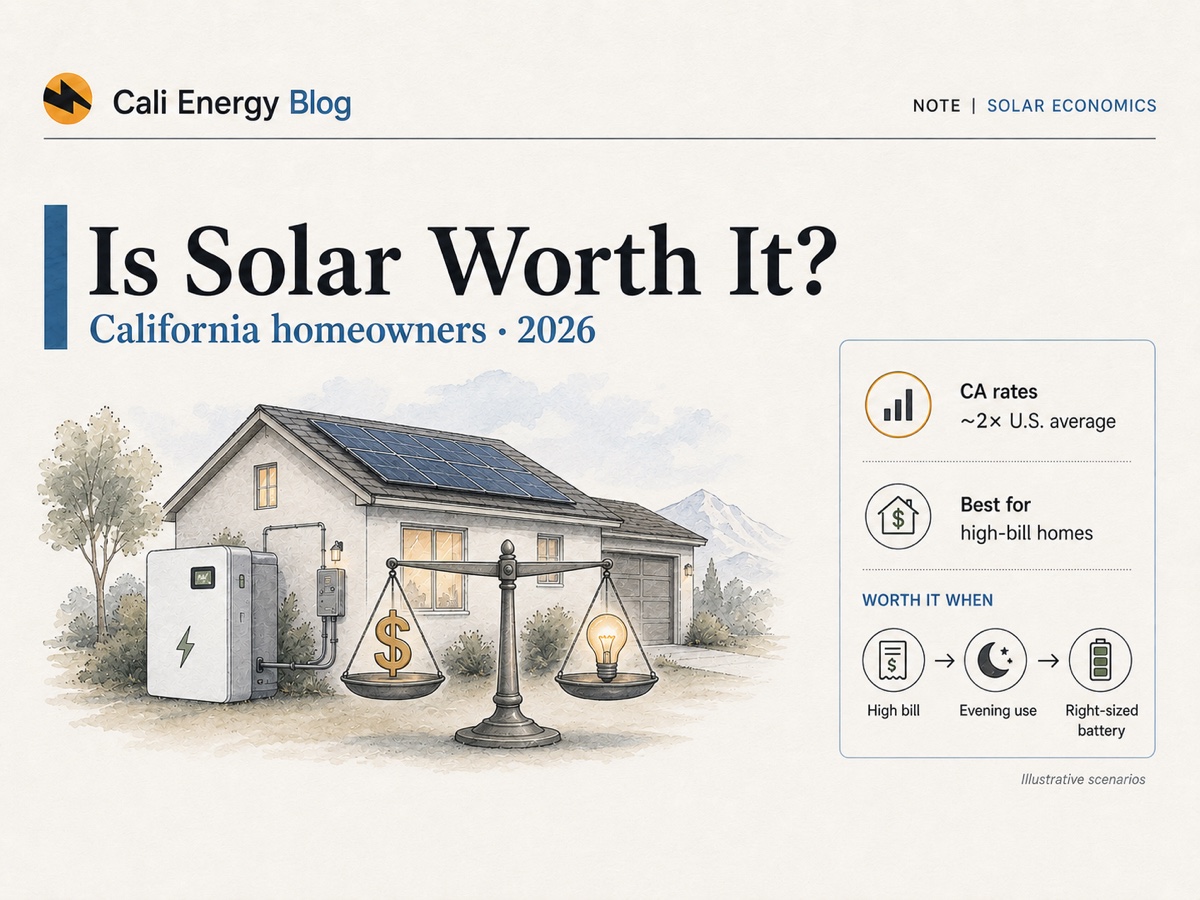
The short answer
Whether solar pays off comes down to three things: your rate, your usage, and how you pay.
California households pay roughly 34.74¢ per kilowatt-hour on average — nearly double the U.S. average of 18.34¢, according to the U.S. Energy Information Administration (June 2026). When power is that expensive, every kilowatt-hour your roof produces is worth a lot. That is the single biggest reason solar still works here in 2026.
But two things now push against you. First, the 30% federal Residential Clean Energy Credit is gone for homeowner-owned systems placed in service after December 31, 2025 — confirmed by the IRS. A system that used to cost $21,000 net now costs the full sticker price, which adds years to payback. Second, if you are on SCE, PG&E, or SDG&E, the Net Billing Tariff (NEM 3.0) pays you far less for exported power than the old net metering did. That makes self-consumption — and often a battery — central to the math.
So the real answer is not a slogan. It depends on which utility you have and how much electricity you use. Let's put numbers to it.
What actually changed for 2026
Two policy shifts reshaped the payback math.
The 30% federal credit expired
The Residential Clean Energy Credit (Section 25D) is not available for homeowner-owned systems placed in service after Dec 31, 2025, per the IRS. Cash and loan buyers in 2026 pay the full cost, which typically adds 2–4 years to payback versus 2025. (Unused credit from an eligible earlier year can still carry forward.)
NEM 3.0 hits SCE, not LADWP
The CPUC's Net Billing Tariff applies to investor-owned utilities — SCE, PG&E, SDG&E — for interconnection applications on or after April 15, 2023. Export credits fell to roughly a few cents per kWh. Municipal LADWP is exempt and still offers far more favorable net metering.
Rates keep climbing
SCE peak pricing on TOU-D plans reaches roughly 58¢/kWh from 4–9 p.m. in summer. LADWP Tier 1 sits around 24–26¢ and summer Tier 3 near 39–41¢ (LADWP rates). Rising rates shorten payback over time.
Three real scenarios — run your own numbers
Pick a preset that looks like your home, then adjust the inputs. Estimates are approximate and vary by plan, season, roof, and installer.
Approximate model for education only. Assumes a cash purchase, ~1,600 kWh produced per kW per year in California, blended rates of ~28¢ (LADWP) and ~42¢ (SCE), and no federal tax credit. Does not include SGIP battery incentives, financing costs, or degradation. Your quote will differ.
The three scenarios, side by side
Same assumptions as the calculator: cash purchase, 2026 pricing, no federal credit.
| Scenario | System | Est. upfront | Monthly bill before → after | Rough payback | Verdict |
|---|---|---|---|---|---|
| 1. LADWP home, solar-only | ~6.5 kW | ~$19,000 | ~$170 → ~$25 | ~10–11 yr | Worth it |
| 2. SCE home, solar + battery (NEM 3.0) | ~8 kW + 13.5 kWh | ~$36,000 | ~$280 → ~$40 | ~11–13 yr | Worth it if you stay put |
| 3. Low-usage home | ~4 kW | ~$13,000 | ~$85 → ~$30 | ~19–20 yr | Often not, as a cash buy |
Sources: EnergySage CA cost data (2026) · EIA · LADWP rates · SCE TOU-D · IRS
Scenario 1 — LADWP home, solar-only
The most straightforward win in Los Angeles.
LADWP is a municipal utility, so it is not on NEM 3.0. It still credits exported solar close to retail value, which means a solar-only system without a battery can offset most of your bill. A roughly 6.5 kW system at about $3.00 per watt runs near $19,000 before any incentives (the 2026 California average is about $2.52/W; we use a slightly higher, conservative figure for a quality install).
A home paying about $170 a month can expect that to fall to roughly a $25 minimum-charge bill, saving on the order of $1,700–$1,800 a year. Without the federal credit, payback lands around 10–11 years — longer than in 2025, but well inside the 25-year life of the panels. For most LADWP homeowners with a normal-to-high bill, solar is still a clear yes.
Scenario 2 — SCE home, solar + battery (Net Billing Tariff)
Higher rates, lower export credits — the battery earns its keep.
On SCE you are under the Net Billing Tariff, where midday exports are worth only a few cents. The way to make solar pay is to store your own power and use it during the expensive 4–9 p.m. peak, which reaches roughly 58¢/kWh in summer. Battery customers move to a plan such as TOU-D-PRIME under SCE's Solar Billing Plan.
An 8 kW system plus a 13.5 kWh battery lands near $36,000 cash in 2026 (batteries run roughly $1,000 per kWh installed). A $280 monthly bill can fall to about $40, saving roughly $2,900 a year, for a payback near 11–13 years. That range tightens if you qualify for an SGIP battery rebate — equity and equity-resiliency tiers can reach around $1.00–$1.10 per watt-hour, though funding and eligibility change over time. For a high-usage SCE home you plan to keep, it still pencils out — mainly because SCE rates are so high and keep rising.
Scenario 3 — the low-usage home
If your bill is small — say around $85 a month — there simply isn't much cost to eliminate. The smallest practical system is about 4 kW at roughly $13,000, and it might save only $660–$700 a year. That is a payback of close to twenty years as a cash purchase — past the midpoint of the panels’ useful life. Without the federal credit, the honest call for many low-usage homes is: not yet.
If this is you, look first at cheaper wins — efficiency, sealing, a heat-pump water heater, an EV that raises your usage and your solar value — or consider a lease/PPA with no upfront cost. Solar can still make sense later if your usage grows.
The assumptions behind these numbers
We would rather show our work than sell you a headline.
Every figure above assumes a cash purchase in 2026 with no federal tax credit. We use production of about 1,550 kWh per kW per year for the LA basin, blended effective rates of roughly 28¢/kWh for LADWP and 42¢/kWh for SCE (SCE is higher because of peak TOU pricing), and installed pricing around $3.00/W for solar and ~$1,000/kWh for storage. We do not bake in SGIP, financing interest, panel degradation (~0.5%/year), or future rate increases — the first two lengthen payback, the last two shorten it. Real quotes vary with roof orientation, shading, panel and inverter choice, and your actual rate plan.
To go deeper on the two policy levers that drive all of this, see our companion guides: NEM 3.0 explained, the 2026 federal solar tax credit change, and LADWP vs. SCE for solar.
So — is it worth it for you?
If you are on LADWP with a normal-to-high bill, solar is very likely worth it, even without the credit. If you are on SCE and use a lot of power, solar plus a battery still makes sense provided you plan to stay in the home long enough to reach payback. If you are a low-usage household, be honest with yourself about the long payback and look at efficiency or a no-upfront lease first. The best way to know is a real quote against your actual bill and rate plan. That is a free conversation — call us at +1 (323) 844-7777.
Frequently asked
Is solar still worth it in California without the federal tax credit?
For most LADWP and SCE homes with a normal-to-high electric bill, yes — but payback is longer. Losing the 30% credit typically adds 2–4 years, pushing cash payback to roughly 10–13 years in the LA area. It is high electricity rates (about 34.74¢/kWh statewide) that keep solar worthwhile even now.
Did the 30% federal solar tax credit really go away?
Yes. The IRS confirms the Residential Clean Energy Credit is not available for homeowner-owned systems placed in service after December 31, 2025. See the IRS page. Unused credit from an eligible earlier year can still carry forward.
Do I need a battery to make solar pay off?
It depends on your utility. On LADWP (municipal, still favorable net metering) a solar-only system offsets most of your bill without storage. On SCE, PG&E, or SDG&E you are under the Net Billing Tariff (NEM 3.0), where exports are worth only a few cents — a battery to self-consume evening power usually improves the economics.
When might solar NOT be worth it?
If your bill is small — around $85/month or less — there isn't much cost to eliminate. The smallest practical system can take close to twenty years to pay back as a cash purchase. In that case, look at efficiency upgrades, adding an EV to raise your usage and solar value, or a no-upfront lease/PPA first.
What's the difference between LADWP and SCE for solar?
LADWP is a municipal utility exempt from NEM 3.0, so it still credits exports near retail value — good for solar-only. SCE is an investor-owned utility on the Net Billing Tariff with low export credits but very high peak rates (about 58¢/kWh from 4–9 p.m.), which makes batteries valuable. See our LADWP vs. SCE guide.
Related reading
Sources & methodology
Figures on this page come from the primary sources below and, where noted, from Cali Energy calculations using the stated assumptions. Rates, incentives, and program terms change; each was verified September 9, 2026.
Get your real payback number
Every home is different. We'll run the math against your actual LADWP or SCE bill and rate plan — no pressure, no hype. Call Cali Energy at +1 (323) 844-7777.
Get a free estimatePrepared by Cali Energy, September 9, 2026. This article is for general educational purposes only and is not legal, tax, financial, engineering, or utility advice. Rates, incentives, codes, permit requirements, equipment specifications, prices, and program terms may change; figures and timelines are estimates, not guarantees. Confirm current requirements with the applicable utility, AHJ, program administrator, manufacturer, or a licensed professional. See our Content Disclaimer. Cali Energy · 19201 Parthenia St, Unit E, Northridge, CA 91324 · CSLB #1032379 (B, C-10, C-39)