

How many solar panels do I need in California?
The count comes from three numbers: how much electricity you use, how much a kilowatt of panels produces where you live, and how much of your usage you want to cover. The middle one is the one most guides flatten into a single statewide average — and across California it swings 23%, which is about three panels on a typical house. This page models it city by city.
Get a free estimate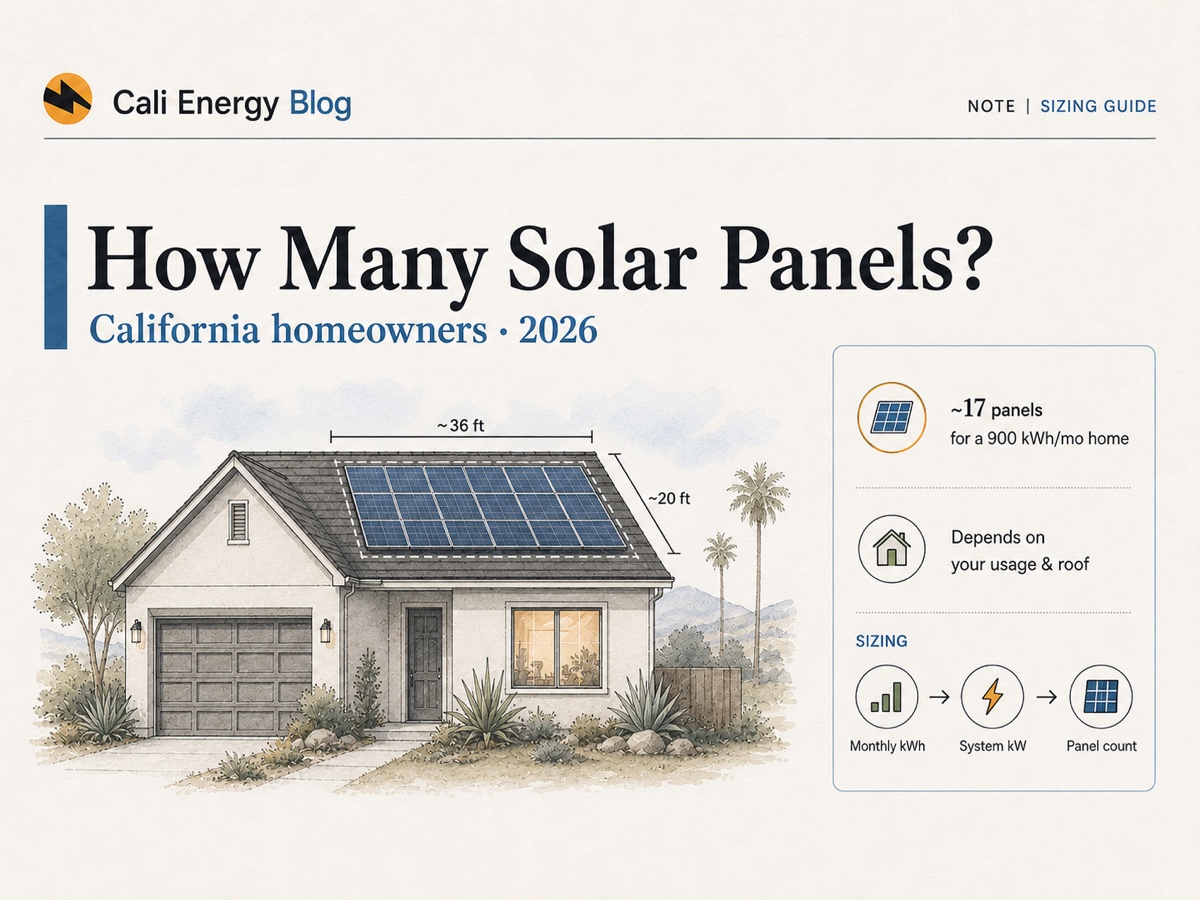
Quick answer
- Most California homes land between 12 and 25 panels. At 400 W each, a house using 900 kWh a month needs about 6.5 kW — roughly 17 panels — to cover a full year of usage.
- Where you live changes the answer by about three panels. One kilowatt of panels makes 1,845 kWh a year in Palmdale but 1,525 in San Diego. The same 10,800 kWh house needs 15 panels in one and 18 in the other.
- Sunshine does not follow latitude. San Diego is near the bottom of the table below — under San Francisco — because coastal marine layer costs more production than a few degrees of latitude gain.
- Panel wattage changes the count, not the roof area. A 6.44 kW array is 17 panels at 400 W or 15 at 460 W — but the glass covers about the same 330 sq ft either way, because a higher-wattage module is physically larger.
- A 100% offset is no longer automatically the target. Under NEM 3.0 exported energy is credited well below what you pay for imports, so sizing past your own consumption pays back slowly without a battery.
Size your system
Enter your usage and pick the city closest to you. Production comes from that city's own figure, not a statewide average.
Production figures are per city from PVGIS for a 20° south-facing roof with 14% system losses. Shading is applied as a production haircut. Module area is computed from real panel dimensions (a REC Alpha Pure-RX 460 W is 1,728 × 1,205 mm, 22.4 sq ft) and scaled by wattage — your roof needs meaningfully more than that once fire setbacks and walkways are included. Planning estimate, not a design.
What a kilowatt of panels makes in your city
The number the whole calculation turns on — modelled separately for each location.
Almost every sizing guide uses one number for the entire state, usually “about 1,600 kWh per kW per year.” Across California that hides a 23% spread, which is the difference between a 15-panel and an 18-panel system on the same house.
| City | Region | kWh per kW·year | Panels for 10,800 kWh |
|---|---|---|---|
| Palmdale | High desert | 1,845 | 15 |
| Palm Springs | Desert | 1,801 | 15 |
| Santa Maria | Central coast | 1,731 | 16 |
| Riverside | Inland Empire | 1,718 | 16 |
| Santa Ana | Orange County | 1,702 | 16 |
| Northridge | San Fernando Valley | 1,682 | 17 |
| Long Beach | LA coast | 1,682 | 17 |
| Los Angeles | LA basin | 1,676 | 17 |
| Bakersfield | Central Valley | 1,659 | 17 |
| Walnut Creek | East Bay | 1,652 | 17 |
| San Francisco | Bay Area | 1,628 | 17 |
| San Jose | South Bay | 1,628 | 17 |
| Fresno | Central Valley | 1,621 | 17 |
| Sacramento | Sacramento Valley | 1,612 | 17 |
| Oakland | East Bay | 1,592 | 17 |
| San Diego | South coast | 1,525 | 18 |
| Redding | Far north | 1,504 | 18 |
Source: PVGIS (European Commission JRC), PVcalc v5.2, queried per city at 1 kWp, 20° fixed tilt, south-facing, 14% system losses. Panel counts are Cali Energy calculations from those figures. PVGIS and NREL's PVWatts use different weather datasets and will not agree to the kilowatt-hour; both are models, and your roof's tilt, azimuth and shading move the result more than the choice of model does.
The arithmetic, so you can check it
Four steps, all reproducible from the table above.
- Annual energy to cover = monthly kWh × 12 × your offset target. 900 kWh a month at 100% is 10,800 kWh.
- System size = annual kWh ÷ (your city's kWh per kW × shading factor). In Los Angeles: 10,800 ÷ 1,676 = 6.44 kW.
- Panel count = system watts ÷ panel wattage, rounded up. 6,440 ÷ 400 = 17 panels.
- Module area = panels × the panel's own area. Seventeen 400 W modules at about 19.5 sq ft each is 332 sq ft of glass — before any setbacks.
Run the same house in San Diego and step 2 gives 7.08 kW, or 18 panels. Run it in Palmdale and it is 5.85 kW, or 15. Nothing about the house changed.
What actually moves the number
Your real 12-month usage
The biggest driver by far. Take a full year off your bills, not one summer month. LADWP bills most homes every two months — read the kWh, not the dollars.
Your city
Worth about 20% between the extremes of the table above, and roughly 3 panels on a typical house.
Shading and orientation
A south-facing open roof is the reference. Partial shade costs roughly 15% of production and heavy shade about 30%, so you need proportionally more panels for the same offset.
Loads you have not added yet
An EV, a heat pump, a pool or an ADU all raise usage. Sizing for them now is usually cheaper than expanding later — see panels for an EV and all-electric load planning.
Panels are not the same as roof space
A modern module is about 22 sq ft: the REC Alpha Pure-RX 460 W we install measures 1,728 × 1,205 mm, which is 2.08 m² or 22.4 sq ft — about 20.5 watts per square foot, and today's 400 W modules land at roughly the same density.
That has a consequence worth stating plainly: higher-wattage panels cut the panel count but not the roof area. The 6.44 kW Los Angeles system above is 17 modules at 400 W covering 332 sq ft, or 15 modules at 460 W covering 337 sq ft. Fewer, larger pieces of glass — the same amount of glass. Area is set by the kilowatts, not by how they are divided up.
Module area is still not roof area. Fire-code setbacks, walkway paths, and clearance around vents, skylights and chimneys all take space, and north-facing planes are usually unusable. Plan on needing meaningfully more roof than the square footage the calculator reports — how much more depends on your roof's shape, which is covered in how much roof space solar needs.
Why 100% offset is no longer the automatic target
If you are on SCE, PG&E or SDG&E and interconnected on or after April 15, 2023, you are on the CPUC's Net Billing Tariff — NEM 3.0 — where exported energy earns far less than imported energy costs. Building past your own consumption to bank credits pays back slowly; using your own production, usually with a battery, is what the tariff rewards. The mechanics are in NEM 3.0 explained.
Municipal utilities are different: LADWP, Burbank and Glendale are not on NEM 3.0 and still credit exports at the retail rate, which keeps a full-offset system attractive there. And the 30% federal Residential Clean Energy Credit is not available for homeowner-owned systems placed in service after December 31, 2025 — if you were counting on it to justify extra panels, re-run the numbers without it.
What this page cannot tell you
It cannot confirm the panels fit your particular roof, that your main panel has capacity for the inverter, or what the system costs — pricing is in solar panel cost in Los Angeles. The city figures model a 20° south-facing plane; a west-facing roof, a steeper pitch or a tree line will all shift production more than the difference between two neighbouring cities in the table. And the model assumes a full year of usage — if your bills only cover a few months, the estimate inherits that uncertainty.
Frequently asked
How many solar panels does a typical California home need?
How many kWh does 1 kW of solar produce per year in California?
Why does San Diego need more panels than Los Angeles?
Do higher-wattage panels mean I need less roof?
Should I still size for a 100% offset?
How much roof area does a solar system actually need?
Related reading
Sources & methodology
Figures on this page come from the primary sources below and, where noted, from Cali Energy calculations using the stated assumptions. Rates, incentives, and program terms change; each was verified September 4, 2026.
- PVGIS (European Commission JRC) — PV performance tool, per-city modelling used for the production table
- NREL — PVWatts Calculator (the other standard production model)
- REC Group — Alpha Pure-RX datasheet (460 W module dimensions)
- CPUC — Net Billing Tariff (NEM 3.0)
- IRS — Residential Clean Energy Credit
- U.S. EIA — Electric Power Monthly, average residential price by state
Want the exact number for your roof?
A calculator gets you the ballpark; the real count comes from your 12-month usage, your roof's planes and shading, and your main panel's capacity. Cali Energy (Northridge, CSLB #1032379) runs that analysis and gives you a firm panel count before anything is installed. Call +1 (323) 844-7777.
Get a free estimatePrepared by Cali Energy, September 4, 2026. This article is for general educational purposes only and is not legal, tax, financial, engineering, or utility advice. Rates, incentives, codes, permit requirements, equipment specifications, prices, and program terms may change; figures and timelines are estimates, not guarantees. Confirm current requirements with the applicable utility, AHJ, program administrator, manufacturer, or a licensed professional. See our Content Disclaimer. Cali Energy · 19201 Parthenia St, Unit E, Northridge, CA 91324 · CSLB #1032379 (B, C-10, C-39)