

Annual Roof Maintenance Checklist
A roof needs two checks a year and a few jobs in between. The National Roofing Contractors Association (NRCA) recommends inspecting a roof at least twice a year, preferably in spring and fall, and suggests another look after severe weather. In Los Angeles that means a spring check once the rainy season is over, a fall check before the first rains, and a look after a big storm or a Santa Ana windstorm. In between, keep the gutters, the valleys and the roof clear of leaves and needles, keep branches and vines back from the roof, and look in the attic for stains. Do your part from the ground, an upstairs window or the attic: NRCA advises homeowners not to walk on a roof or repair it without the experience and equipment to do it safely, so whatever needs doing on the roof goes to a roofer. And some jobs that look like upkeep, such as power washing or painting a shingle roof, can leave the damage they cause outside the manufacturer's warranty. This page sets out the year as of October 2026.
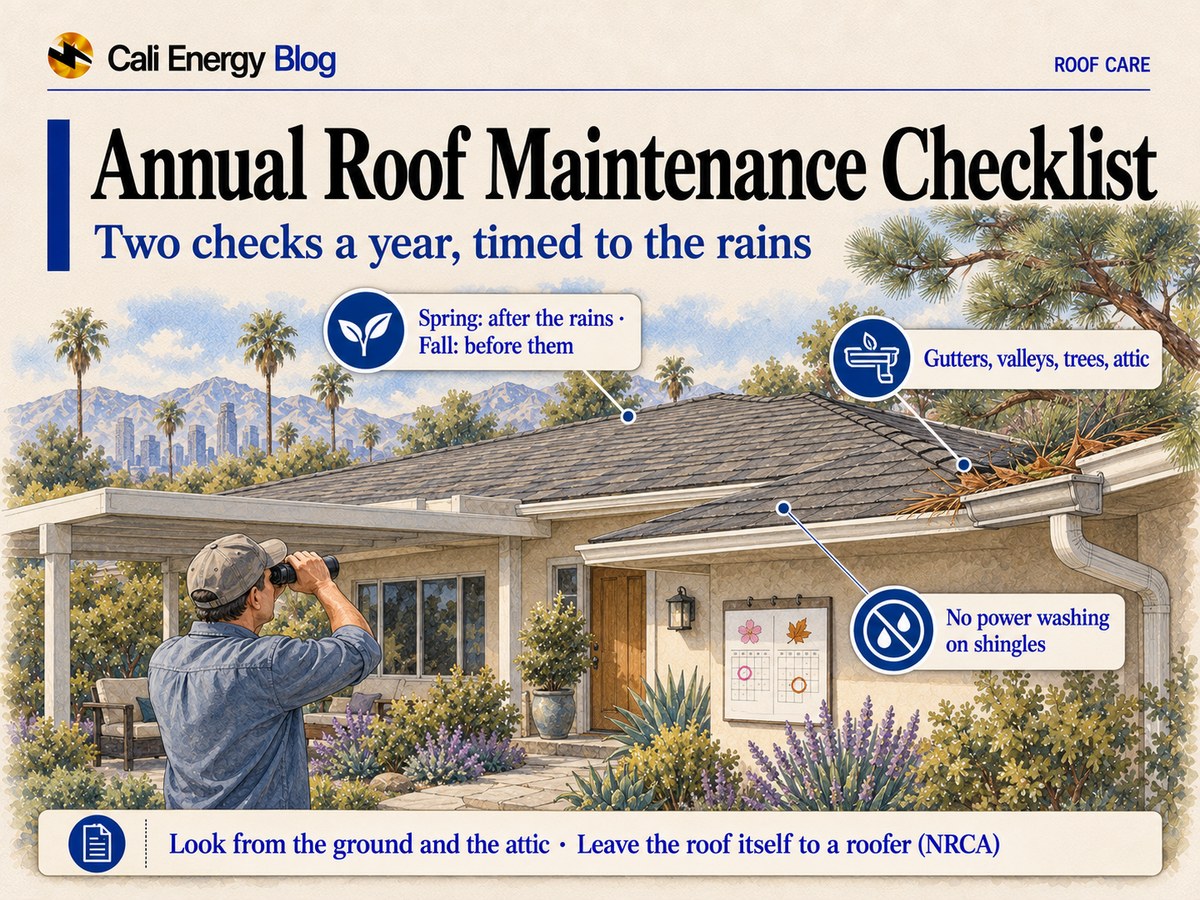
It covers house roofs through the whole year. The detailed list for September and October is in getting your roof ready for the rainy season, and what an inspection by a roofer or a home inspector covers, and what its report should include, is in what a roof inspection checks.
A year of roof care in Los Angeles
NRCA's spring-and-fall schedule fits Los Angeles, because the rain comes in a short season. In NOAA's 1991–2020 climate normals, about 87% of a normal year's rain falls from November through March, and the first rains usually arrive in October; the rainy-season guide has the numbers station by station. Santa Ana winds are most common from October through March, according to a National Weather Service climate bulletin. The Asphalt Roofing Manufacturers Association (ARMA) calls spring, once the winter weather and whatever damage it did have passed, the best time for an inspection and an ideal season for repairs.
| When | What to do | Who does it |
|---|---|---|
| April–May, after the rains | The spring check: look at every slope from the ground, clear what the winter left in the gutters and downspouts, check the attic and top-floor ceilings for new stains, and book any repairs while it's dry | You, from the ground and the attic; a roofer for anything on the roof |
| June–August, the dry months | Keep the gutters, the valleys and the roof clear where trees drop leaves or needles; in a fire zone that's the law all year | You, for what you can reach safely; a roofer or gutter service for the rest |
| September–October | The fall check before the first rains: branches trimmed back, gutters and roof drains cleared, flashings, tile and flat sections checked | The full list is in the rainy-season guide |
| November–March | Watch the gutters and downspouts in the first real rain; after a big storm or a Santa Ana windstorm, look from the ground and in the attic | You; a roofer for anything you find |
| After an earthquake | Look from the ground for slipped or broken tiles and a cracked or leaning chimney before you walk under the eaves | You; a roofer for repairs, an engineer if the framing moved |
| After other trades work on the roof | After solar, air conditioning or antenna work, ask how each new hole through the roof was flashed | The installer; a roofer if something was disturbed |
What to check after a quake, in order, is in tile roofs and earthquakes, and after a windstorm in Santa Ana winds and your roof.
What you can do from the ground and the attic
NRCA says a steep roof can usually be inspected from the ground or from a ladder at the roof's edge, and ARMA suggests the ground or upstairs windows, with binoculars. That covers the homeowner's share:
- Every slope, with binoculars. Walk around the house. On shingles, NRCA treats curling or splitting as signs of wear, and dislodged or missing tabs as repairs to make; on tile, slate, wood shakes and metal shingles, cracked, broken or missing pieces. Look too for debris in the valleys and behind the chimney, and for flashing that has lifted; NRCA's inspection takes in the walls and chimneys where they meet the roof. Photograph what you see, with the date. What each sign can point to is in signs you need a new roof.
- Gutters and downspouts. Keep them clear and check that water comes out at the bottom; how to clean and test them safely is in the rainy-season guide. One thing ARMA calls out: a downspout from an upper story shouldn't empty straight onto a lower roof. It should connect to the lower roof's gutter.
- Trees and vines. ARMA says to keep branches trimmed so they don't scuff the roof, which also keeps the roof drier and slows algae, mold and lichen, and to keep climbing plants trimmed back from the roof. Large or high branches go to a tree service, and anything near a power line goes to the electric utility.
- The attic. With a flashlight, stepping only on the framing, look at the underside of the roof deck, especially where pipes and vents pass through and where roof planes meet walls or the chimney; ARMA calls those penetrations and intersections typically the places most vulnerable to leaks. Look for stains, dark or soft wood and damp insulation, and check that insulation isn't blocking the eave vents, which the code doesn't allow (attic ventilation requirements). Mark and date the edge of any stain, so the next check shows whether it has grown.
- Ceilings and skylight shafts. Stains or peeling paint on the top-floor ceilings and around skylights point to where the roof should be looked at.
What goes to a roofer
NRCA doesn't recommend that homeowners walk on a roof, or repair it, unless they have the experience and the equipment to do it safely, and recommends having an experienced roofing contractor make repairs promptly. ARMA says to keep walking on a roof to a minimum, because it damages the surface. On the roof itself, that leaves the roofer:
- Debris on the roof. Leaves and needles in the valleys, behind chimneys and around skylights. NRCA says debris should be removed during a maintenance inspection, with special attention to valleys, gutters and roof drains. ARMA's method is a leaf blower or another non-abrasive way, with the air aimed down the slope so debris isn't driven under the shingle edges.
- Flashings, sealant and pipe boots. The metal at walls, chimneys, skylights and valleys, and the collars around pipes. How each kind of flashing works is in roof flashing types, and pipe boots in how pipe boots and vent flashing leak.
- Broken or missing pieces. Shingles, tiles, shakes or metal pieces repaired or replaced, which NRCA says keeps the roof weathertight.
- Flat sections. Drains, scuppers and overflow outlets cleared, and the surface checked for ponding, blisters and split seams; see flat roof drains, scuppers and crickets.
Many roofing contractors offer this as a maintenance agreement, NRCA notes: the inspection, the debris removal and any repairs in one visit. If you take one, get in writing what each visit includes and how repairs found on a visit are priced.
What each roof type needs
The yearly checks are the same for every roof; what to look for, and what to avoid, depends on the covering.
| Roof | What to watch for | What to avoid | More |
|---|---|---|---|
| Asphalt shingle | Curling or splitting, missing tabs, granules piling up in the gutters of an older roof, debris in the valleys; dark streaks may be algae, which ARMA says hasn't been shown to affect a roof's service life, while moss damages shingles | Power washing, scrubbing or brushing; painting or coating the shingles to change their color | Signs you need a new roof |
| Clay or concrete tile | Cracked, broken or slipped tiles, hips and ridges out of line; the underlayment under the tile keeps the water out, and tile often outlasts it | Walking on the tile | Spanish tile roof care; tile underlayment |
| Flat or low-slope | Clogged drains and scuppers, ponding marks, blisters, cracks and split seams | Leaving debris at the drains into the rainy season | Ponding water on a flat roof |
| Metal | On exposed-fastener panels, loose, backed-out or rusted screws and damaged washers; near the ocean, corrosion at fasteners, flashing and edges | Covering a stripped screw with sealant instead of replacing it | Standing seam vs exposed fastener |
| Wood shake | Cracked, broken or missing shakes | — | Replacing a wood shake roof |
If a flat roof has been coated, keep the product's name, data sheet and warranty: a later coating has to be one whose data sheet allows it over what's already there (roof coatings compared).
What can void a roof warranty
NRCA notes that most roofing warranties require the roof to be properly maintained, and the fine print shows what that means. Owens Corning's Preferred Protection Limited Lifetime Warranty, in the version dated August 2026, doesn't cover:
- damage caused by alterations after the roof is installed, including structural changes, equipment or solar panel installation, power washing, painting, coatings, and cleaning solutions not used according to Owens Corning's algae removal instructions;
- damage due to debris, resins or drippings from foliage;
- foot traffic on the roof, and objects such as tree branches falling on it;
- damage caused by improper or inadequate roof ventilation or roof drainage;
- damage or leaks caused by defective areas on or near the roof that aren't part of the roofing system, such as chimneys with loose or cracked mortar, faulty counterflashing, or gutters and downspouts that weren't properly designed or installed.
ARMA's manual says the same about paint: never paint or coat asphalt shingles to change their color or give the roof a new look, because it may void the manufacturer's warranty. GAF's and Owens Corning's standard warranties also exclude foot traffic and inadequate ventilation, as set out in roof warranties explained. So before you clean, coat or add anything to a shingle roof, read the warranty and ask the manufacturer or your roofer; how roof and solar warranties split is in roof, solar and installer warranties.
Timing counts too. If a check turns up what looks like a defect in the shingles, the same Owens Corning warranty requires a claim within 30 days after the problem is discovered, may ask for photos or samples at the owner's expense, and may deny a claim if the shingles are repaired or replaced before it decides.
In a fire zone, a clear roof is the law
In a State Responsibility Area (Public Resources Code §4291) and in a Very High Fire Hazard Severity Zone designated by a local agency (Government Code §51182), part of this list is a legal duty all year. Both laws require keeping the roof free of leaves, needles and other plant material, keeping trees and plants next to or over the house free of dead or dying wood, and removing any part of a tree within 10 feet of the outlet of a chimney or stovepipe; the rainy-season guide quotes them. Whether an address is in one of these areas is covered in the fire hazard severity zone lookup, and the state's draft rules for the first 5 feet around a house in Zone 0 and your roof.
Under the 2025 California Wildland-Urban Interface Code, what the code required when the roof was built, such as ember-resistant vents, has to be maintained to the edition it was installed under (WUI roofing requirements).
Keep a roof file
A folder, paper or digital, with the roof's history pays off at a warranty claim, an insurance renewal and a sale:
- The contract, the permit and the final inspection. How to confirm a re-roof permit was finaled is in checking a re-roof permit's final status.
- The products and the warranties. The shingle or tile line and color, the manufacturer's warranty and its registration, and the roofer's workmanship warranty in writing. Owens Corning's warranty, for example, can pass to a buyer of the house once, and only if the buyer submits, within 60 days of the sale, proof of purchase of the roofing system, the installation date and ownership history, and a $100 fee.
- Every check and repair. Dated photos from each check, and invoices that say what was repaired and where.
Insurers look at the roof too: its age can decide whether a company will write or renew a policy and how roof damage is paid; see roof age and home insurance in California.
Our roofing work
On a Studio City house, we measured and photographed the roof plane by plane before the solar, and the survey found the history of a roof looked after in patches: old penetrations sealed with mastic rather than flashed, debris collected in the valleys, and worn sections on a flat part where water had been standing. The covering was replaced first, 27 squares over the existing sheathing, with the permit closed out in January 2026, and the array went on after. Other jobs are in our project write-ups; what we do on roofs is described on the roofing service page. Our California contractor license, CSLB #1032379, carries the C-39 roofing classification alongside B and C-10.
Frequently asked
When should I check my roof in Los Angeles?
Can I inspect my own roof?
Should I pressure wash my roof?
Does skipping maintenance void a roof warranty?
How do I keep moss and algae off a shingle roof?
Related reading
Sources & methodology
Code sections, rules and figures on this page come from the primary sources below. Codes, local requirements and product terms change; each was verified October 9, 2026.
- National Roofing Contractors Association, Mark S. Graham, Tech Today: Routine preventative maintenance is necessary for optimal residential roof…
- Asphalt Roofing Manufacturers Association, Residential Asphalt Roofing Manual: Design and Application Methods, 2014 edition (Chapter 17, Roof Care…
- Owens Corning, Preferred Protection Limited Lifetime Warranty (Pub. No. 10020609-P, August 2026)
- California Public Resources Code §4291
- California Government Code §51182
- NOAA NCEI, U.S. Climate Normals 1991–2020 (monthly)
- Tom Murphree, Emily Szasz and Kellen Jones, Santa Ana Events in California, NOAA National Weather Service Science and Technology Infusion Climate…
- TRI Alliance, Technical Brief 2014-02, Walkability on Concrete and Clay Roof Tiles
We check the roof and tell you what it needs
Call (323) 844-7777. We look at the roof from the eaves to the ridge and in the attic, photograph what we find, and tell you in writing which items are upkeep and which are repairs. Have ready the address, the roof type and its age if you know it.
Prepared by Cali Energy, October 9, 2026. This article is for general educational purposes only and is not legal, tax, financial, engineering, or utility advice. Rates, incentives, codes, permit requirements, equipment specifications, prices, and program terms may change; figures and timelines are estimates, not guarantees. Confirm current requirements with the applicable utility, AHJ, program administrator, manufacturer, or a licensed professional. See our Content Disclaimer. Cali Energy · 19201 Parthenia St, Unit E, Northridge, CA 91324 · CSLB #1032379 (B, C-10, C-39)