

Ponding Water on a Flat Roof: Causes and Fixes
Water still standing on a flat roof 48 hours after rain is ponding. That's the line California's residential code draws: it defines positive roof drainage as slope that drains the roof within 48 hours of precipitation, allowing for the deck's deflection under load, and the U.S. Army's built-up roof inspection manual uses the same 48 hours. The manual lists three causes: the design of the roof's drainage, irregularities in the roof surface, and clogged drains, scuppers or other obstructions. The fix follows the cause: clear what's blocked, lower or add an outlet where a drain sits too high or too far away, and add slope, with tapered insulation, crickets or reframing, where the roof itself holds water. It matters because water is heavy, at about 5.2 pounds per square foot for every inch of depth, because a roofing manufacturer warns that it can harm the membrane and may void a warranty, and because on a re-roof, a roof that doesn't drain within 48 hours has to be brought to the code's minimum slope. This page goes through it as of October 2026.
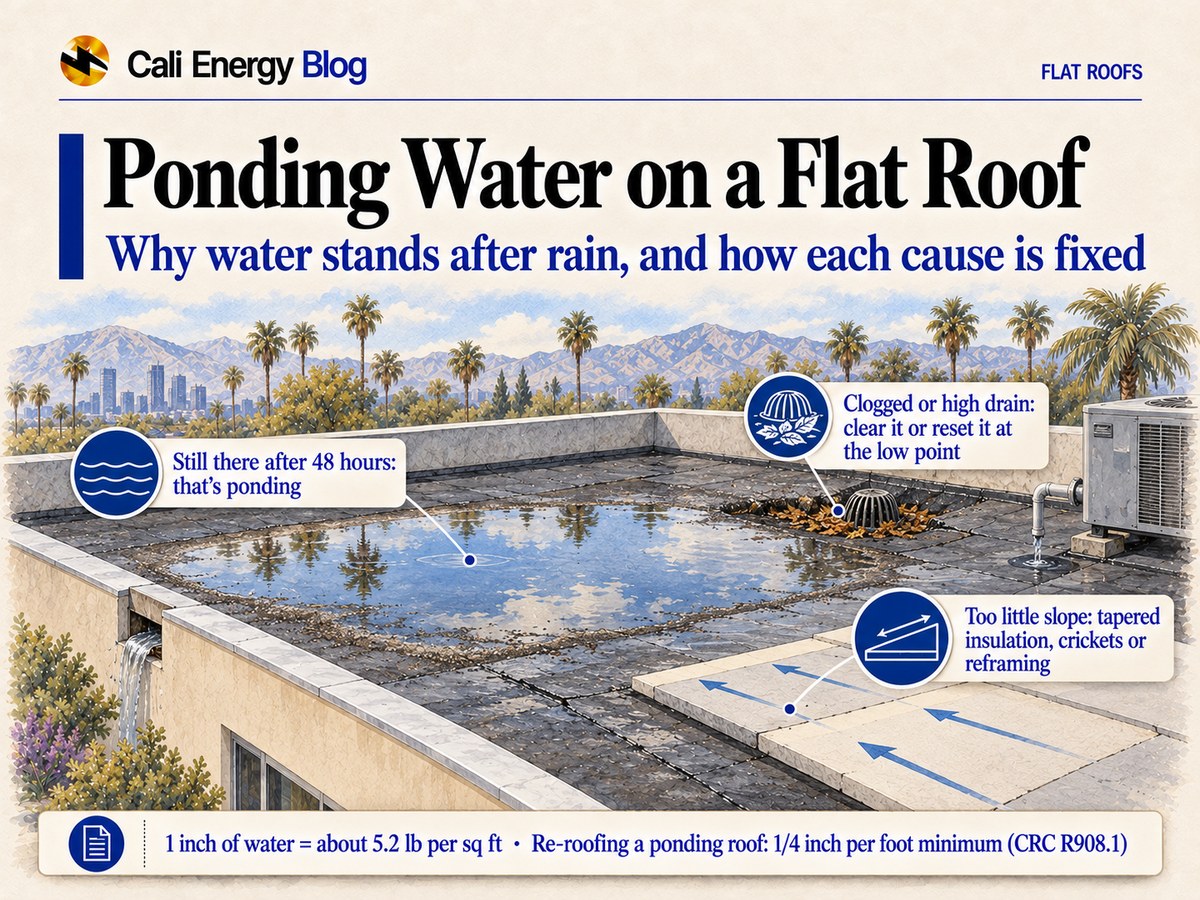
It covers houses with flat or low-sloped roofs under the 2025 California codes, in force since January 1, 2026. It can't diagnose a roof at a distance and doesn't price the work. Whether a ponding roof should be repaired, coated or replaced is in flat roof repair, coating or replacement.
Ponding or a puddle
Some water after rain is normal; what counts is how long it stays. The 48-hour line comes from three places that agree:
- The code. The California Residential Code (CRC 2025, chapter 2) defines positive roof drainage as drainage in which the deck's deflection under load has been considered and enough slope added to drain the roof within 48 hours of precipitation.
- The inspection manual. The Army's manual for built-up roofs counts water that remains after 48 hours as ponded water.
- Coating makers. Kool Seal's acrylic coating sheet asks for drains or other corrective measures where ponding lasts beyond 48 hours.
A dry roof can still show where water stands. The manual accepts staining as evidence of ponding, and its photographs show the signs: dirt collected around a drain, debris gathered in a low spot. Photos from an upstairs window a day and two days after rain are a good start for a roofer; nobody needs to climb onto a wet roof to find out.
What causes it, and the fix for each
The Army's manual groups the causes in three, and its photographs show the common versions of each; a sagging deck and condensate add two more.
| Cause | What it looks like | How it's fixed |
|---|---|---|
| A clogged drain or scupper | Water around the outlet, debris in or at it | Clear it; the manual's own example is a blocked drain whose ponding ends once it's cleared |
| An outlet set too high | Water held back right at the drain or scupper; a scupper edge above the roof surface | Reset the outlet at the low point; the code puts a roof drain at each low point (R903.4) |
| Drains in the wrong places, or too few | Water standing between drains, or across much of the roof | Add or move drains or scuppers, and slope the roof toward them |
| A roof built dead-flat | Water over large areas after every rain | Add slope with tapered insulation, crickets between drains, or reframing |
| An uneven surface | Isolated low spots in the field of the roof | Build up low spots within the roofing system, to the manufacturer's instructions |
| A sagging deck or framing | A low area that deepens over time, often between supports | Restore the slope in the structure before re-covering it |
| Water that isn't rain | Water in the dry months, near a rooftop air conditioner | Pipe the condensate to a drain |
The last row matters in Los Angeles, where a roof can go months without rain: GAF's coating manual names improperly piped air-conditioning condensate lines as a source of ponding, and in the dry season they can be the only one.
Why it matters
- Weight. Water weighs about 62.4 pounds per cubic foot, so each inch of depth adds about 5.2 pounds per square foot. A 10-by-10-foot pond 2 inches deep is about 1,040 pounds. A deck that deflects under that weight holds more water, which is why the code's definition of positive drainage accounts for the deck's deflection under load.
- The membrane and its warranty. CertainTeed's modified bitumen handbook says every roof area should be designed and installed to drain without holding water, that water collecting on the roof can be detrimental to the membrane and may void an existing warranty, and that limited, minor ponding may be accepted under its warranty terms, possibly with extra surfacing.
- Coatings. Acrylic coating sheets rule ponding out or ask for drains first; some silicone sheets say their coatings resist it. A coating doesn't make a roof drain; how the types compare is in silicone, acrylic or elastomeric roof coating.
- Overflow behind a parapet. Where a parapet would trap water if the drains back up, the code calls for secondary overflow drains with their inlets 2 inches above the low point, or overflow scuppers three times the size of the roof drains and at least 4 inches high (R903.4.1). They're the roof's protection when a drain clogs in a storm; how the outlets work is in flat roof drains, scuppers and crickets.
What a re-roof has to fix
A re-roof is where slope gets corrected, and the code ties it to the same 48 hours:
- The minimum slope. Built-up, modified bitumen, single-ply, spray foam and liquid-applied roofs need a design slope of at least 1/4 inch per foot (2%), and coal-tar built-up roofs 1/8 inch (CRC R905.9.1, R905.11.1, R905.12.1, R905.13.1, R905.14.1).
- The re-roof exception, and its limit. A re-roof doesn't have to bring a roof up to that minimum if the roof provides positive roof drainage, and it doesn't have to add overflow drains or scuppers that aren't there (R908.1). A roof that still holds water after 48 hours doesn't provide positive drainage by the code's definition, so the exception doesn't cover it.
- How the slope is made. Tapered insulation boards are made for it; CertainTeed's handbook lists tapered boards "to promote positive drainage." Crickets split the flow between drains, and where the framing itself is out of level, the slope is built into the structure.
- Everything that rises with it. Added slope or insulation raises the roof surface, so the bid should say how the drains, scuppers, base flashings and door thresholds are raised to match. Where the energy code also calls for insulation, tapered insulation can count toward it; see flat roof options for Los Angeles homes.
Questions to ask a roofer
1. Where does the water stand, and for how long? Photos a day and two days after rain, marked on a sketch of the roof.
- What's the cause? A blocked outlet, an outlet too high, too few outlets, a flat spot, a sagging deck, or condensate.
- What's the fix, and does it address the cause? A cleared drain or a reset outlet, added slope, or framing work.
- Is there an overflow? Behind a parapet, where the water goes if the main drain clogs.
- For a re-roof: how will the roof reach 1/4 inch per foot? Tapered insulation, crickets or reframing, and how the edges and outlets are raised.
- What does the membrane or coating maker say about ponding? And what it does to the warranty.
Frequently asked
How long can water stand on a flat roof?
Is some standing water on a flat roof normal?
Can a roof coating fix ponding?
Does a re-roof have to fix ponding?
How much does standing water weigh on a roof?
Related reading
Sources & methodology
Code sections, rules and figures on this page come from the primary sources below. Codes, local requirements and product terms change; each was verified October 9, 2026.
- California Residential Code 2025, Chapter 2, Definitions (Positive Roof Drainage)
- California Residential Code 2025, Chapter 9, Roof Assemblies (R903.4, R903.4.1, R905.9.1 through R905.14.1, R908.1)
- Shahin, Bailey and Brotherson, Membrane and Flashing Condition Indexes for Built-Up Roofs, Volume II: Inspection and Distress Manual, U.S. Army…
- CertainTeed, Flintlastic Modified Bitumen Application Handbook, third edition (2016), copy published by a distributor
- Kool Seal, Elastomeric Finish Coat KS0063000, product data sheet
- GAF, Liquid-Applied Roofing Manual, version 2.1 (2024)
We'll find out why the water stands, and fix the cause
Call (323) 844-7777. We look at where the water stands and the stains it leaves, check the drains, scuppers and overflows, the slope and the deck, and where any air-conditioner condensate goes, and the estimate says which cause we found and how it's corrected. Have ready the address, photos of the roof a day or two after rain, and whether solar is on the roof or planned.
Prepared by Cali Energy, October 9, 2026. This article is for general educational purposes only and is not legal, tax, financial, engineering, or utility advice. Rates, incentives, codes, permit requirements, equipment specifications, prices, and program terms may change; figures and timelines are estimates, not guarantees. Confirm current requirements with the applicable utility, AHJ, program administrator, manufacturer, or a licensed professional. See our Content Disclaimer. Cali Energy · 19201 Parthenia St, Unit E, Northridge, CA 91324 · CSLB #1032379 (B, C-10, C-39)