

What Does a Roof Inspection Check?
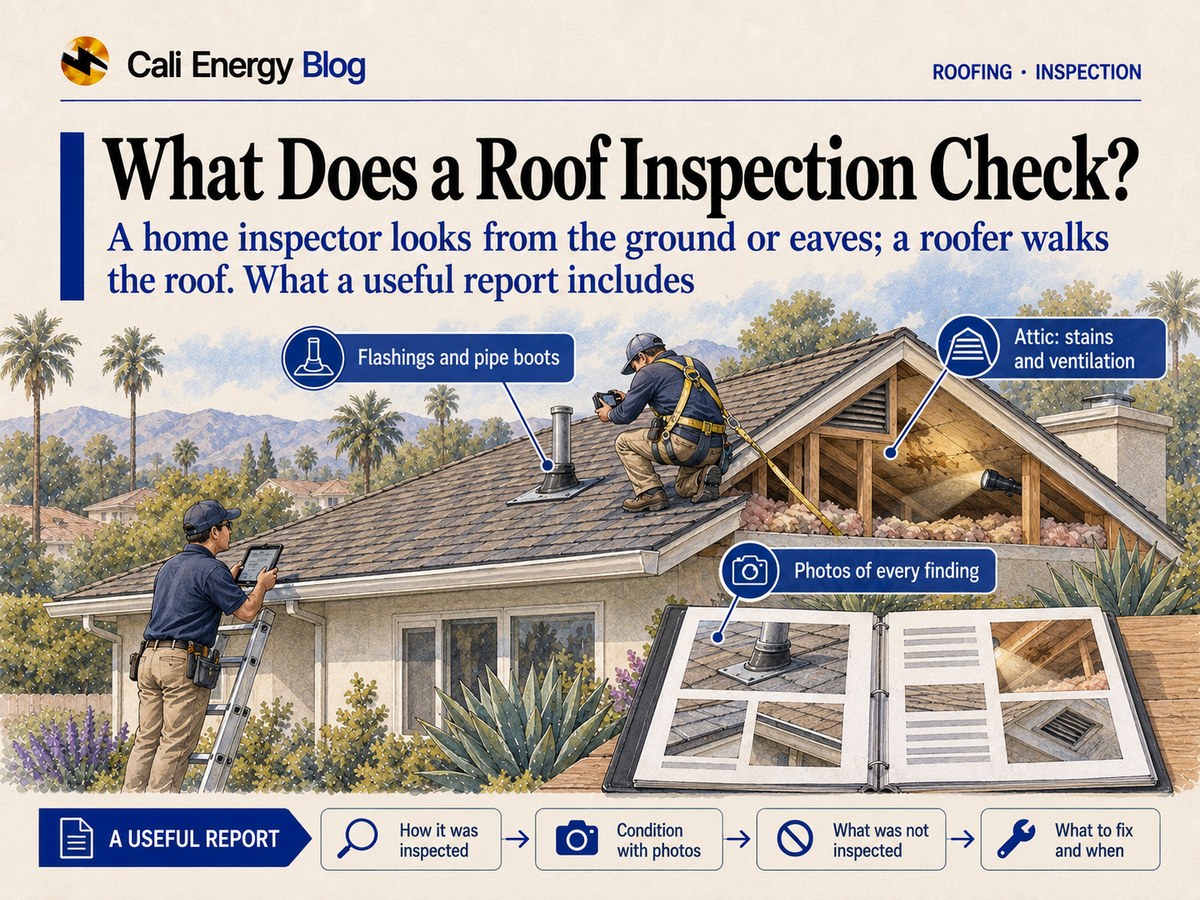
It depends on who does it. A home inspector at a sale looks at the roof from the ground or the eaves: under the InterNACHI standards, the covering, the gutters and downspouts, the vents, flashing, skylights, chimney and other penetrations, and the roof structure from wherever it's readily accessible, and reports any signs of active leaks. That standard doesn't require walking on the roof, predicting how long it will last, a water test, or certifying it. A roofer usually walks the roof where it's safe, looks closely at flashings, penetrations and soft spots, and checks the attic, but works for the company that will quote the repair. Whoever does it, a useful report says how the roof was inspected, what's there and in what condition, with photos, what wasn't inspected and why, and what needs fixing and how soon.
Who inspects, and what each one covers
The same word covers several different visits.
| Who | Usually looks from | What it covers | What it leaves out |
|---|---|---|---|
| A home inspector, at a sale | The ground, the eaves, the attic access | Covering, gutters and downspouts, vents and flashings, skylights, chimney, penetrations; the roof structure where readily accessible; signs of active leaks (InterNACHI 3.1) | Walking the roof, predicting service life, water tests, checking fastening, certifying the roof |
| A roofer | The roof itself where it's safe, and the attic | Covering, flashings, penetrations, sealants, soft spots in the deck, attic stains and ventilation | Anything under the covering until it's opened |
| An insurer | Aerial images, sometimes a site visit | The condition the insurer uses to decide on coverage | A repair plan; the findings serve the insurer's decision |
| A solar installer, before an array | The roof and the attic | A visual check that the roof is a single layer and the structure looks sound, without alterations, deterioration or sagging (state Solar Permitting Guidebook) | Remaining roof life, unless asked |
None of these can see through the covering; rot under the roofing often shows only once it's off, as covered in rotted roof decking and your estimate.
What a home inspection covers in California
California's home inspection law covers paid inspections done in connection with a sale of a one-to-four-unit home. It defines a home inspection as a noninvasive, physical examination designed to identify material defects, meaning conditions that significantly affect the home's value, desirability, habitability or safety, not its looks (California Business and Professions Code 7195). The law defines the report as one that clearly describes the systems and components inspected, any material defects found, and any recommendations, including for evaluation by other specialists (B&P 7195(c)). A home inspector who isn't an engineer can't do engineering analysis of the structure (B&P 7196.1), and the inspector's company can't charge to repair a house it inspected in the past 12 months (B&P 7197).
The InterNACHI standards many inspectors work to say plainly what's left out: an inspection isn't technically exhaustive, won't find concealed or latent defects, and doesn't determine the life expectancy of any component. In the attic, the inspector reports a general absence of insulation or ventilation but isn't required to judge whether the ventilation is adequate (InterNACHI 2.1 and 3.9). A note to "have a licensed roofer evaluate" is the report doing its job.
What a useful report includes
Whoever inspects, ask for a written report that covers:
- How the roof was inspected. Walked, from a ladder at the eaves, from the ground with binoculars or by drone, and whether the attic was entered.
- What's there. The covering type, the number of layers if visible, and its age if known.
- Condition, part by part. The covering, flashings at walls, chimneys and skylights, pipe boots and vents, valleys, gutters and the roof edge, each with photos.
- Leaks. Any active leak or stain, where it is, and its likely source.
- What wasn't inspected, and why. Steep slopes, tile that couldn't be walked, an attic that couldn't be entered.
- What needs doing, and how soon. Repairs listed separately from maintenance, with an urgency for each.
- Who inspected. Their name, and their license number if it's a contractor.
A remaining-life estimate isn't part of a standard home inspection, but it's what some decisions turn on: from January 1, 2028, an independent roof inspection confirming at least five years of remaining life will keep an insurer from refusing to renew a policy on roof age alone, as covered in roof age and home insurance. How that estimate is made is in how much life is left in your roof, and when a sale calls for a roof certification is in roof certification for a California home sale.
Before you book
- Know what you're buying. A home inspection at a sale and a roofer's visit before a quote are different services; a roofer's inspection before a quote comes from the company that will price the work, so ask for the findings in writing, with photos, either way.
- Ask what they'll walk. Steep roofs, wet roofs and tile may not be walked, and that changes what can be seen.
- Share what you know. Leaks, past repairs and the roof's age save time; a photo of a ceiling stain taken while it's wet tells more than the same stain dry.
- Check yourself between inspections. From the ground and the attic, as in signs you need a new roof.
What we've seen on our jobs
On a 2025 North Hills job, we walked the roof before the solar rails went down, looking for a soft deck, lifted shingles or an old repair that should be dealt with first; it turned up nothing that needed doing, and the check took about an hour (the North Hills case). Photographs from an inspection keep paying off: in Porter Ranch, our photos of the roof from before and after an installation answered a household's question, after a windy night, about whether a metal piece in the yard had come off the array (the Porter Ranch case).
Frequently asked
Does a home inspector walk on the roof?
Can an inspection tell me how long my roof will last?
Can the home inspector fix what they found?
Should the inspector go in the attic?
How often should a roof be inspected?
Related reading
Sources & methodology
Code sections, rules and figures on this page come from the primary sources below. Codes, local requirements and product terms change; each was verified October 9, 2026.
- International Association of Certified Home Inspectors, InterNACHI Home Inspection Standards of Practice (last revised October 2022), sections 1,…
- California Business and Professions Code, Division 3, Chapter 9.3, Home Inspectors, sections 7195–7197
- Governor's Office of Planning and Research, California Solar Permitting Guidebook, 4th edition (2019), Structural Criteria for Residential…
- Asphalt Roofing Manufacturers Association, Residential Asphalt Roofing Manual: Design and Application Methods, 2014 edition (Chapter 17, Roof Care…
- National Roofing Contractors Association, Mark S. Graham, Tech Today: Routine preventative maintenance is necessary for optimal residential roof…
We inspect the roof and put what we find in writing
Call (323) 844-7777. We walk the roof where it's safe, look in the attic, photograph what we find and tell you in writing what needs fixing and how soon. We're a roofing contractor, so the same visit can end in a quote; ask for the findings either way. Have ready the roof's age if you know it, and any leaks or past repairs.
Prepared by Cali Energy, October 9, 2026. This article is for general educational purposes only and is not legal, tax, financial, engineering, or utility advice. Rates, incentives, codes, permit requirements, equipment specifications, prices, and program terms may change; figures and timelines are estimates, not guarantees. Confirm current requirements with the applicable utility, AHJ, program administrator, manufacturer, or a licensed professional. See our Content Disclaimer. Cali Energy · 19201 Parthenia St, Unit E, Northridge, CA 91324 · CSLB #1032379 (B, C-10, C-39)