

When to Replace Tile Roof Underlayment
Under clay or concrete tile, the underlayment is done when it has stopped keeping water out or has turned brittle where a roofer lifts the tile, not when the roof reaches a certain age. No figure in years fits every roof, because the answer depends on the kind of sheet, the heat under the tile, the slope, how much of the sheet has sat in the sun, and how it was put down. The signs to act on are leaks in hard or wind-driven rain while the tile looks fine, stains running down the roof boards in the attic, and felt that cracks when a roofer bends it. The best times to replace it are before the rainy season, before solar goes on, and whenever the tile is coming up anyway.
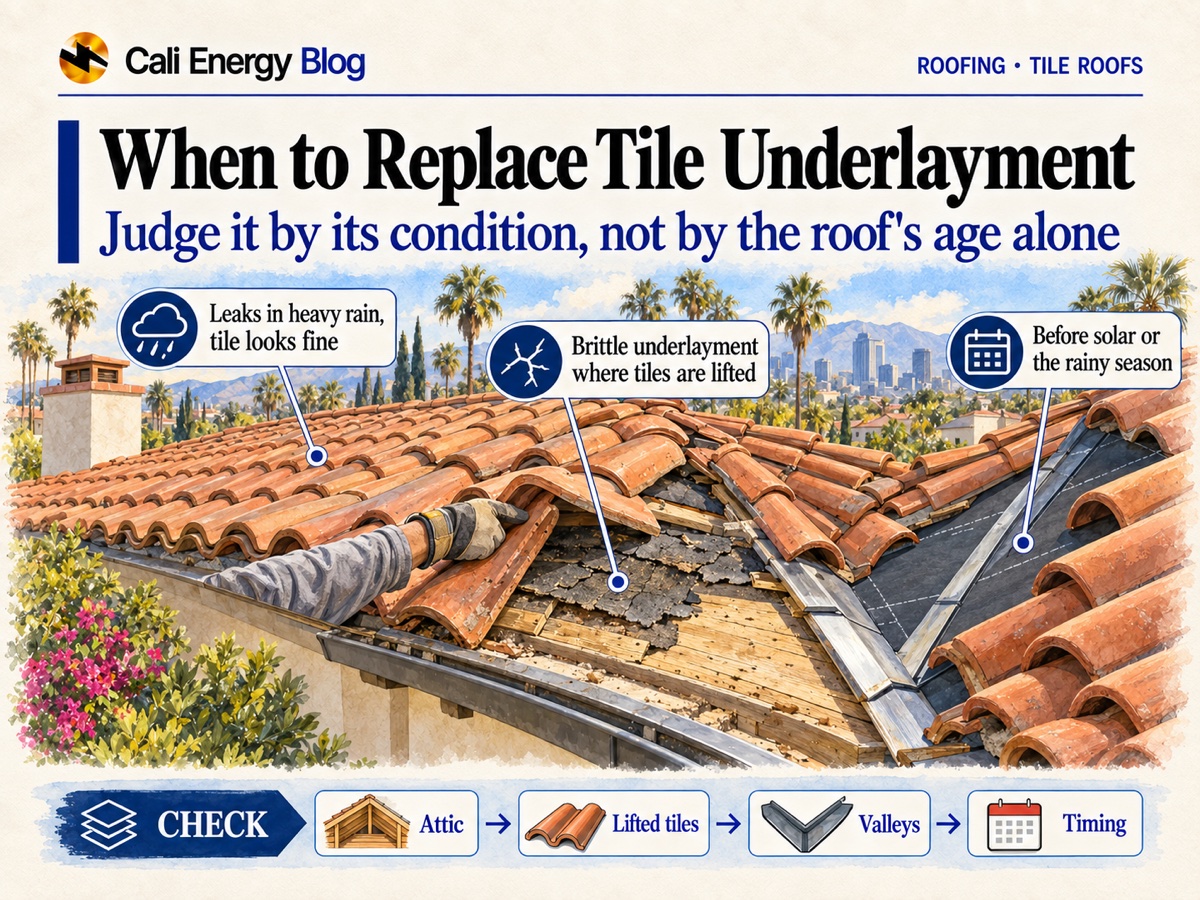
This page answers whether and when. Picking the job, from patching one spot to relaying part or all of the roof or putting on new tile, is covered in repair, relay or new tile. Tracing one particular leak is covered in where water gets into a tile roof; prices, underlayment products in depth and roofing lifespans in general are left out. Stay off the tile yourself: it cracks when stepped on, and each broken piece bares the sheet beneath.
What the underlayment does on a tile roof
Tile is a shield more than a seal. It turns away most of the rain and shades what's under it, but it isn't watertight: wind drives rain up between the pieces, water runs beneath them toward the eaves, and valleys, walls and pipes all leave gaps. The underlayment, the sheet over the wood deck under the tile and any battens, is what keeps that water off the wood. For where it sits among the other layers, see parts of a roof.
That split is why a tile roof can look perfect from the street and still leak: the worn part is the part nobody sees. It's also why the tile often has plenty of life left when the sheet under it is finished.
There's no single number of years
Ask around and you'll hear a number of years for underlayment under tile. No one number holds. What wears the sheet out differs from roof to roof, and two tile roofs built the same year can differ a lot underneath:
- The material. Asphalt-saturated felt, common on older tile roofs, dries out and stiffens with age; synthetics are plastic-based; self-adhered membranes bond to the deck and seal around the nails. Types age differently, and so do products within a type; how they compare is in roof underlayment: felt vs synthetic vs self-adhered.
- Heat. Tile soaks up the sun and holds it. Heat is what dries out asphalt-based sheets, so south- and west-facing slopes usually wear first.
- Slope. On a shallow tile roof, water moves slowly and more of it gets under the tile, so the sheet does more of the work.
- Exposure. Where a tile has slipped or broken, the sheet under it takes direct sun and rain.
- Holes and debris. Every batten and tile nail pierces the sheet, and leaves dammed behind tiles and in valleys hold water against it.
- Installation. The laps, how the sheet was turned up walls and worked into valleys and around pipes, and how often the roof has been walked on or opened since.
A warranty isn't a lifespan
A warranty doesn't answer the question either. One manufacturer's example: Westlake Royal Building Products lists TileSeal HT, a self-adhered high-temperature underlayment for tile and metal roofs, with a 30-year limited manufacturer's warranty, and gives its MetalSeal HT the same term. That is the length of a limited warranty on those products, under their own conditions. It isn't a forecast of how long the sheet will keep water out on your roof, and it says nothing about felt or any other product.
The same pages rate both sheets for up to 6 months of UV exposure, which makes the other point: underlayment is made to be covered. Where tile has slipped or broken and the sheet has sat in the sun, it's outside what it was built for, whatever the warranty says.
What the signs usually mean
Most signs can have more than one cause: a cracked tile, a rusted flashing or a valley packed with leaves can leak just like worn underlayment. The lifted tiles settle it.
| What you or the roofer see | What it usually means | What to do |
|---|---|---|
| Leaks only in heavy or wind-driven rain; the tile looks fine | The sheet no longer stops the water that hard rain drives past tile, or a flashing is letting it in | Have tiles lifted near the leak before the next storm |
| Stains or damp on the roof boards in the attic, running down a slope | Water is getting through the underlayment, or at a flashing uphill, and running along the deck | Photograph and date it; have tiles lifted uphill of it |
| Leaks at a valley, or around a chimney or skylight | Worn underlayment where water gathers, failed metal there, or both | Lift tiles at that spot and renew whichever has failed; usually a local job |
| Brittle, cracked or crumbling underlayment at most lifted spots, open slopes included | The sheet is worn across the roof, not in one place | Renew it on the whole roof, ideally before the rain; sound tile goes back |
| Brittle only where water or debris collects (an eave run, a valley, one wall); pliable on the open slopes | Local wear, often where water or debris collects | Renew that area and reset the tile; recheck the rest at the next inspection |
| Slipped or broken tiles leaving the sheet open to the sun | Sun on a sheet made to be covered; the longer it's open, the worse | Reset or replace the tiles soon and check the sheet while they're off |
| Patch after patch: sealant on tiles, odd replacement pieces, repeat leaks | Leaks fixed from the top while the layer under them kept wearing | Lift tiles away from the patches to see whether the wear is general |
| No leaks, an older roof, underlayment never checked | Age alone doesn't say; the sheet may be fine or near the end | A check with a few tiles lifted, in the dry months before the rain |
| Solar planned | Panels will sit over this layer, and renewing it later means taking them off | Check the underlayment before the layout is final; if it's worn, renew it first |
Once the answer is to renew one area or the whole roof, the tile scope guide sorts out which job that is.
What a roofer checks when lifting tiles
A useful check takes up a handful of tiles where failure starts, not one tile wherever it's convenient:
- The attic first. Stains, damp or dark wood on the underside of the deck, noted by location so the tiles lifted above match what shows inside.
- Tiles in the likely spots. A few in the bottom courses at the eaves, where a slope's water passes; in valleys, where leaves pile up; around chimneys, skylights, vent pipes and walls; on the hot south and west slopes; and above any attic stain.
- The sheet itself. Sound felt bends without cracking; worn felt snaps, flakes or crumbles, or tears at a touch. Synthetic and self-adhered sheets are checked for tears, open laps and sun damage.
- Nail holes. Whether the holes around batten and tile nails are tight or open, and whether the wood under them is stained.
- Battens and metal. Battens that are rotted, split or holding water; valley metal, pan flashings and wall flashings that are rusted, holed or loose.
- Photos of each spot, labeled by location, so you see what the roofer saw.
The pattern matters more than any one spot: wear at most lifted tiles, open slopes included, points to the whole roof; wear only where water or debris collects points to those areas. The tiles go back afterward, with cracked pieces replaced.
When it's worth doing
Replacing underlayment means taking the tile off and putting it back, so timing matters as much as condition.
- Before the rainy season. The roof is open while the tile is off, so this is dry-weather work: check in late summer, finish before the first storms. Getting the roof ready for the rainy season has the calendar.
- Before solar goes on. Once panels cover the tile, the sheet under them can be reached only by removing them. Checking first lets the mounts be flashed into new underlayment if it's due. More in solar panels on clay and concrete tile and, for panels already up, removing and reinstalling solar for a re-roof.
- When the tile is coming up anyway. A new skylight, chimney reflashing, valley work or wind repairs all take tiles off. If the sheet there is worn, renewing it then adds the least extra work.
- When buying or selling. An inspection that saw the tile from the ground and the deck from the attic says little about the sheet between them. Ask whether tiles were lifted; if not, have a roofer check before the deal is settled.
When it can wait. A pliable sheet wherever tiles were lifted, and a dry attic, mean nothing under the tile needs replacing yet. Fix slipped or broken tiles, keep the valleys clear, and recheck before a later rainy season; signs you need a new roof lists what to watch for meanwhile.
What the 2025 code says
Three sections of the 2025 California Residential Code (CRC 2025, in effect since January 1, 2026) bear on this decision:
- Underlayment is required. R905.1.1 requires it under clay and concrete tile.
- Shallow roofs get two layers. R905.3.2 sets a minimum slope of 2½:12 for tile and calls for a double layer of underlayment between 2½:12 and 4:12. A shallow tile roof leans harder on that layer, which is why the code doubles it.
- Sound tile can go back. R908.5 lets existing clay or cement tile be put back on, leaving out any piece that is damaged, cracked or broken. So worn underlayment on its own seldom means buying new tile, as long as the roof has the 2½:12 minimum slope; below it, tile can't go back on.
In a fire zone covered by the WUI code
In the zones where the 2025 California Wildland-Urban Interface Code applies, replacing the roof covering, or half of it or more within 12 months, brings in the rules for new construction. Where the tile leaves an air space over a wood deck, as most tile does, those reach the layer under the tile: a 72-lb cap sheet over the deck, or a listed Class A underlayment instead. Whether a relay of the same tile counts as a replacement of the covering is a question for your building department, best asked before anyone prices the work. More in the tile scope guide and fire class and hazard zones.
Two roofs where we renewed the underlayment
Burbank, 2023. The tile was in good shape, yet the house leaked: the water was getting through the underlayment and flashings under it. We rebuilt about 300 square feet with a self-adhered high-temperature membrane, chosen for the heat that builds up under tile, and a torch-applied membrane at the wall, tucked under the Z-bar flashing. The tile pan flashings were replaced, and the original tile was set back.
Canoga Park, 2026. A flat concrete tile roof of 26 squares (a roofing square covers 100 square feet). We took the tile up, laid new underlayment and reset the original tile; LADBS permitted it as roofing work covering all 26 squares. The solar mounts were fastened and sealed to the new underlayment while the tile was off; the tile went back around them, and the panels went on after, so the array sits over new underlayment.
We hold California contractor license #1032379 with the CSLB, classification C-39 Roofing. More finished work is under case studies, and what we do on roofs is on the Cali Energy roofing page.
Frequently asked
How long does underlayment last under tile?
Can the underlayment be replaced without buying new tile?
Does a new roof warranty cover the underlayment?
Is a leak in the first big storm a sign the underlayment is done?
Can I check the underlayment myself?
Related reading
Sources & methodology
Code sections, rules and figures on this page come from the primary sources below. Codes, local requirements and product terms change; each was verified October 8, 2026.
We'll tell you whether the underlayment under your tile is done
Call (323) 844-7777 and we'll tell you where to send photos of the roof and the attic. We lift a few tiles in the places where underlayment fails first, the eaves, valleys, walls and openings, and tell you plainly whether it's done and what to do if it is. Photos alone can't settle that: what's under the tile shows only when tiles come up.
Prepared by Cali Energy, October 8, 2026. This article is for general educational purposes only and is not legal, tax, financial, engineering, or utility advice. Rates, incentives, codes, permit requirements, equipment specifications, prices, and program terms may change; figures and timelines are estimates, not guarantees. Confirm current requirements with the applicable utility, AHJ, program administrator, manufacturer, or a licensed professional. See our Content Disclaimer. Cali Energy · 19201 Parthenia St, Unit E, Northridge, CA 91324 · CSLB #1032379 (B, C-10, C-39)