

Zone 0 and Your Roof: Status and Rules in California
Zone 0 is the first 5 feet around a house, where California law calls for an ember-resistant zone in State Responsibility Areas and in Very High Fire Hazard Severity Zones. The rules that would define it weren't in effect as of October 6, 2026: the Board of Forestry approved a final draft on August 19, 2026 and filed it with the Office of Administrative Law, then withdrew the filing on September 8. For a roof, two things matter now. In those areas the law already requires the roof to be kept clear of leaves and needles, branches to stay 10 feet from a chimney, and dead wood off any tree over the house. The final draft would add the gutters, keep live branches out from under the eaves and at least 5 feet above the roof, and keep plants out from under the eaves.
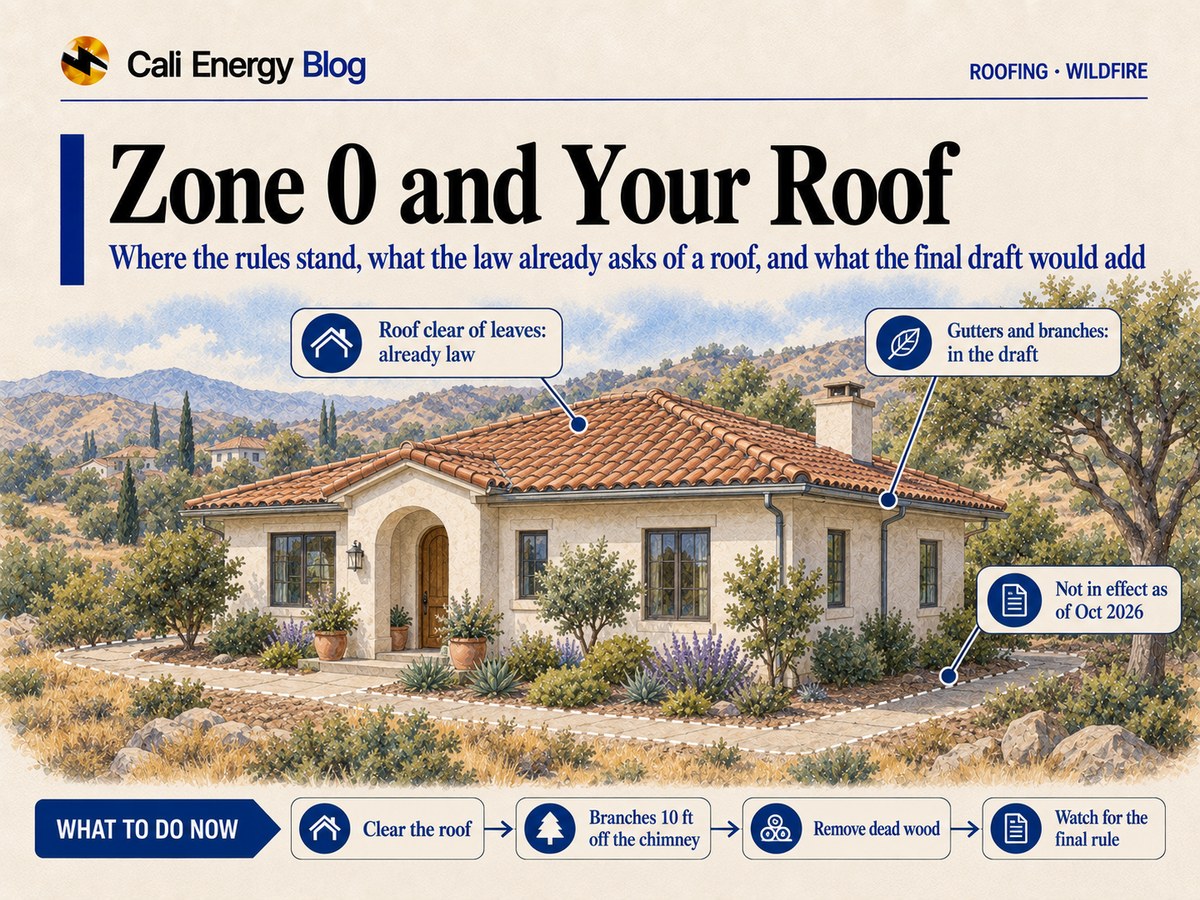
This page covers the roof, gutters and eaves. Plants, fences and the rest of the first 5 feet are in the Board's draft itself; what the wildfire building code requires of gutters, eaves and vents on a new roof is in California's WUI roofing requirements.
Where the Zone 0 rules stand
- The law (2020, amended through 2025). Public Resources Code 4291 and Government Code 51182 require an ember-resistant zone within 5 feet of a structure "based on regulations promulgated by the board." Under Public Resources Code 4291 as amended in October 2025, the requirement takes effect for new structures only once the Board updates its regulations and guidance, and for existing structures three years after that. An attached deck counts as part of the structure.
- The final draft (August 2026). The Board approved its final Zone 0 package on August 19, 2026; the rule text is dated that day.
- The filing. The package went to the Office of Administrative Law on August 28, 2026 as file 2026-0828-03E, adding sections 1298.01 to 1298.04 to Title 14 and amending 1299.01 to 1299.03. The Office lists it as withdrawn on September 8, 2026.
- Today. As of October 6, 2026, no Zone 0 filing was on the Office's list of emergency regulations under review, so none of the draft's requirements are in force.
- Enforcement. Even after the rules take effect, the law bars CAL FIRE from changing its defensible space inspections and enforcement for the ember-resistant zone until the State Fire Marshal finds the Legislature has funded it.
What the law already requires of a roof
These rules are in force now. They apply in a State Responsibility Area (Public Resources Code 4291) and, for occupied dwellings, in a Very High Fire Hazard Severity Zone designated by a local agency (Government Code 51182):
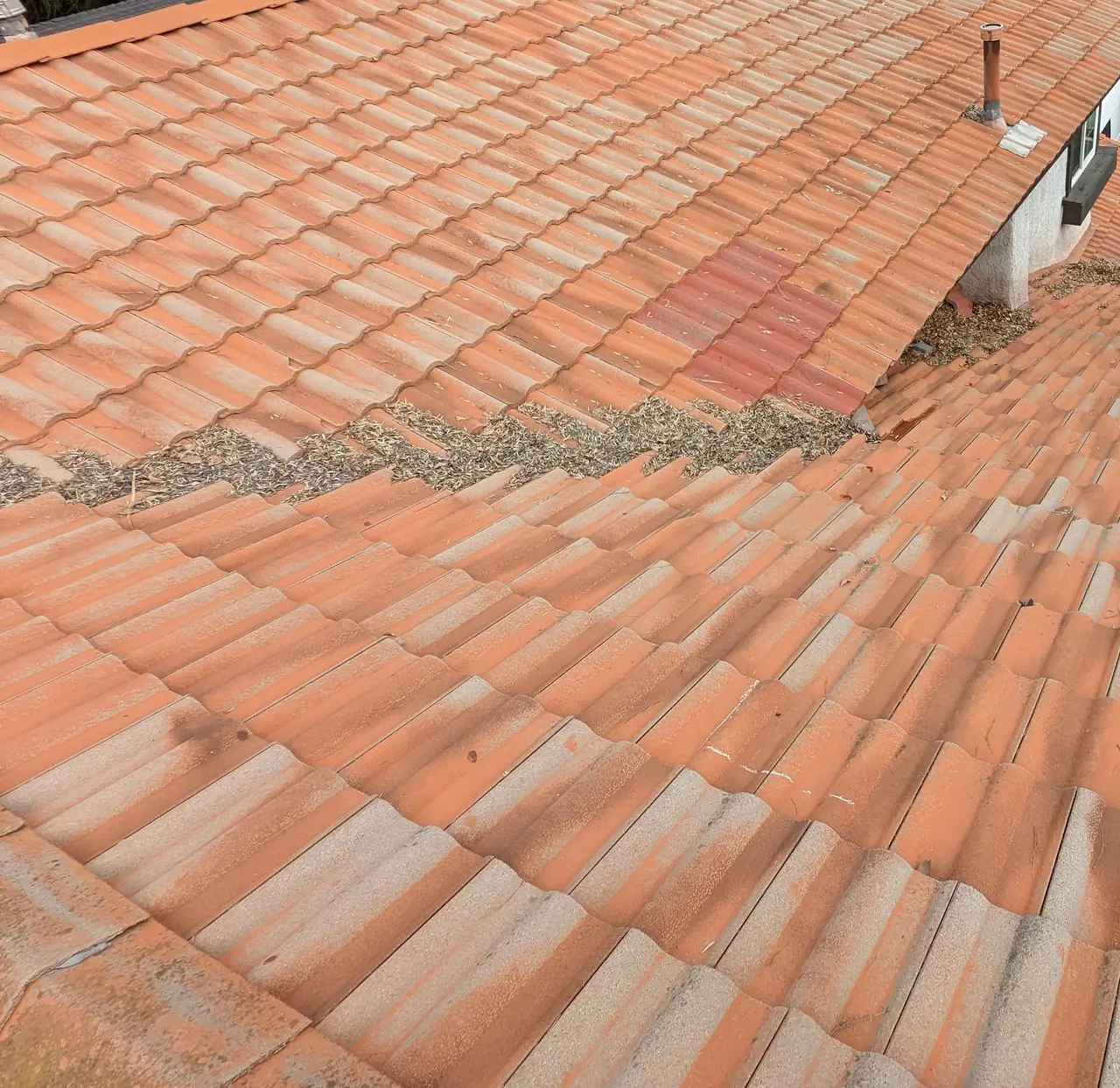
- The roof: "Maintain the roof of a structure free of leaves, needles, or other vegetative materials."
- The chimney: remove the part of any tree within 10 feet of the outlet of a chimney or stovepipe.
- Trees over the house: keep any tree, shrub or plant next to or overhanging a building free of dead or dying wood.
When to clean the roof and gutters ahead of the rains is covered in getting the roof ready for the rainy season.
What the final draft would add for the roof
These are draft rules, not rules in force, for State Responsibility Areas and local Very High Fire Hazard Severity Zones, and the timing below counts from the day they take effect.
| Rule in the draft | When, for an existing home |
|---|---|
| Roof and rain gutters of an occupied structure kept clear of leaves, needles and other combustible debris | On the effective date |
| No dead or dying branches on trees in Zone 0; live branches at least 10 feet from chimneys and stovepipe outlets and not underneath eaves | On the effective date |
| Live branches at least 5 feet above the roof, and ladder fuels within 5 feet above the roof removed where they create a high risk of fire spreading | Within 3 years |
| No vegetation under the eaves, within 1 foot of a wall where there's no eave, within 2 feet of windows, doors and vents, or within 5 feet of an attached deck | Within 3 years, or up to 5 years on a timeline the local fire agency sets |
| Outbuildings in Zone 0 only if built entirely of noncombustible materials | Within 3 years, or up to 5 years on a timeline the local fire agency sets |
New construction would have to comply as soon as the rules take effect. Existing trees can stay, trimmed to these standards, but no new trees could be planted in Zone 0. Because the phases count from the effective date, none of these clocks has started.
Local versions, including Los Angeles
The law lets a local fire agency adopt, by ordinance, alternative practices with "substantially similar practical effects" to the state rules, or rules that are stricter (Government Code 51182(f)). In the City of Los Angeles, the City Council asked its Community Forest Advisory Committee and the Fire Department to report on the state's proposals; their report of September 8, 2025 recommended exempting well-maintained vegetation and trees, an appeals process and flexibility for local inspectors. What the City ends up adopting will decide how Zone 0 is enforced there, so check with LAFD for the rules that apply to your address.
What it means for a re-roof
Zone 0 is about what's around the house; the wildfire building code covers the roof itself. Where a lot is in a fire hazard severity zone (how to check an address), new gutters have to be noncombustible with a way to keep debris out, eaves have to be built of protected materials, and vents have to resist embers (which rule covers which vent). A re-roof is the natural time to fix the edges embers find first: the gutters, the eaves and the branches over them.
Insurers already reward the first 5 feet. The Department of Insurance's Safer from Wildfires list includes a 5-foot ember-resistant zone around the house, and IBHS's Wildfire Prepared Home standard requires a noncombustible zone there (what the discounts are worth).
Frequently asked
Is Zone 0 law in California?
Do I have to clean my gutters under Zone 0?
Do I have to cut trees that hang over my roof?
When will Zone 0 apply to my house?
Does Zone 0 apply outside fire zones?
Related reading
Sources & methodology
Code sections, rules and figures on this page come from the primary sources below. Codes, local requirements and product terms change; each was verified October 6, 2026.
- California Public Resources Code §4291 (as amended by AB 1455, effective October 13, 2025)
- California Government Code §51182
- California Board of Forestry and Fire Protection, Defensible Space Zones 0, 1 and 2
- California Board of Forestry and Fire Protection, Zone 0 Regulation Summary and Rule Plead, August 2026
- California Board of Forestry and Fire Protection, Zone 0 Draft Regulations, memorandum to the Board, August 2026
- Office of Administrative Law, Recent Actions Taken on Emergency Regulations (file 2026-0828-03E)
- Office of Administrative Law, Emergency Regulations Under Review
- City of Los Angeles, Council Motion Report Back CF 10-2468-S2, September 8, 2025
- California Department of Insurance, Safer from Wildfires
- IBHS, Wildfire Prepared Home How-To Prepare Checklist
We'll check the roof, gutters and eaves for the fire rules
Call (323) 844-7777. We look at the roof, the gutters, the eaves and the vents, and tell you what the fire rules ask of each; on a re-roof in a fire zone, gutters and eaves are built to the wildfire code. Have ready the address, so the zone can be checked, and a few photos of the roof edge and gutters.
Prepared by Cali Energy, October 6, 2026. This article is for general educational purposes only and is not legal, tax, financial, engineering, or utility advice. Rates, incentives, codes, permit requirements, equipment specifications, prices, and program terms may change; figures and timelines are estimates, not guarantees. Confirm current requirements with the applicable utility, AHJ, program administrator, manufacturer, or a licensed professional. See our Content Disclaimer. Cali Energy · 19201 Parthenia St, Unit E, Northridge, CA 91324 · CSLB #1032379 (B, C-10, C-39)