

How Do Pipe Boots and Vent Flashing Leak?
Usually through the boot itself, or through the way it was put in. GAF's guide for homeowners puts vent pipe leaks down mostly to damage to the collar or flashing around the pipe, which can degrade with exposure to the elements or be damaged by debris. Other leaks come from the installation: a flashing whose lower edge is tucked under the shingles instead of lying on top of them, nails through the part water runs over, or no flashing at all, just shingles cut around the pipe and caulked. California's residential code requires flashing around every opening in a roof, and on a shingle roof it says vent pipe flashing goes in to the shingle maker's instructions (CRC R903.2.1 and R905.2.8.4). A leak at a pipe tends to show in every rain, not only in storms, close to the pipe in the attic.
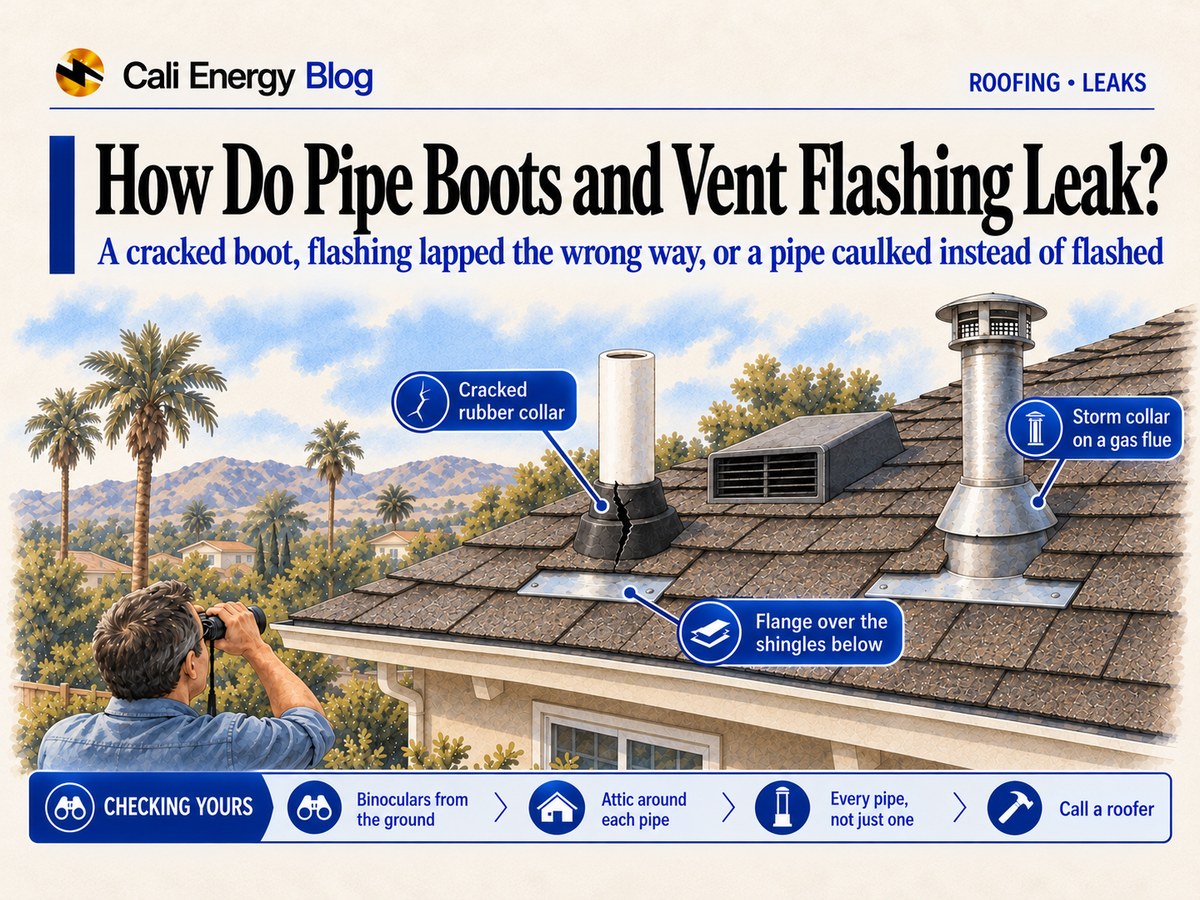
How a pipe flashing is supposed to sit
The asphalt roofing industry's manual lays out the sequence for a vent pipe through shingles (Asphalt Roofing Manufacturers Association, ARMA). The shingles go up to the pipe, a shingle cut to fit over the pipe is set in roof cement, and the boot, a preformed flange that fits snugly around the pipe, goes over it, also set in cement, with a bead of compatible sealant where the pipe meets the collar. The shingles above then continue around it. When it's done, the lower part of the flange lies over the shingles below, and the shingles at the sides and above lie over the flange, so water running down the roof crosses the flange and comes back onto the shingles. No nail goes closer than 2 inches to the pipe.
A gas flue, such as the vent from a water heater or furnace, follows the vent maker's instructions. DuraVent's for its Type B gas vent put the lower part of the roof flashing over the roofing and the upper part under it, nail only through the upper part and sides, and add a storm collar over the gap between the pipe and the flashing, sealed with non-hardening silicone.
What goes wrong, and how it looks
Most of these can be seen from the ground with binoculars, or from the attic.
| Problem | What you see from the ground or in the attic | What fixes it |
|---|---|---|
| Cracked or split rubber collar | Cracks or a gap where the collar meets the pipe; wet wood right around the pipe in the attic | A new boot |
| Flashing lapped the wrong way | The flange sitting on top of the shingles above it, or its lower edge hidden under the shingles below | Re-flashing with the laps reversed |
| Nails in the wrong place | Nail heads in the lower part of the flange, or close to the pipe | Re-flashing, with nails only where the shingles cover them |
| No flashing at all | A ring of caulk where the shingles were cut around the pipe | A proper boot |
| Storm collar on a gas flue loose or unsealed | The collar slid down, or a gap between it and the pipe | Resetting and resealing the collar to the vent maker's instructions |
GAF warns that caulk alone around a pipe wears away or cracks with changing temperatures and sun. A bead of sealant is part of a correct installation; it isn't a substitute for the flange.
Checking yours
- From the ground. With binoculars, look at each pipe and vent: the collar, the edges of the flange, any caulk, and on a gas flue, the storm collar. ARMA's manual calls for checking the flange for cracks once a year.
- In the attic. GAF suggests feeling for soft or damp spots on the underside of the deck. Around a pipe, look at the wood and insulation right next to it; water at a boot can run down the pipe or along the deck close by. How to trace a wet trail uphill is in how to find a roof leak.
- Every pipe, not just one. A roof can have several plumbing vents, flues and attic vents; the one above the stain may not be the one that leaks.
- Not the pipe at all? If the stain grows on dry days, it may be the plumbing or the air conditioner's condensate line rather than the roof, as covered in ceiling water stain: roof, plumbing or AC.
Replacing a boot
A roofer lifts the shingles above and beside the pipe, takes off the old flashing, sets the new one in the order ARMA describes and lays the shingles back over its sides and top. Boots range from ones with a rubber collar to all-metal ones; GAF, for example, sells a metal boot for slopes of 3:12 to 12:12 with no seals or gaskets to wear out. Match the boot to the pipe size and the roof's slope.
During a re-roof, California's code requires existing flashings, vents and similar devices to be replaced where they're rusted, damaged or deteriorated (CRC R908.5), and ARMA's manual says the same of pipe flashings; one in good condition can stay, with the new shingles worked under its lower flange and no nails driven inside its outer edge. On a tile roof, a pipe needs two flashings, one at the deck and one at the tile, as covered in why a tile roof leaks when the tiles look fine. Solar mounts are penetrations too, with their own flashing, covered in how a solar mount is sealed.
What we've seen on our jobs
On a Granada Hills shingle roof in November 2025, the existing vent pipes and flue that sat where the array was going were re-flashed while the roof was open, rather than worked around. Old pipe flashings on a roof of any age are frequently the first thing to fail, and once modules cover them they are much harder to reach (the Granada Hills case). Moving a pipe is a different job: on a 2025 Simi Valley roof crowded with turbine vents, plumbing stacks and flues, the array was laid out around them, because plumbing stacks come up where the drains are and relocating them is separate work with its own permit and its own holes in the roof (the Simi Valley case).
Frequently asked
How long does a pipe boot last?
Can I seal a cracked boot with caulk?
What is a storm collar?
Should the pipe boots be replaced with a new roof?
Is a leak at a pipe urgent?
Related reading
Sources & methodology
Code sections, rules and figures on this page come from the primary sources below. Codes, local requirements and product terms change; each was verified October 8, 2026.
- Asphalt Roofing Manufacturers Association, Residential Asphalt Roofing Manual: Design and Application Methods, 2014 edition (Chapter 10, Soil…
- California Residential Code 2025, Chapter 9, Roof Assemblies (R903.2.1, R905.2.8.4, R908.5)
- GAF, How to Spot and Prevent Roof Vent Pipe Leaks (June 29, 2023)
- DuraVent, Model BV Type B Gas Vent Installation Instructions (2024)
We check every pipe and vent through your roof
Call (323) 844-7777. We look at every pipe and vent through the roof, not only the one above the stain, and replace worn boots and flashings with the shingles lapped the right way around them. Have ready where the water shows inside and any photos of the roof from the ground.
Prepared by Cali Energy, October 8, 2026. This article is for general educational purposes only and is not legal, tax, financial, engineering, or utility advice. Rates, incentives, codes, permit requirements, equipment specifications, prices, and program terms may change; figures and timelines are estimates, not guarantees. Confirm current requirements with the applicable utility, AHJ, program administrator, manufacturer, or a licensed professional. See our Content Disclaimer. Cali Energy · 19201 Parthenia St, Unit E, Northridge, CA 91324 · CSLB #1032379 (B, C-10, C-39)