

Roof Age and Home Insurance in California
No California law sets a maximum roof age for home insurance. Each insurer writes its own rules and files them with the state, and the roof's age can decide whether a company will write or renew the policy, whether damage to the roof is paid at replacement cost or at a depreciated value, and, at the California FAIR Plan, whether an older house gets replacement-cost coverage at all. Today the law controls how you're told, not why: a nonrenewal notice must arrive at least 75 days before the policy ends and give the specific reason. From January 1, 2028, a new law, SB 1301, bars an insurer from turning a house down on roof age alone if the owner gets an independent inspection showing at least five years of roof life left.

This page covers how roof age affects getting and keeping a policy and how an older roof is paid in a claim. It isn't legal advice or a reading of any particular policy: your declarations page and endorsements say how your roof is covered. What makes a roof fire-rated is in Class A roof ratings.
What the largest insurers' filed rules say
Insurers admitted in California disclose their underwriting guidelines, the rules for which homes they will and won't cover, in their rate filings with the state. In May 2026 the San Francisco Chronicle compiled the roof rules from the guidelines of the 20 largest home insurers in the state, which together collected 90% of home insurance premiums in 2024. Some set a hard age limit, some keep the house but pay for an older roof at its depreciated value, some cover an old roof only against fire and lightning, and several judge the roof by its condition rather than a number. Tile, slate and metal often get longer limits or none.
| Insurer | Shingle roofs | Tile, slate or metal |
|---|---|---|
| Mercury | No more than 25 years old | Slate and tile exempt from the age limit |
| Liberty Mutual (LM General, Safeco) | Asphalt or composite shingle over 25 years is a restricted roof | Not stated in the quoted rule |
| Allstate (Integon) | Over 20 years: ineligible | Slate and tile exempt |
| Allstate (Encompass) | Composition over 15 years restricted for new policies | Not stated in the quoted rule |
| American Family | Asphalt shingle and several other types, including aluminum and tin, replaced within the last 20 years | Roof types not on that list: within the last 40 years |
| Lemonade | Replaced within the last 20 years | Concrete or clay tile and metal: 25 years; slate: 50 |
| Pacific Specialty | 20 years or less to qualify; a roof not replaced within 25 years is covered for fire and lightning only | Clay or concrete tile and standing-seam metal: no age limit to qualify |
| Farmers | 15 years or older: wind and hail damage to the roof surface is paid at actual cash value only | Not stated in the quoted rule |
| The Hartford | Over 20 years: accepted with an actual-cash-value roof endorsement | One of its two rulebooks excepts "lifetime" roofs |
| Sutton | 20 to 25 years: actual cash value; 25 and older: the roof is covered for fire or lightning only | Tile in good condition excepted |
| Travelers | Not eligible after a wind, hail, water or fire loss in the past 15 months if the roof is over 25 years old | Tile, slate and similar "lifetime" roofs excepted |
| State Farm, CSAA, USAA, Wawanesa | No age number in the quoted rules: condition, layers or material decide | Same |
Two other things come up often in these rules. Wood roofs are declined or restricted by many of the same companies, and the City of Los Angeles no longer allows new wood shake at all (LABC 91.1505.1). And layers count: Mercury's guideline rules out more than one layer of roofing, and Travelers, Lemonade and American Family rule out more than two, so a new layer laid over an old one can cost the eligibility a tear-off keeps.
The guidelines change with each filing, so ask the insurer or your agent for the current rule before acting on this table.
Where an insurer gets your roof's age
Not always from you. Verisk, an insurance data company, sells a roof-age product that combines building-permit records from BuildFax with other property data, and Metromile's filed guideline names BuildFax as its source of roof age, validated by the customer. Sutton's says roof age comes from an underwriting tool that an agent can correct, and that underwriters check disputed age or condition with aerial photos usually taken within six months of the policy date. Pacific Specialty's requires the signed application to state the roof's age, or the roof is covered for fire and lightning only. Farmers expects an owner who replaced the roof to have documents showing the year.
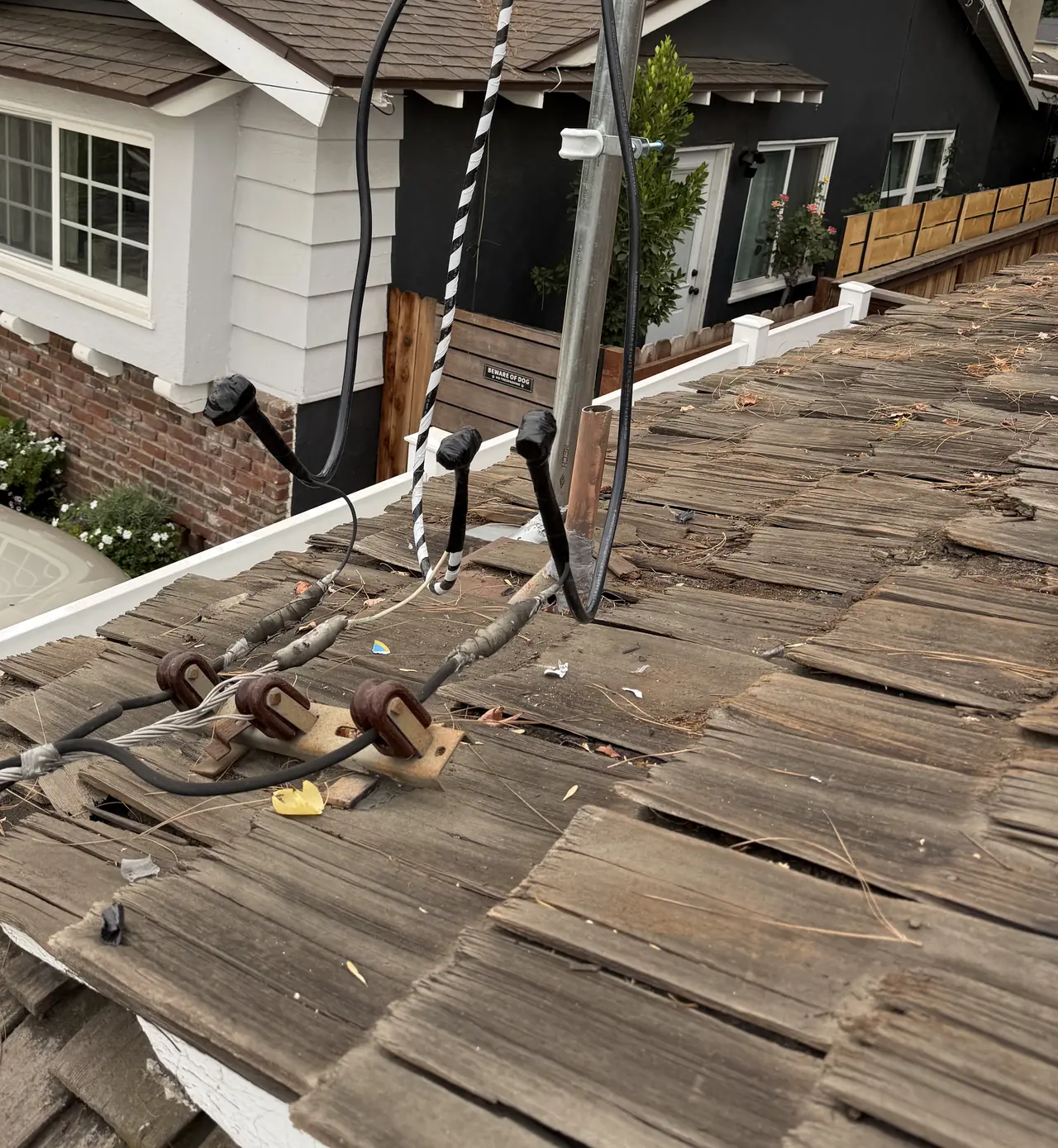
That makes a finaled permit the record that matters: it's what permit-based roof data reads, and it carries a date. In the City of Los Angeles the date is in the LADBS permit record (how to check a re-roof permit); keep the contract and the final invoice with it. On the Woodland Hills house in the photo above, which we re-roofed in October 2025, the re-roof permit went from application to final in 12 days, and that put the new roof's date on the public record.
Photos from the air are the other source. The California Department of Insurance said in March 2025 that it had investigated numerous complaints in which flawed aerial images led to wrongful cancellations or nonrenewals, including imprecise drone or satellite photos used to judge roofs. Bills to regulate insurers' aerial images, AB 75 in 2025 and AB 1559 in 2026, didn't become law.
How an older roof is paid in a claim
If your policy pays actual cash value, California law measures it as the cost to repair or replace minus a fair and reasonable deduction for physical depreciation, based on the condition at the time of the loss, and the deduction applies only to parts of a house that are normally repaired and replaced during its life (Insurance Code §2051). A roof is such a part, so the older and more worn it is, the more comes off.
On a replacement-cost policy that requires the work to be done first, the insurer pays actual cash value up front and the rest once the roof is replaced, and it can't give you less than 12 months from that first payment to do it, or 36 months after a declared state of emergency (§2051.5). Some insurers attach an endorsement that settles the roof itself at actual cash value even on a replacement-cost policy: in the filed rules above, Farmers does it for wind and hail damage on asphalt roofs 15 years or older, and The Hartford for roofs over 20 years. Your declarations page and endorsements show whether yours has one. Which roof damage a policy covers in the first place, and how matching and code upgrades figure in the payout, is in does insurance cover roof replacement?
Your rights today if the roof is the reason
Until 2028, nothing in the Insurance Code stops an insurer from declining or not renewing a house because of the roof's age. What the law controls is how you're told:
- 75 days. A notice of nonrenewal has to reach you at least 75 days before the policy ends and state the specific reason. If it's late, the policy stays in force for 75 days from the date the notice is delivered or mailed (Insurance Code §678).
- In writing. When an insurer declines, cancels or doesn't renew a homeowners policy, it has to give the specific reasons in writing at the time of the decision (§791.10).
- Mid-term is different. Once a policy has been in force 60 days, or right away on a renewal, the insurer can cancel it only for the reasons the law lists: nonpayment, certain crimes, fraud or material misrepresentation, gross negligence that increases the hazard, or physical changes that make the property uninsurable (§676). Roof age isn't on that list.
- A review. The notice must say that if you've contacted the insurer and are still unsatisfied, the Department of Insurance can review the matter: insurance.ca.gov, (800) 927-HELP (4357).
- Your wildfire score. Insurers that score your home's wildfire risk have to give you that score before a renewal or nonrenewal, and you can appeal it, under the Department of Insurance's Safer from Wildfires rules.
What changes on January 1, 2028
SB 1301, signed on September 27, 2026 (Chapter 693, Statutes of 2026), rewrites the nonrenewal rules for homeowners policies starting January 1, 2028:
- Roof age alone isn't enough. An insurer can't refuse to issue or renew a policy, or decide eligibility, solely on the roof's age if you get and pay for an independent roof inspection confirming at least five years of useful roof life remaining. It may still take roof age into account, and the law doesn't define who counts as an independent inspector. How a remaining-life estimate is put together is in how much life is left in your roof.
- More time. A nonrenewal notice has to arrive at least 90 days before the policy ends. If the problem is one you can fix, the insurer has to tell you at least 120 days ahead what would qualify you for renewal, give you at least 90 days to do it, and answer in writing within 15 days of receiving your evidence. Work done as explained and verified by the insurer qualifies you for renewal.
- The evidence. The insurer has to explain the grounds in plain language and give you the non-aerial images it relied on, and, on request, its inspection findings or reports within 15 days.
- A way to dispute it. You can dispute or correct the information the insurer relied on, and if the dispute is about the condition of the house, ask for an on-site inspection. The insurer must acknowledge your dispute within 10 days and decide in writing within 30.
- Claims. An insurer can't refuse to renew solely because of a claim that wasn't paid, fell within your deductible or wasn't covered, or a claim whose cause has been repaired, with exceptions, nor because you asked about your coverage.
None of it applies before January 1, 2028.
The FAIR Plan and an old roof
The California FAIR Plan is the state's insurer of last resort, for homes that can't get coverage elsewhere. Its dwelling policy covers only the causes of loss it names, fire and lightning, an explosion inside the building and smoke, with others such as vandalism available at extra cost; a Difference in Conditions policy from a private insurer can fill the gaps. Roof age matters there too:
- Replacement cost. Dwelling replacement cost is included automatically for a house 25 years old or newer. For an older house, the FAIR Plan's application (form revision 01/2021) offers it only if the roof was replaced in the last 25 years, and asks for the year. Otherwise a partial loss is paid at actual cash value, minus depreciation on the parts normally replaced during a house's life (policy form CFP 00 01, May 2026).
- Discounts. Since November 15, 2025, the FAIR Plan has offered up to 12 wildfire discounts. A Class A roof, meaning fiberglass composition shingle, stone, concrete or clay tile, or metal, is one of them, and a dwelling that earns all 12 may see up to 16.4% off the wildfire portion of its premium.
- A way back. Unless you opt out, the FAIR Plan may share your policy information with insurers in its clearinghouse program, which may offer to move you to a regular policy. Under the Department of Insurance's Sustainable Insurance Strategy, homes that take the Safer from Wildfires steps get priority in moving back to the regular market.
If a notice blames your roof
1. Check the date and the reason. The notice should arrive at least 75 days before the policy ends, with the specific reason in writing. If either is missing, call the insurer, then the Department of Insurance.
- Ask what would keep the policy. Ask the insurer or your agent whether a repair, an inspection report or a replacement would qualify you for renewal, and get the answer in writing.
- Have the roof inspected. A roofer can tell you, with photos, whether the problem is a few repairs, such as debris, a damaged section or loose flashing, or the end of the roof's life. Signs you need a new roof and repair or replace cover that decision.
- Shop now, not at day 74. The rules differ by company, as the table shows: a 27-year-old shingle roof one insurer won't take, another may write with the roof at actual cash value. The notice comes with information on the Department of Insurance's Home Insurance Finder.
- If you replace the roof, choose a Class A covering, tear the old roof off rather than adding a layer, get the permit finaled and send the insurer the date and the paperwork. A Class A roof is one of the Safer from Wildfires steps that qualify for a discount, and it counts toward the FAIR Plan's discounts.
- As a last resort, the FAIR Plan plus a Difference in Conditions policy.
A tile roof is judged differently. Several of the filed rules exempt clay and concrete tile from age limits, but the underlayment under the tile usually wears out well before the tile does; when to replace tile roof underlayment covers how to tell.
Frequently asked
Is there a maximum roof age for home insurance in California?
Can my insurance company drop me because my roof is old?
How much notice does my insurer have to give before not renewing?
Will a new roof lower my home insurance premium?
Does the FAIR Plan cover an old roof?
Who can do the independent roof inspection the 2028 law mentions?
Does my insurer have to show me the photos it used?
Related reading
Sources & methodology
Code sections, rules and figures on this page come from the primary sources below. Codes, local requirements and product terms change; each was verified October 7, 2026.
- SB 1301 (Allen), Residential property insurance: nonrenewals, Chapter 693, Statutes of 2026
- Office of the Governor, legislative update, September 27, 2026
- California Insurance Code §678 (offer of renewal and notice of nonrenewal)
- California Insurance Code §676 (grounds for cancellation)
- California Insurance Code §791.10 (reasons for an adverse underwriting decision)
- California Insurance Code §2051 (actual cash value)
- California Insurance Code §2051.5 (replacement cost)
- San Francisco Chronicle, Here are exactly what roof types California's 20 largest insurers won't cover, May 24, 2026
- California FAIR Plan, Dwelling policies
- California FAIR Plan, Dwelling New Business Application, revision 01/2021
- California FAIR Plan, Optional Dwelling Replacement Cost Addendum for properties more than 25 years old
- California FAIR Plan, Dwelling Property Policy, CFP 00 01 (05/2026)
- California FAIR Plan, Wildfire Hardening Discounts, November 2025
- California FAIR Plan, Clearinghouse Disclosures
- California Department of Insurance, FAQ: Safer from Wildfires Regulation, September 2026
- California Department of Insurance, California's Sustainable Insurance Strategy, October 14, 2025
- California Department of Insurance, Commissioner Lara supports legislation on insurers' use of aerial imagery, March 28, 2025
- CalMatters Digital Democracy, AB 75 and AB 1559 (residential property insurance images), bill status
- Verisk, Roof Age
- Los Angeles Building Code 2026, Chapter 15, 91.1505.1 (UpCodes)
We'll inspect the roof and tell you what it needs
Call (323) 844-7777. We inspect the roof, photograph what we find and tell you whether it needs repairs or replacement. If it's replaced, we pull the permit and see it through final inspection, so the new roof's date is on the city's record. Have ready the notice from your insurer, if you got one, and any papers from the roof's last replacement.
Prepared by Cali Energy, October 7, 2026. This article is for general educational purposes only and is not legal, tax, financial, engineering, or utility advice. Rates, incentives, codes, permit requirements, equipment specifications, prices, and program terms may change; figures and timelines are estimates, not guarantees. Confirm current requirements with the applicable utility, AHJ, program administrator, manufacturer, or a licensed professional. See our Content Disclaimer. Cali Energy · 19201 Parthenia St, Unit E, Northridge, CA 91324 · CSLB #1032379 (B, C-10, C-39)