

Tile Roofs and Earthquakes: Lessons From Northridge
Not when the tile is properly fastened and the framing was built to carry it. After the January 1994 Northridge earthquake, a damage assessment prepared for the U.S. Department of Housing and Urban Development, built on a random survey of homes around the epicenter, found roof tile damage infrequent and scattered across the San Fernando Valley; in the worst case it documented, poorly attached tiles slid down the roof. Damage to roof framing was rare too, and in the extremely rare roof collapse it photographed, the report pointed to rafter ties not sized and spaced for a tile roof's added weight as the more likely cause. Today's California Residential Code requires a fastener on every tile around a roof's edges, hips and ridges, and on every tile laid directly on a solid deck. After a quake, check for slipped tiles, hip and ridge pieces out of line, the chimney and the attic.
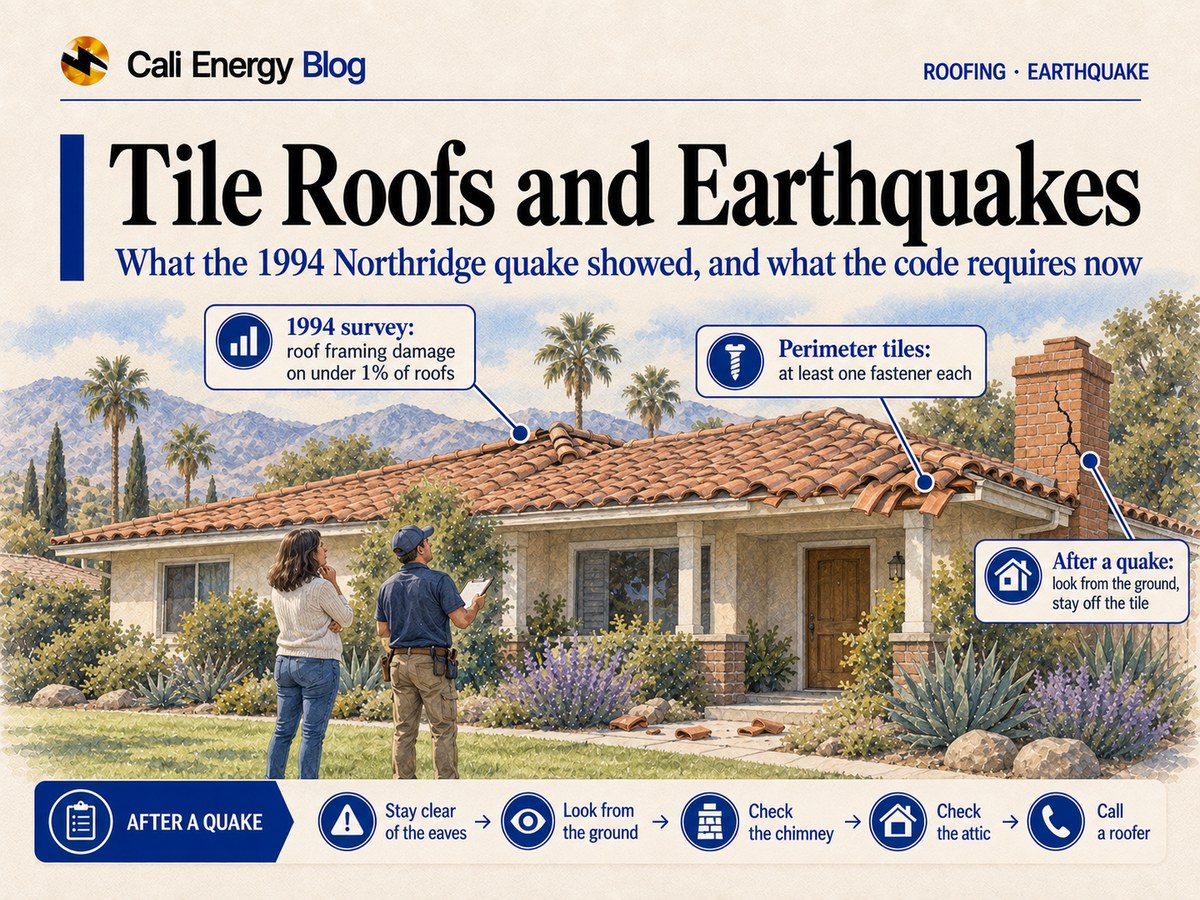
What the 1994 survey found
The earthquake struck at 4:31 a.m. on January 17, 1994, at magnitude 6.7, near Northridge. Teams from the NAHB Research Center, each with a City of Los Angeles building inspector, surveyed 341 single-family homes, picked as a random sample from property tax records in the ZIP codes within or touching a 10-mile radius of the epicenter, then studied badly damaged houses case by case.
| Part of the house | What the survey found |
|---|---|
| Roof framing | Low damage on fewer than 1 percent of roofs, none moderate or high in the sample; where roof framing was damaged, it most often followed alterations that modified, removed or overloaded the rafter ties |
| Roof tile | Infrequent and scattered across the San Fernando Valley; the worst case was poorly attached tiles that loosened and slid down the roof onto each other |
| Masonry chimneys | Fairly common and widespread, from leaning to collapsed; a moving chimney often damaged the finishes and roof framing around it, and leaning or cracked chimneys were a major reason homes were red- or yellow-tagged |
| Walls | Low damage on about 2 percent; in one example, heavy roofing added to the load on a wall with a garage door opening |
| Finishes | About half of homes had at least minor damage, mostly cracked stucco, drywall and plaster; 4 percent or less was moderate to high |
| Foundations | Moderate to high damage on fewer than 2 percent, mostly from local ground conditions and hillside sites |
The report also noted that prefabricated wood chimneys with steel flue pipe performed very well. How the City of Los Angeles lets an earthquake-damaged masonry chimney be rebuilt today is in chimney flashing leaks.
What shake-table tests found
After the earthquake, the National Tile Roofing Manufacturers Association commissioned tests at the University of Southern California, and the tile industry's association publishes a summary. Twenty-four full-scale tile roof panels, installed by professional roofers to the Uniform Building Code of the time, were shaken on the university's dual shaking tables at increasing accelerations, in two horizontal directions. All of them held beyond the 0.8 g design level the authors derived from the code, at more than one and a half times that level. Where performance was limited, it was mostly by unfastened field tiles on slopes below 12:12; tiles fastened with nails and wire nose clips held to 1.6 g, and in many tests the equipment, not the tile, set the limit.
The study was funded by the industry and tested roof panels, not whole houses, so it speaks to the tile and its fastening, not to the rest of the house's framing.
What California's code requires now
Tile on a California house goes on under the 2025 California Residential Code, and a re-roof follows the same roofing rules (R908.1).
- A solid deck. Clay and concrete tile go over wood structural panels or solid lumber sheathing; spaced boards are allowed only in Seismic Design Categories A, B and C (R905.3.1). The building department can tell you which category applies to your address.
- Fastened edges. Every perimeter tile gets at least one fastener, and the perimeter covers three tile courses, but not less than 36 inches, from hips, ridges, eaves and gable rakes (R905.3.7, R905.3.8).
- Fastened field tiles, depending on the deck and slope: one fastener per tile on a solid deck without battens; on battens, none required below 5:12, one per tile in every other row from 5:12 to 12:12, and one per tile from 12:12 to 24:12. Tiles lighter than 9 pounds per square foot get one per tile at any slope (R905.3.8).
- Fasteners and wire. Corrosion-resistant nails at least 11-gage with a 5/16-inch head, reaching 3/4 inch into the deck or through it, and tile wire at least 0.083 inch (R905.3.7).
- Framing that carries it. The roof structure has to support the roof covering (R908.2). For houses built to the code's prescriptive seismic rules in Seismic Design Categories D0 to D2, the roof and ceiling together may weigh up to 15 pounds per square foot, or up to 25 if the wall bracing is increased (R301.2.2.2).
In the City of Los Angeles's High Wind Velocity Areas, boundary tiles also get nails or ties and a bead of mastic, as described in Santa Ana winds and your roof.
The case to check is going from a lighter covering to tile. The 1994 lesson was framing that wasn't sized for tile's weight or had been altered since, so before switching, have the rafters, the rafter ties and the wall bracing checked. How tile's weight compares with other coverings is in can you replace a tile roof with something lighter?, and the permit routes in the City of Los Angeles are in do you need a permit to replace a roof in Los Angeles.
After an earthquake: what to check, in order
1. Keep out from under the eaves and away from the chimney until you've looked. Loose tiles can slide off the edges, and a cracked or leaning masonry chimney can come down.
- Look from the ground for slipped, broken or missing tiles, gaps in the courses, and hip and ridge pieces out of line, and photograph them with the date.
- Check the chimney for leaning, cracks or damage to the roof around it.
- Check the attic and ceilings. The 1994 survey's signs of roof-structure damage were a ridgeline that sags, rafters and bracing that show movement or stressed connections, and walls bowing outward under a settling roof. Look for daylight too, and for stains after the next rain.
- Stay off the tile. The tile industry's association recommends a trained roofing professional for getting on a roof, notes that most manufacturers don't warrant breakage from foot traffic, and advises replacing broken tiles soon to protect the underlayment.
- Bring in the right people. A roofer resets slipped tiles and fastens them to current rules, as described in cracked and slipped roof tile repair; a sagging ridge or framing that moved is a question for a structural engineer and the building department.
Insurance after an earthquake
A standard homeowners policy generally doesn't cover earthquake damage, even indirect damage; the main exception is fire, and some policies cover explosion, theft or breaking glass caused by an earthquake. The California Department of Insurance still says to read your policy and contact your insurer whenever an earthquake damages your property. Earthquake damage takes a separate earthquake policy, which your homeowners insurer has to offer you in writing every other year. On a California Earthquake Authority homeowners policy, the deductible is 5 to 25 percent of the dwelling coverage limit (15 percent at the lowest for some homes), and the first $1,500 of emergency repairs to prevent further damage carries no deductible. The claim steps are in how to file a roof insurance claim in California.
Frequently asked
Are tile roofs dangerous in an earthquake?
Does a heavy tile roof make earthquake damage to the house more likely?
Do roof tiles have to be nailed in California?
Does homeowners insurance cover tiles broken in an earthquake?
Should I replace my tile roof with something lighter because of earthquakes?
Related reading
Sources & methodology
Code sections, rules and figures on this page come from the primary sources below. Codes, local requirements and product terms change; each was verified October 8, 2026.
- NAHB Research Center for the U.S. Department of Housing and Urban Development, Assessment of Damage to Residential Buildings Caused by the…
- Yan Xiao and Henry W. Yun, University of Southern California, A Summary of Experimental Studies on Seismic Performance of Concrete and Clay…
- TRI Alliance, Technical Brief 2014-02, Walkability on Concrete and Clay Roof Tiles
- California Residential Code 2025, Chapter 9 Roof Assemblies, R905.3.1, R905.3.7, R905.3.8, R908.1 and R908.2 (UpCodes)
- California Residential Code 2025, Chapter 3 Building Planning, R301.2.2 and R301.2.2.2 (UpCodes)
- California Department of Insurance, Earthquake Insurance (revised April 25, 2024)
- California Earthquake Authority, Homeowners Coverages and Deductibles
We check a tile roof after a quake and refasten what moved
Call (323) 844-7777. We're based in Northridge. We inspect the tile, hips and ridges, the chimney and the attic, photograph what moved, reset and fasten slipped tiles to current rules, and tell you when the framing needs an engineer's look. Have ready the date of the earthquake and your policy details if you carry earthquake coverage.
Prepared by Cali Energy, October 8, 2026. This article is for general educational purposes only and is not legal, tax, financial, engineering, or utility advice. Rates, incentives, codes, permit requirements, equipment specifications, prices, and program terms may change; figures and timelines are estimates, not guarantees. Confirm current requirements with the applicable utility, AHJ, program administrator, manufacturer, or a licensed professional. See our Content Disclaimer. Cali Energy · 19201 Parthenia St, Unit E, Northridge, CA 91324 · CSLB #1032379 (B, C-10, C-39)