

Roof Flashing Types and Where Each Goes
Flashing goes wherever the roof covering stops or is broken: along walls, in valleys, around chimneys, skylights and pipes, and at the eaves and rakes. The 2025 California Residential Code requires it where a roof meets a wall, wherever the slope or direction changes and around roof openings, plus a flashing that turns water away where an eave meets a sidewall; metal flashing has to be corrosion-resistant and at least 0.019 inch thick, the thickness of No. 26 galvanized sheet (R903.2.1). Each kind has its own job: step flashing laid in with each course along a sidewall, at least 4 by 4 inches; counterflashing lapped over it from the wall; a continuous strip where a slope runs into a wall; valley linings, 24 inches wide when they're open metal; drip edge at the eaves and rakes; and a cricket behind any chimney wider than 30 inches. On a re-roof, the code has the flashings rebuilt to the manufacturer's instructions (R908.6).
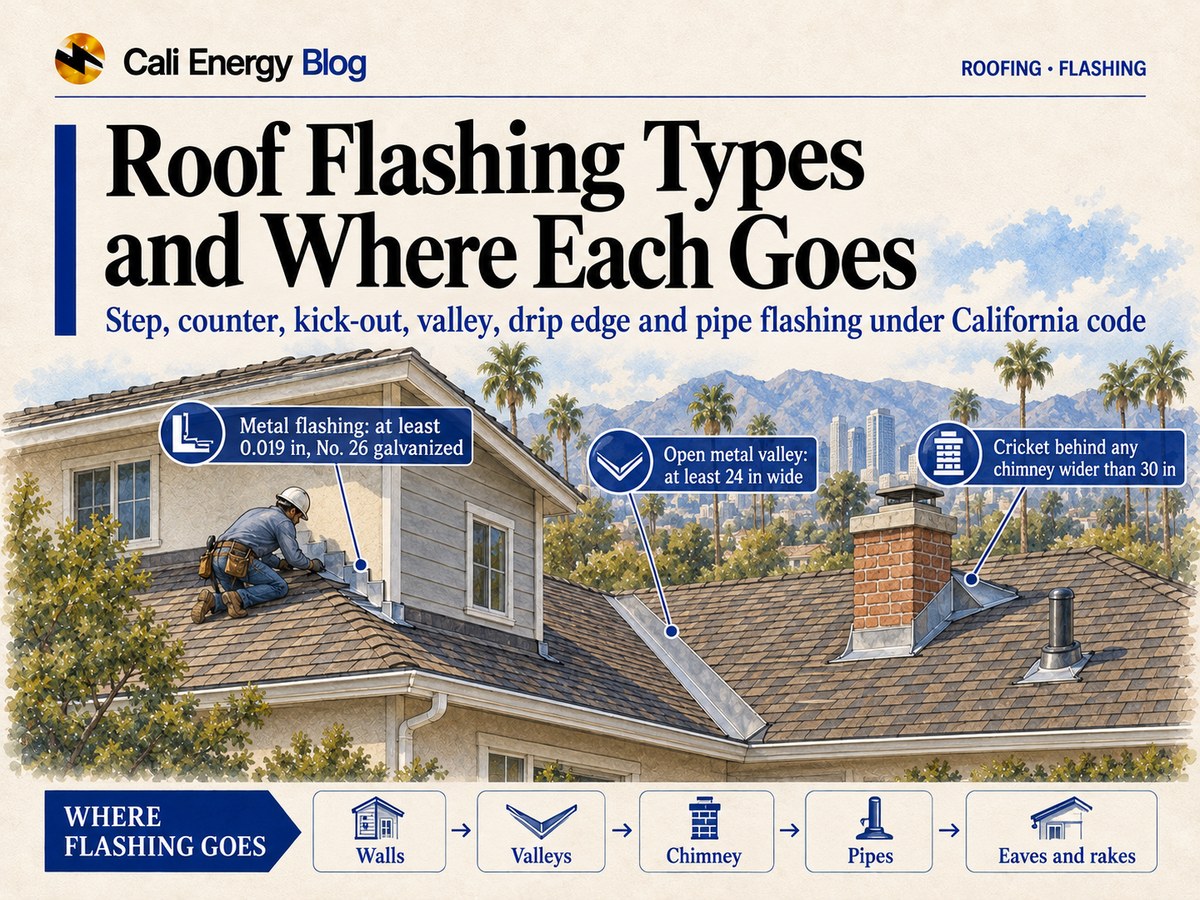
Flashing types at a glance
The rules below are for asphalt shingle roofs unless marked; tile has its own valley rule.
| Flashing | Where it goes | What the code or ARMA asks |
|---|---|---|
| Step flashing | Where a sloped roof runs along a sidewall | Continuous or step base flashing at least 4 in high and 4 in wide, sending water onto the roof or into the gutter (R905.2.8.3); ARMA: one piece per course, at least 10 in long and 2 in wider than the shingle exposure |
| Counterflashing | Over step, apron and cricket flashing, from the wall or chimney | Cap flashing of corrosion-resistant metal at least 0.019 in (R905.2.8.1); ARMA: siding brought down at least 2 in over step flashing can serve as counterflashing |
| Front-wall flashing | Where the top of a slope runs into a wall | Per the shingle maker (R905.2.8.4); ARMA: a continuous metal strip at least 5 in up the wall and 4 in onto the last course, not nailed to the wall |
| Kick-out flashing | The bottom end of a roof-to-wall joint, at the eave | Required to divert water away from the wall (R903.2.1) |
| Valley lining | Where two slopes meet in an inside corner | Open metal valley at least 24 in wide; closed valley over 36-in roll roofing or D1970 self-adhered membrane (R905.2.8.2); tile: metal 11 in each side of center with a 1-in diverter rib (R905.3.9) |
| Drip edge | Eaves and rakes of shingle roofs | Lapped 2 in, 1/4 in below the deck and 2 in onto it, nailed every 12 in; underlayment over it at eaves, under it at rakes (R905.2.8.5) |
| Chimney flashing and cricket | Around a chimney | Cricket on the ridge side of any chimney or penetration wider than 30 in (R903.2.2); ARMA: step flashing on the sides, apron in front, counterflashing set into the brick |
| Pipe and vent flashing | Around plumbing vents and other pipes | Per the shingle maker (R905.2.8.4) |
| Skylight flashing | Around skylights | The maker's flashing; a unit skylight flashed to the maker's instructions doesn't need a cricket (R903.2.2) |
Walls: step, counter, front-wall and kick-out flashing
At a wall, four pieces work together, and each has to lap the next the right way. The Asphalt Roofing Manufacturers Association's manual lays out the details:
- Step flashing goes in one piece per shingle course, each piece placed just up-roof of the shingle that covers it and lapping the piece below by about 2 inches. For shingles with a 5-inch exposure, that's a piece at least 10 by 7 inches, bent to run 5 inches onto the deck and 5 inches up the wall.
- Nail it to the roof, not the wall. Two nails near the top of the roof flange; nailing the wall flange to the framing lets the wall and roof pull against each other, which the manual says will likely buckle shingles or break the sealant.
- Counterflashing keeps water from running behind the step flashing. On a sided wall, the siding brought down over it can do the job; on a chimney, it's metal set into the brick joints.
- Front-wall flashing is one continuous strip, set in roofing cement over the last course and nailed to the roof only. The manual cautions that too much roofing cement can blister the shingles.
- Kick-out flashing sits at the bottom of a roof-to-wall joint and turns the water into the gutter instead of letting it run down the wall. The code requires it where an eave meets a sidewall.
Where there's siding, the flashing's vertical leg runs under it; on stucco or adhered masonry, the code's plaster and veneer rules apply as well (R905.2.8.3). Either way, replacing that flashing can mean working on the wall finish as well as the roof.
Valleys
A valley carries water from two slopes, so its lining is spelled out:
- Open valleys (lining exposed) take metal at least 24 inches wide, or two plies of mineral-surfaced roll roofing, 18 inches under 36 inches (R905.2.8.2).
- Closed valleys (shingles run across) go over one ply of smooth roll roofing or D1970 self-adhered membrane at least 36 inches wide.
- Valley metals and minimum thickness (Table R905.2.8.2): aluminum 0.024 inch, copper 16 oz per square foot, galvanized steel 0.0179 inch (No. 26, G90 zinc coating), stainless steel No. 28 gauge, zinc alloy 0.027 inch, among others.
- Under tile, valley metal runs at least 11 inches each side of center with a splash diverter rib at least 1 inch high, end laps at least 4 inches, and on slopes of 3:12 and steeper a 36-inch strip of underlayment the full length of the valley (R905.3.9).
In a fire hazard zone under the wildland-urban interface code, valley flashing has its own requirement, covered in WUI roofing requirements in California.
Edges, chimneys and pipes
- Drip edge is required at the eaves and rakes of shingle roofs, with the underlayment over it at the eaves and under it at the rakes (R905.2.8.5).
- Chimneys get step flashing on the sides, an apron across the front, a cricket behind if they're wider than 30 inches, and counterflashing over all of it; how chimney leaks are traced is in chimney flashing leaks.
- Pipes and vents take a flashing sized to the pipe, laid in with the shingles; how they fail is in pipe boot and vent flashing leaks.
- Skylights take the maker's flashing kit for the unit and the roof covering; whether to keep the unit itself is in should you replace skylights when you re-roof?.
Metal, and the re-roof
Flashing metal has to be corrosion-resistant, at least 0.019 inch where the code sets a minimum. Near the ocean, the metal and fasteners matter more, and copper shouldn't drain onto aluminum or zinc-coated steel; that's covered in coastal roofing and salt air.
On a re-roof, the code has the flashings rebuilt to the manufacturer's instructions, and metal flashing that bituminous material will be stuck to has to be primed first (R908.6). A quote should list flashing by location, such as sidewalls, front walls, valleys, chimney, pipes and skylights, not only by size or as "flashing as needed."
What we've seen
On a 31-square Northridge re-roof in 2023, the parts nobody photographs included thirty pieces of drip edge and the step and valley flashing (the Northridge case). On a Woodland Hills re-roof in 2025–2026, valley metal, a full set of flashings and new drip edge went on over the new deck (the Woodland Hills case). On a leaking Burbank tile roof in August and September 2023, the tile was lifted and stacked, the underlayment and flashings under it rebuilt, and the same tile set back (the Burbank case).
Frequently asked
What are the main types of roof flashing?
Does flashing have to be replaced with a new roof?
Is kick-out flashing required?
How thick does roof flashing have to be?
Do I need a cricket behind my chimney?
Related reading
Sources & methodology
Code sections, rules and figures on this page come from the primary sources below. Codes, local requirements and product terms change; each was verified October 9, 2026.
We rebuild the flashing with the roof and list it by location
Call (323) 844-7777. We check the walls, valleys, chimney, pipes and edges, photograph the flashing that's there, and write into the quote which flashing is replaced where, in what metal. Have ready the address and a few photos of the roof from the ground.
Prepared by Cali Energy, October 9, 2026. This article is for general educational purposes only and is not legal, tax, financial, engineering, or utility advice. Rates, incentives, codes, permit requirements, equipment specifications, prices, and program terms may change; figures and timelines are estimates, not guarantees. Confirm current requirements with the applicable utility, AHJ, program administrator, manufacturer, or a licensed professional. See our Content Disclaimer. Cali Energy · 19201 Parthenia St, Unit E, Northridge, CA 91324 · CSLB #1032379 (B, C-10, C-39)