

Flat Roof Drains, Scuppers and Crickets Explained
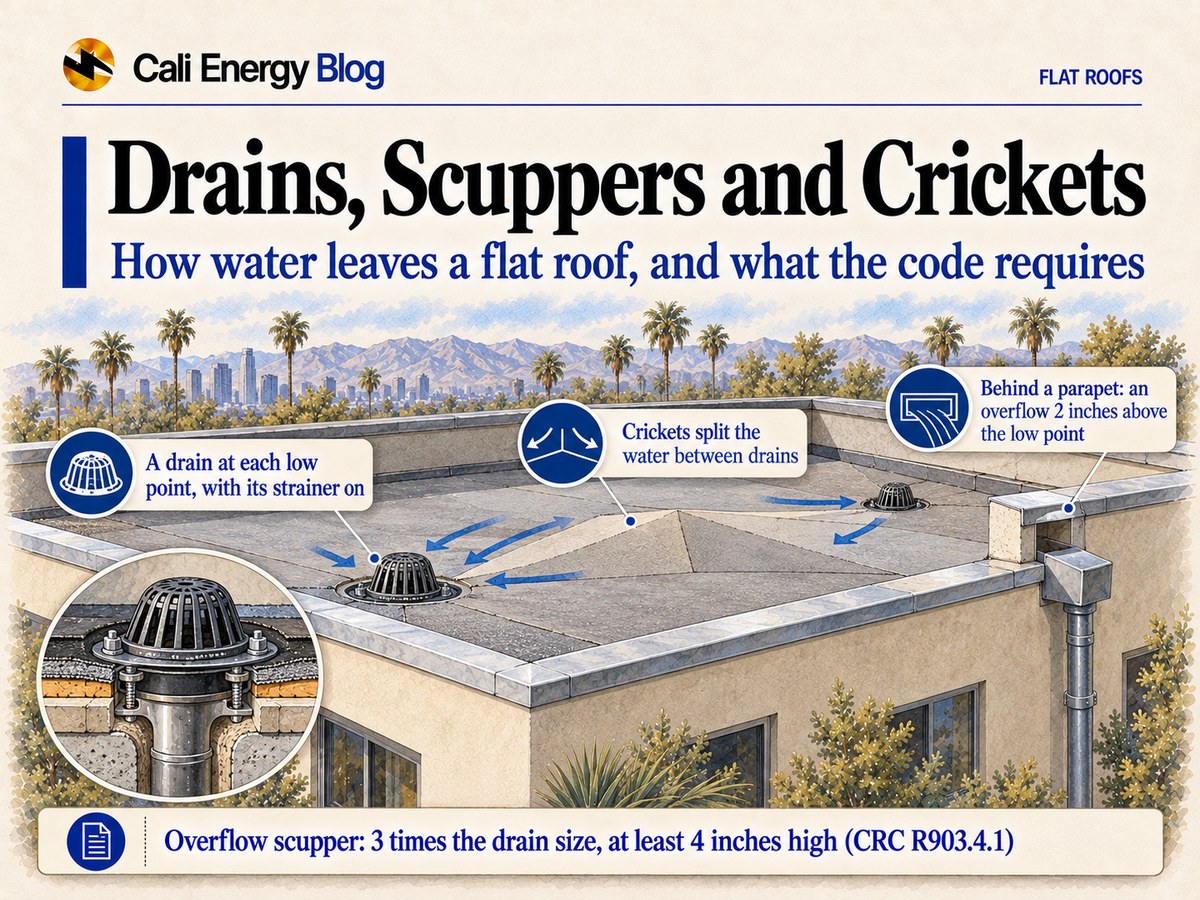
A flat roof gets rid of water in one of three ways: over a low edge into a gutter, through scuppers, which are openings in a parapet or raised edge, or into interior drains piped down through the building. California's residential code requires a roof drain at each low point unless the roof drains over its edges, and where a parapet would trap water if the drains back up, a second, emergency outlet: an overflow drain with its inlet 2 inches above the low point, or an overflow scupper three times the size of the roof drain and at least 4 inches high. The roof's slope, at least 1/4 inch per foot for most flat-roof systems, carries the water to those outlets, and crickets, small sloped build-ups, split the flow between drains or around obstacles. What goes wrong is usually at the outlet itself: a clogged drain, a broken or missing strainer, a loose clamping ring, worn flashing around the opening, a corroded scupper. This page explains the parts as of October 2026.
It covers houses with flat or low-sloped roofs under the 2025 California codes, in force since January 1, 2026. It doesn't size a drainage system, which the code leaves to the California Plumbing Code and a designer, and doesn't price the work. When water already stands on the roof, causes and fixes are in ponding water on a flat roof.
Three ways water leaves a flat roof
The U.S. Army's inspection manual for built-up roofs defines the two outlets that sit on the roof itself: a drain is a penetration in the roof membrane that lets water flow from the roof into a piped drainage system, with a flange or clamping arrangement that the membrane is attached to, and a roof-level scupper is a channel through a parapet or raised roof edge, made for draining the roof at its perimeter.
| Outlet | How it works | Where it's used | What has to stay right |
|---|---|---|---|
| Over the edge | Water runs off a low edge past the edge metal, into a gutter where there is one | Roofs sloped to an open edge, without a parapet there | The edge metal and the gutter; see do you need gutters in Los Angeles |
| Scupper | An opening through the parapet or raised edge that lets water out at the roof's perimeter | Roofs with parapets; also as the emergency overflow | The flashing around the opening, especially at its corners, and the metal itself |
| Interior drain | A drain bowl set into the roof at a low point, with a clamping ring holding the membrane and a strainer over the opening, piped down through the building | Low points inside the roof area | The strainer, the clamping ring and its bolts, the flashing, and the pipe staying clear |
What the code requires
- A drain at each low point. Unless a roof is sloped to drain over its edges, roof drains go at each low point (CRC 2025, R903.4).
- An overflow behind a parapet. Where the roof's perimeter rises above it in a way that would trap water if the main drains back up, the code calls for secondary emergency overflow drains or scuppers: overflow drains the same size as the roof drains, with the inlet 2 inches above the low point, or overflow scuppers three times the size of the roof drains, at least 4 inches high, in the parapet, with the inlet 2 inches above the low point (R903.4.1). Sizing of overflow drains, leaders and conductors follows the California Plumbing Code.
- Slope toward the outlets. Built-up, modified bitumen, single-ply, spray foam and liquid-applied roofs need a design slope of at least 1/4 inch per foot, and coal-tar built-up roofs 1/8 inch (R905.9.1 through R905.14.1).
- Coping on the parapet. Parapet walls are capped with noncombustible, weatherproof coping at least as wide as the wall (R903.3).
- On a re-roof. A roof that provides positive drainage, which the code defines as draining within 48 hours of rain with the deck's deflection taken into account, doesn't have to be brought up to the minimum slope, and a re-roof doesn't have to add overflow drains or scuppers that aren't there (R908.1). Whether to add one anyway is a question for the bid.
Crickets
A cricket is a small, sloped build-up that turns water in a direction the main slope doesn't. California's code requires one, also called a saddle, on the ridge side of any chimney or penetration more than 30 inches wide on a sloped roof, covered with sheet metal or the same material as the roof (R903.2.2).
On a flat roof, crickets do the same job between outlets: a low, sloped area between two drains, or behind a rooftop unit or skylight curb, is built up into two slopes that send the water to the drains on either side. They can be built of tapered insulation, and manufacturers make pieces for it: CertainTeed's handbook lists pre-cut cricket sections in triangular pieces sized to match its standard 4-by-4-foot tapered insulation panels. Because a cricket raises the roof surface, the flashings at curbs and walls next to it have to rise with it.
How a drain and a scupper are built into the roof
Each membrane manufacturer has its own details, and the roof is installed to them. CertainTeed's handbook for its modified bitumen roofs is one example:
- A drain. A strip of membrane at least 40 by 40 inches goes over the base sheet around the drain, then a lead flashing sheet at least 30 by 30 inches, then the roof membrane. The opening is cut out, the lead is pressed down into the drain bowl, and the drain's clamping ring is set and tightened over the layers.
- A scupper. The scupper's flange sits between the base ply and the roof membrane, fastened every 3 inches in a bead of sealant, with the membrane carried up the parapet and a cap sheet over the top of the wall, under the metal coping.
On a recover, the same handbook asks for every drain clamping ring to be removed and cleaned to bare metal, damaged drain parts to be replaced, all bolts replaced with new ones, preferably non-ferrous, and the drains secured to the deck. Old gravel stops and edge metal are replaced with new metal at least 24 gauge, and condensate lines from rooftop equipment are made of UV-resistant material and run to drains or scuppers, so that condensate doesn't run across the roof.
What goes wrong at the outlets
The Army's manual grades drains and scuppers by what it finds:
- Low: asphalt has run into the drain leader, but the drain isn't clogged.
- Medium: the felts around the drain are exposed, the strainer is broken or missing, or a scupper is losing its paint or coating, or starting to corrode.
- High: the felts around the drain have holes or have deteriorated, the clamping ring is loose or missing or its bolts are gone, the drain is clogged, or the scupper's metal is broken or has holes through it.
It adds a note to check the flashing at the corners of scuppers for holes. A missing strainer matters because it lets debris into the pipe, where it's harder to clear than on the roof; a loose clamping ring lets water past the membrane at a spot all the water from that part of the roof passes through.
Keeping them working
- Clear the outlets before the rains and after storms. Leaves and debris collect at drains and scuppers; the steps for the season are in getting a roof ready for the rainy season.
- Keep the strainers on. A drain without its strainer can clog out of reach.
- Keep overflows open. An overflow scupper or drain that's been sealed or blocked can't do its job when the main drain clogs.
- Watch where the water stands. Water still there 48 hours after rain, or dirt and stains around an outlet, point to an outlet that's clogged, too high or too far away; see ponding water on a flat roof.
Questions to ask a roofer
1. Where are the low points, and where does each one drain? And whether there's an overflow behind each parapet.
- What's the condition of each outlet? Strainers, clamping rings and bolts, the flashing around drains, and the scupper metal.
- On a re-roof: how are the drains flashed into the new membrane? By the manufacturer's detail, with new bolts and a cleaned clamping ring.
- Will the slope or added insulation change the outlets' height? How drains and scuppers are reset at the new low points, and where crickets go.
- Where do condensate lines end? At a drain or scupper, not on the roof surface.
Frequently asked
What is a scupper on a flat roof?
Does a flat roof need an overflow drain?
What is a cricket on a flat roof?
Why does a roof drain have a strainer?
What is a drain clamping ring?
Related reading
Sources & methodology
Code sections, rules and figures on this page come from the primary sources below. Codes, local requirements and product terms change; each was verified October 9, 2026.
- California Residential Code 2025, Chapter 9, Roof Assemblies (R903.2.2, R903.3, R903.4, R903.4.1, R905.9.1 through R905.14.1, R908.1)
- California Residential Code 2025, Chapter 2, Definitions (Positive Roof Drainage)
- Shahin, Bailey and Brotherson, Membrane and Flashing Condition Indexes for Built-Up Roofs, Volume II: Inspection and Distress Manual, U.S. Army…
- CertainTeed, Flintlastic Modified Bitumen Application Handbook, third edition (2016), copy published by a distributor
We'll check every way the water leaves your roof
Call (323) 844-7777. We find the low points, check each drain, scupper and overflow, its strainer, clamping ring and flashing, and look at where condensate lines end, and the estimate says what needs clearing, resetting or adding. Have ready the address, photos of the roof, its drains and parapet openings, and whether water stands anywhere after rain.
Prepared by Cali Energy, October 9, 2026. This article is for general educational purposes only and is not legal, tax, financial, engineering, or utility advice. Rates, incentives, codes, permit requirements, equipment specifications, prices, and program terms may change; figures and timelines are estimates, not guarantees. Confirm current requirements with the applicable utility, AHJ, program administrator, manufacturer, or a licensed professional. See our Content Disclaimer. Cali Energy · 19201 Parthenia St, Unit E, Northridge, CA 91324 · CSLB #1032379 (B, C-10, C-39)