

Silicone, Acrylic or Elastomeric Roof Coating?
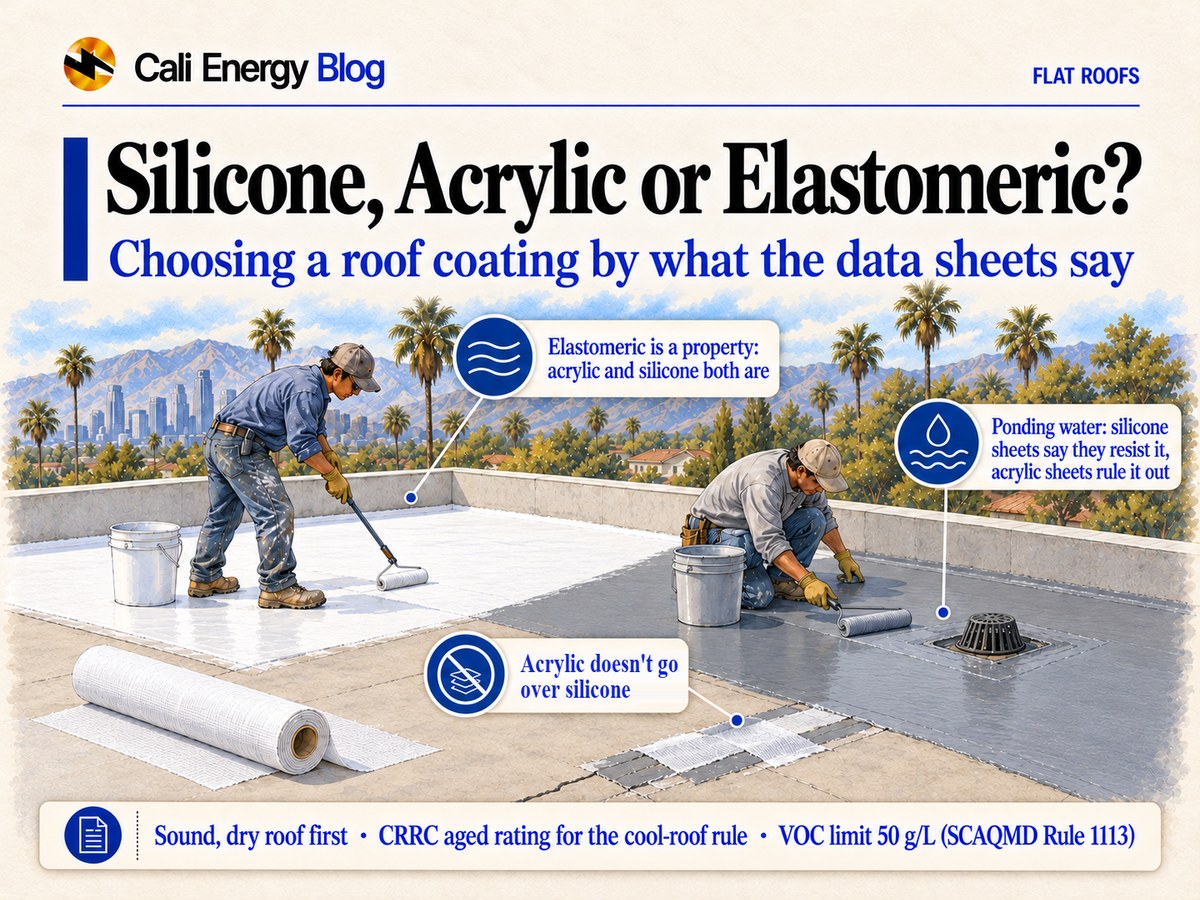
"Elastomeric" isn't a third kind of roof coating. ASTM's standards describe acrylic, silicone and moisture-cured polyurethane roof coatings all as elastomeric, and a product sold as "elastomeric roof coating" can be an acrylic, as two such products' data sheets say. Between acrylic and silicone, the deciding question on the manufacturers' data sheets is standing water: one acrylic sheet rules out roofs with ponding water and another asks for drains where water stands more than 48 hours, while the silicone sheets say their coatings resist ponding water. The same sheets show silicone going on in one thick coat and shrugging off rain sooner, and acrylic needing two coats and warmer, drier weather; once a roof is silicone, an acrylic sheet rules out going over it. Whichever is chosen, the roof has to be sound and dry underneath, and a coating over most of a low-sloped roof has to meet California's cool-roof values and the air district's limit on solvents. This page compares them as of October 2026.
It covers coatings on flat and low-sloped house roofs under the 2025 California codes, in force since January 1, 2026. It doesn't price the work or predict how long a coating will last, and it compares specific products only as examples of what their own data sheets say. Whether a particular roof should be coated at all, repaired or replaced is in flat roof repair, coating or replacement.
"Elastomeric" is a property, not a type
California's residential code (CRC 2025, Table R909.2) lists the standards a roof coating has to meet, and the descriptions in those standards answer the naming question:
- Acrylic, ASTM D6083: "liquid-applied water-dispersed acrylic latex elastomeric protective roof coatings."
- Silicone, ASTM D6694: a solvent-dispersed elastomeric coating whose main polymer is more than 95 percent silicone, written for spray polyurethane foam roofs.
- Moisture-cured polyurethane, ASTM D6947: a single-component, moisture-cured elastomeric urethane coating for spray polyurethane foam roofs.
- Asphalt-based coatings: asphaltic emulsion (D1227), asphalt coatings (D2823, D4479) and aluminum-pigmented asphalt coating (D2824).
So "elastomeric," meaning a coating that stretches and recovers with the roof, describes all three of the first group. Rust-Oleum's 750 Elastomeric Roof Coating, for example, lists its resin as water-based acrylic and says it meets or exceeds ASTM D6083, and Kool Seal's Elastomeric Finish Coat is described as 100 percent acrylic. When a bid says "elastomeric," ask which chemistry and which standard.
Acrylic and silicone, side by side
What follows comes from four products' data sheets, two acrylics and two silicones. They show how the two chemistries tend to differ, but each product has its own limits, so the sheet and the warranty of the product actually quoted are what count.
| Acrylic | Silicone | |
|---|---|---|
| Standard in the code's coating table | ASTM D6083 | ASTM D6694 |
| Ponding water | Rust-Oleum 750: not intended for areas with ponding water. Kool Seal: where ponding lasts beyond 48 hours, drains or other corrective measures must be installed | Rust-Oleum 995: resists ponding water. APOC 576: made for flat roofs or areas where ponding water may occur |
| Application temperature | 50 to 100°F, humidity under 85% (Rust-Oleum 750); not below 50°F (Kool Seal) | 32 to 120°F (Rust-Oleum 995); 35 to 120°F (APOC 576) |
| Rain after application | Rain-resistant in 4 hours (Rust-Oleum 750); 4 to 6 hours before rain or heavy dew (Kool Seal) | Resists rain after 1 hour, not applied if rain is expected within 2 hours (Rust-Oleum 995) |
| Coats and thickness | Two coats required, about 12 mils dry each (Rust-Oleum 750) | One coat at 1.5 gallons per 100 square feet, about 24 mils dry (Rust-Oleum 995) |
| Over existing coatings | Not over tar or silicone (Rust-Oleum 750) | Over aged acrylic coatings and existing silicone roof coatings (Rust-Oleum 995) |
| Over asphalt roofs | Built-up and modified bitumen: primer optional (Rust-Oleum 750) | A primer to stop asphalt bleeding through (Rust-Oleum 995); a primer as a stain-blocking base coat (APOC 576) |
Two consequences follow. A roof that holds water after rain points away from an acrylic, but it's a drainage problem first: a coating over standing water doesn't make it drain; see ponding water on a flat roof: causes and fixes. And the first coating sets the path for the next: by these sheets, silicone can go over an aged acrylic, but an acrylic doesn't go over silicone.
Polyurethane
Moisture-cured polyurethane coatings are written, in ASTM D6947, as protective coatings for spray polyurethane foam roofs, and California's code lists acrylic, moisture-cured polyurethane and silicone as the coatings for a new foam roof, applied 2 to 72 hours after the foam (CRC R905.13.3). Whether a particular polyurethane product is meant for other roof surfaces is a question for its own data sheet.
What the code and LA's rules ask of any coating
- Only over a sound roof. A new coating can go over an existing coating, built-up roof, modified bitumen, single-ply membrane, spray foam, metal or mineral-surfaced roll roofing without a tear-off, but not over a roof that's water-soaked or has deteriorated to the point that it isn't an adequate base (CRC R908.4).
- By the manufacturer's instructions, and within the fire rules. A roof coating is installed to the manufacturer's instructions and has to comply with the code's sections on fire classification and roofing materials (CRC R909.1, pointing to R902 and R904).
- The cool-roof values. California's 2025 Energy Code counts "adding a new surface layer on top of the existing exterior surface" as a re-roof once it covers more than half of the roof, so a coating over most of a low-sloped roof needs an aged solar reflectance of at least 0.63 with a thermal emittance of 0.75, or an SRI of 75, in climate zones 4 and 6 through 15. The figure to check is the product's aged rating in the Cool Roof Rating Council's directory; the zones and local versions are in flat roof options for Los Angeles homes.
- The air district's solvent limit. In the South Coast Air Quality Management District, Rule 1113 caps roof coatings at 50 grams of volatile organic compounds per liter, and aluminum roof coatings at 100.
- A permit. In the City of Los Angeles, a roof coating is on LADBS's express-permit list; other cities' rules are in re-roof permit rules across LA-area cities.
Before any coating goes on
The data sheets agree on the preparation, whichever chemistry:
- Repairs first. APOC asks for all leaks and cracks to be repaired before any coating, with polyester reinforcing fabric; Rust-Oleum's silicone sheet calls for reinforcement fabric in all repairs and over alligatored surfaces, and for torn flashings, large blisters and surface breaks on built-up and modified bitumen roofs to be repaired first.
- Clean and dry. Dirt, mildew, loose granules and chalk come off, usually with a pressure wash, and the roof dries before coating.
- A test patch. Rust-Oleum's silicone sheet asks for a small area to be tested for adhesion and for asphalt bleeding through before the whole roof is coated.
- The right rate. Each product has a coverage rate in gallons per 100 square feet and a dry thickness in mils; comparing bids on those numbers shows whether they're quoting the same coating.
What a coating can't fix, from wet insulation to a roof past its service life, is in flat roof repair, coating or replacement, and the systems that replace a roof outright are in flat roof options for Los Angeles homes.
What we've seen
On a new Calabasas house with a flat torch-down roof, the solar standoffs went in first, each in a curb filled with sealant, and the roofer then coated the whole roof white around them; the array went up once the coating had dried (the Calabasas case). On a Northridge house in 2025 with a white-coated flat membrane roof, the array went up on tilt legs, and every mount through the membrane was sealed (the Northridge case).
Questions to ask about a coating bid
1. Which product, which chemistry, which standard? Acrylic (D6083), silicone (D6694) or polyurethane (D6947), by name.
- Does water stand on the roof, and what does the product's data sheet say about ponding? And what the warranty says about it.
- Which repairs come first, and with what? Fabric-reinforced repairs at seams, cracks and blisters, and any wet areas cut out.
- Adhesion test and primer? Especially over asphalt, single-ply or an older coating.
- How much goes on? Gallons per 100 square feet, coats, and the dry thickness in mils.
- The cool-roof rating and the solvent content? The CRRC product ID with its aged values, and grams of VOC per liter.
- What's on the roof now? If it's silicone, the new coat has to be compatible with it.
Frequently asked
Is elastomeric roof coating the same as acrylic?
Silicone or acrylic for a flat roof that holds water?
Can you put acrylic coating over silicone?
Does a roof coating have to meet the cool-roof rule in Los Angeles?
How thick should a roof coating be?
Related reading
Sources & methodology
Code sections, rules and figures on this page come from the primary sources below. Codes, local requirements and product terms change; each was verified October 9, 2026.
- California Residential Code 2025, Chapter 9, Roof Assemblies (R905.13.3, R908.4, R909)
- ASTM D6083/D6083M-24, Liquid-Applied Acrylic Coating Used in Roofing
- ASTM D6694/D6694M-15, Liquid-Applied Silicone Coating Used in Spray Polyurethane Foam Roofing Systems
- ASTM D6947/D6947M-16, Liquid Applied Moisture Cured Polyurethane Coating Used in Spray Polyurethane Foam Roofing System
- Rust-Oleum, 750 Elastomeric Roof Coating, technical data sheet ROC-65
- Rust-Oleum, 995 Silicone Roof Coating, technical data sheet ROC-184
- Kool Seal, Elastomeric Finish Coat KS0063000, product data sheet
- APOC, 576 Premium Silicone White Roof Coating, technical data sheet
- California Energy Commission, 2025 Building Energy Efficiency Standards (Title 24, Part 6), CEC-400-2025-010, section 150.2(b)1I
- South Coast Air Quality Management District, Rule 1113, Architectural Coatings
We'll tell you which coating your roof can take, if any
Call (323) 844-7777. We check whether the roof is sound and dry enough to coat at all, where water stands after rain, and what's on the surface now, and the estimate names the product, its rating with the Cool Roof Rating Council, the repairs and primer before it, and the rate it goes on at. Have ready the address, photos of the roof, especially any spots where water stands, and whether solar is on the roof or planned.
Prepared by Cali Energy, October 9, 2026. This article is for general educational purposes only and is not legal, tax, financial, engineering, or utility advice. Rates, incentives, codes, permit requirements, equipment specifications, prices, and program terms may change; figures and timelines are estimates, not guarantees. Confirm current requirements with the applicable utility, AHJ, program administrator, manufacturer, or a licensed professional. See our Content Disclaimer. Cali Energy · 19201 Parthenia St, Unit E, Northridge, CA 91324 · CSLB #1032379 (B, C-10, C-39)