

Spanish S-Tile and Barrel Roofs: Care and Replacement
A Spanish tile roof is one of two things: one-piece S-tile, where each tile has a curved roll and a flatter pan in one piece, or two-piece barrel tile, also called mission or pan-and-cover, where concave pans are laid in rows and convex covers go over the joints between them. Both break easily underfoot and usually outlast what holds them down and the underlayment beneath, so care means staying off the tile, keeping valleys and gutters clear, and replacing broken pieces, slipped covers, missing eave closures and cracked ridge mortar before water gets through. When tile has to come off, the work turns on matching the shape, size and color, and in Los Angeles on the permit and the tile's weight, the City's high-wind areas, fire zones and historic districts.

This page covers what's particular to S and barrel tile. Whether a roof needs a repair, a lift-and-relay or new tile is decided in tile roof: repair, lift-and-relay or replacement, and when the underlayment under tile is due, in when to replace tile roof underlayment.
Which Spanish tile is on your roof
Clay roof tile has a long history in California: the National Park Service (NPS) dates the first clay tile made on the West Coast to 1780, at Mission San Antonio de Padua. In Los Angeles, Spanish tile tops Spanish Colonial Revival houses, with their white stucco and red tile, and many later houses roofed in concrete S-tile. The two are laid and repaired differently.
| One-piece S-tile | Two-piece barrel (mission, pan and cover) | |
|---|---|---|
| Shape | One tile with a curved roll and a nearly flat pan; a lip on each tile locks against the roll of the next | Concave pans laid in rows up the roof, convex covers over the joints between them |
| Made in | Clay or concrete | Clay in the makers' data below |
| Pieces per square (100 sq ft) | 75 (MCA, clay) to 88.5 (Eagle, concrete) | 180: 90 pans and 90 covers (MCA, clay) |
| Weight per square, from the maker | 788 lb (MCA, clay); about 900 lb (Eagle, concrete), 570 lb in Eagle's lightweight line | 1,008 lb (MCA, clay) |
| How it's held | Nails through holes at the top, sometimes mortar | Pans nailed; covers on long nails, hooks or wire, or nailed to vertical battens |
| What breaks first | Any tile stepped on carelessly | The covers, more often than the pans |
| At the eave | A closure (bird stop) fills the open curve of the first course | The same |
The tile industry's association, TRI Alliance, classes both as high-profile tile: the rise is more than a fifth of the tile's width. To tell clay from concrete, look at the tile itself. Concrete tile is generally thicker than clay (NPS), and it can show a white bloom called efflorescence, which TRI says is temporary and does no harm. Many older clay tiles carry the maker's name, the size and the name of the shape on the back (NPS), and that mark is the first thing to find when you need more of them. How the two materials differ in color, weight and standards is in clay vs concrete roof tile.
Looking after a Spanish tile roof
The tile itself asks for little. NPS's guide to clay tile roofs puts the usual trouble elsewhere: in the fastenings that hold the tile, in the flashing, valleys and gutters, and in damage from people walking on it. In practice:
- Stay off it. TRI says walking on tile should be avoided; if someone has to, weight goes on the lower 3 to 4 inches of each tile, where it rests on the one below. NPS calls high-profile tile very fragile and describes roofers spreading their weight with plywood, planks, sandbags or a ladder hooked over the ridge. Before painters, a solar crew or an HVAC tech go up, ask how they'll protect the tile; TRI suggests lifting the tiles and resetting them afterward, or covering them with secured plywood or roof pads.
- Keep valleys and gutters clear. A gutter that fills with debris can back water up under the tile (NPS), and leaves collect where two planes meet.
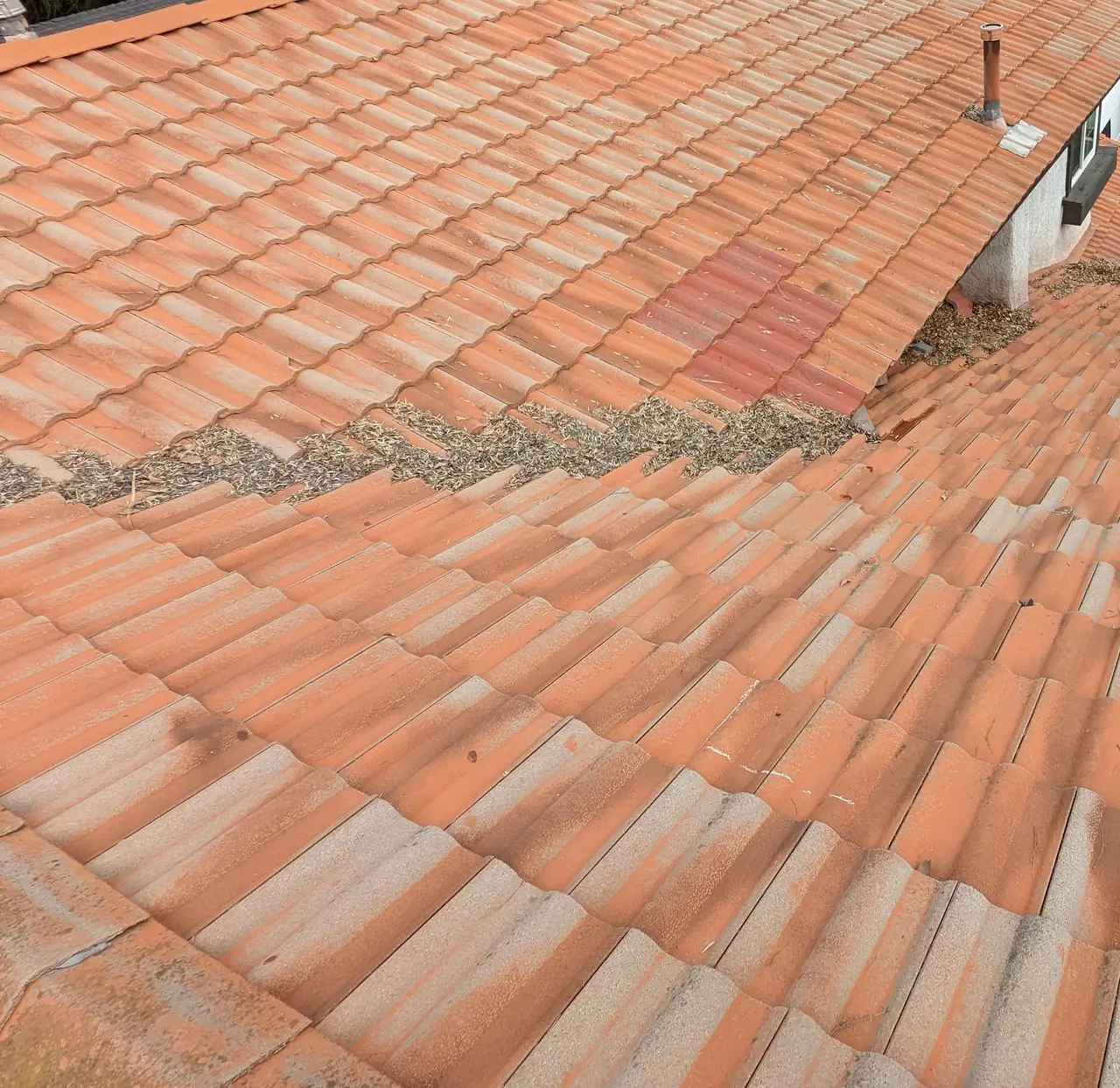
- Replace broken pieces promptly. A broken tile no longer sheds water over the underlayment, and NPS calls for replacing broken tiles promptly. It lists patches of roofing tar, caulk, asphalt, metal or a non-matching tile among the repairs to avoid: water collects behind them.
- Watch the ridges and eaves. Ridge and hip caps are often set in mortar, which cracks and works loose with time; setting loose caps back is a repair, not a re-roof. At the eaves, closures (bird stops) fill the open ends of the first course and keep birds and debris out; TRI calls for them on high-profile tile.
- Look from the attic. NPS suggests checking the underside of the roof after a heavy rain, where a stain shows a leak early. Why a tile roof leaks when the tiles look fine and how to find a roof leak cover what to look for.
How a broken piece is replaced
The hard part of replacing one tile, NPS notes, is getting it out without breaking its neighbors. NPS and TRI describe the same steps: the nails or wire holding it are cut with a slate ripper or a hacksaw blade slipped under the tile, the pieces come out, and any damage to the underlayment beneath is repaired. The new tile can't be nailed through its own holes, because the course above covers them, so it's held instead by a copper tab bent up over its lower edge, a slate hook (a "tingle"), wire, or roofer's mastic or an approved adhesive at the overlap. When a chip can be glued instead, and how a slipped tile is reset and fastened, is in cracked or slipped roof tiles.
On a barrel roof it's usually the covers that break. NPS notes that the pans under them often survive and can stay in place, which keeps the repair, and the matching, smaller.
Finding tile that matches
Matching an S or barrel roof takes more than a color name. Bring a tile, or photos and measurements of one, and check:
- The shape: one-piece S or two-piece barrel, and for barrel, straight or tapered.
- The size and exposure: length, width, and how much of each tile shows once laid.
- The maker's mark on the back, if there is one.
- The color, held next to the weathered roof, not judged from a brochure.
If the profile is still made, current production is the simplest source. Where it isn't, NPS describes salvage dealers who match old tile by the imprint on the back, makers whose original molds can still produce matching tile for a large enough order, and firms that make reproductions of historic tile. Where a profile is discontinued, we source salvage or blend new pieces in out of sight lines, and we check that at the inspection, not after. Order the ridge, rake and eave pieces with the field tile, plus extras: NPS suggests allowing 10 to 20 percent for breakage and keeping spare tiles for later repairs.
Matching also has a limit. For historic clay roofs, NPS offers a rule of thumb: if more than about 30 percent of the tile is lost, broken or beyond repair and matching tile can't be found, it may be necessary to replace all of it with new matching tile. Whether a roof has reached that point is the decision covered in repair, lift-and-relay or replacement. NPS is also plain that on a historic clay roof, concrete, metal or plastic tile isn't an appropriate stand-in for clay.
When the tile comes off: Los Angeles rules
The permit and the weight
In the City of Los Angeles, a lift-and-relay, with the tiles off, new underlayment and the same tiles back, is item 23 on LADBS's express-permit list: no plan check, and no cool-roof requirement (bulletin P/GI 2026-003). New tile is a different matter. The express re-roof items cover coverings lighter than 6 pounds per square foot, and Spanish tile is heavier, going by the makers' figures:
- two-piece clay barrel (MCA Classic Tapered Mission): 1,008 lb per square, about 10.1 lb per sq ft;
- concrete S-tile (Eagle Capistrano): about 900 lb per square, 9 lb per sq ft;
- one-piece clay S-tile (MCA One Piece "S" Mission): 788 lb per square, about 7.9 lb per sq ft;
- lightweight concrete S-tile (Eagle's lightweight Capistrano): about 570 lb per square, 5.7 lb per sq ft.
So a new roof of standard Spanish tile isn't on the express list, and plan check should be expected; confirm the path with LADBS before the job is priced, since the lightweight line falls under the 6-pound mark. The roof structure has to carry whatever goes on it (CRC R908.2): going lighter takes load off the framing, going heavier means showing that it can carry more. The permit routes are in do you need a permit to replace a roof in Los Angeles. New tile over more than half the roof can also bring in the cool-roof rule on a re-roof, depending on the climate zone; a relay under item 23 doesn't.
What the code expects when tile goes back
California's 2025 Residential Code lets clay and concrete tile be reinstalled, but not cracked or broken pieces (R908.5), and no new roof may be laid over tile (R908.4). Tile needs a slope of at least 2½:12, with a double layer of underlayment from there up to 4:12 (R905.3.2; see minimum roof slope by material). On solid sheathing without battens, every tile gets at least one fastener (R905.3.8). Because a re-roof follows the chapter's rules (R908.1), tile that was once held only by mortar is fastened when it's relaid; NPS notes that a dab of mortar alongside the fastening is still customary.
The City's High Wind Velocity Areas
Parts of the San Fernando Valley, along its northern, northeastern and western edges, are High Wind Velocity Areas under LADBS bulletin P/BC 2026-016, which lists them by street. There, tile at the eaves, hips, ridges and rakes is fastened with 11-gauge nails or approved ties and also bonded at its exposed end with a bead of roofer's mastic, and every field tile is attached. For mission tile, the bulletin lets cement mortar take the place of mastic between tiles, provided the tiles are soaked first, and the open ends of the eave tiles are filled with a bird stop or mortar.
Fire zones
S and barrel tile leave an air space between the tile and the deck. Where California's wildland-urban interface code applies, that brings extra layers and details: a 72-pound cap sheet over the deck or a Class A-tested underlayment, bird stops at the eaves where the profile fits, and hip and ridge caps set in mortar (CWUIC 504.2.1). Whether a relay counts as replacing the covering under those rules is a question for the building department, discussed in repair, lift-and-relay or replacement; the rules themselves are in California's WUI roofing requirements, and how tile holds up in a wildfire is in fire-resistant roofs in Los Angeles.
Historic districts (HPOZ)
If the house is in a Historic Preservation Overlay Zone (check the address on ZIMAS, the City's zoning map), exterior work goes through City Planning before it starts, including work that doesn't need a building permit, and work done without that review can bring enforcement and fines from LADBS. Each district's Preservation Plan sets its own rules; which review a re-roof gets is in re-roofing in a Los Angeles HPOZ. The South Carthay plan is one example:
- a tile repair that reuses the existing tile, without touching fascia, eaves or brackets, is delegated to the Director of Planning rather than the HPOZ board, as long as it meets the plan's guidelines;
- on a re-roof, original clay tile is to be kept and reused, with the originals on the street-visible sides and new pieces to the rear;
- clay tile is to be replaced only with natural clay of a similar shape and color; the plan notes that concrete or synthetic tile doesn't recreate clay's texture or color.
If the house is in a fire zone too, raise the bird stops at that review: the plan's photo of a historic tile eave shows none, while the WUI code asks for them.
Solar on S-tile
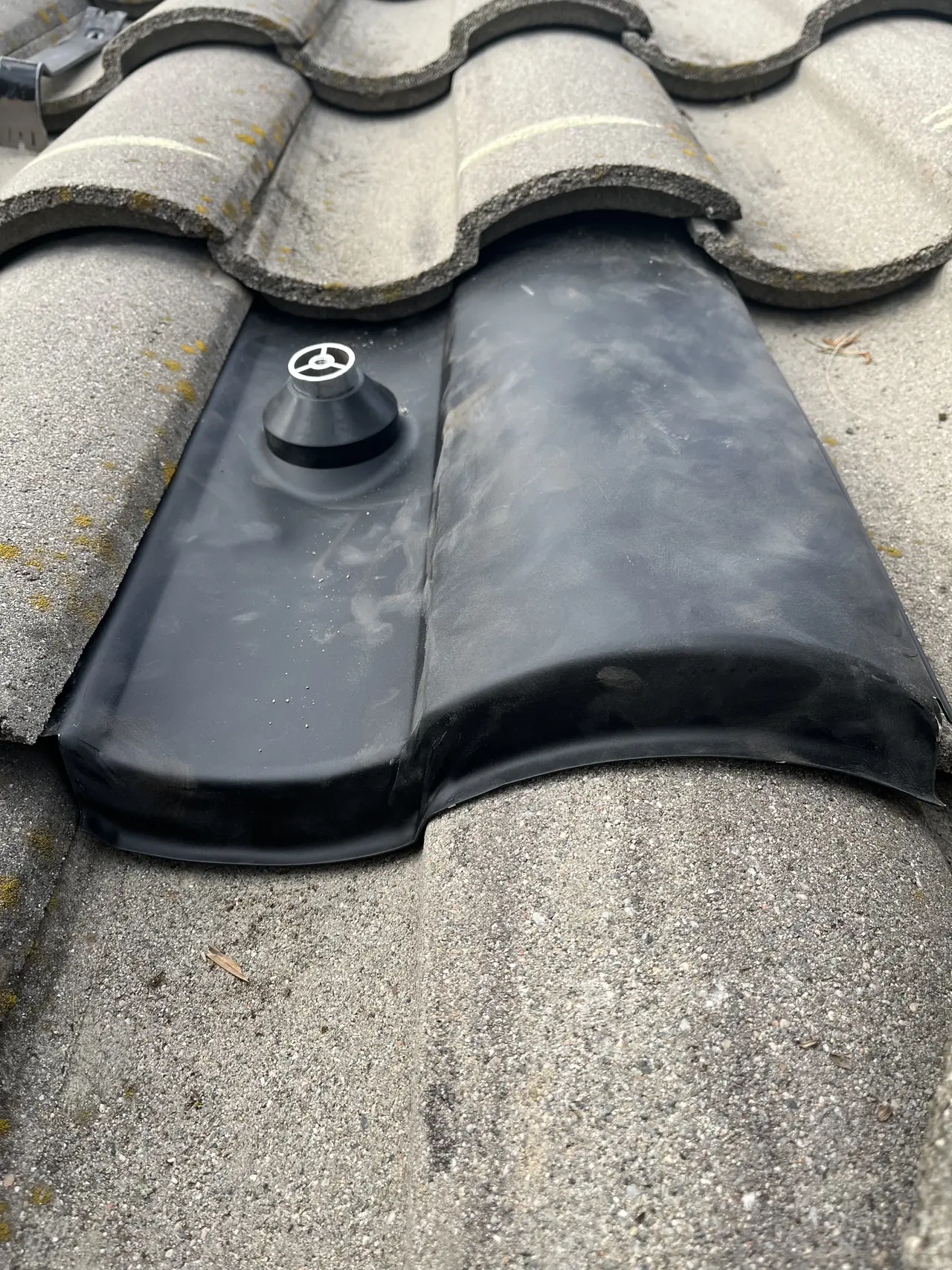
Solar goes onto S-tile the way it goes onto other tile, one attachment at a time. On our Northridge job, on concrete S-tile over 2×4 rafters at 24 inches, tile was lifted along the rail lines, the attachments went into the rafters, each penetration was flashed and the tile was reset over it. On a hipped S-tile roof in Tarzana, hooks were fastened through the underlayment into the rafters and the tile set back over them; where a penetration had to pass through the tile field, a flashed replacement tile took the original's place, lapped under the course above. More in solar on clay and concrete tile.
Frequently asked
Can I walk on my Spanish tile roof?
How do I find tiles that match my roof?
Can broken clay tiles be replaced with concrete ones?
Why is there mortar on my tile roof, and does it need redoing?
What are bird stops, and does my roof need them?
Does relaying a Spanish tile roof need a permit in LA?
Can I replace heavy clay barrel tile with a lighter S-tile?
Related reading
Sources & methodology
Code sections, rules and figures on this page come from the primary sources below. Codes, local requirements and product terms change; each was verified October 8, 2026.
- National Park Service, Preservation Brief 30: The Preservation and Repair of Historic Clay Tile Roofs (Anne E. Grimmer and Paul K. Williams, 1992)
- Tile Roofing Industry Alliance, Concrete and Clay Roof Tile Installation Manual, 2024 edition (Uniform ES ER-2015, revised May 2025)
- California Residential Code 2025, Chapter 9, Roof Assemblies: R905.3, R908.1, R908.2, R908.4 and R908.5 (UpCodes)
- California Wildland-Urban Interface Code 2025 (Title 24, Part 7), Chapter 5, section 504.2.1 (UpCodes)
- LADBS, Express Permits (No Plan Check Required), Information Bulletin P/GI 2026-003, effective January 1, 2026, revised June 10, 2026
- LADBS, Dwellings in High Wind Velocity Areas (HWA), Information Bulletin P/BC 2026-016, effective January 1, 2026, revised April 24, 2026
- Los Angeles City Planning, Historic District Project Review
- Los Angeles City Planning, South Carthay HPOZ Preservation Plan (adopted December 9, 2010), sections 3.6 and Roofs
- City of Los Angeles, ZIMAS (Zoning Information and Map Access System)
- MCA Clay Tile, One Piece "S" Mission (specifications)
- MCA Clay Tile, Classic Tapered Mission (specifications)
- Eagle Roofing, Technical Specifications (Capistrano weights)
- Eagle Roofing, High Barrel Concrete Roof Tile (Capistrano S-tile)
We'll check your S-tile or barrel roof and say what it needs
Call (323) 844-7777. We inspect S-tile and barrel roofs, lift tiles only where there's a reason to see underneath, and tell you whether the job is a few broken pieces, mortar and closures, or more. Matching tile is checked at the inspection: current production where the profile is still made, salvage or a blend set out of sight where it isn't. Have ready the address, a few photos from the ground and, if you have one, a spare or loose tile. Some breakage when tile is lifted is normal, and we plan for it.
Prepared by Cali Energy, October 8, 2026. This article is for general educational purposes only and is not legal, tax, financial, engineering, or utility advice. Rates, incentives, codes, permit requirements, equipment specifications, prices, and program terms may change; figures and timelines are estimates, not guarantees. Confirm current requirements with the applicable utility, AHJ, program administrator, manufacturer, or a licensed professional. See our Content Disclaimer. Cali Energy · 19201 Parthenia St, Unit E, Northridge, CA 91324 · CSLB #1032379 (B, C-10, C-39)