

The Roof Replacement Process in Los Angeles, Step by Step
A roof replacement on a Los Angeles house runs in a fixed order: an inspection and a written scope, a contract, a permit, the material order, the tear-off down to the deck, deck repairs (with a written change order if the scope grows), a sheathing inspection where the agency calls for one, underlayment, edge metal and flashings, the new roofing and attic vents, cleanup, and a final inspection that closes the permit. The days on the roof are usually the shortest part. On our 2025 Woodland Hills re-roof, 28 squares stripped to new plywood, the permit went from application to final in 12 days; on a 2021 Canoga Park re-roof of 42 squares, the permit was finaled 12 days after it was issued.
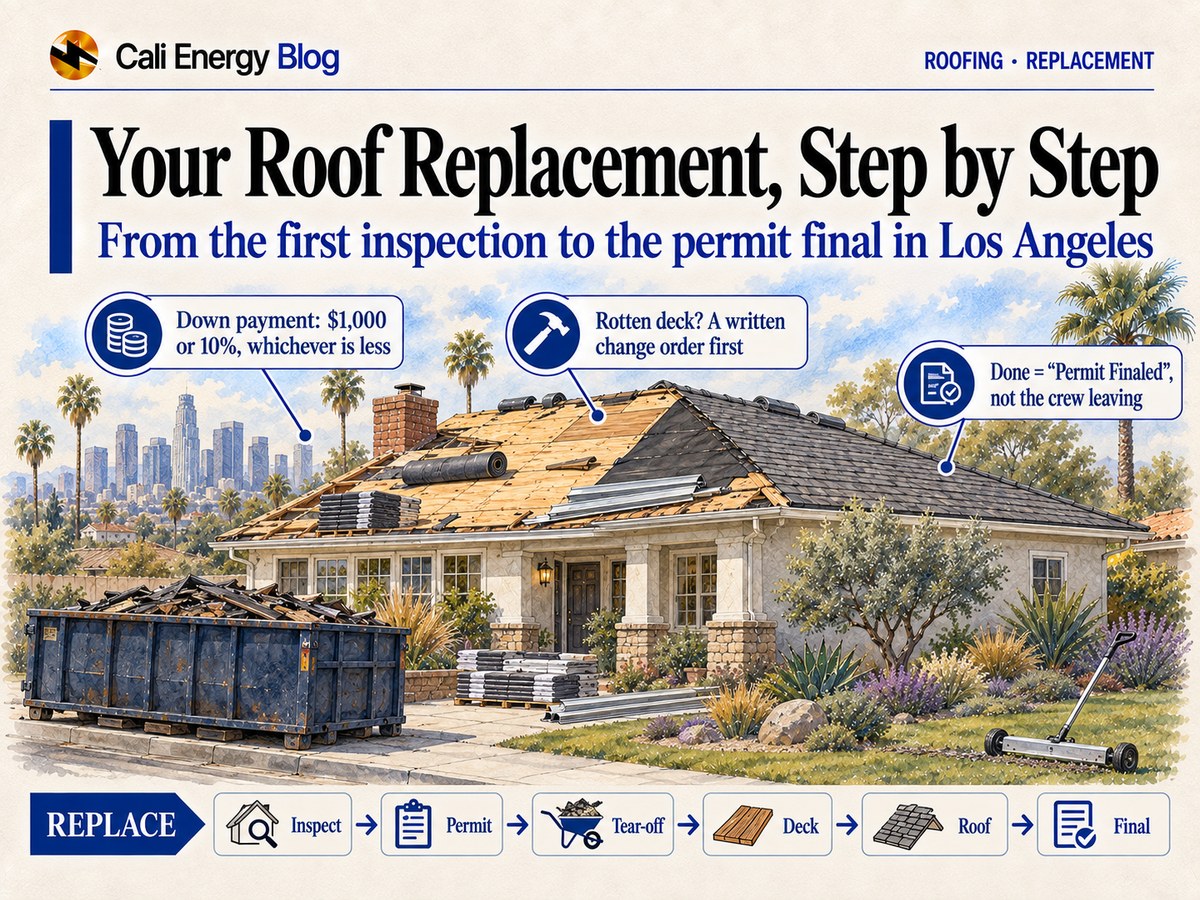
This page covers pitched roofs, shingle and tile, on houses in the City of Los Angeles and nearby, under the 2025 California codes in force since January 1, 2026. It doesn't price the work, and the dates from our jobs are examples rather than processing times. The permit itself is covered step by step in roof permit in Los Angeles and, for other cities, in re-roof permit rules across LA-area cities; flat roofs have their own guides, starting with flat roof options for Los Angeles homes.
The steps at a glance
Twelve steps cover a typical re-roof, and only a few of them happen on the roof. The rest are paperwork and inspections, and they're where a job is either kept on schedule or held up.
| Step | What happens | The rule or record that goes with it |
|---|---|---|
| 1. Inspection | The roof, the attic and the deck from below, the layers, the vents | A line-item estimate that names tear-off or overlay |
| 2. Contract | Price, payment schedule, start and completion dates | California's contract rules: a capped down payment, payments that don't run ahead of the work, who pulls the permit, written change orders |
| 3. Permit | The roofer (or the owner, as owner-builder) applies | In the City of Los Angeles most re-roofs take an express permit; other agencies differ |
| 4. Material | The covering, its fire class and cool-roof rating, delivered to the site | Class A in fire zones; a cool-roof product when more than half the roof is replaced, in most LA climate zones |
| 5. Tear-off | Old layers removed down to the deck, debris hauled away | A replacement removes the existing layers down to the roof deck (CRC R908.3) |
| 6. Deck | The deck is checked with the roof open; bad boards replaced, or new plywood laid | Shingles need solid sheathing (R905.2.1); a change in scope gets a written change order and, in Los Angeles, a supplemental permit |
| 7. Sheathing inspection | The inspector sees the deck before it's covered | Required where the agency lists it; LADBS doesn't let work pass a point that needs inspection until it's approved |
| 8. Underlayment and metal | Underlayment, drip edge, valley metal, flashings at walls and penetrations | Double underlayment on shingle roofs below 4:12 (R905.2.2); drip edge at eaves and rakes (R905.2.8.5) |
| 9. Roofing and vents | Shingle or tile laid, ridge cap, attic vents | Shingle fasteners per the manufacturer, at least four per strip shingle (R905.2.6); attic vent area of 1/150 of the space (R806.2) |
| 10. Cleanup | Debris and nails cleared from the yard and drive | Our crews sweep the yard with a magnetic roller at the end of each work day |
| 11. Final | The final inspection; in Los Angeles, the owner's notarized statement first | The permit record shows "Permit Finaled" with a date |
| 12. Solar back on | Panels reinstalled on the new roof, if there are any | Its own permit, depending on the agency |
The sections below go through the steps that carry the decisions.
Before the roof comes off
The inspection and the estimate. A roof is priced from what's on it and under it: the covering and how many layers of it, the pitch and access, the vents and valleys, and the deck, which shows best from the attic before anything is removed. Ask for a line-item estimate that says whether the old roof comes off or a new one goes over it, and how deck repairs will be priced if the deck turns out worse than it looks. If one bid prices per square and another per square foot, price per square vs price per square foot shows how to put them on the same footing. An overlay is limited by California's residential code (CRC R908.4: not over a water-soaked or deteriorated roof, not over tile or slate, and not over two or more existing coverings), and some agencies limit it further.
The contract. California's Contractors State License Board (CSLB) sets the terms a home improvement contract has to carry: a down payment of no more than $1,000 or 10% of the contract price, whichever is less, with no exception for special-order materials; a written payment schedule in which payments don't exceed the value of the work performed; who will get the permits; and a completion date. What to do at home before and during the work is in how to prepare your home for a roof replacement. A change in the price or the scope is made with a written change order, signed by the customer and the contractor before the change. The rest of what to check in a roofing contract, including the right to cancel one signed at home, is in how to choose a roofing contractor in California, and the law itself, section by section, is in California roofing contracts: what the law requires.
The permit. In the City of Los Angeles, most re-roofs take an express permit from the Department of Building and Safety (LADBS), issued without plan check online or at a counter: a Class A or B covering under 6 pounds per square foot over existing solid sheathing (bulletin P/GI 2026-003, item 4) or over new solid sheathing (item 5), and a tile lift-and-relay (item 23). Elsewhere the agency, the route and the local add-ons differ, from Glendale's design review when the material changes to the county's debris-recycling plan.
The material. Two choices are made before anything is ordered. The fire class: in the City of Los Angeles wood shakes and shingles aren't allowed anywhere, and a Very High fire zone takes a Class A roof, as covered in the Class A roof rating. And the cool-roof rating: under California's 2025 Energy Code, replacing more than half of a steep-sloped roof in climate zones 4 and 8 through 15 calls for an aged solar reflectance of 0.20 with a thermal emittance of 0.75, or an SRI of 16, unless an exception applies, such as at least R-38 ceiling insulation, a qualifying attic radiant barrier, or, in zones 2, 4, 9, 10, 12 and 14, no ducts in the attic. In the City of Los Angeles, LADBS's express item for a tile lift-and-relay (item 23) states that cool-roof compliance isn't required for it. The exceptions and the color choices are in the cool-roof requirement on a re-roof. On our Woodland Hills job, two shingles were priced side by side, a standard architectural shingle and a premium shake-look one, both cool-rated; the difference was appearance, color range and lead time.
Tear-off and the deck
Tear-off day is the loudest one. The old roofing comes off down to the deck, which is what California's residential code means by a roof replacement (R908.3), and goes to the truck or bin. On a roof with more than one layer, all of them come off. In the South Coast air district, the asbestos survey comes before this day, as covered in asbestos in old roofs: testing before a tear-off.
Then the deck is open, and it's the moment a re-roof can change. Asphalt shingles have to be fastened to wood structural panels or solid lumber sheathing (CRC R905.2.1), so a house whose old shakes sat on spaced boards gets new sheathing across the roof. On our Woodland Hills job, the old wood shake came off and the whole roof was re-decked with new plywood, 87 sheets, delivered a day ahead of the rest of the material so the crew could lay the deck without climbing over bundles.
Where the deck is worse than expected, two papers follow:
- A written change order before the extra work, signed by you and the contractor, under the CSLB's contract rules. What it has to say, and how to check the sheet count, is in rotted roof decking and your estimate.
- A revised permit. In the City of Los Angeles, a job permitted over existing sheathing that turns out to need new sheathing gets a supplemental permit, so the permit describes the work that was done. On our 2024 Canoga Park re-roof, the permit taken out October 22 for 22 squares was followed on November 8 by a supplemental permit for new sheathing, and both were finaled that November.
Where the agency calls for it, the deck is inspected before it's covered. On our 2021 Canoga Park re-roof the roof sheathing inspection was signed a week after the permit was issued. LADBS's code doesn't let work go past a point that needs inspection until it's approved, and unincorporated Los Angeles County's re-roof inspections run from the sheathing to the final.
Underlayment, metal and flashing
Before the roofing goes on, the deck gets its layers of protection, and the code is specific about several of them:
- Underlayment. The residential code lists the underlayment types allowed under each covering (CRC R905.1.1). On a shingle roof between 2:12 and 4:12, the underlayment goes on double (R905.2.2); shingles aren't allowed below 2:12 at all.
- Drip edge. A drip edge goes along the eaves and rake edges of a shingle roof, lapped at least 2 inches at joints, reaching at least 1/4 inch below the sheathing and 2 inches back onto the deck, fastened at no more than 12 inches. At the eaves the underlayment laps over the drip edge; along the rakes it goes under it (R905.2.8.5).
- Flashing. Flashing goes at every wall-to-roof intersection, change of slope or direction, and roof opening (R903.2.1). Valleys are lined before the shingles go on (R905.2.8.2), and a sidewall gets continuous or step flashing at least 4 inches high and 4 inches wide (R905.2.8.3). Old flashings, vents and edge metal that are rusted, damaged or deteriorated are replaced, not reused (R908.5).
On our Woodland Hills job that meant synthetic underlayment with ice-and-water membrane at the vulnerable edges, valley metal, a full set of flashings and new drip edge.
Roofing, ridge and vents
The covering goes on to the manufacturer's instructions. For asphalt shingles, the code sets a floor under those instructions: at least four fasteners per strip shingle, or two per individual shingle (CRC R905.2.6). On a tile relay, existing tiles can go back on, but cracked or broken ones can't (R908.5), so a relay bid should say how replacement tiles are matched; whether a tile roof calls for a repair, a relay or new tile is in tile roof repair, lift-and-relay or replacement.
A re-roof is also when attic ventilation is set right. The code asks for net free vent area of at least 1/150 of the vented space, or 1/300 when the vents are split between the top and bottom of the space within set limits (CRC R806.2), and in a fire hazard severity zone the vents have to meet the wildland-urban interface code (R806.1.1); how to size and balance them is in attic ventilation requirements. Our Woodland Hills roof got twelve low-profile vents, and the ridge cap was extended once the crew could see the sides of the roof: 280 feet in all.
Cleanup and the final
At the end of each work day our crews clear the debris and sweep the yard with a magnetic roller for nails. The permit closes with the final inspection:
- In the City of Los Angeles, the owner completes, signs and notarizes LADBS's Owner Statement and Acknowledgment of Compliance and sends it to the inspector before the final; Re-Roof is one of the improvements on it, and for a permit over $1,000 it covers smoke and carbon monoxide alarms among other items. On our Woodland Hills job, that notarized acknowledgment was collected along the way, and the final followed five days after it was requested.
- Elsewhere, the final is requested through the agency's own system, as in the third table of re-roof permit rules across LA-area cities.
The roofers leaving isn't the end of the job; the permit record showing "Permit Finaled" with a date is. How to read that record, and what to keep, is in checking that a re-roof permit was finaled; the lien releases to collect with the final payment are in mechanics liens on a roof job.
Solar on the roof
If panels are on the roof, they come off before the tear-off and go back on the new roof, with every mount flashed into the new covering and, depending on the agency, a permit of its own. On a one-square Studio City re-roof in 2026 under a working array, the permit was filed March 25 and the crew was on site March 30. What removing and reinstalling an array involves is in solar removal and reinstall. If solar is planned rather than installed, the roof comes first; panels set on a roof that's due for replacement have to come off again. How the two jobs are ordered, from the permits to the utility's meter, is in a new roof and solar together.
How long it takes: dates from our jobs
These dates show how the steps lined up on our own re-roofs. They're not a schedule to expect for yours: each job ran under the rules in force when it was permitted, and the deck, the weather and the inspector's calendar all move them. More of our jobs, and what stretched each one, are in how long a roof replacement takes.
- Woodland Hills, 2025. 28 squares of wood shake stripped to new plywood. Permit applied for October 3; plywood delivered October 7 and the rest of the material the next day; final requested October 10 and passed at the first available slot, October 15: 12 days from application to final.
- Canoga Park, 2021. 42 squares of composition shingle over the existing sheathing. Permit issued September 24, roof sheathing inspection signed October 1, permit finaled October 6.
- Canoga Park, 2024. 22 squares; the deck needed replacing, so a supplemental permit for new sheathing followed the original by 17 days, and both were finaled in November 2024.
- Glendale, 2022. Concrete tile to composition shingle, 28 squares. The change of material needed planning approval before the roofing permit could issue; the city inspected the roof nailing and the interim work on November 29 and 30 and signed the final on December 2.
Cali Energy holds California contractor license #1032379, with C-39 Roofing, B General Building and C-10 Electrical, the classification that covers solar. How we run a re-roof, and our payment terms, are on our roofing page.
Frequently asked
How long does a roof replacement take?
What happens if the roofer finds rotten wood under the old roof?
How much should I pay upfront for a new roof in California?
Who gets the roofing permit?
What inspections are there on a re-roof?
Do I need to replace the drip edge and flashings?
Related reading
Sources & methodology
Code sections, rules and figures on this page come from the primary sources below. Codes, local requirements and product terms change; each was verified October 9, 2026.
- California Residential Code 2025, Chapter 9, Roof Assemblies (R903.2.1, R905.1.1, R905.2.1, R905.2.2, R905.2.6, R905.2.8.2, R905.2.8.3,…
- California Residential Code 2025, Chapter 8, Roof-Ceiling Construction (R806.1, R806.2)
- California Energy Commission, 2025 Building Energy Efficiency Standards (Title 24, Part 6), section 150.2(b)1I
- Contractors State License Board, What is a contract (home improvement contracts)
- LADBS, Express Permits (No Plan Check Required), Information Bulletin P/GI 2026-003
- LADBS, Owner Statement and Acknowledgment of Compliance
We'll walk your roof through these steps before we price it
Call (323) 844-7777. We inspect the roof and the attic first, then write a line-item estimate that names tear-off or overlay, the deck work we expect and how anything we find under the old roof is handled. We file the permit, schedule the inspections and close the permit with the final. Have ready the address, the roof type, a few photos, and whether solar is on the roof or planned. The deck's condition shows only once the old roof is off.
Prepared by Cali Energy, October 9, 2026. This article is for general educational purposes only and is not legal, tax, financial, engineering, or utility advice. Rates, incentives, codes, permit requirements, equipment specifications, prices, and program terms may change; figures and timelines are estimates, not guarantees. Confirm current requirements with the applicable utility, AHJ, program administrator, manufacturer, or a licensed professional. See our Content Disclaimer. Cali Energy · 19201 Parthenia St, Unit E, Northridge, CA 91324 · CSLB #1032379 (B, C-10, C-39)