

How to Choose a Roofing Contractor in California (2026)
Straight answer: run four checks on the CSLB license lookup before anything else — an active license with the C‑39 Roofing classification, workers’ compensation on file (every C‑39 license needs it, even with no employees), the $25,000 bond, and a registered salesperson. Then hold the contract to California’s rules: in writing, a down payment of no more than $1,000 or 10%, whichever is less, payments that never run ahead of the work, and a named party for the permit. In the City of Los Angeles a re-roof is an express permit; replace more than half the roof and the product must be a certified cool roof.
Get a free estimate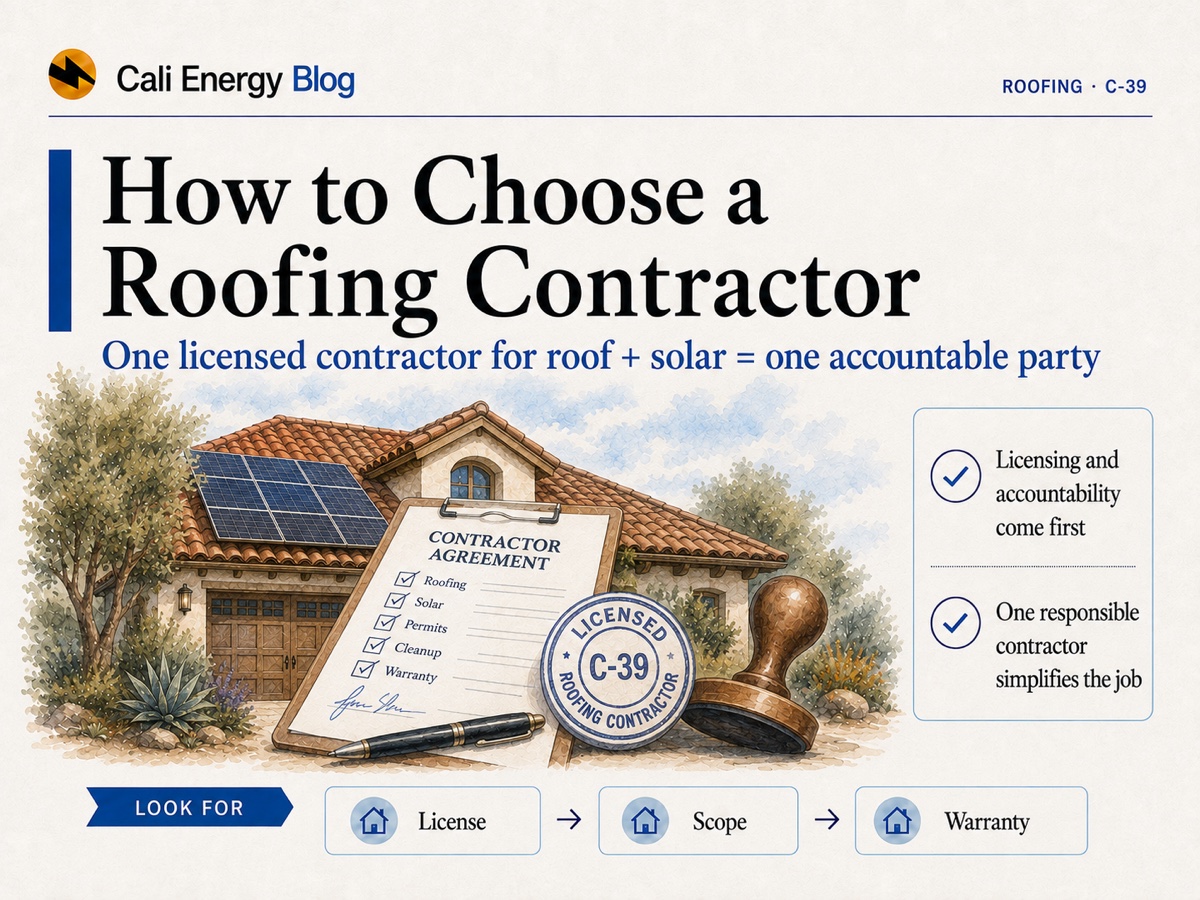
- A re-roof is permitted work — in the City of LA, an express permit — so the $1,000 small-job exemption does not cover it: the contractor needs an active C‑39 license, whatever the price.
- The CSLB record shows the classification, status, $25,000 bond and workers’ comp — which C‑39 roofers must carry even with no employees. The salesperson at your door must be a registered home improvement salesperson.
- California caps the down payment at $1,000 or 10%, whichever is less, with no exception for special-order materials, and gives you 3 business days to cancel a contract signed at home, counted from when you receive a signed copy — 5 if you are 65 or older.
- If solar will follow, keep to one layer of roofing: LADBS’s building-permit exemption for rooftop arrays requires it, and an overlay removes it.
The ten-minute check before you sign
| Check | Where | The rule |
|---|---|---|
| Active license with C‑39 Roofing | CSLB license lookup, by name or number | Required for any job that needs a building permit or costs $1,000 or more, labor and materials together; splitting a job to stay under does not count |
| Status and history | Same CSLB record | Suspensions, citations and disciplinary actions are listed; the name on the contract should match the record |
| Workers’ compensation | Same CSLB record | C‑39 roofers must carry it whether or not they have employees — no exemption form |
| Contractor’s bond | Same CSLB record | $25,000, required to hold an active license |
| Salesperson registration | CSLB lookup, by the salesperson’s name | Anyone selling home improvements for a contractor must be a registered home improvement salesperson; selling without it is a misdemeanor |
| Written contract and payments | The contract | Required in writing above $500; down payment no more than $1,000 or 10%, whichever is less; payments may not exceed the work done; who obtains the permit and a completion date must be stated; changes need a signed change order |
| Right to cancel | The contract’s cancellation notice | A contract signed at home can be canceled until midnight of the third business day after you receive a signed, dated copy — the fifth for buyers 65 and older |
| Permit and code | Ask who pulls the permit | City of LA: express re-roof permit; Class A covering in Very High Fire Hazard Severity Zones; certified cool roof when more than half the roof is replaced |
| After a declared disaster | CSLB record, again | Unlicensed repair work on disaster damage in a declared emergency area can be charged as a felony — and the homeowner is treated as the victim |
| Solar on the same roof | Same CSLB record | Solar PV is installed under the C‑46 Solar or C‑10 Electrical classification; one firm holding C‑39 as well can answer for both |
Sources: CSLB C‑39 · CSLB workers’ comp · CSLB home improvement contracts · B&P §7048 · §7071.6 · §7153 · §7028.16 · Civil Code §1689.6 · LADBS P/GI 2026-003 · CSLB classifications.
What the C‑39 license covers — and why price is not an exemption
The CSLB defines a C‑39 roofing contractor as one who “installs products and repairs surfaces that seal, waterproof and weatherproof structures,” working with shingles, shakes, roof tile, slate, metal roofing, membranes and similar materials. California’s small-job exemption from licensing covers only work under $1,000 in total that is “casual, minor, or inconsequential” and does not require a building permit (B&P §7048, as amended effective January 1, 2026). A re-roof is permitted work — in the City of Los Angeles, an express permit — so it needs a licensed contractor at any price.
Workers’ compensation is the other roofing-specific line. Most licensees with no employees may file an exemption; C‑39 roofers — along with concrete, HVAC, asbestos-abatement and tree-service contractors — may not (CSLB). A roofer who says they “work alone, so no comp” is describing a license that should not be active.
Get the scope in writing — the four line items that matter
Tear-off or overlay
A tear-off strips the roof to the deck so damage can be seen and repaired; an overlay adds a second layer. Overlays cost less up front, but if solar is coming, LADBS’s building-permit exemption for rooftop arrays requires a single layer of roofing.
Underlayment
The layer between deck and covering. The contract should name the product — synthetic underlayment, self-adhering membrane in valleys and at eaves — not just “underlayment.”
Flashing
Metal at chimneys, walls, valleys and vents. The scope should say new flashing, not “reuse existing where possible.”
Ventilation
Intake and exhaust vents keep the attic dry and the roof cooler. Ask what the contractor will change, not only what they will cover over.
Permit and code: what a Los Angeles re-roof triggers
In the City of Los Angeles, re-roofing with a Class A or B covering weighing under 6 pounds per square foot over solid sheathing is an express permit with no plan check. Two conditions come with it: a Class A covering is required inside a Very High Fire Hazard Severity Zone, and a home re-roof covering more than 50% of the total roof area must use a cool-roof product labeled and certified by the Cool Roof Rating Council (LADBS P/GI 2026-003). The state Energy Code sets the same more-than-half trigger for single-family re-roofs (CRRC Title 24 summary). Other cities run their own permits; how the cool-roof rule plays out by climate zone and color is in the cool-roof rule for re-roofs. Either way, the permit is the contractor’s job — and the contract must say who obtains it.
Roof and solar: one accountable contractor
Two companies, one hole in your roof
Panels are fastened through the roof. When a leak shows up near a mount, a separate roofer and a separate solar installer each have a reason to point at the other. A contractor holding the roofing classification (C‑39) and a solar-capable one (C‑46 Solar or C‑10 Electrical) can answer for the roof and the penetrations together — provided the written contract and warranty name both.
Sequence matters too. A roof near the end of its life is cheaper to replace before the array goes on than to reach later by removing and reinstalling it — see should you replace your roof before solar? and solar removal & reinstall. In the City of LA, a flush-mounted array can skip a separate building permit only on a roof with one layer of roofing and no sagging or deterioration (LADBS P/GI 2023-027; details in solar permits in Los Angeles). For the solar side of the hire, see how to choose a solar installer.
Two warranties, not one
The manufacturer’s warranty covers defects in the shingles, tile or membrane. The contractor’s workmanship warranty covers the installation — flashing, fastening, penetrations. Get both in writing, with how long each runs, what voids it and whether the workmanship promise survives a change of ownership at the company. CSLB tells consumers to get any labor and material warranty in writing (CSLB).
Red flags worth a second look
Each of these is either illegal outright or a reason to ask for an explanation: a down payment above $1,000 or 10%; “pay now for special-order materials” (the cap has no such exception); payments ahead of the work; no written scope; reluctance to pull a permit; a license that lacks C‑39 or does not match the company name; no workers’ comp on the record; a salesperson with no registration; a door-to-door pitch after a fire or storm from anyone you cannot find on the CSLB lookup. A bid far below the others or pressure to sign today is not illegal, but the contract you sign at home can still be canceled within the legal window.
One license for the roof and the array
Cali Energy holds the B, C‑10 and C‑39 classifications under CSLB #1032379 (Northridge, CA), so one accountable contractor stands behind a roof we replace and the solar mounted on it. Check our license, bond and workers’ comp yourself on the CSLB lookup.
Frequently asked
What license does a roofing contractor need in California?
An active license with the C‑39 Roofing classification from the Contractors State License Board. The only exemption is for casual work under $1,000 in total that needs no building permit; a re-roof is permitted work (in the City of Los Angeles, an express permit), so it requires a licensed contractor at any price. Check it on the CSLB license lookup.
Do California roofers have to carry workers’ compensation?
Yes. C‑39 roofing contractors must carry workers’ compensation or a valid self-insurance certificate whether or not they have employees; they cannot file the no-employee exemption that most other licensees can. The policy appears on the CSLB license record.
How much can a roofer ask as a down payment in California?
No more than $1,000 or 10% of the contract price, whichever is less, for a home improvement job — with no exception for special-order materials. After that, payments may not exceed the value of the work already done.
Can I cancel a roofing contract I signed at home?
A home solicitation contract can be canceled until midnight of the third business day after you receive a signed, dated copy of the contract, or the fifth business day if you are 65 or older; Saturday counts as a business day (Civil Code §1689.6). Follow the cancellation notice in the contract and keep proof of when you sent it.
Do I need a permit to replace my roof in Los Angeles?
Yes. In the City of Los Angeles a re-roof with a Class A or B covering under 6 pounds per square foot is an express permit with no plan check. A Class A covering is required in Very High Fire Hazard Severity Zones, and replacing more than half of a home’s roof requires a CRRC-certified cool-roof product. Other cities issue their own permits. The contractor normally pulls it.
Should the same contractor do my roof and my solar?
It removes the dispute over who owns a leak at a panel mount, provided the contractor holds roofing (C‑39) and solar-capable (C‑46 or C‑10) classifications and the contract names both. Keep to a single layer of roofing if solar will follow: in the City of LA the building-permit exemption for rooftop arrays requires it.
How do I check a roofing contractor’s license?
Search the CSLB license lookup by business name or license number. Confirm the license is active, C‑39 is listed, the name matches your contract, the bond and workers’ comp are current, and there is no disciplinary history you have not asked about. Look up the salesperson’s registration the same way.
Related reading
Sources & methodology
Figures on this page come from the primary sources below and, where noted, from Cali Energy calculations using the stated assumptions. Rates, incentives, and program terms change; each was verified September 29, 2026.
- CSLB — Check a license (license lookup)
- CSLB — C-39 Roofing classification (CCR Title 16)
- CSLB — Workers’ compensation requirements (C-8, C-20, C-22, C-39, C-61/D-49 must carry it)
- CSLB — Home improvement contracts (written contract over $500, down payment cap, payments, permits, change orders)
- CSLB — Description of classifications (C-10 Electrical, C-46 Solar)
- Business and Professions Code §7048 — minor work exemption (amended effective January 1, 2026)
- Business and Professions Code §7071.6 — $25,000 contractor’s bond
- Business and Professions Code §7153 — home improvement salesperson registration
- Business and Professions Code §7028.16 — unlicensed disaster repair work
- Civil Code §1689.6 — right to cancel a home solicitation contract
- LADBS — Information Bulletin P/GI 2026-003, Express Permits (re-roof items 4 and 5)
- LADBS — Information Bulletin P/GI 2023-027, Solar Energy Systems (one layer of roofing)
- Cool Roof Rating Council — 2025 California Energy Code summary
Get a licensed roofing and solar estimate
Tell us about your roof and we'll give you an itemized, written scope from one licensed contractor — CSLB #1032379, C-39 roofing plus solar. Call +1-323-844-7777.
Get a free estimatePrepared by Cali Energy, September 29, 2026. This article is for general educational purposes only and is not legal, tax, financial, engineering, or utility advice. Rates, incentives, codes, permit requirements, equipment specifications, prices, and program terms may change; figures and timelines are estimates, not guarantees. Confirm current requirements with the applicable utility, AHJ, program administrator, manufacturer, or a licensed professional. See our Content Disclaimer. Cali Energy · 19201 Parthenia St, Unit E, Northridge, CA 91324 · CSLB #1032379 (B, C-10, C-39)