

Solar Panel Removal & Reinstall for a Roof Replacement
Straight answer: a full re-roof means the array comes off and goes back on — a detach and reset, also called remove and reinstall or detach and reattach. Reconnecting the system is licensed solar or electrical work (C-46 or C-10); the roof is roofing work (C-39). In Los Angeles the re-roof itself can go through an LADBS express permit, and the reinstalled array is PV work with its own electrical permit. Equipment warranties do not pay for the labor, so the price belongs in your roofing plan from the start.
Get a free estimate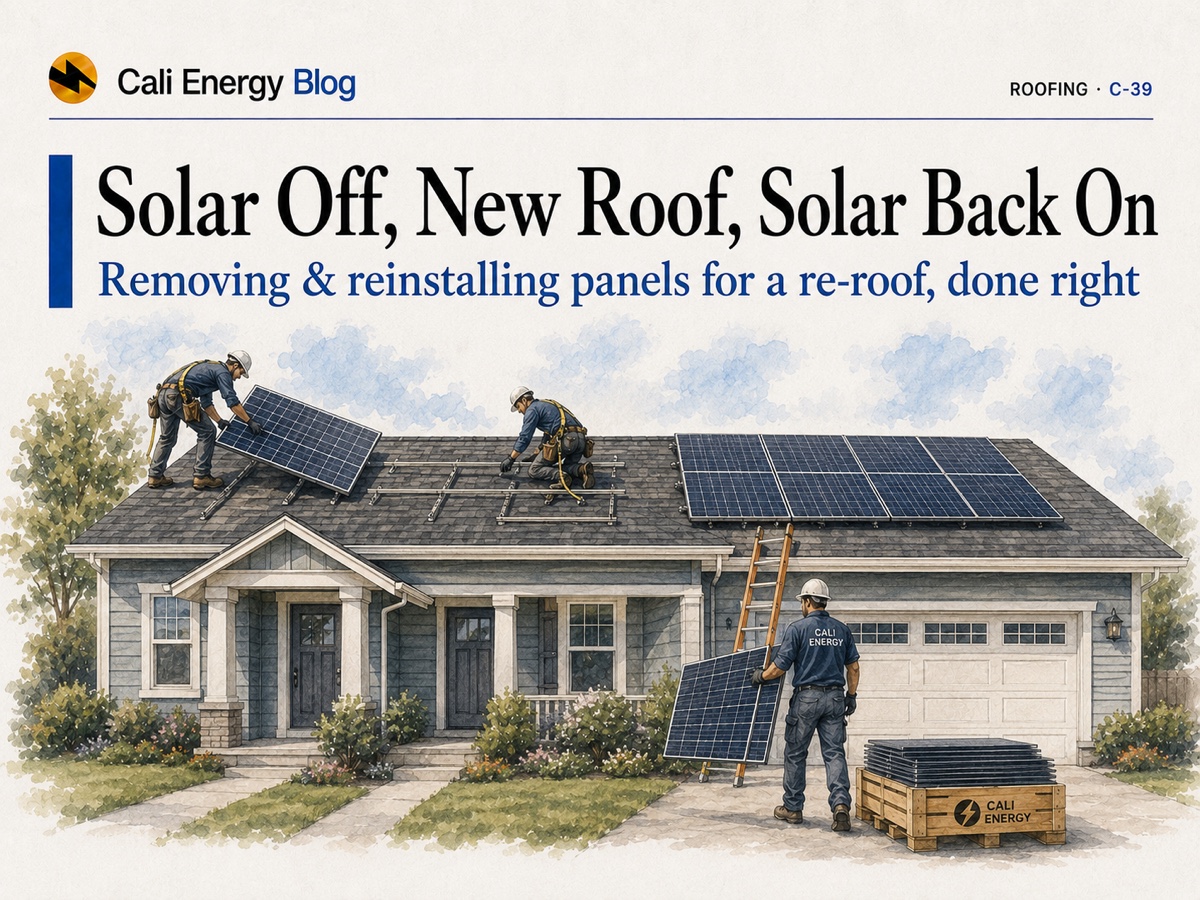
- A full re-roof means the whole array comes off and goes back on; plan it before the tear-off date.
- Disconnecting and reinstalling the PV system is work for a C-46 Solar or C-10 Electrical contractor; the roof is C-39 roofing work.
- In Los Angeles, an LADBS express permit covers a re-roof with Class A or B covering under 6 lb per sq ft; replacing more than half of a residential roof calls for a cool roof product, except when tiles are reset on new underlayment.
- Enphase and SolarEdge product warranties do not pay for removal or reinstallation labor, and SolarEdge requires reinstallation per its documentation.
- Leased or PPA system? The provider owns it; its agreement decides who may remove it.
Why the panels have to come off
A full roof replacement strips the roof to the deck and rebuilds it — underlayment, flashing and new covering. That cannot happen under a mounted array, so the system is shut down, detached and set aside first, then remounted once the new roof is on. A small, localized repair may need only the panels over the work area lifted. The tear-off is also the one time the deck is bare, so any deck or flashing repair is simplest then. If you do not have solar yet and the roof is near the end of its life, the order usually runs the other way: see replace your roof before installing solar?
The detach-and-reset, step by step
| Step | What happens | Who does it |
|---|---|---|
| 1. Plan and document | Record the layout and equipment, check the system’s output, confirm permits; for a leased or PPA system, get the provider’s terms first | Solar or electrical contractor |
| 2. Shut down and detach | The system is de-energized and the modules, wiring and racking come off | C-46 or C-10 contractor |
| 3. Store the array | Modules handled and stored as the manufacturer’s instructions require | Solar crew |
| 4. Replace the roof | Tear-off, deck check, new underlayment and covering, old penetrations sealed | C-39 roofing contractor |
| 5. Remount | Attachments set and flashed into the new roof, racking and modules reinstalled per the manufacturers’ documentation | Solar crew with the roofer |
| 6. Reconnect and test | The system is reconnected, energized and checked against its pre-removal output | C-46 or C-10 contractor |
| 7. Inspect | The city inspects the permitted work before sign-off | Contractor schedules it |
License scopes: CSLB, Description of Classifications. Exact permits and inspections are set by the city.
Permits: Los Angeles, and how another city writes it down
Los Angeles. LADBS’s express permit list, with no plan check, covers a re-roof with a Class A or B roof covering weighing less than 6 pounds per square foot over existing or new solid sheathing. Class A covering is required in a Very High Fire Hazard Severity Zone, and a residential roof replacement of more than 50% of the roof area has to use a cool roof product certified by the Cool Roof Rating Council. Removing roof tiles, applying new underlayment and resetting the tiles is its own express item, with no cool roof requirement (LADBS IB P/GI 2026-003). The reinstalled array is solar work: LADBS requires an electrical permit for PV systems, and a building permit for their structural support unless the rooftop exemption applies (LADBS IB P/GI 2023-027). Confirm the permit path for the reinstall with LADBS before the tear-off. The cool roof rule is explained in cool roof requirements for a re-roof.
San Diego, for comparison, puts the whole procedure in one bulletin: removing existing roof-mounted PV for a roof renewal needs a building or combination building permit; the reinstallation must be done by a contractor holding a C-10 or C-46 license; the permit does not allow any alteration of the original equipment; the original approved plans must accompany the submittal; and a pre-removal inspection may be required (City of San Diego, Information Bulletin 301, May 2026). That last point matters everywhere: adding a battery or swapping the inverter during the re-roof is a change to the system, permitted as such, not a like-for-like reset.
Who should do the work
Disconnecting, reconnecting and testing a PV system is electrical work: in California it falls under the C-46 Solar or C-10 Electrical classification, while the roof falls under C-39 Roofing (CSLB). A roofing company without one of those classifications should not be reconnecting the array. The cleanest arrangement is one contractor licensed for both, so the attachments, flashing and roof are built and warranted as one job; the alternative is two contractors with a written split of who owns the penetrations. How to check a license is in choosing a roofing contractor and choosing a solar installer.
Warranties: what they do not pay for
Equipment warranties cover defective parts, not moving a working system. Enphase’s warranty excludes the labor of uninstalling a product or reinstalling a repaired or replacement one (Enphase). SolarEdge’s requires its products to be installed, reinstalled and handled according to its documentation, and does not cover labor for uninstalling and reinstalling on site (SolarEdge). So the detach-and-reset is paid by you, unless your installer’s contract says otherwise, and it should be done to the manufacturers’ instructions to protect the coverage that remains. Two more checks: whether your original installer’s workmanship warranty survives another contractor moving the array, and who warrants the new penetrations. The layers are laid out in roof warranty vs solar warranty and solar warranties explained.
What drives the price
Number of panels
Labor scales with the modules and attachments that come off and go back on.
Roof type and pitch
Steep, tall and tile roofs take longer to work on and to flash.
Attachments and flashing
New attachments and flashing are set into the new roof; reused racking must still be sound.
Permits and inspection
A re-roof permit, the PV permit and any inspection visits.
Electrical work
Reconnection and testing, plus anything the inspector requires.
Storage and schedule
A long roof job can mean storing the array off site.
Ask for the detach-and-reset as its own line on the roofing quote. If you are buying solar now, ask it before you sign: the CPUC’s consumer guide lists “Roughly how much will it cost to remove and re-install the panels if I need to replace my roof in the future, including inspection fees?” among the questions for any installer (CPUC).
The owner’s agreement comes first
On a lease or power purchase agreement the provider owns the system, so its agreement decides who may remove and reinstall it, who schedules the work and who pays. Read the removal and roof-work terms and get the provider’s written approval before any crew touches the array; sort this out before you book the roofer.
Older systems and current code
A reinstalled system is inspected under the permit issued for the job, and codes have changed since many older arrays went up — rapid shutdown, for example. Whether a like-for-like reset has to be brought up to current requirements is the building department’s call for your permit; San Diego’s reinstall permit allows no alteration of the original equipment, so an upgrade needs its own permit. Ask the question at permitting, not on inspection day. Tile roofs add their own steps: see solar on clay tile roofs.
Roof and solar under one contractor
Cali Energy holds general building (B), electrical (C-10) and roofing (C-39) classifications under CSLB #1032379, so one company can detach the array, replace the roof, flash the new attachments and reinstall and test the system as a single job, with one point of responsibility for the roof and the array. See our combined roofing-and-solar work on our projects.
Frequently asked
Do solar panels have to be removed to replace a roof?
For a full re-roof, yes: the roof is stripped to the deck and rebuilt, so the whole array is detached, stored and reinstalled on the new roof. A small repair may need only the panels over the work area lifted.
Who can remove and reinstall solar panels in California?
Disconnecting and reconnecting a PV system is electrical work under the C-46 Solar or C-10 Electrical license classification; the roof is C-39 Roofing work. San Diego’s re-roof bulletin, for example, requires the reinstallation to be done by a C-10 or C-46 contractor.
Do I need a permit to remove and reinstall solar for a re-roof in Los Angeles?
The re-roof can use an LADBS express permit when the covering is Class A or B and under 6 lb per sq ft, with Class A in Very High Fire Hazard Severity Zones and a cool roof product when more than half of a residential roof is replaced. The reinstalled array is PV work, which LADBS permits electrically, plus structurally unless exempt; confirm the path with LADBS before the tear-off.
Does my solar warranty cover removal and reinstallation?
Generally not. Enphase excludes the labor of uninstalling and reinstalling products, and SolarEdge does not cover on-site uninstall and reinstall labor and requires reinstallation per its documentation. Check your installer’s contract for any workmanship terms.
What if my solar panels are leased or on a PPA?
The provider owns the system, so its agreement decides who may remove and reinstall it and who pays. Get its written approval before scheduling the roof.
How much does solar removal and reinstallation cost?
It depends on the number of panels, the roof type and pitch, new attachments and flashing, permits, electrical work and any storage. Ask for it as its own line on the roofing quote; the CPUC’s consumer guide also tells solar buyers to ask the cost up front.
Related reading
Sources & methodology
Figures on this page come from the primary sources below and, where noted, from Cali Energy calculations using the stated assumptions. Rates, incentives, and program terms change; each was verified September 30, 2026.
- LADBS — Information Bulletin P/GI 2026-003, Express Permits (No Plan Check Required), re-roof items
- LADBS — Information Bulletin P/GI 2023-027, Solar Energy Systems
- City of San Diego — Information Bulletin 301 (May 2026): permits for solar PV, re-roofing with existing PV
- CSLB — Description of Classifications (C-10 Electrical, C-39 Roofing, C-46 Solar)
- CPUC — California Solar Consumer Protection Guide
- Enphase — US Limited Warranty, IQ Microinverters (labor exclusions)
- SolarEdge — Limited Product Warranty (effective January 1, 2026)
Need a new roof under your solar?
We detach the array, replace the roof, flash the new attachments and reinstall and test the system as one job — roof and electrical under one license (CSLB #1032379). Call +1-323-844-7777 for a quote.
Get a free estimatePrepared by Cali Energy, September 30, 2026. This article is for general educational purposes only and is not legal, tax, financial, engineering, or utility advice. Rates, incentives, codes, permit requirements, equipment specifications, prices, and program terms may change; figures and timelines are estimates, not guarantees. Confirm current requirements with the applicable utility, AHJ, program administrator, manufacturer, or a licensed professional. See our Content Disclaimer. Cali Energy · 19201 Parthenia St, Unit E, Northridge, CA 91324 · CSLB #1032379 (B, C-10, C-39)