

Attic Insulation When You Re-Roof in California
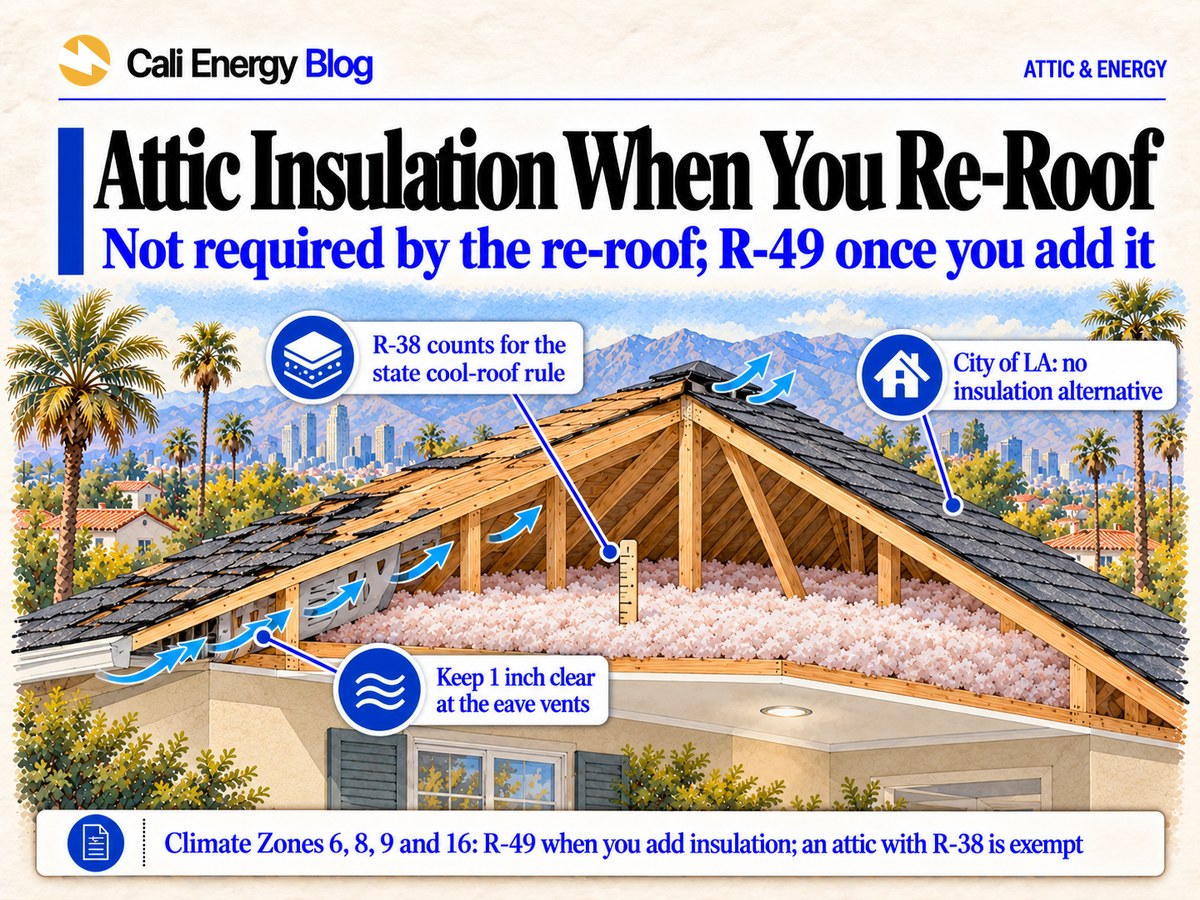
Replacing a steep roof in California doesn't by itself require adding insulation to the attic. Two rules tie them together. Under the state Energy Code, an attic with R-38 or more counts as an alternative to a cool-rated covering when more than half of a steep roof is replaced in Climate Zones 4 and 8 through 15, though the City of Los Angeles's own cool-roof rule has no such alternative. And once the attic itself is altered, by adding insulation or by putting a new duct system in it, the code asks for R-49 in Climate Zones 1 through 4, 6 and 8 through 16, which take in the Los Angeles area, with air sealing, covered recessed lights and code ventilation depending on the zone and on how much insulation is already there; an attic that already has R-38 is exempt. A flat roof is different, because its re-roof brings its own insulation rule. This page sets out the rules as of October 2026.
How a radiant barrier compares is in radiant barrier in a Los Angeles attic, and the vent rule in attic ventilation requirements.
What adding insulation brings in
What the Energy Code asks for depends on the climate zone and on how much insulation the attic already has (Section 150.2(b)1J).
| Climate zone | Under R-19 now | R-19 to under R-38 now | R-38 or more now |
|---|---|---|---|
| 6, the coast | R-49 and code ventilation | Code ventilation only | None of these |
| 8 and 9, most of the basin and the Valley | R-49, air sealing, covered recessed lights, code ventilation | R-49 and code ventilation | None of these |
| 16, the mountains | R-49, air sealing, covered recessed lights, code ventilation | R-49, covered recessed lights, code ventilation | None of these |
- R-49 is for the insulation alone at the ceiling level, or a weighted U-factor of 0.020 for the assembly.
- Air sealing covers all accessible areas of the ceiling between the attic and the house. It doesn't apply where a fuel-burning furnace or water heater that vents by natural draft sits inside the house.
- Recessed lights have to be covered to the same depth as the rest of the ceiling; fixtures not rated for insulation contact are replaced or get a fireproof cover.
- Code ventilation means the attic vents meet R806 of the California Residential Code.
- Other exceptions. None of these apply where the work would disturb asbestos, where there's knob-and-tube wiring in the attic, or where the attic is shared with another unit that isn't being altered. Where the attic is too shallow for R-49, it's filled as far as the vent clearance allows.
The same rules apply when a new duct system goes into the attic. A building official checks them; no ECC rater is needed.
How a re-roof and the attic connect
The roof and the attic floor are separate jobs, but a few rules join them.
- The state cool-roof rule. Replacing more than half of a steep roof in Climate Zones 4 and 8 through 15 calls for a cool-rated covering, and ceiling insulation of R-38 or more, or a ceiling U-factor of 0.025 or less, counts as equivalent (Section 150.2(b)1I). The other alternatives are in the cool-roof requirement on a re-roof.
- The City of Los Angeles. The city's own cool-roof rule for replacing more than half a roof has no insulation alternative; its exceptions include a re-roof where solar is being installed (LAMC 99.04.106.5), which lifts only the city's rule and which LADBS's express re-roof permit doesn't repeat, so confirm it with LADBS. Inside the city, insulation doesn't let a dark roof that isn't cool-rated pass; how to check a color is in CRRC cool roof ratings.
- Flat roofs. Replacing more than half of a low-slope roof in Climate Zones 8 through 16 also calls for R-14 continuous insulation at the roof deck, with exceptions for roofs already insulated; the details are in flat roof replacement cost in Los Angeles.
- Vents and baffles. Deeper insulation can't block the eave vents, and there has to be at least 1 inch between the insulation and the roof deck at the vent (CRC R806.3). A re-roof is when the roof's vents are set, so the insulation plan and the vent plan should match.
Permit and paperwork
Attic insulation has its own permit and its own paper trail.
- Permit. In the City of Los Angeles, installing insulation or a radiant barrier in a residential attic is an express permit item (LADBS P/GI 2026-003, item 26), separate from the re-roof.
- Certified product. Insulation sold and installed in California has to be certified with the Department of Consumer Affairs; the Bureau of Household Goods and Services lists certified products in its Directory of Certified Insulation Materials.
- The installer's receipt. Under the Federal Trade Commission's R-value rule, a loose-fill receipt shows the coverage area, the initial installed thickness, the minimum settled thickness, the R-value and the number of bags; for batts, the coverage area, thickness and R-value. It's dated and signed by the installer (16 CFR 460.17).
Frequently asked
Do I have to add attic insulation when I replace my roof?
How much attic insulation does the code ask for in Los Angeles?
Does attic insulation let me keep a dark roof?
Do I need a permit to add attic insulation in Los Angeles?
What should the insulation receipt show?
Related reading
Sources & methodology
Code sections, rules and figures on this page come from the primary sources below. Codes, local requirements and product terms change; each was verified October 14, 2026.
- California Energy Commission, 2025 Building Energy Efficiency Standards (Title 24, Part 6), CEC-400-2025-010-F, Sections 150.2(b)1I and…
- California Energy Commission, Single-Family Residential Compliance Manual for the 2025 Building Energy Efficiency Standards, CEC-400-2025-005,…
- Los Angeles Department of Building and Safety, Information Bulletin P/GI 2026-003, Express Permits (No Plan Check Required), revised June 10, 2026
- Los Angeles Municipal Code, Section 99.04.106.5, Cool Roof for Reduction of Heat Island Effect (as amended by Ordinance 187,208)
- California Department of Consumer Affairs, Bureau of Household Goods and Services, Directory of Certified Insulation Materials (July 2026)
- Federal Trade Commission, Labeling and Advertising of Home Insulation, 16 CFR 460.17
We check the attic before we price the re-roof
Call (323) 844-7777. We look at how much insulation the attic has, where the ducts run and how the eaves are vented, and tell you which cool-roof route your address allows and what adding insulation would bring in. Have ready the address and, if you can, photos of the attic.
Prepared by Cali Energy, October 14, 2026. This article is for general educational purposes only and is not legal, tax, financial, engineering, or utility advice. Rates, incentives, codes, permit requirements, equipment specifications, prices, and program terms may change; figures and timelines are estimates, not guarantees. Confirm current requirements with the applicable utility, AHJ, program administrator, manufacturer, or a licensed professional. See our Content Disclaimer. Cali Energy · 19201 Parthenia St, Unit E, Northridge, CA 91324 · CSLB #1032379 (B, C-10, C-39)