

How Re-Roof Permit Rules Differ Across LA-Area Cities
A whole re-roof on a house needs a building permit in all seven jurisdictions compared here (the City of Los Angeles, unincorporated Los Angeles County, Burbank, Glendale, Long Beach, Santa Clarita and Simi Valley), apart from a certified-contractor route for detached single-family houses in the City of Los Angeles. The permit comes from the agency with jurisdiction over the parcel, which isn't always the city in the mailing address. What differs is how you apply, how small a repair can go without a permit, what each agency adds to the state code, and how inspections and the final are handled. The sharpest local add-ons in agency documents as of October 2026: Glendale requires an approved Design Review Exemption when the roofing material changes, Burbank requires cool-roof products on a re-roof with no 50% threshold, and unincorporated Los Angeles County requires a construction-debris recycling plan for permitted work and Department of Regional Planning approval to switch to a metal roof.
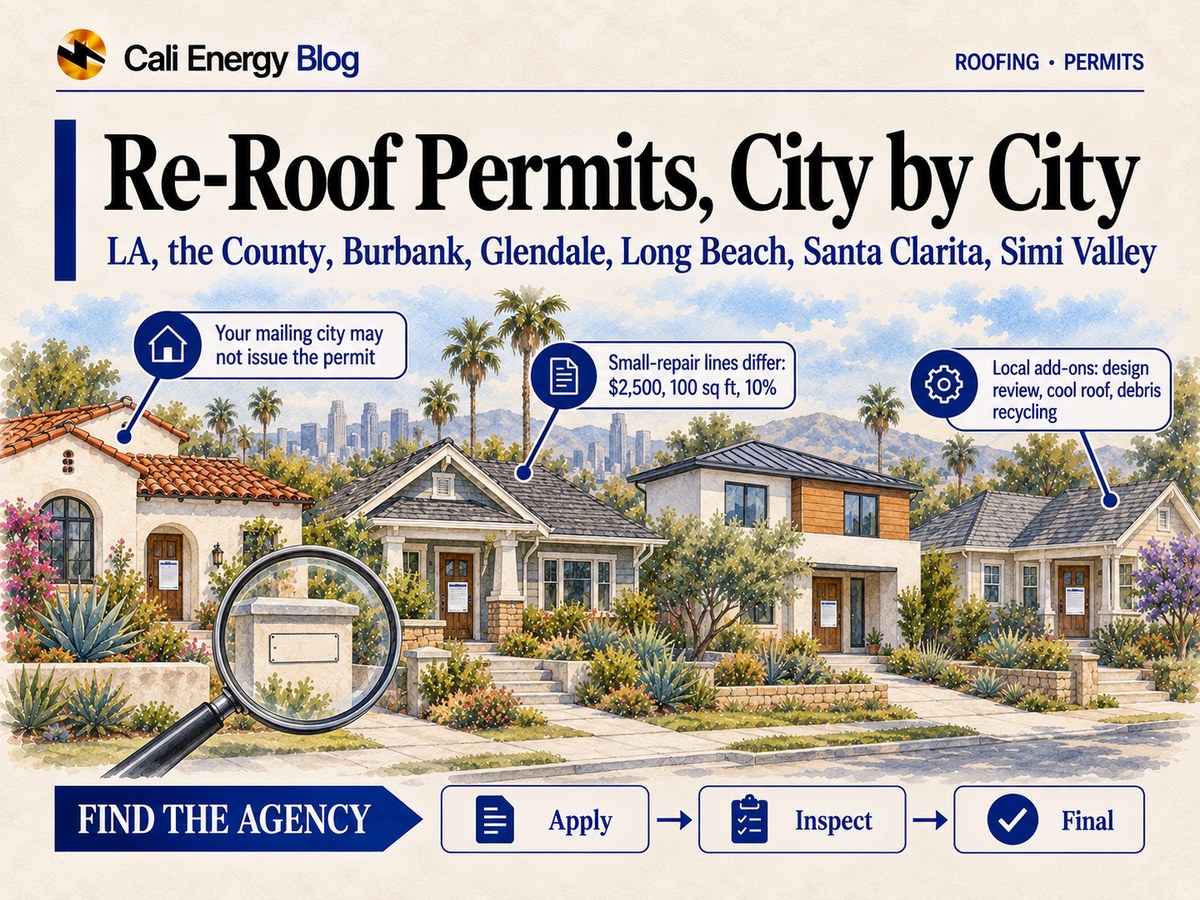
This comparison covers one- and two-family houses under the 2025 California codes, in force since January 1, 2026, with each agency's own amendments, and it's drawn from each agency's documents as of October 2026; a handout or manual with an older date is dated where it's cited. A mailing city isn't necessarily the permitting agency, so start with the next section. Rules and agency pages change, so confirm the requirements with the agency before work starts. Fees and processing times aren't covered here, and neither are the state code's technical requirements for the roof itself, which have guides of their own: California WUI roof requirements, the Class A roof rating and the cool-roof requirement on a re-roof. The City of Los Angeles is covered step by step in roof permit in Los Angeles and checking that a re-roof permit was finaled.
First, find the agency that issues the permit
Everything else on this page depends on which agency has jurisdiction over the parcel, and the city in the mailing address doesn't settle that. Three checks sort it out:
- Look the address up in the county's Service Locator. Los Angeles County Public Works' Service Locator shows which agency serves an address.
- For a Los Angeles address, check ZIMAS too. LADBS's homeowner guide says that if ZIMAS can't find the address, the property may be outside the City of Los Angeles.
- If the parcel is unincorporated, the county issues the permit. Unincorporated county parcels are permitted by Los Angeles County Public Works, Building and Safety, not by the neighboring city, even when the mailing address carries that city's name.
We've seen it on our own jobs. A 2022 solar job of ours, not a re-roof, was on a house with a Long Beach mailing address and ZIP code, but the parcel is unincorporated Los Angeles County. The permit came from Los Angeles County Public Works in July 2022, not from the City of Long Beach, and the county inspection was signed on August 12, 2022; the Long Beach case study has the details.
Santa Clarita is its own city, with its own Building & Safety Division. Simi Valley is a city in Ventura County, also with its own Building & Safety Division. The Service Locator covers Los Angeles County only, so for a Simi Valley mailing address, confirm with the City of Simi Valley that the parcel is inside city limits.
Side by side: how the seven agencies differ
The three tables below put each agency's rules into short cells, each tagged with the document it comes from; the city-by-city sections after them add the conditions, the dates and links to each agency's pages. Where a cell says "not published," ask the agency. Fire-zone rules turn on the parcel's designation, which is looked up as described in checking a home's fire hazard zone.
| Agency | How a re-roof permit is applied for | Small repair without a permit |
|---|---|---|
| City of Los Angeles (LADBS) | Most re-roofs: an express permit (e-permit) with no plan check, online or at an LADBS counter (bulletin P/GI 2026-003, items 4, 5 and 23). A certified licensed contractor can instead re-roof a detached single-family house under a Certificate of Compliance (LABC 2026, 91.108.12) | Set by value, not area: work valued at $2,500 or less may be exempt, unless it impacts structural stability or public safety, among other conditions (LABC 2026, 91.106.2). Confirm with LADBS |
| Unincorporated LA County (Public Works) | Online in EPIC-LA as a Residential "Repair/Replacement" permit, with no plan review, or at the district office that serves the address. Not on the county's express-permit list (list effective August 26, 2026) | No roofing item in the county's list of work exempt from a building permit (Title 26, §106.3); Public Works says a permit is required to alter or repair a dwelling |
| Burbank | A "Tier 1" permit with a streamlined submittal, generally obtained over the counter; single-family reroofing can also be applied for online in Burbank Online Permits | No roofing item in the city's work-exempt handout (2025 CRC and CBC) or on its permits page; ask the city before a repair |
| Glendale | "Roofing Permit (All Structures)": submitted, reviewed and issued online in the Glendale Permits Portal, with nothing submitted in person | Not published; ask the city before a repair |
| Long Beach | One- and two-family re-roofs: applied for and issued automatically in one step online (LB Services). Express items B9 and B10 (IB-058, rev. July 9, 2025), except in the Coastal Zone, a Historic District or on a qualified historical building, which go over the counter or through plan review | Roofing repair of no more than 100 sq ft within 12 months (LBMC 18.04.020). An older city FAQ page still says 500 sq ft; the code says 100 |
| Santa Clarita | Online in the city's eService portal (Accela) or at the Permit Center at City Hall; not one of the city's Instant Online Permits | Roof repairs up to 10% of the roof area or 200 sq ft, whichever is less, within one year (Santa Clarita Building Code, enforceable January 1, 2026) |
| Simi Valley (Ventura County) | Online in the Customer Self Service portal, with a Construction Permit Declaration (contractor) or a Property Owner's Package (owner); no automatic issuance for re-roofs | Two city sources differ: the code exempts less than 10% of the roof within 12 months (SVMC 8-5.03(a)(14)); the Building & Safety FAQ requires a permit for more than 10% or over 100 sq ft. Plan on the stricter reading |
| Agency | Tear-off and overlay | Wood and fire class | Cool roof | Extra approvals or requirements |
|---|---|---|---|---|
| City of Los Angeles (LADBS) | Express items: a new covering over the existing solid sheathing (item 4) or over new solid sheathing (item 5); see the LADBS guide | No wood shake or wood shingle roofs anywhere in the city (91.1505.1). Class A in Very High fire hazard zones (items 4, 5); LADBS's fire-zone checklist applies it in High zones too | Residential replacement over 50% of the roof: a CRRC-labeled and certified product (items 4, 5) | The owner signs and notarizes LADBS's Owner Statement before the final |
| Unincorporated LA County | The old covering may stay only if inspection shows no more than one layer of a listed type, a sound deck and framing for the added weight, among other conditions; clay or concrete tile, and wood shakes with a narrow exception, come off completely (Building Code Manual 1512, April 2025, written under the 2023 county code) | In a Fire Hazard Severity Zone: Class A, and no wood shingles or shakes in any zone regardless of classification; reaches repairs applied for from January 1, 2026 (Title 30) | Replacing over 50% of the roof: steeper than 2:12, aged reflectance 0.25 with emittance 0.85, or SRI 20; 2:12 or less, 0.65 with 0.85, or SRI 78 (Title 31, §4.106.6) | Switching to metal: Department of Regional Planning approval (Manual 1512). Debris: at least 70% recycled or reused, plan filed with Public Works, final report approved before the final inspection (Title 20, Ch. 20.87) |
| Burbank | No new covering over wood shakes or shingles; with two or more layers and any of them wood, all layers come off (Ordinance 25-4,034). The application asks for existing layers and new sheathing | No wood roof covering on any new or existing building (Ordinance 25-4,034, effective January 1, 2026); the application asks for the fire zone | Required except for roof repair, building-integrated PV and roofs with at least 25 lb/sq ft of thermal mass over the membrane, such as green roofs; no 50% threshold. Over 2:12: aged reflectance 0.23 with emittance 0.85, or SRI 20 (BMC 9-1-11-4.509) | Issued re-roof permits carry a condition to install a CRRC-labeled and certified cool-roof product |
| Glendale | Every tear-off needs solid sheathing, gaps between 1x boards under 3/8 inch (city permit guidance); down to spaced sheathing, at least 3/8-inch plywood goes on (2026 Glendale code, R908.7) | No wood roof covering. Outside Fire Hazard Severity Zones, at least Class B when over 50% is replaced in a year and for any covering in an alteration, repair or replacement; in fire hazard areas, R337 (2026 Glendale code) | No local amendment found; the state energy code's re-roof rule applies | Design Review Exemption approved when the material type changes or the building is historic; a separate permit for a detached garage or other detached structure; permit good for 180 days from issuance |
| Long Beach | All layers come off where there are already two or more, or over slate, clay, cement or asbestos-cement tile (IB-014, rev. December 2023, written under the 2019 codes). Express item B9: composition over at most one existing composition layer on solid sheathing | Not published; ask the city | No local amendment: the city adopted the state energy code as is | Active Long Beach business license for the contractor (IB-029, rev. July 27, 2026). Historic districts: Certificate of Appropriateness before work, no midnight or black shingles. Express application: radiant barrier shall be provided (APP-011, rev. May 2026) |
| Santa Clarita | An inspection once all layers are off, or before a recover goes on; new solid sheathing where spaced sheathing was installed; any wood shingle or shake layers removed first (2026 code). Per the 2020 handout: no more than two composition layers in total; tile on panel sheathing, one layer | Outside Fire Hazard Severity Zones, at least Class B when over 50% is replaced in a year and for any covering in an alteration, repair or replacement; in the city's Fire Zone, the 2025 California WUI code (2026 code) | No local cool-roof amendment found in the 2026 city code; the state rule applies | An onsite pre-inspection, which the 2020 handout places once the old layers are off or, on a recover, before the new roofing goes on. Per the same handout: 10–50% of the roof, the new portion to current code; over 50%, the whole roof; over 7 lb/sq ft or heavier than what came off, an engineer or architect may be required |
| Simi Valley (Ventura County) | No city roofing amendment found; the state code applies (2025 codes, Ordinance 1366, effective January 1, 2026) | No city rule beyond the state code, which includes the 2025 California WUI code (Ordinance 1366) | No city amendment found; the state rule applies | ICC report for brand-new roof tile with the application |
| Agency | Inspections | How to request | Where to check the final |
|---|---|---|---|
| City of Los Angeles (LADBS) | LADBS inspects the work and finals the permit; the steps are in the LADBS guide | See roof permit in Los Angeles | LADBS Permit & Inspection Report; how to read it: checking a re-roof permit final |
| Unincorporated LA County | Roof sheathing and roof final, plus smoke and carbon monoxide alarm verification (remote-inspection guide for re-roofing); at the final, the inspector signs the inspection record card and finals the permit | Online in EPIC-LA, at least 24 hours ahead | EPIC-LA (case status and inspections); the Building Permit Viewer has scanned permits for some district offices only |
| Burbank | Required; no re-roof-specific sequence published. The permit is posted where it's visible from the street | Online in Burbank Online Permits, one day ahead; the permit number is the nine-digit number beginning with "BS" | Public records portal (OnBase): building permits, inspection records, certificates of occupancy. Permit holders see results in Burbank Online Permits after logging in |
| Glendale | Only the inspections that relate to the work; no re-roof-specific sequence published; no inspection cards, everything is posted online | Online; in by 1:30 PM for a next-day inspection | Permit search shows Status and Finalized Date; the inspection tab is visible only to contacts on the record; older records by request form (allow up to 10 days) |
| Long Beach | No re-roof-specific sequence published. For exterior-only work such as a re-roof, a battery-operated smoke alarm is acceptable in an existing home (IB-028) | Online only, received by 3:00 p.m. the day before; no phone requests (IB-037, rev. January 2025) | Permit Status and Permit History: project number, description and inspection final dates, though not every address or status is available; older documents in the city archive (Laserfiche) |
| Santa Clarita | Onsite pre-inspection; a roof sheathing nail inspection when new sheathing or framing goes in; a final that checks the flashing and laps (2020 handout). The 2026 code requires an inspection on every re-roofing | City inspection hotline, before 2:30 p.m. one working day ahead. Per the 2020 handout: job card posted visible from the street, and a Type IA ladder rated 300 lb, reaching 2 ft above the roofline, on site. A city notice: no inspection unless the permit placard is posted in public view | eService permit search, after an account login; previous permits at the Permit Center |
| Simi Valley (Ventura County) | Inspection record card posted before work; a final inspection; no re-roof-specific sequence published | Customer Self Service portal; in by 4:00 p.m. for the next workday | Portal permit search, after a login; copies of documents through Building & Safety |
The tables reflect agency documents as of October 2026. Documents with dates of their own, such as the county's April 2025 re-roofing manual and Santa Clarita's 2020 re-roof handout, are dated in each agency's section below and in the Sources list.
City by city
The detail behind the tables, agency by agency, with links to each agency's own pages. The City of Los Angeles comes first and briefly, since it has guides of its own.
City of Los Angeles (LADBS)
A re-roof in the City of Los Angeles needs a permit from the Department of Building and Safety (LADBS) under the 2026 Los Angeles Building Code (LABC 2026, 91.106.1.1). Most re-roofs go through an express permit, which LADBS also calls an e-permit, with no plan check, online or at LADBS counters: bulletin P/GI 2026-003 lists a Class A or B covering under 6 pounds per square foot over the existing solid sheathing (item 4) or over new solid sheathing (item 5), and a tile lift-and-relay (item 23). The points to compare with the other six:
- A small-repair line set by value, not area. Work valued at $2,500 or less may be exempt (91.106.2), unless it impacts structural stability or public safety, among other conditions, so confirm a repair with LADBS.
- A certified-contractor route. A certified licensed contractor can re-roof a detached single-family house without a permit, with a Certificate of Compliance signed by the owner and the contractor (91.108.12).
- No wood roofs anywhere in the city. Wood shake and wood shingle roof coverings aren't allowed citywide (91.1505.1). Class A is required in Very High Fire Hazard Severity Zones (items 4 and 5), and LADBS's fire-zone checklist applies it in High zones too.
- A cool roof above 50%. A residential replacement of more than 50% of the roof area takes a cool-roof product labeled and certified by the Cool Roof Rating Council, or CRRC (items 4 and 5).
- A notarized statement before the final. The owner signs and notarizes LADBS's Owner Statement before the final, and the final shows in LADBS's Permit & Inspection Report.
The application, the inspections and the final are covered step by step in roof permit in Los Angeles, and reading the permit record in checking that a re-roof permit was finaled. Whether a tile roof calls for a relay or new tile is in tile roof repair, lift-and-relay or replacement.
Unincorporated Los Angeles County (LA County Public Works)
In unincorporated areas, Los Angeles County Public Works, Building and Safety, issues the permit under the county's own code titles, and several of them reach a re-roof (county permits page).
A permit for repairs, too. Public Works' FAQ answer is direct: "A building permit is required to alter or repair your dwelling." The county's list of work exempt from a building permit (Title 26, §106.3) has 21 items, and none of them is roofing.
Applying. Apply online in EPIC-LA under Building, then Residential, then "Repair/Replacement," the permit type the county describes as "Fixing a roof or replacing windows"; permits listed as Repair/Replacement don't need plan review. The other route is the Building and Safety district office that serves the address. A re-roof isn't on the county's express-permit list (as of the list effective August 26, 2026).
Licenses. The county's Building Code Manual 1512 on reroofing (April 1, 2025, written under the 2023 county code) has re-roofing done by a C-39 contractor and rooftop PV reinstalled by a C-10 or C-46 contractor; otherwise an A or B contractor may apply for both.
Overlay or tear-off. Under the same manual, the building official may let the existing covering stay when inspection shows, among other conditions, no more than one layer of wood shingles, asphalt shingles, metal, mineral-surfaced rolled roofing or built-up roofing; a sound deck; framing able to carry the added weight; and a new covering listed for application over the old one. All other coverings come off down to the deck. Clay or concrete tile is removed completely before re-roofing with any material, and wood shakes are removed completely, with a narrow code exception.
Switching to metal. Changing the existing material to a metal roof needs Department of Regional Planning approval (same manual).
Cool roof. The county has its own green building code, and Title 31 §4.106.6, applied to alterations of existing homes, requires roofing to meet minimum solar reflectance and thermal emittance values. The exceptions include roof repair and a replacement of 50% or less of the total roof area, as well as building-integrated PV, steep-slope roofs in climate zone 16, and roofs with at least 25 pounds per square foot of thermal mass over the membrane, such as green roofs. For low-rise residential roofs:
- slope of 2:12 or less: 3-year aged solar reflectance 0.65 with thermal emittance 0.85, or SRI 78;
- steeper than 2:12: 0.25 with 0.85, or SRI 20.
The county's cool-roof handout (updated July 2019) asks for the product's CRRC ID and for the roofing product to be on site at the roof inspection. The steep-slope values are higher than the state energy code's re-roof values of 0.20 with 0.75, or SRI 16, which are explained in the cool-roof requirement on a re-roof.
Fire zones. The county's residential code, Title 30, brings in the 2025 California WUI code as amended (section R337) and requires Class A roof coverings in a Fire Hazard Severity Zone and states: "Wood shingles and wood shakes are prohibited in any Fire Hazard Severity Zone regardless of classification." It reaches repairs whose permit application is submitted on or after January 1, 2026, in any Fire Hazard Severity Zone. The county's 2026 fire-zone plan notes also require the vegetation management requirements to be met before final approval. What the zone rules ask of the rest of the roof is in California WUI roof requirements.
Construction debris. Title 20, Chapter 20.87, covers any work in the unincorporated area that requires a permit, and none of its exemptions is a re-roof. At least 70% of the project's construction and demolition debris, by weight, is to be recycled or reused. A recycling and reuse plan is filed with Public Works, with a refundable deposit, and the final compliance report has to be approved before the final building inspection. Ask the roofer who files the plan and the report; the county's construction and demolition debris page explains the program.
Inspections and records. Public Works' remote-inspection guide for re-roofing lists a roof sheathing inspection and a roof final inspection, plus verification of the smoke and carbon monoxide alarms. Inspections are requested online in EPIC-LA at least 24 hours in advance, and when the work passes the final inspection, the inspector signs the inspection record card and finals the permit (county inspections page). EPIC-LA shows a case's status and inspections; the county's Building Permit Viewer has scanned permits for some district offices only.
Burbank
In Burbank, the permit comes from Community Development's Building & Safety.
Applying. Re-roofing is a "Tier 1" permit with a streamlined submittal. Burbank says Tier 1 permits "can generally be obtained over the counter," and some Tier 1 permits for single-family homes, reroofing among them, can be applied for online through the Burbank Online Permits portal (building permits page). The residential application (January 2026) has a REROOF block that asks for the total square feet, the number of existing layers, whether new sheathing goes on and the fire zone, and it states that work isn't authorized until fees are paid and the permit is issued.
Small repairs. Neither Burbank's work-exempt handout, written to the 2025 California Residential and Building Codes, nor the exemption list on its permits page includes a roofing item. With no published roofing exemption, ask the city before a repair.
A cool roof without a 50% line. Burbank amended the code itself: BMC 9-1-11-4.509, adopted by Ordinance 25-4,034 and effective January 1, 2026, requires roofing materials to meet cool-roof values. Its only exceptions are roof repair, building-integrated PV and roofs with at least 25 pounds per square foot of thermal mass over the membrane, such as green roofs, and unlike the county's rule and LADBS's condition, it has no 50% threshold. For low-rise residential roofs:
- under 2:12: aged solar reflectance 0.65 with thermal emittance 0.85, or SRI 78;
- over 2:12: 0.23 with 0.85, or SRI 20, which is also stricter than the state's steep-slope re-roof values.
Burbank's issued re-roof permits carry a condition to install a cool-roof product labeled and certified by the CRRC under BMC 9-1-11-4.509.
Wood. The same ordinance bars any wood roof covering on any new or existing building in Burbank, and any new roof covering over existing wood shakes or wood shingles. When a roof has two or more layers and any of them is wood, all layers come off.
Inspections and records. Inspections are required, and they're requested a day ahead online in Burbank Online Permits, where the permit number is the nine-digit number beginning with "BS" (building inspections page). The permit is posted where it's visible from the street, and skipping a required inspection is a violation of the code. Burbank doesn't publish a re-roof-specific inspection sequence. Building permits, inspection records and certificates of occupancy are in Burbank's public records portal (OnBase), and permit holders see inspection results in Burbank Online Permits after logging in.
Glendale
In Glendale, the permit comes from Community Development's Building & Safety, and the whole process runs online.
Applying. The permit type is "Roofing Permit (All Structures)." Everything is submitted, reviewed and issued online through the Glendale Permits Portal, and in the city's words, "nothing is submitted in person" (permit guidance). C-39, B or A licensed contractors and owner-builders may apply; workers' compensation is required; contractors file a Construction Permit Declaration, and owner-builders a Property Owner's Package. A detached garage, or any structure not attached to the house, needs a separate permit, and an issued permit is good for 180 days from issuance.
Design review when the material changes. If the material type changes (Glendale's example is Spanish tile to asphalt shingle), or the building is identified as historic, a Design Review Exemption application must be approved. On our 2022 Glendale re-roof, concrete tile to composition shingle, the change of material needed planning approval before the roofing permit could issue.
Sheathing. All tear-offs require solid sheathing, with gaps between 1x boards under 3/8 inch. The 2026 Glendale Building and Safety Code (R908.7) adds that when roofing is removed down to spaced sheathing, at least 3/8-inch plywood goes on.
Wood and fire class. The 2026 Glendale code allows no wood roof covering. Outside Fire Hazard Severity Zones, the entire roof covering must be at least Class B where more than 50% of the roof is replaced within a year, and any roof covering applied in an alteration, repair or replacement must be at least Class B. In fire hazard areas, the code points to R337, the wildland-urban interface rules.
Cool roof. We found no Glendale-specific cool-roof amendment; the state energy code's re-roof rule still applies, as set out in the cool-roof requirement on a re-roof.
Inspections and records. Inspections are requested online, and a request in by 1:30 PM gets a next-day inspection (Development Services FAQ). Glendale no longer uses inspection cards; everything is posted online, and the city asks that only the inspections that relate to the work be requested. It doesn't publish a re-roof-specific sequence: on our 2022 job, the city inspected the roof nailing and the interim work before the roofing final, which is one job's example, not a rule. The Glendale permit search shows each permit's Status and Finalized Date; the inspection tab is visible only to contacts on the record, and older records come by request form, so allow up to 10 days.
Long Beach
In Long Beach, the permit comes from Community Development's Building & Safety Bureau.
A permit for repairs, with a 100-square-foot line. The Long Beach Municipal Code requires a permit to repair (18.04.010) and exempts repair of roofing of no more than 100 square feet on an existing building within any 12-month period (18.04.020); the city's "Do I Need a Permit?" page says the same. An older city FAQ page still says 500 square feet; the code says 100.
Applying online. Re-roofing of one- and two-family homes and their accessory structures can be applied for and automatically issued in one step through LB Services – Permitting and Licensing (online permits). An owner's or contractor's agent needs a letter of authorization or FORM-006. For a house in the Coastal Zone or a historic district, check with the city before using the one-step route, since express permits don't cover those areas and a historic district needs its Certificate of Appropriateness first.
Express permits, and where they stop. Information Bulletin IB-058 (revised July 9, 2025) has two re-roof express items. B9 covers composition shingles over solid sheathing, or over no more than one existing layer of composition shingles that was installed over solid sheathing, with shingles of 6 pounds per square foot or less; B10 covers built-up roofing with Class A or B material. Express permits aren't available in the Coastal Zone, in a Historic District or on a qualified historical building, and those jobs go through over-the-counter or regular plan review. The express application (APP-011, revised May 2026) notes on its re-roof items: "Radiant barrier shall be provided."
Tear-off. Under IB-014 (revised December 2023, written under the 2019 codes), all existing layers come off where the roof already has two or more applications, or where the existing covering is slate, clay, cement or asbestos-cement tile.
City business license. The contractor needs an active City of Long Beach business license (IB-029, revised July 27, 2026).
Historic districts. The city's re-roofing application packet (revised December 2025) calls for a Certificate of Appropriateness before work and says: "No midnight or black shingles allowed."
Cool roof. There's no Long Beach cool-roof amendment: the city adopted the state energy code as is.
Inspections and records. Inspections are requested online only and must be received by 3:00 p.m. the day before; the city takes no phone requests (IB-037, revised January 2025). Long Beach doesn't publish a re-roof-specific inspection sequence. For exterior-only work such as replacing roofing, a battery-operated smoke alarm is acceptable in an existing home (IB-028). The city's Permit Status and Permit History lookups list the project number, description and inspection final dates, though the city notes that not all street addresses or permit statuses are available; older documents are in the city's archive, Laserfiche (permit records).
Santa Clarita
Santa Clarita's Building & Safety Division issues the permit. The city's current code and its re-roof handout carry different dates, so each point below says which one it comes from.
Small repairs (2026 code). The Santa Clarita Building Code, enforceable January 1, 2026, exempts repairs to a roof not exceeding 10% of the total roof area or 200 square feet, whichever is less, and not exceeded within any one-year period.
Applying. Apply online through the city's eService portal (Accela) or at the Permit Center at City Hall (Building & Safety); a re-roof isn't one of the city's Instant Online Permits. The city's re-roof handout (revised January 2020, written under the 2019 codes) requires a re-roof permit and an onsite pre-inspection, which its inspection section places once all existing layers are off or, on a recover, before the new roofing goes on.
How much of the roof meets current code (2020 handout). When 10–50% of the roof is redone, the new portion meets current code; over 50%, the entire roof must.
Deck and layers (2026 code). An inspection is required for every re-roofing, after all existing layers are removed or, on a recover, before the new roofing goes on, and damaged deck or framing is repaired before it. Where spaced sheathing was originally installed, new solid sheathing is added before the new roofing. Over wood shingles or shakes, all wood layers are removed first.
Fire class (2026 code). Outside Fire Hazard Severity Zones, the roof covering must be at least Class B where more than 50% of the roof is replaced within a year, and for any roof covering applied in an alteration, repair or replacement. The city's fire zones are a "Fire Zone" layer on its GIS map; there, the 2025 California WUI code applies, enforced jointly with Los Angeles County Fire.
Layers, weight and vents (2020 handout). Composition over an existing roof: no more than two layers of composition shingles in total. Tile goes directly on wood structural panel sheathing, one layer. If the new roofing, plus any layer left in place, exceeds 7 pounds per square foot or is heavier than what was removed, an engineer or architect may be required. Contact Building & Safety before installing ridge vents.
Inspections. Under the 2020 handout, the inspection job card is posted where it's visible from the street before work starts. A newer city notice says permits now come with a 12-by-18-inch construction permit placard, posted at the main entrance to the work site or another spot visible to the public, and that city inspections only occur where it's posted. A roof sheathing nail inspection follows when new panel sheathing or framing goes in, and it can be combined with the pre-inspection; the final inspection checks the flashing and laps. A ladder rated at least 300 pounds (Type IA), long enough to extend 2 feet above the roofline, must be on site. The city takes inspection requests on its inspection hotline before 2:30 p.m. one working day ahead.
Records. The eService permit search requires an account login; previous permits are available at the Permit Center.
Simi Valley (Ventura County)
Simi Valley's Building & Safety Division issues the permit; the city is in Ventura County, not Los Angeles County.
Small repairs: two city sources disagree. The Simi Valley Municipal Code (8-5.03(a)(14)) exempts replacement, repair or overlay of less than 10% of an existing roof within any 12-month period. The Building & Safety FAQ lists "re-roofing of more than 10% of the total square footage of the roof or over 100 sq. ft." as needing a permit. On a 2,000-square-foot roof, a 180-square-foot repair is under the code's 10% but over the FAQ's 100 square feet. Plan for the stricter reading and ask at the counter.
Applying. Apply online through the city's Customer Self Service portal, where roofing is among the construction permits applied for (online permit submittal). Every submittal needs a Construction Permit Declaration (contractor) or a Property Owner's Package (owner), and for brand-new roof tile, the tile's ICC report goes in with it. Automatic issuance exists only for some plumbing and electrical permits, not re-roofs.
Codes. Simi Valley adopted the 2025 California codes, including the WUI code, by Ordinance 1366, effective January 1, 2026. We found no Simi Valley roofing amendments: no city cool-roof, wood or layer rules beyond the state code.
Inspections and records. Inspections are requested through the self-service portal, and requests in by 4:00 p.m. are done the next workday (inspection procedures). An inspection record card is posted before work, and there's a final inspection; the city doesn't publish a re-roof-specific sequence. The portal's permit search needs a login, and copies of documents come through Building & Safety.
Solar on the roof
When there's an array on the roof, or one is planned, the agencies here handle the solar side differently, and that changes who applies for what and in which order. What taking an array off and putting it back involves is covered in solar removal and reinstall; the permits, by agency:
- Unincorporated Los Angeles County. If a rooftop PV system is removed for the re-roof, its reinstallation needs a separate permit in addition to the re-roof permit, and existing WEEB clips can't be reused (Building Code Manual 1512, April 1, 2025). Under the same manual, the PV is reinstalled by a C-10 or C-46 contractor, or an A or B contractor may apply for both.
- Santa Clarita. Under the city's Solar PV Re-roofing Policy (updated November 2017), the re-roof gets its own permit, and a separate PV permit is needed only if the PV system is modified. The homeowner signs a Homeowner Re-roofing Clearance Form before the re-roof permit can be issued. The re-roof permit goes only to a C-39, a B or an owner-builder, and the PV is removed and reinstalled by a C-46, C-10, A or B contractor, not by a C-39 or the homeowner. Two re-roof inspections are typical: the deck, once the PV and the old roofing are off, and the final, where the inspector checks that the panels went back where the PV roof-layout placard shows.
- Simi Valley. Removing and reinstalling an existing array for roof work is an electrical permit in Simi Valley, running alongside the roofing permit. On our July 2025 job, the counter wouldn't issue it until the contractor's City of Simi Valley business tax certificate was current; the dates are under "Timelines from our jobs" below.
- Glendale. Glendale doesn't bundle trades. On our 2022 job, a re-roof ahead of a new array, the re-roof, the solar and the panel upgrade were three separate permits with three finals.
- Long Beach. The city's solar express permit (FORM-016, revised March 2025) requires a single roof without a re-roof overlay, and no PV over wood shake or wood shingle. If solar may go on later, an overlay now keeps that future array off the express route.
- City of Los Angeles. The roofing under an array is still a re-roof under the same permit rules, and taking the array off and putting it back is solar work that LADBS permits on the electrical side; roof permit in Los Angeles has the details.
Before you sign: questions for the roofer
A bid that names the agency, the permit route and the local approvals is easier to compare, and easier to hold a roofer to, than one that just says the permit is included. Seven questions to ask before you sign, wherever the house is:
- Which agency issues the permit for this address? The answer should come from the parcel, through the county's Service Locator or ZIMAS, not from the mailing city.
- Which route will the permit take, and who applies? Express or online, over the counter, or plan review, and whether the roofer applies under its own license or you'd be signing as an owner-builder.
- Tear-off or overlay, and is an overlay allowed here? The county, Burbank, Long Beach and Santa Clarita each limit what can stay under a new roof, so ask how many layers are on the roof now and what they are.
- Which local approvals does the job need? Glendale's Design Review Exemption for a change of material, a Certificate of Appropriateness in a Long Beach historic district, Regional Planning approval for a metal roof and a debris recycling plan in unincorporated county areas, Santa Clarita's homeowner clearance form when there's solar.
- Does the roofer hold the right state license, and the city's business license? The state license and its classification, such as C-39 Roofing, can be checked on the CSLB site. Long Beach requires an active city business license (IB-029), and on our 2025 Simi Valley job the counter wanted a current city business tax certificate.
- Which cool-roof values does the product meet? On a steep roof, Burbank's and the county's values are higher than the state's re-roof values, and Burbank applies its values without a 50% threshold.
- Who requests the inspections and the final, and how will you see the final? Ask for the permit number when it's issued, and check the final yourself in the agency's records, listed in the third table above.
Checking a roofer's license, the contract and the payment schedule is covered in how to choose a roofing contractor in California.
If your city isn't one of these seven
For Pasadena or any other city with its own building department, the comparison works the same way: confirm the agency for the parcel first, then find these on that agency's site.
- Its list of work exempt from a permit, and whether it has a roofing item, with a size or value line.
- Its local amendments, in the ordinance that adopted the 2025 California codes: the roof chapter, for wood, fire class and layers, and any cool-roof amendment.
- Its re-roof handouts or bulletins, with their revision dates, since a handout written under an older code can trail the current one.
- Its inspection route: how inspections are requested, how far ahead, and whether a card goes up at the house.
- Its records portal, and whether it shows a finaled status and date publicly or only after a login.
Then confirm the details with the agency before work starts. The agency, not a guide, decides how a particular job is permitted.
Timelines from our jobs
Dates from four of our jobs in these jurisdictions. They show how permits, approvals, inspections and finals lined up on those jobs, not processing times to expect, and each job ran under the rules in force when it was permitted. Only the Glendale job was our re-roof; the other three were solar jobs, included for what they show about the permits around a roof.
- Glendale, 2022. Our re-roof: concrete tile to composition shingle, 28 squares, on a two-story house. The change of material needed planning approval before the roofing permit could issue, which added a few days in November. The city inspected the roof nailing and the interim work on November 29–30 and signed the roofing final on December 2, 2022. The re-roof, the solar and the panel upgrade were three separate permits with three finals.
- Long Beach mailing address, 2022. A solar job, not a re-roof. The parcel is unincorporated Los Angeles County, so Los Angeles County Public Works issued the permit in July 2022, and the county inspection was signed on August 12, 2022.
- Santa Clarita, 2021. A solar job. The roof, about 30 squares, was replaced under its own city permit before our array went up: re-roof permitted September 15, roof complete November 16, array installed November 19, and the solar final inspection on December 2, 2021.
- Simi Valley, 2025. Taking an existing array off and putting it back for roof work, which in Simi Valley is an electrical permit running alongside the roofing permit. The fees were invoiced July 2; the counter then required the contractor's current City of Simi Valley business tax certificate before issuing; the certificate was obtained July 3, and the permit issued on payment. A state license isn't the city's registration, so ask about both.
Cali Energy holds California contractor license #1032379, with three classifications: C-39 Roofing, B General Building and C-10 Electrical, the one that covers solar. More finished jobs are in our case studies, and the roofing work we take on is on our roofing page.
Frequently asked
Does my mailing city decide which rules apply?
Can a small roof repair be done without a permit?
Can I put new shingles over the old ones?
Do I need a cool roof when I re-roof?
How do I check the permit was finaled?
What if my city isn't on this page?
Related reading
Sources & methodology
Code sections, rules and figures on this page come from the primary sources below. Codes, local requirements and product terms change; each was verified October 3, 2026.
- LADBS, Express Permits (No Plan Check Required), Information Bulletin P/GI 2026-003
- LADBS, Homeowner step-by-step
- City of Los Angeles, ZIMAS
- Los Angeles County Public Works, Service Locator
- Los Angeles County Public Works, Building and Safety permits
- Los Angeles County Public Works, permit types in EPIC-LA
- Los Angeles County Public Works, Building Code Manual 1512, Reroofing on Roofs With or Without Solar Energy Systems, April 1, 2025
- Los Angeles County Public Works, Building and Safety inspections
- Los Angeles County Code, Titles 20, 26, 30 and 31 (Municode)
- Los Angeles County, Construction and Demolition Debris Recycling
- City of Burbank, Building Permits
- City of Burbank, Building Inspections
- City of Burbank, Ordinance 25-4,034 adopting the 2025 California Building Standards Code, effective January 1, 2026
- City of Burbank, Residential permit application, January 2026
- City of Glendale, Permit Guidance
- City of Glendale, Development Services FAQ
- City of Glendale, 2026 Glendale Building and Safety Code (Ordinance 6043)
- City of Long Beach, Do I Need a Permit?
- City of Long Beach, Online permits
- City of Long Beach, Information Bulletin IB-058, Express Permits, revised July 9, 2025
- City of Long Beach, Information Bulletin IB-014, Reroofing, revised December 6, 2023
- City of Long Beach, Information Bulletin IB-029, revised July 27, 2026
- City of Long Beach, Information Bulletin IB-037, Inspections, revised January 24, 2025
- Long Beach Municipal Code, Title 18 (Municode)
- City of Long Beach, Building permit records
- City of Santa Clarita, Santa Clarita Building Code 2025, enforceable January 1, 2026
- City of Santa Clarita, Roof Recovering and Replacement (Residential), revised January 1, 2020
- City of Santa Clarita, Solar PV Re-roofing Policy (Residential), updated November 30, 2017
- City of Santa Clarita, Building & Safety
- Simi Valley Municipal Code, Title 8, Chapter 5 (Municode)
- City of Simi Valley, Building & Safety FAQ
- City of Simi Valley, Online permit submittal instructions
- City of Simi Valley, Inspection procedures
We'll sort out the permit before we price the roof
Call (323) 844-7777. Give us the address, and before we price the job we'll tell you which agency issues the re-roof permit, which route it takes there (express or online, over the counter, or plan review) and which local approvals apply. If there's solar on the roof, we take it off and put it back under the permit the agency requires. Have ready the address, the roof type and roughly how much of it needs work, and whether there's solar. Whether the old roofing can stay under an overlay depends on its layers and the deck, which we check on the roof.
Prepared by Cali Energy, October 3, 2026. This article is for general educational purposes only and is not legal, tax, financial, engineering, or utility advice. Rates, incentives, codes, permit requirements, equipment specifications, prices, and program terms may change; figures and timelines are estimates, not guarantees. Confirm current requirements with the applicable utility, AHJ, program administrator, manufacturer, or a licensed professional. See our Content Disclaimer. Cali Energy · 19201 Parthenia St, Unit E, Northridge, CA 91324 · CSLB #1032379 (B, C-10, C-39)