

California Roofing Contracts: What the Law Requires
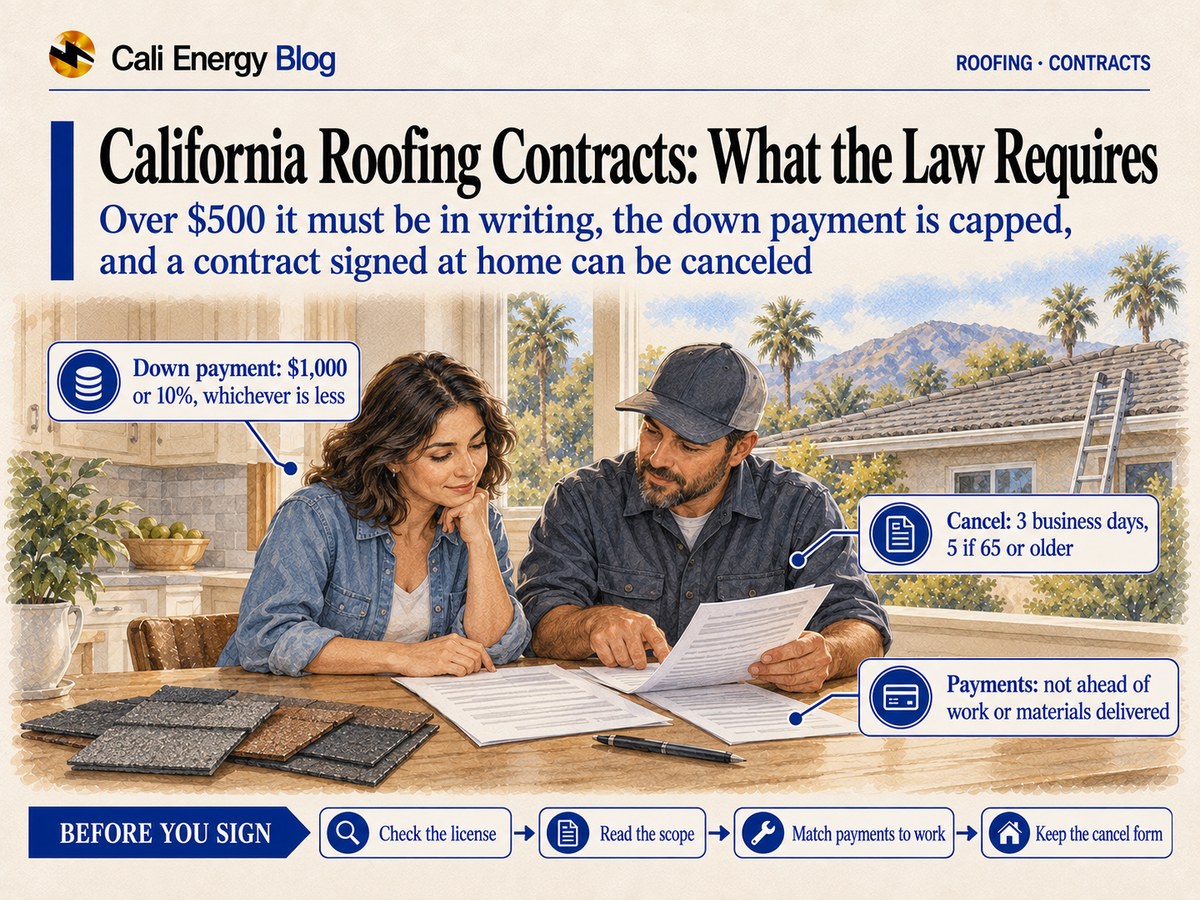
In writing, with set terms. Under California's home improvement law, a roofing contract for more than $500 has to be in writing and signed by both sides before work starts, and it has to state, among other things, the contractor's license number, the price, the work and the significant materials, the start and completion dates and a schedule of any progress payments (Business and Professions Code 7159). The down payment can't be more than $1,000 or 10 percent of the price, whichever is less, and after that the contractor can't take payment ahead of the work done or the materials delivered (7159.5). A contract signed at your home can be canceled in writing within three business days of receiving your signed copy, five if you're 65 or older, and seven for repairs after a declared emergency. This page explains the law; it isn't legal advice about a particular contract.
What the contract has to say
Section 7159 lists what a home improvement contract must contain, and a re-roof is a home improvement. The main items:
| Item | What the law requires | Section |
|---|---|---|
| Writing and signatures | In writing and signed by both parties before work starts; you get a signed, dated copy before any work begins | 7159(c)(3), (d) |
| The contractor | Name, business address and license number; the salesperson's name and registration number if one sold the job | 7159(d)(1)–(2) |
| Price | "Contract Price" in dollars and cents, with any finance charge shown separately | 7159(d)(5)–(6) |
| The work | A description of the project and of the significant materials to be used and equipment to be installed | 7159(d)(7) |
| Down payment | The amount, with a notice in bold that it can't exceed $1,000 or 10 percent of the price, whichever is less | 7159(d)(8) |
| Progress payments | A schedule in dollars and cents, each payment tied to the work and materials it pays for | 7159(d)(9) |
| Dates | What counts as substantial commencement, an approximate start date and an approximate completion date | 7159(d)(10)–(11) |
| Changes | A note that extra work and change orders become part of the contract once written and signed before that work starts | 7159(d)(13) |
| Notices | A mechanics lien warning, information about the Contractors State License Board, and whether the contractor carries commercial general liability and workers' compensation insurance | 7159(e) |
The progress-payment section has to carry a bold statement that it's against the law for a contractor to collect payment for work not yet completed or materials not yet delivered. What a roofing scope should spell out beyond the legal minimum, such as tear-off, deck work, underlayment and flashing, is in hidden costs in a roofing quote.
How payments work
After the down payment, every payment has to follow the work:
- The down payment cap. No more than $1,000 or 10 percent of the contract amount, whichever is less (7159.5(a)(3)).
- No payment ahead of the work. Except for the down payment, the contractor can't request or accept payment that exceeds the value of the work performed or material delivered, and that includes an advance from a lender or financier (7159.5(a)(5)).
- Lien releases. After any payment, and before the next, the contractor has to obtain and give you, if you ask, a full and unconditional release from any potential lien claimant for the work you've paid for, and you can withhold further payments until you get them (7159.5(a)(6)). How liens work, and which release forms to use, is in mechanics liens on a roof job.
- The bonded exception. A contractor with a performance and payment bond, a lien and completion bond, or a bond equivalent or joint control approved by the registrar is exempt from the down payment cap, the payment schedule requirement and the no-payment-ahead rule (7159.5(a)(8)).
Violating the written-contract, down payment or payment-ahead rules is a misdemeanor punishable by a fine of $100 to $5,000, up to a year in county jail, or both, and if the violation happens in a place damaged by a natural disaster under a declared state or federal emergency, the court has to impose the maximum fine (7159.5(b)). How financing fits into a roofing contract is in roof financing in California.
Your right to cancel
A contract made somewhere other than the contractor's place of business, such as your kitchen table, is a home solicitation contract (Civil Code 1689.5). You can cancel one:
- Within three business days after you receive a signed and dated copy of the contract, or within five business days if you're 65 or older (Civil Code 1689.6; the five-day rule has applied since January 1, 2021).
- Within seven business days if the contract is for repairing or restoring a home damaged by a sudden or catastrophic event for which the president, the governor, or a city or county has declared an emergency (7159).
You cancel in writing, by email, mail, fax or delivery to the contractor's place of business, by midnight of the last day, and the contractor has to return what you paid within 10 days of receiving the notice; the contract has to include the cancellation notice that says so (7159). There's an exception for true emergencies: if you called the contractor for repairs needed right away to protect people or property, you can waive the right to cancel by giving the contractor a separate dated and signed statement that describes the situation and expressly waives it (Civil Code 1689.13). What to do first when a storm opens the roof is in emergency roof leak in a storm.
Small repairs can fall under a different set of rules. A service and repair contract of $750 or less, where you called the contractor, the work covers only the problem you called about, and nothing is paid until it's done, has its own requirements (7159.10).
Before you sign
- Check the license on the Contractors State License Board's website, and that the name and number on the contract match it.
- Read the scope. The project description should name the work and the significant materials; if tear-off, deck repair or flashing aren't there, ask.
- Look at the payment schedule. Each payment should match a stage of work or a delivery of materials.
- Find the lien warning and the insurance notices, and keep the cancellation form; note the date your right to cancel ends.
- Ask who pulls the permit; in the City of Los Angeles that's covered in roof permits with LADBS.
- Get the warranty terms in writing, including who issues each warranty; see roofing warranties explained.
What we've seen
The scope we wrote for a 2023 North Hollywood re-roof lists every line as a count, from 18 squares of architectural shingle and two rolls of synthetic underlayment to 57 sheets of OSB for a new deck, 22 pieces of drip edge and five low-profile vents (the North Hollywood case). On a 2024 Canoga Park re-roof, the cool-rated membrane for two low-slope sections didn't match the gray shingle, and that was put in writing to the owner, with a link to the material, before the contract was signed (the Canoga Park case). How a change order is handled when the deck turns out to be rotten is in rotted roof decking and the change order.
Frequently asked
How much can a roofer ask for up front in California?
Can I cancel a roofing contract after signing it?
Does a small roof repair need a written contract?
What if the roofer wants full payment before finishing?
Is a verbal agreement with a roofer valid?
Related reading
Sources & methodology
Code sections, rules and figures on this page come from the primary sources below. Codes, local requirements and product terms change; each was verified October 8, 2026.
- California Business and Professions Code §7159 (home improvement contracts)
- California Business and Professions Code §7159.5 (down payment, payments, lien releases, penalties)
- California Business and Professions Code §7159.10 (service and repair contracts)
- California Civil Code §1689.5 (home solicitation contract; senior citizen)
- California Civil Code §1689.6 (right to cancel)
- California Civil Code §1689.13 (emergency repair waiver)
We put the whole scope and schedule in writing
Call (323) 844-7777. We inspect the roof first and write a contract that names the work and materials line by line, with the start and completion dates and a payment schedule tied to the work. Have ready the address and what you want done; for a storm repair, the date of the damage.
Prepared by Cali Energy, October 8, 2026. This article is for general educational purposes only and is not legal, tax, financial, engineering, or utility advice. Rates, incentives, codes, permit requirements, equipment specifications, prices, and program terms may change; figures and timelines are estimates, not guarantees. Confirm current requirements with the applicable utility, AHJ, program administrator, manufacturer, or a licensed professional. See our Content Disclaimer. Cali Energy · 19201 Parthenia St, Unit E, Northridge, CA 91324 · CSLB #1032379 (B, C-10, C-39)