

Flat Roof Options for Los Angeles Homes, Compared
A flat roof on a Los Angeles house is re-covered with one of a few systems: a single-ply membrane (TPO, PVC or EPDM), modified bitumen sheets, a built-up "hot mop" roof, spray polyurethane foam with a protective coating, or a liquid-applied coating over an existing roof that's still sound. The code expects nearly all of them to slope at least 1/4 inch per foot, and none is best everywhere. On a re-roof in LA the choice is narrowed by rules more than by taste: when more than half of a low-sloped roof is replaced, the 2025 California Energy Code asks for a reflective surface in climate zones 4 and 6 through 15 and for added insulation in zones 1, 2, 4 and 8 through 16, the fire code puts conditions on torches and hot asphalt, and the residential code limits what can go over an old roof. This page compares the systems on those terms, as of October 2026.
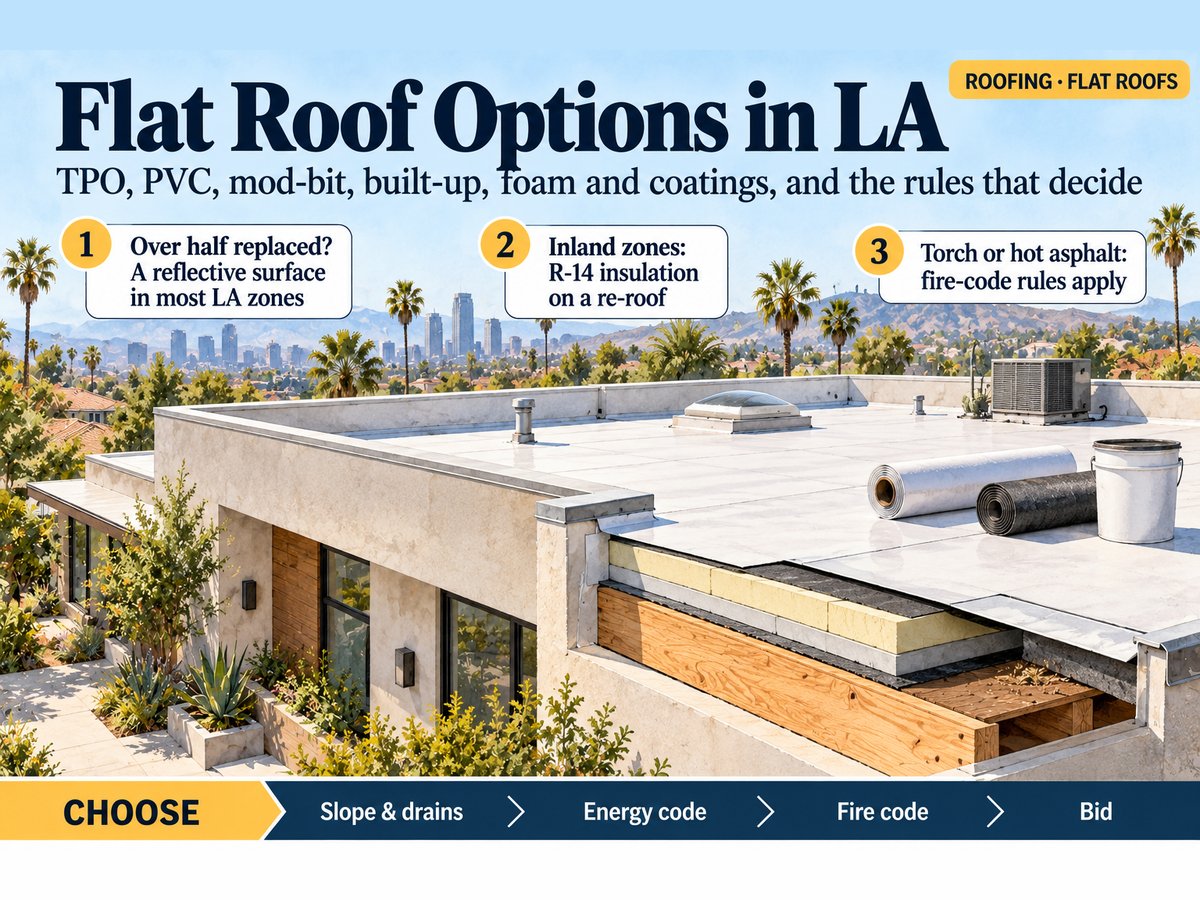
It covers one- and two-family houses with low-sloped roofs under the 2025 California codes, in force since January 1, 2026. It doesn't give prices or service lives, which depend on the product, the installation and the upkeep, and whether a particular roof should be repaired, coated or replaced is in flat roof repair, coating or replacement, and for an existing built-up roof in hot mop roof: repair or replace. Solar on a flat roof, from slopes to ballast and attachments, is covered in solar on flat and low-slope roofs, and the permit, city by city, in re-roof permit rules across LA-area cities.
What counts as a flat roof
The energy code calls a roof low-sloped when it rises less than 2 inches per foot (2:12, about 9.5 degrees), and steep-sloped from 2:12 up. Few "flat" roofs are dead level. The California Residential Code (CRC 2025) sets a minimum design slope of 1/4 inch per foot (2%) for built-up, modified bitumen, single-ply, spray foam and liquid-applied roofing, and 1/8 inch per foot only for coal-tar built-up roofs (sections R905.9.1 through R905.14.1).
An existing roof is treated more gently on a re-roof. Under CRC section R908.1, a roof that provides positive drainage doesn't have to be rebuilt to the 1/4-inch minimum, and a re-roof doesn't have to add the emergency overflow drains or scuppers that a new parapet roof needs. A roof that ponds doesn't get that exception, so correcting the slope, with tapered insulation or reframing, belongs in the re-roof scope rather than under the new membrane.
The systems side by side
Each of these systems has its own section, material standards and minimum slope in the residential code. On an LA house, what separates them is how they go on, what their surface does under the energy code, and whether they can go over the roof that's there now.
| System | What it is (code standard) | How it goes on | Surface and the cool-roof rule | Over an existing roof? |
|---|---|---|---|---|
| TPO single-ply | A reinforced thermoplastic polyolefin sheet (ASTM D6878) | Mechanically fastened or adhered; seams heat-welded with hot air, no open flame | Usually white; the product's Cool Roof Rating Council (CRRC) rating shows whether it meets the energy code's values | Where the manufacturer's instructions allow it, over a sound roof with fewer than two existing roof coverings (CRC R908.4) |
| PVC single-ply | A reinforced polyvinyl chloride sheet (ASTM D4434) | Fastened or adhered; seams heat-welded with hot air | Light colors common; check the CRRC rating | Same as TPO |
| EPDM single-ply | A synthetic rubber sheet (ASTM D4637) | Adhered, fastened or ballasted; seams joined with tape or adhesive, since the rubber can't be welded | Often black, which can't reach the reflectance a low-sloped re-roof needs in most LA zones without a coating or the insulation trade-off; light versions exist | Same as TPO |
| Modified bitumen | Asphalt sheets modified with SBS rubber (ASTM D6162, D6163, D6164) or APP plastic (D6222, D6223), usually a base sheet under a granule-surfaced cap sheet | Depending on the product: torched, set in hot asphalt, cold adhesive, or self-adhered | Granule surfaces come in reflective and dark versions; a dark cap sheet is coated or traded off with insulation | Where the instructions allow, as above |
| Built-up ("hot mop") | Layers of roofing felt set in hot asphalt, finished with a mineral-surfaced cap sheet (ASTM D3909) or aggregate (D1863) | Hot asphalt from a kettle on the ground, mopped on the roof | Dark unless finished with a reflective cap sheet, coating or light aggregate rated for it | Where the instructions allow, as above |
| Spray polyurethane foam (SPF) | Foam sprayed in place (ASTM C1029 Type III or IV, or D7425) under a protective coating | Sprayed, then coated with acrylic, polyurethane or silicone 2 to 72 hours after the foam goes on (CRC R905.13.3) | The coating sets the reflectance; the foam itself is insulation | Foam roofs can be recoated without a tear-off; new foam over an old roof follows the manufacturer's instructions |
| Liquid-applied coating | Acrylic, silicone, polyurethane or asphalt-based coatings (CRC R905.14, R909) | Rolled or sprayed over the existing surface | Reflective coatings are the common way to make a dark roof meet the cool-roof values | A new coating over an existing coating, built-up, modified bitumen, single-ply, spray foam, metal or mineral-surfaced roll roof is allowed without a tear-off, if the roof isn't wet or deteriorated (CRC R908.4) |
| Standing-seam metal | Metal panels with raised seams | Fastened with clips; the minimum slope is 1/4 inch per foot for standing seam (CRC R905.10.2) | Painted finishes carry their own CRRC ratings | A complete standing-seam system that carries its load to the structure can go over an existing roof (CRC R908.4) |
A material that meets its ASTM standard isn't automatically fire-rated or wind-rated: ASTM's own scope notes for the TPO, PVC and EPDM sheet standards treat fire resistance, field seaming strength and uplift resistance as design criteria for the roof system in place, outside the sheet specification. The fire class comes from the listing of the whole assembly, covered below.
The energy code decides more than the color
On a flat roof in most of Los Angeles, the 2025 California Energy Code (Title 24, Part 6) is the rule that shapes the bid. It applies when more than 50% of the roof is replaced, and the trigger counts "adding a new surface layer on top of the existing exterior surface," not only a tear-off (section 150.2(b)1I).
A reflective surface, or insulation instead
For a low-sloped roof in climate zones 4 and 6 through 15, the new roofing has to have an aged solar reflectance of at least 0.63 together with a thermal emittance of at least 0.75, or a solar reflectance index (SRI) of at least 75 (section 150.2(b)1Iiia). Aged means measured after three years of weathering, so the figure to check is the product's aged rating with the CRRC, not its out-of-the-box brightness. The CRRC's rated products directory lists them.
Two routes avoid the reflectance value:
- The insulation trade-off. Table 150.2-E lets continuous insulation at the roof deck stand in for reflectance. In climate zones 6 and 7, R-2 lowers the required aged reflectance to 0.60, R-4 to 0.55, R-6 to 0.50, R-8 to 0.45, and R-10 removes it. In zones 2, 4 and 8 through 15, the same steps take R-16, R-18, R-20, R-22 and R-24.
- Exempt roof areas. Areas covered by building-integrated photovoltaic or solar thermal panels, and roof constructions weighing at least 25 pounds per square foot, aren't held to the reflectance values.
Insulation on most inland LA roofs
The same section adds a second requirement that's easy to miss: a low-sloped roof being replaced has to be insulated to Table 150.2-F (section 150.2(b)1Iiib). In climate zones 1, 2, 4 and 8 through 16, that's R-14 continuous insulation, or a roof assembly U-factor of 0.039. Zones 3 and 5 through 7, which include the LA coast, have no insulation requirement. The table doesn't apply where:
- the existing roof already has R-10 or more continuous insulation above or below the deck;
- in zones 1, 2, 4 and 8 through 10, the existing roof has an assembly U-factor of 0.056 or less, or at least R-19 between the rafters in contact with the roof deck.
It can drop to R-4 where rooftop mechanical equipment stays in place, or a parapet or sidewall finished in another material would have to lose its cladding, and the full thickness would leave the base flashing lower than the roofing manufacturer allows, under conditions the code spells out; tapered insulation can be thinner at the drains if it averages out. Those exceptions exist because insulation raises the roof surface, and on a parapet roof that height has to be found at every wall, door threshold, drain and curb. A bid that adds insulation should say how the flashings and drains are raised to match.
Because the code's wording also covers a new surface layer over the old one, a coating applied over more than half of a low-sloped roof falls within the same section on its face. Ask the building department how it applies the insulation part to a coating-only job before counting on a coating as the cheaper path.
Which zone, and the city's own rule
Climate zones are assigned by the California Energy Commission, which has an address search, the EZ Building Climate Zone Search. A city isn't one zone: in our own project records, Los Angeles addresses fall in zones 6, 8 and 9, and Long Beach addresses in 6 and 8. Where one postal code straddles two zones, the Energy Commission lets the local building department assign a single zone to it, so confirm the zone with the department too. Of the flat roofs in our records that we could match to a zone, all 36 sit in a zone where the low-slope reflectance rule can apply.
Some agencies set their own cool-roof values on top of the state's, without the insulation trade-off:
- Unincorporated Los Angeles County (Title 31, §4.106.6): replacing more than 50% of the roof, a roof sloped 2:12 or less needs an aged reflectance of 0.65 with an emittance of 0.85, or SRI 78.
- Burbank (BMC 9-1-11-4.509): the same 0.65 with 0.85, or SRI 78, for roofs under 2:12, on every re-roof except a repair, with no 50% threshold.
- City of Los Angeles: LADBS's express re-roof permits call for a CRRC-labeled and certified product on a residential replacement over 50% of the roof.
The details and dates are in re-roof permit rules across LA-area cities, and the steep-slope side of the state rule is in the cool-roof requirement on a re-roof.
Flame, hot asphalt or neither
How a system goes on changes what happens on and around the house. The 2025 California Fire Code treats "installation of torch-applied roof systems" as hot work, and it puts separate rules on asphalt kettles:
- Torch-applied roofing. The fire code lists the "application of roof coverings with the use of an open-flame device" among the hot work that needs an operational permit from the fire code official, the local fire department (section 105.5.25). A fire watch is kept during the work and for at least 30 minutes after it ends (3504.2.1), with a portable extinguisher rated at least 2-A:20-B:C within 30 feet (3504.2.6), and roofing that uses heat-producing systems needs a multipurpose extinguisher rated at least 3-A:40-B:C on the roof (3305.10.2). The industry's own torch rules, which go further, are in torch-down roofing: pros and fire risks.
- Hot asphalt (built-up and mopped modified bitumen). Asphalt kettles can't be used inside a building or on its roof, and they're kept at least 20 feet from combustible material, combustible building surfaces and building openings (303.2). An operating kettle is attended by a worker within 100 feet who can see it (303.4), with an extinguisher rated at least 40-B:C within 25 feet of the kettle and a 3-A:40-B:C extinguisher on the roof (303.5).
- No open flame. Hot-air-welded TPO and PVC, adhered or taped EPDM, cold-applied or self-adhered modified bitumen, spray foam and coatings go on without a torch or a kettle.
On a small LA lot, with the neighbor's eaves a few feet away and a wood deck under a parapet, those conditions are part of choosing the system, not only part of the crew's checklist. Ask how the roofer applies the product and who arranges the fire department permit if a torch is used.
What's on the roof now
What can stay under the new roof is set by CRC section R908.4. A new covering can go over an existing one where the new covering's manufacturer allows it, and a new protective coating can go over an existing coating, built-up roof, modified bitumen, single-ply membrane, spray foam roof, metal panel or mineral-surfaced roll roofing without a tear-off. No new roofing goes over an old one that's water-soaked or deteriorated to the point that it isn't an adequate base, and none goes over a roof that already has two or more applications of any type of covering.
Some agencies narrow this further. Unincorporated Los Angeles County's re-roofing code manual lets the building official keep the old covering only when inspection shows no more than one layer of certain listed types, built-up roofing among them, with a sound deck and framing able to carry the added weight; Long Beach's re-roofing bulletin requires a full tear-off once a roof has two or more applications. The details are in re-roof permit rules across LA-area cities.
A coating isn't a repair for what it covers. Over wet insulation, a soft deck or a membrane that has let go, the code's own exception rules the coating out, and the roof needs opening first.
Fire class
Where the code calls for a fire class, the roof assembly has to be tested to ASTM E108 or UL 790 and listed as to class by an approved agency (CRC R902.1). Outside fire hazard severity zones, California's residential code sets Class C as the floor for a re-roof covering more than half the roof within a year and for any covering applied in a repair or replacement (R902.1.2). Local codes raise it: the City of Los Angeles's express re-roof items call for Class A or B, and Glendale and Santa Clarita require at least Class B outside fire zones. Inside a fire hazard severity zone, the California Wildland-Urban Interface Code applies and Class A is the rule.
On a low-sloped roof, the class belongs to the assembly the product was tested in, which may include a particular deck, a base sheet or cover board, and a maximum slope. Ask for the listing that matches your deck and slope, not only the membrane's name. What the classes mean is in the Class A roof rating, whether an address is in a fire zone in checking a home's fire hazard zone, and the zone rules for roofs in California WUI roof requirements.
Drains, parapets and edges
A flat roof sheds water by design. Unless it drains over its edges, the CRC requires a roof drain at each low point (R903.4), and where a parapet or other perimeter construction would trap water if the drains back up, a secondary overflow: an overflow drain the same size as the roof drain with its inlet 2 inches above the low point, or an overflow scupper three times the size of the roof drain, at least 4 inches high, in the parapet (R903.4.1). Flashing goes at every wall-to-roof intersection and roof opening (R903.2), and parapets are capped with a noncombustible, weatherproof coping at least as wide as the wall (R903.3).
As noted above, a re-roof with positive drainage doesn't have to add overflow drains that aren't there. Whether to add one anyway, and how the new surface and any added insulation meet the existing drains and scupper openings, belongs in the bid.
Solar on a flat roof
An array changes the choice in two ways: the roofing has to take the mounts, and it should last as long as the array above it. On our own flat-roof solar jobs we've worked over a 1938 built-up roof in Glendale with a gray surface, where every post of the tilt frames went through the membrane with a collar and sealant; over a cap sheet in Long Beach, where each standoff went into the structure below and every penetration was flashed and sealed; on a Northridge house with a white-coated membrane and modules on tilt legs; and behind a parapet in Chatsworth, where the array was scheduled after the roofers had finished. Ballast or attachment, membrane warranties and drainage around an array are covered in solar on flat and low-slope roofs, and taking an array off and putting it back for a re-roof in solar removal and reinstall.
Coatings in the LA basin
Coatings are the lightest change to a flat roof, and they're often offered as an alternative to a new one. Three rules shape them here:
- They go only over a sound roof. CRC R908.4 allows a coating over most existing low-slope coverings without a tear-off, and rules it out where the roof is water-soaked or deteriorated.
- They count under the energy code. A coating over more than half of a low-sloped roof is "a new surface layer," so in zones 4 and 6 through 15 it needs the CRRC-rated reflectance described above, and the insulation question goes to the building department.
- Air district limits. In the South Coast Air Quality Management District, Rule 1113 caps roof coatings at 50 grams of volatile organic compounds per liter, and aluminum roof coatings at 100.
The coating standards the code recognizes are listed in its Table R909.2: acrylic (ASTM D6083), silicone (D6694), moisture-cured polyurethane (D6947) and asphalt-based coatings. How acrylic and silicone compare is in silicone, acrylic or elastomeric roof coating.
Comparing flat-roof bids
Bids for the same flat roof can describe very different work. These questions put them on the same terms:
- Which system, which product? The manufacturer's product name and its CRRC rating ID, not only "TPO" or "torch-down."
- How does it go on? Torch, hot asphalt, heat-welded, adhered or self-adhered, and, for a torch, who arranges the fire department permit and the fire watch.
- Tear-off or over the old roof? How many layers are there now, what they are, and what the bid does if the insulation or deck is wet.
- What does the energy code take here? The climate zone, the product's aged reflectance or the insulation trade-off used, and the R-value, type and thickness of any insulation added.
- How are the edges raised? Base flashing at parapets and walls, door thresholds, curbs, drains and scuppers once the roof surface is higher.
- Which fire class, from which listing? The assembly listing that matches the deck and slope.
- Who warrants what? The manufacturer's warranty and the roofer's workmanship warranty, each in writing.
- Which permit route? The agency, the permit type and the inspections, as in re-roof permit rules across LA-area cities or, in the City of Los Angeles, roof permit in Los Angeles.
Cali Energy holds California contractor license #1032379, with C-39 Roofing, B General Building and C-10 Electrical, the classification that covers solar. Our roofing work is on our roofing page, and finished jobs, including the flat-roof solar jobs above, are in our case studies.
Frequently asked
What's the best flat roof material in Los Angeles?
Do I need a white or reflective flat roof in Los Angeles?
Do I have to add insulation when I replace a flat roof?
Is torch-down roofing allowed in Los Angeles?
Can a new flat roof go over the old one?
Is a roof coating a substitute for a new roof?
Related reading
Sources & methodology
Code sections, rules and figures on this page come from the primary sources below. Codes, local requirements and product terms change; each was verified October 9, 2026.
- California Residential Code 2025, Chapter 9, Roof Assemblies (R902, R903, R905, R908, R909)
- California Energy Commission, 2025 Building Energy Efficiency Standards (Title 24, Part 6), CEC-400-2025-010, section 150.2(b)1I and Tables…
- California Energy Commission, Single-Family Residential Compliance Manual for the 2025 Standards, CEC-400-2025-005
- California Energy Commission, climate zone tool, maps and information
- Cool Roof Rating Council, rated products directory
- California Fire Code 2025, Chapter 1 (105.5.25), Chapter 3 (303, Asphalt Kettles), Chapter 33 (3305.10) and Chapter 35 (3504.2)
- South Coast Air Quality Management District, Rule 1113, Architectural Coatings, as amended February 5, 2016
- ASTM D6878, TPO sheet roofing
- ASTM D4434, PVC sheet roofing
- ASTM D4637, EPDM sheet for single-ply roof membranes
- ASTM D6162 and D6222, SBS and APP modified bituminous sheets
We'll measure the flat roof before we price a system
Call (323) 844-7777. We check the slope, the drains and overflows, the parapets, what's on the roof now and how many layers, then the climate zone and the city's own rules, and the estimate names the system, the product's cool-roof rating and the insulation the energy code calls for. Have ready the address, a few photos of the roof surface, the drains and the parapet edges, and whether solar is on the roof or planned. Wet insulation or a damaged deck under the surface only shows once the roof is opened.
Prepared by Cali Energy, October 9, 2026. This article is for general educational purposes only and is not legal, tax, financial, engineering, or utility advice. Rates, incentives, codes, permit requirements, equipment specifications, prices, and program terms may change; figures and timelines are estimates, not guarantees. Confirm current requirements with the applicable utility, AHJ, program administrator, manufacturer, or a licensed professional. See our Content Disclaimer. Cali Energy · 19201 Parthenia St, Unit E, Northridge, CA 91324 · CSLB #1032379 (B, C-10, C-39)