

Roof Permit in Los Angeles: LADBS Rules for a Re-Roof
Yes. In the City of Los Angeles, replacing a roof takes a permit from the Department of Building and Safety (LADBS): section 91.106.1.1 of the 2026 Los Angeles Building Code (LABC 2026) bars anyone from erecting, constructing, altering, repairing, demolishing, removing or moving a building without one, so repair is covered along with replacement. Most re-roofs with a Class A or B covering weighing less than 6 pounds per square foot over solid sheathing, and tile lift-and-relays, qualify for an express permit with no plan check, which can be issued online. LADBS then inspects the work, and the job ends with a final inspection. A very small repair valued at $2,500 or less may be exempt under section 91.106.2, but not if it affects the building's structure or public safety, among other conditions, so confirm a small job with LADBS before it starts.
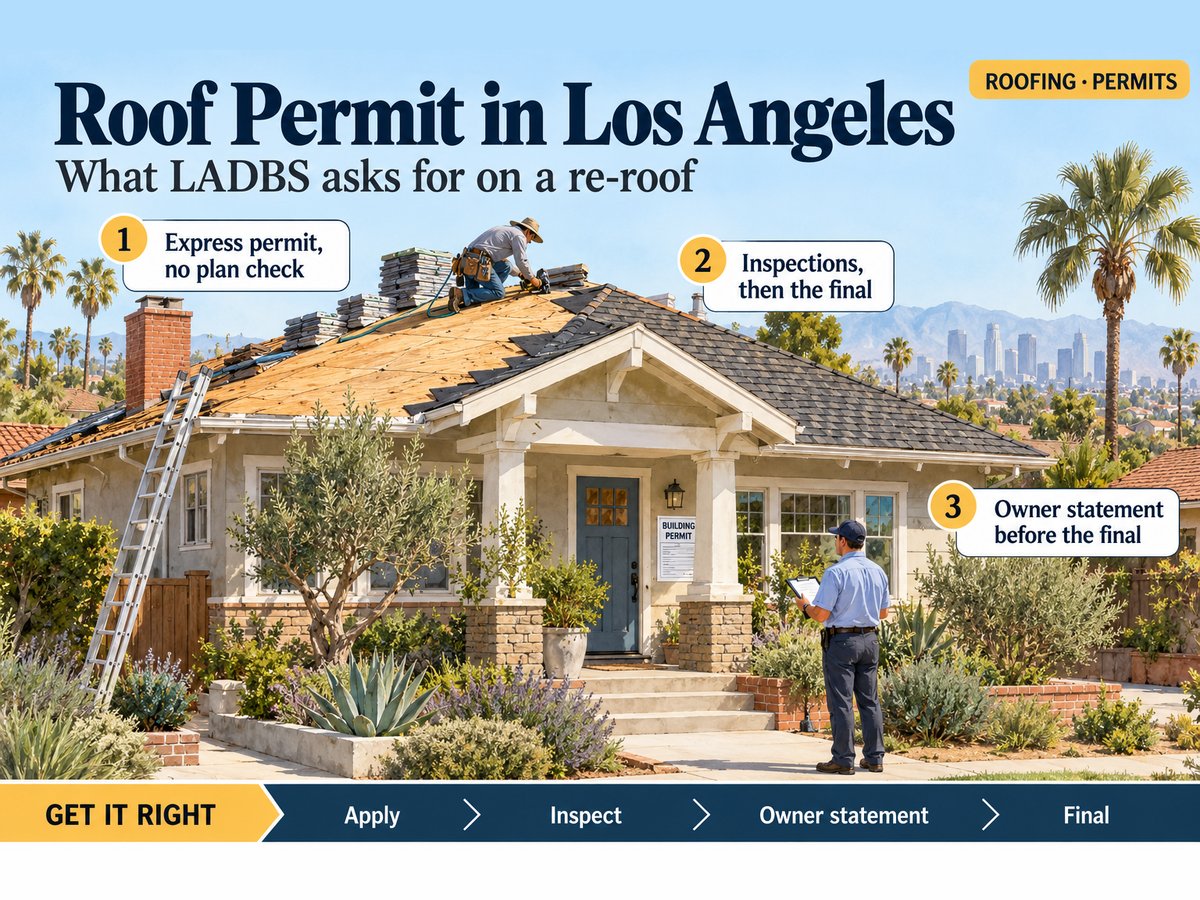
This page covers the permit for an address in the City of Los Angeles under LABC 2026 and the LADBS express-permit bulletin, P/GI 2026-003, as revised June 10, 2026: which permit a roof job takes, who applies and what the application asks for, which inspections follow, and how to confirm the permit was finaled. What the code requires of the roof itself is touched on only briefly: the item-by-item list is in California re-roof code requirements, the fire-zone rules are in California WUI roof requirements and checking a home's fire hazard zone, and the cool-roof rule is in the cool-roof requirement on a re-roof. Deciding between a repair and a new roof is in roof repair or replace; checking a roofer's license, the contract and the payment schedule is in how to choose a roofing contractor in California. LADBS fee amounts aren't covered here. LADBS decides how a particular job is permitted, so confirm with it wherever the sections below say so.
Is the house in the City of Los Angeles?
LADBS issues permits for property inside the City of Los Angeles, and a Los Angeles mailing address doesn't by itself mean the house is in the city. LADBS's homeowner step-by-step starts with this check:
- Look the address up in ZIMAS, the city's zoning information map.
- If ZIMAS can't find it, the property may be outside the city and handled by another agency. Los Angeles County Public Works has an online service locator for finding which one. How the rules differ in the county and in nearby cities is in re-roof permit rules across LA-area cities.
Everything below applies only to addresses inside the City of Los Angeles.
Which permit a roof job takes
For a building permit, LADBS has two routes. Work on the list in its express-permit bulletin, P/GI 2026-003 (effective January 1, 2026, revised June 10, 2026), gets an express permit, which LADBS also calls an e-permit, with no plan check. Express permits can be issued online or by appointment at the Metro, Van Nuys, West Los Angeles, San Pedro and South Los Angeles counters. Work that isn't on the list goes through plan check, where LADBS reviews the plans before it issues the permit. Beside those two routes, the code has two narrow cases where a roof job needs no permit at all. The bulletin counts roof area in squares: a square is 100 square feet of roof surface, which isn't the same as the house's floor area.
Roof jobs on a house in the City of Los Angeles and the permit path for each (LABC 2026; LADBS bulletin P/GI 2026-003, revised June 10, 2026):
| Roof job | Permit path | Conditions and notes |
|---|---|---|
| Re-roof with a Class A or B covering weighing less than 6 lb per sq ft, over the existing solid sheathing | Express permit, no plan check (bulletin item 4) | The application gives the number of squares. Class A is required in a Very High Fire Hazard Severity Zone, and LADBS's fire-zone checklist applies it in High zones too. A residential roof replacement over 50% of the total roof area needs a cool roof product labeled and certified by the Cool Roof Rating Council (CRRC) |
| The same covering over new solid sheathing | Express permit, no plan check (item 5) | The same conditions as item 4. If the deck turns out bad once the old roof is off, a supplemental permit changes the scope to new sheathing |
| Tile lift-and-relay: remove the tiles, apply new underlayment, reset the tiles | Express permit, no plan check (item 23) | The bulletin states that cool roof compliance isn't required for this item |
| Roof coating | Express permit, no plan check (item 25) | Covers applying an approved coating to an existing roof |
| A covering of 6 lb per sq ft or more, or work that alters the roof framing (new or resized members, a pitch change) | Not on the express list, so expect plan check | Replacing damaged framing members, or repairing water, termite or dry-rot damage, under 10% of the building's replacement cost is on the express list (items 14 and 16; item 14 covers single-family houses and duplexes). Confirm the path with LADBS before the job is priced |
| Small repair valued at $2,500 or less | May be exempt from a permit (91.106.2) | Not exempt if it impacts structural stability, affects public safety, is done to comply with a Department order, or involves a change in use or occupancy. An exemption doesn't authorize work that violates the code. Confirm with LADBS, especially for anything touching the deck or framing |
| Re-roof on a detached single-family house by a certified licensed contractor | No permit (91.106.2), but the work is still filed with LADBS: the contractor notifies LADBS before work starts, certifies the work in place of LADBS inspections, and files a Certificate of Compliance signed by the owner and the contractor (91.108.12) | Only for removing and replacing roofing with code-compliant materials and no change to the roof support system. LADBS may allow the route and can still inspect. A CSLB license alone doesn't make a contractor "certified" here |
| Re-roof in a High or Very High Fire Hazard Severity Zone | The same path as the job itself | A Class A roof assembly: items 4 and 5 name Very High zones, and LADBS's fire-zone checklist applies the rule in High zones too. Wood shake and wood shingle aren't permitted anywhere in the city (91.1505.1) |
| Finishing work under a permit that expired | Express permit (item 9) | The work has to be at least 75% complete, as determined by inspection |
Re-roofs over solid sheathing (items 4 and 5)
Items 4 and 5 describe the same re-roof with one difference: whether the new covering goes over the solid sheathing that's already on the house (item 4) or over new solid sheathing (item 5). Both require a Class A or B covering weighing less than 6 pounds per square foot, and both leave a blank for the number of squares. Both carry the same two conditions:
- Fire zone. A Class A covering in a Very High Fire Hazard Severity Zone; LADBS's fire-zone checklist also requires a Class A roof assembly in High zones.
- Cool roof. For a residential roof replacement over 50% of the total roof area, a cool roof product labeled and certified by the CRRC.
Both items speak of solid sheathing. Where the existing deck isn't solid sheathing, item 4 doesn't describe the job, and item 5, with new solid sheathing, does. The product's fire class and weight are worth checking before the application goes in, since a covering at 6 pounds per square foot or heavier takes the job off the express list.
When the deck turns out bad mid-job
How the deck is doing often can't be seen until the old roof is off. When a job permitted over existing sheathing turns out to need new sheathing, the permit is brought in line with a supplemental permit, so that the permit on file describes the work actually done and the inspections and final cover it. That's how our 2024 Canoga Park re-roof ran; the dates are under "Timelines from our jobs" below. How the extra deck work is priced, and what the change order for it has to say, is in rotted roof decking and your estimate. A supplemental permit can also correct a description in the other direction: on a 2026 tile reset in Canoga Park, one rewrote the work description to existing sheathing.
Tile relay and roof coating (items 23 and 25)
Item 23 covers a tile lift-and-relay: the roof tiles come off, new underlayment goes on, and the tiles are reset. The bulletin states that cool roof compliance isn't required for this item, which sets it apart from items 4 and 5. Item 25 covers applying an approved coating to an existing roof. Whether a tile roof calls for a repair, a relay or new tile is in tile roof repair, lift-and-relay or replacement.
Heavier coverings and changes to the framing
The re-roof items stop at coverings under 6 pounds per square foot, over solid sheathing. A heavier covering, or a re-roof that changes the roof framing, isn't on the express list, so expect plan check, where the plans are reviewed before a permit is issued. Confirm the path with LADBS before the job is priced. Weight is one of the trade-offs covered in choosing a roofing material.
Small repairs and the $2,500 line (91.106.2)
Section 91.106.2, Work Exempt From a Permit, says permits aren't required for work valued at $2,500 or less, unless the work:
- impacts the structural stability of the building;
- affects public safety;
- is performed to comply with a Department order;
- involves a change in use or occupancy.
The same section says an exemption doesn't authorize work that violates the code. A whole-house re-roof is far beyond the $2,500 line, and the section sets that line by value, not by square footage; the exemption is about small work, and whether a particular repair qualifies is LADBS's call. Confirm with LADBS before the work starts, especially for anything that touches the deck or the framing, where a roof repair reaches the building's structure.
Certified licensed contractors (91.108.12.1)
Section 91.108.12.1 sets up a program in which a certified licensed contractor, employed by the owner, installs, inspects and certifies certain listed work on a detached single-family dwelling in place of LADBS inspections. The contractor has to notify LADBS before the work starts. The list includes "the removal of existing roofing and the replacement of roofing materials," provided the materials are code-compliant and the job doesn't require any alteration to the roof support system. Work done under the program is among the exemptions in 91.106.2.
The rest of the section sets the conditions (91.108.12.2–91.108.12.3): LADBS may allow the certification in place of its own inspections, and can still inspect; the contractor must hold a valid LADBS Certificate of Registration; and a Certificate of Compliance, on LADBS's form and signed by both the owner and the contractor, is filed for each installation. If a roofer says no permit is needed because of this program, ask for that Certificate of Registration (a CSLB license alone isn't one) and the notice they filed before work started, and expect to sign the Certificate of Compliance. That certificate, not a permit, is the record a buyer will look for.
Expired permits, and a change of owner or contractor (items 9 and 10)
Item 9 of the bulletin is an express permit for completing work under a previously expired permit, where the work is at least 75% complete as determined by inspection. Item 10 is an express permit for a change of ownership or contractor. Both are worth knowing about when a house changes hands or a roofer is replaced before a permit is closed.
Who applies, and what the application asks for
Who can apply. Under LADBS's homeowner step-by-step, homeowners of single-family dwellings may apply for e-permits, and an owner who applies provides the recorded grant deed. Contractors who apply must be licensed by the Contractors State License Board (CSLB). An owner who applies signs as the owner-builder and takes on responsibility for the job, its inspections and the final. When a licensed roofer does the work, the roofer should pull the permit under its own license, and the contract should say so; checking the license and the contract terms is covered in how to choose a roofing contractor in California.
What to have settled before applying (bulletin items 4, 5, 23 and 25; LADBS homeowner step-by-step):
- The address, confirmed inside the city in ZIMAS.
- The work item: re-roof over existing solid sheathing (item 4), over new solid sheathing (item 5), a tile reset (item 23) or a coating (item 25).
- The number of squares of roof surface. A square is 100 square feet of roof, measured on the roof rather than taken from the floor plan.
- The covering: its fire class, A or B, with a Class A roof assembly in a High or Very High Fire Hazard Severity Zone, and its weight, under 6 pounds per square foot for items 4 and 5.
- Cool roof: for a residential replacement over 50% of the total roof area under items 4 and 5, a CRRC-labeled and certified product.
- The construction waste hauler. A building permit application asks for it, and the hauler has to be on the city's Permitted Waste Haulers list.
- The applicant: a CSLB-licensed contractor, or the owner of a single-family home with the recorded grant deed.
Inspections and the final
Under 91.108.1, all work for which a permit is required is subject to LADBS inspection, and a final inspection is made. The person doing the work:
- notifies LADBS when the work is ready for inspection, and LADBS can require the request a working day ahead (91.108.3);
- provides access to the work for the inspection (91.108.3);
- doesn't take the work past a point that needs inspection until it's approved (91.108.4).
On a re-roof, that last rule matters most at the deck: once the underlayment and the new covering go on, the sheathing can't be seen. On our 2021 Canoga Park re-roof, 42 squares of composition shingle over the existing sheathing, the roof sheathing inspection was signed a week after the permit was issued, and the permit was finaled five days after that; the dates are under "Timelines from our jobs" below. That job was permitted under the rules in force in 2021.
Before the final: the owner statement. On a building permit to alter or repair an existing house, LADBS has the owner complete, sign and notarize an Owner Statement and Acknowledgment of Compliance and send it to the building inspector before the final inspection; Re-Roof is one of the improvements listed on the form. For a permit valued over $1,000 it covers smoke alarms, carbon monoxide alarms where the house has an attached garage or fuel-burning appliances, and water-saving showerheads (2.0 gallons per minute) and toilets (1.28 gallons per flush). For a single-family house or duplex with a permit valued at $10,000 or more, it adds impact-safe glass, or an approved film, in sliding glass doors and a seismic gas shut-off or excess-flow valve where there is gas piping. Check these items when the roof is scheduled, not on the day of the final. A roofing quote won't include them; other lines it can leave out are in hidden costs in a roofing quote. On our 2025 Woodland Hills re-roof, 28 squares stripped to new plywood, the permit went from application to final in 12 days, with the owner's notarized acknowledgment collected along the way.
Waived inspections. Section 91.108.1 has an exception for reroofing: when a permit is obtained for reroofing, LADBS may waive inspections if the materials and work are certified by a licensed contractor, or by an owner who did the work or used their own employees (Business and Professions Code 7044). The code says LADBS may waive them, so the decision is LADBS's. The certification for this waiver is LADBS's Re-Roofing Certificate of Compliance, signed by the licensed contractor, or by the owner-builder if no contractor did the work, and returned to the inspector. It's also different from the certified licensed contractor program above: the waiver applies to a job that has a permit, while work under 91.108.12.1 is exempt from one.
Confirming the permit was finaled
A permit that's applied for, one that's issued, one with inspections passed and one that's finaled are four different things, and only the last means LADBS signed off on the finished work. An issued permit that was left open isn't a closed one. How to read the record step by step, and what to do if it never closed, is in checking that a re-roof permit was finaled.
- Look it up. LADBS publishes permit and inspection records online through its Permit and Inspection Report, which can be searched by address or permit number from dbs.lacity.gov. Find the address's roofing permit and check that its status shows it finaled.
- Match the description to the roof. The permit describes the work: the squares, the covering class, and existing or new sheathing. If the deck was replaced during the job, look for the supplemental permit too, and check that each one shows final.
- Keep the papers. Keep the permit number and the final inspection. They're the record a buyer, an insurer, an appraiser or the next roofer looks for.
- If the permit expired before final. Item 9 of the bulletin, described above, is the express route for finishing work under an expired permit when it's at least 75% complete.
If you're buying a house, the same lookup applies to the roof that's on it.
Fire zone and cool roof
Wood roofs and fire zones. The Los Angeles Building Code permits no wood shake or wood shingle roof covering anywhere in the city, fire-retardant-treated included (LABC 2026, 91.1505.1). In a High or Very High Fire Hazard Severity Zone, LADBS's fire-zone checklist applies the 2025 wildland-urban interface code: a covering that replaces the roof, or 50% or more of it within 12 months, has to meet the new-construction rule, a Class A roof assembly, and any covering added in a repair has to be at least Class A. In a Moderate zone, ask LADBS which rule applies. What the zone rules require of the roof, eaves, gutters and vents is in California WUI roof requirements, and how to look up a home's zone is in checking a home's fire hazard zone.
Cool roof. Under bulletin items 4 and 5, a residential roof replacement over 50% of the total roof area needs a CRRC-labeled and certified cool roof product. The bulletin's condition carries no climate-zone exception, so in the City of Los Angeles don't rely on the coastal-zone exception in the state rule without confirming with LADBS; color and the state rule elsewhere are covered in the cool-roof requirement on a re-roof.
Timelines from our jobs
Dates from four of our roofing permits in the City of Los Angeles. They show how the permit, the inspections and the final fit around the work on these jobs, not a processing time to expect for yours, and each job ran under the rules in force when it was permitted.
- Canoga Park, 2021. 42 squares of composition shingle over the existing sheathing. Permit issued September 24, roof sheathing inspection signed October 1, permit finaled October 6: under two weeks from permit to final.
- Canoga Park, 2024. A roofing permit for 22 squares, taken out October 22, 2024. When the deck needed replacing, a supplemental permit on November 8 rewrote the scope to new sheathing. Both permits were finaled in November 2024.
- Canoga Park, 2026. Concrete tile, 26 squares. The roofing permit was issued February 10, 2026, and a supplemental permit on February 27 rewrote the work description to existing sheathing.
- Studio City, 2026. A re-roof permit filed March 25, 2026 for one square, about 100 square feet, of "Class A or B material over existing solid sheathing," under a working solar array. Work was on site March 30.
Cali Energy holds California contractor license #1032379, which carries three classifications: C-39 Roofing, B General Building, and C-10 Electrical, the one that covers solar. Finished jobs are in our case studies, and what we do on roofs is on the Cali Energy roofing page.
Frequently asked
Do I need a permit to repair a roof leak?
Can a homeowner pull the permit?
Does a tile relay need a permit?
How long does an LA roof permit take?
What happens if the deck needs replacing mid-job?
Do I need a permit to re-roof under solar panels?
Related reading
Sources & methodology
Code sections, rules and figures on this page come from the primary sources below. Codes, local requirements and product terms change; each was verified October 8, 2026.
- Los Angeles Building Code 2026, Chapter 1, Administration: 91.106.1.1, 91.106.2, 91.108.1, 91.108.3, 91.108.4 and 91.108.12.1–91.108.12.3 (UpCodes)
- LADBS, Express Permits (No Plan Check Required), Information Bulletin P/GI 2026-003, effective January 1, 2026, revised June 10, 2026
- LADBS, Homeowner step-by-step
- LADBS, Owner Statement and Acknowledgment of Compliance (Re-Roof, smoke and CO detectors, etc.)
- Los Angeles Building Code 2026, Chapter 15, 91.1505.1 (UpCodes)
- LADBS, Fire Hazard Severity Zone Supplemental Checklist
- City of Los Angeles, ZIMAS
We'll pull the LADBS permit and see it to final
Call (323) 844-7777. For a re-roof in the City of Los Angeles, we pull the LADBS permit, schedule the inspections and close the permit out with the final. Have ready the address, the roof type, its rough size and a few photos of the roof. Whether the deck needs replacing shows only once the old roof is off; if it does, the permit is updated to match the work.
Prepared by Cali Energy, October 8, 2026. This article is for general educational purposes only and is not legal, tax, financial, engineering, or utility advice. Rates, incentives, codes, permit requirements, equipment specifications, prices, and program terms may change; figures and timelines are estimates, not guarantees. Confirm current requirements with the applicable utility, AHJ, program administrator, manufacturer, or a licensed professional. See our Content Disclaimer. Cali Energy · 19201 Parthenia St, Unit E, Northridge, CA 91324 · CSLB #1032379 (B, C-10, C-39)