

How Often and When LA Roofs Get Replaced: Permit Data
The City of Los Angeles issued 8,912 re-roof permits for houses in 2025 and 10,768 in 2024, according to the Department of Building and Safety's (LADBS) own permit records. From 2021 through 2025 that came to about 15 permitted re-roofs a year for every 1,000 detached houses in the city, or 7% of them in five years. Re-roofs run all year, busiest in October and slowest in December. The typical permitted job is 22 squares, about one in five goes over new sheathing, and about one in five permits still shows no final years after it was issued.
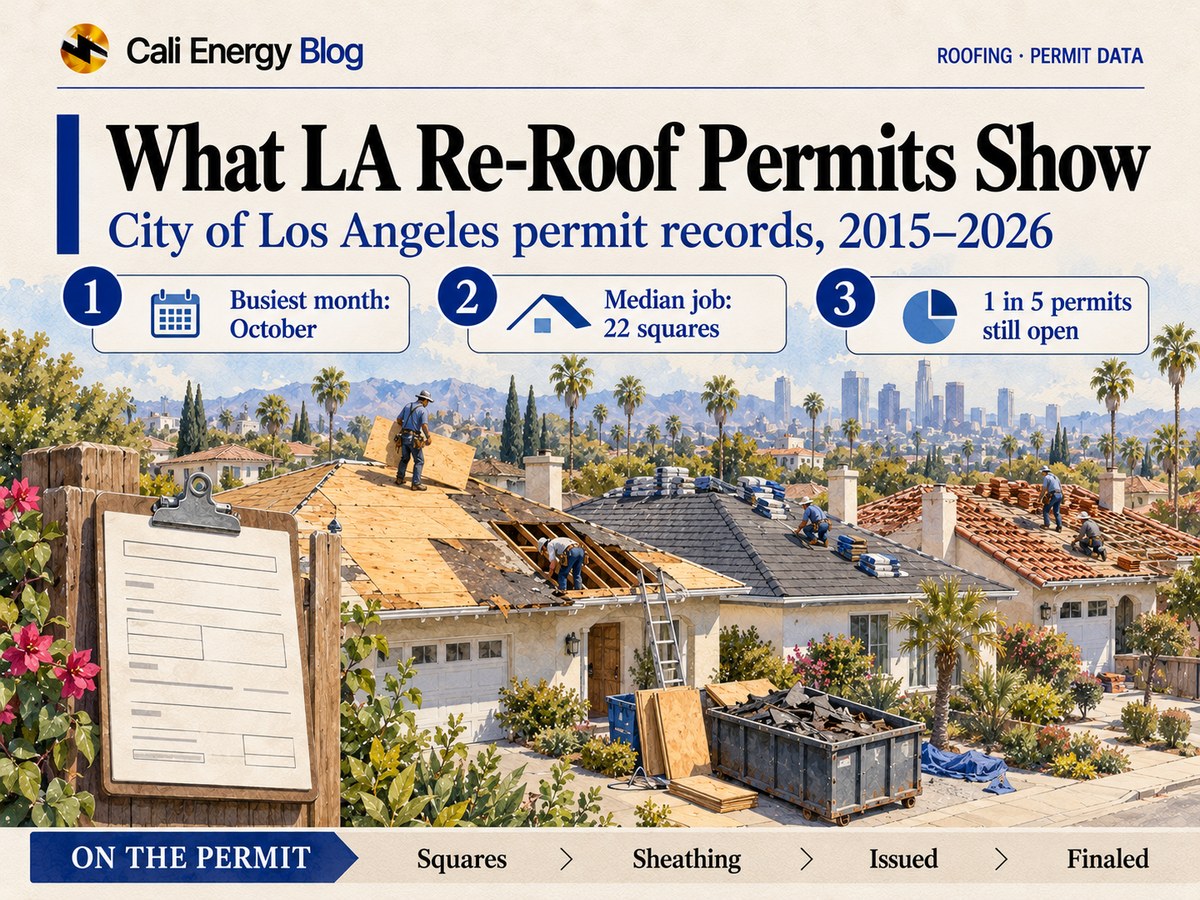
These numbers come from our analysis of LADBS's open permit data for houses (single-family homes and duplexes) in the City of Los Angeles, covering permits issued from 2010 through October 3, 2026, with the tables starting in 2015. They count roofs replaced with a permit, so they're a floor, not a full count of every roof replaced. Some re-roofs legally go without one: on a detached single-family house, a contractor certified under LADBS's program can re-roof under a Certificate of Compliance instead of a permit (Los Angeles Building Code 91.108.12), and that work isn't in the permit data. Cities around Los Angeles keep their own records, as covered in re-roof permit rules across LA-area cities. How we picked the re-roofs out of the permit records, and what the data can't tell, is under "How we counted" at the end.
Re-roof permits by year
The count grew from under 5,000 house re-roof permits in 2015 to almost 11,000 in 2023 and 2024, then eased in 2025. Through October 3, 2026, LADBS had issued 7,991, against 6,713 by the same date in 2025, about 19% more. The permit records don't say why the volume moves. The 2023 jump, about 39% over 2022, built month by month through the spring and held through 2024.
The other columns describe the same permits: how many were tile lift-and-relays, where the tile comes off, new underlayment goes down and the same tile goes back (see tile roof repair, lift-and-relay or replacement); how many were written over new sheathing; the median size; and where each permit stood when the data was pulled.
| Year | Re-roof permits | Tile lift-and-relay | Over new sheathing | Median size, squares | Finaled | Still "Issued" |
|---|---|---|---|---|---|---|
| 2015 | 4,863 | 15 | — | — | 82% | 8% |
| 2016 | 5,258 | 27 | — | — | 82% | 10% |
| 2017 | 6,754 | 54 | 34% | 22 | 78% | 16% |
| 2018 | 5,792 | 50 | 28% | 22 | 78% | 18% |
| 2019 | 6,820 | 92 | 27% | 22 | 78% | 18% |
| 2020 | 6,981 | 43 | 25% | 23 | 79% | 17% |
| 2021 | 6,909 | 28 | 24% | 23 | 78% | 19% |
| 2022 | 7,873 | 90 | 23% | 22 | 78% | 19% |
| 2023 | 10,941 | 209 | 20% | 22 | 78% | 20% |
| 2024 | 10,768 | 236 | 19% | 22 | 81% | 18% |
| 2025 | 8,912 | 168 | 20% | 22 | 79% | 21% |
Sheathing and size are shown from 2017, the first year almost every re-roof permit recorded both. The rest of the permits in each year are expired, closed or in another status.
How often a house gets a permitted re-roof
The California Department of Finance counts 570,390 detached single-family houses in the City of Los Angeles in its provisional estimate for January 1, 2026. From 2021 through 2025 LADBS issued an average of 8,730 re-roof permits a year for single-family houses, about 15 for every 1,000 of them. Counted by parcel rather than by permit, 41,200 different properties got a re-roof permit in those five years, 7.2% of the city's detached houses; since 2010, 88,876 have, about 16%.
At that pace it would take roughly 65 years for every house in the city to get one permitted re-roof. That's a measure of permits, not of how long roofs last. The count leaves out roofs replaced without a permit, whether by a certified contractor under a Certificate of Compliance, as the city allows on detached houses (see getting a roof permit in the City of Los Angeles), or with no paperwork at all, and the permit records can't show either. It also counts a partial re-roof the same as a whole one. What it does show is the floor: at least this many houses a year have a new roof that LADBS knows about.
When: re-roofs by month
Re-roofs in Los Angeles don't stop for a season. The busiest month is October, with about 10% of a year's permits; the slowest is December, with about 7%. October is the last month before the rainy season, when about 87% of a normal year's rain falls, from November through March (see preparing a roof for the Los Angeles rainy season).
| Jan | Feb | Mar | Apr | May | Jun | Jul | Aug | Sep | Oct | Nov | Dec |
|---|---|---|---|---|---|---|---|---|---|---|---|
| 7.6% | 7.6% | 8.3% | 8.5% | 8.6% | 8.2% | 8.1% | 8.9% | 8.9% | 10.1% | 8.2% | 6.8% |
The spread is narrow: the slowest month still has about two-thirds of the busiest month's permits. A permit is issued before the work starts, so these are the months jobs were permitted.
How big a typical job is
Express re-roof permits record the size of the job in squares, 100 square feet of roof each, as explained in price per square vs price per square foot. From 2017 through 2025 the median house re-roof permit was for 22 squares, about 2,200 square feet of roof, and the middle half of permits fell between 16 and 28 squares. About 42% were between 20 and 29 squares; 7% were under 10, and 6% were 40 squares or more.
Size varies by area. In the San Fernando Valley's two planning areas the median was 25 squares; in South and East Los Angeles it was 18 to 19.
New sheathing or the existing deck
Since 2017, almost every re-roof permit records whether the new roof goes over the existing solid sheathing or over new sheathing, two separate items on LADBS's express-permit list (items 4 and 5 of bulletin P/GI 2026-003). The share written over new sheathing fell from 34% in 2017 to about 20% from 2023 on.
The share at issue isn't the whole story. When the old roof comes off and the deck turns out worse than expected, a supplemental permit can rewrite the job to new sheathing. From 2024 through October 2026, about 3 supplemental permits for every 100 house re-roof permits rewrote a job to new sheathing, up from under 1 per 100 before 2023. How that scope change is priced and papered is in rotted roof decking and your estimate.
New sheathing is most common in South Los Angeles (about 30% of re-roofs) and least common in the west San Fernando Valley, Encino and Chatsworth (14% to 16%), as the area tables below show.
How long to the final, and how many never get one
A re-roof permit is closed by a final inspection, and the record then reads "Permit Finaled" with a date. For permits that reached that point, the median time from issue to final was 22 days for permits issued in 2024; a quarter took longer than 43 days, and one in ten more than 100 days. Jobs over new sheathing ran longer: a median of 27 days against 23 for jobs over the existing deck (permits issued 2021–2024), and a quarter of them took more than 65 days.
Then there are the permits that never close. Of the house re-roof permits issued from 2017 through 2023, 16% to 20% still read "Issued" in October 2026, years after they were issued. We checked 40 of them at random, issued in 2017–2019, against LADBS's separate inspection records: none had a final inspection that passed. Fifteen had no inspection at all, 14 had inspections but no final, and 11 had a final scheduled or attempted that never passed.
The records don't say whether those roofs were put on. An open permit can go on reading "Issued" in the records for years, even though under LADBS's rules a permit expires two years after it's issued, or after 12 months without work. How to read a permit record and what to do about one that never closed is in checking that a re-roof permit was finaled.
By area
LADBS tags each permit with the city's planning areas. The first table groups the city into its seven area planning commissions; the second lists the community plan areas, so you can look up your own. Counts reflect how many houses each area has, so they compare volume, not how often a given house is re-roofed.
| Area | Re-roof permits a year | Over new sheathing | Median size, squares | Finaled (issued 2021–2024) | Median days to final |
|---|---|---|---|---|---|
| South Valley | 2,586 | 18% | 25 | 81% | 22 |
| North Valley | 1,921 | 19% | 25 | 79% | 22 |
| South Los Angeles | 1,273 | 29% | 19 | 75% | 24 |
| West Los Angeles | 1,131 | 20% | 24 | 79% | 28 |
| East Los Angeles | 1,021 | 23% | 18 | 80% | 26 |
| Central | 703 | 20% | 20 | 77% | 30 |
| Harbor | 431 | 19% | 20 | 76% | 26 |
The community plan areas follow in alphabetical order. Downtown, Central City and Central City North, with few houses, are left out.
| Community plan area | Re-roof permits a year | Over new sheathing | Median size, squares | Finaled (issued 2021–2024) | Median days to final |
|---|---|---|---|---|---|
| Arleta, Pacoima | 170 | 17% | 20 | 81% | 19 |
| Bel Air, Beverly Crest | 163 | 16% | 30 | 72% | 35 |
| Boyle Heights | 78 | 30% | 17 | 80% | 25 |
| Brentwood, Pacific Palisades | 249 | 18% | 30 | 75% | 36 |
| Canoga Park, Winnetka, Woodland Hills, West Hills | 857 | 16% | 26 | 81% | 21 |
| Chatsworth, Porter Ranch | 332 | 15% | 27 | 79% | 25 |
| Encino, Tarzana | 307 | 14% | 30 | 80% | 24 |
| Granada Hills, Knollwood | 294 | 19% | 26 | 80% | 23 |
| Harbor Gateway | 89 | 18% | 21 | 81% | 21 |
| Hollywood | 383 | 20% | 20 | 76% | 31 |
| Mission Hills, Panorama City, North Hills | 256 | 20% | 24 | 79% | 22 |
| North Hollywood, Valley Village | 266 | 28% | 22 | 80% | 22 |
| Northeast Los Angeles | 724 | 23% | 18 | 81% | 25 |
| Northridge | 243 | 21% | 30 | 82% | 22 |
| Palms, Mar Vista, Del Rey | 244 | 20% | 21 | 83% | 23 |
| Reseda, West Van Nuys | 395 | 18% | 23 | 82% | 20 |
| San Pedro | 211 | 19% | 20 | 76% | 29 |
| Sherman Oaks, Studio City, Toluca Lake, Cahuenga Pass | 343 | 17% | 26 | 81% | 27 |
| Silver Lake, Echo Park, Elysian Valley | 220 | 23% | 18 | 78% | 31 |
| South Los Angeles | 507 | 32% | 19 | 74% | 23 |
| Southeast Los Angeles | 272 | 30% | 17 | 73% | 23 |
| Sun Valley, La Tuna Canyon | 190 | 24% | 22 | 78% | 21 |
| Sunland, Tujunga, Lake View Terrace, Shadow Hills, East La Tuna Canyon | 266 | 19% | 22 | 81% | 22 |
| Sylmar | 176 | 20% | 23 | 73% | 21 |
| Van Nuys, North Sherman Oaks | 337 | 23% | 24 | 80% | 24 |
| Venice | 114 | 19% | 17 | 76% | 25 |
| West Adams, Baldwin Hills, Leimert | 493 | 27% | 20 | 76% | 25 |
| West Los Angeles | 174 | 20% | 23 | 79% | 27 |
| Westchester, Playa del Rey | 181 | 21% | 24 | 84% | 24 |
| Westlake | 22 | 27% | 20 | 77% | 30 |
| Westwood | 58 | 24% | 26 | 82% | 35 |
| Wilmington, Harbor City | 131 | 19% | 20 | 74% | 23 |
| Wilshire | 327 | 20% | 20 | 77% | 29 |
To read your row: the median size is a check on a bid for your own roof, the share over new sheathing says how often a re-roof in your area involved a new deck, and the days to final are a guide to how long the paperwork ran, not a promise. How the permit itself works is in getting a roof permit in the City of Los Angeles.
How we counted
The data. LADBS publishes its building permits on the city's open data portal in two sets, "Building Permits Issued Between 2010 and 2019" and "Building Permits Issued from 2020 to Present." We downloaded both on October 5, 2026, the day both were last refreshed, taking every alteration and repair permit for a one- or two-family dwelling whose work description mentions a roof: 126,620 permits issued from 2010 through October 3, 2026.
Picking out re-roofs. A permit counts as a re-roof when its work description is LADBS's standard re-roof text (the express permit's "Re-roof with Class A or B roof covering material…" in its versions, or the older e-permit's "Reroof with N sqrs…"), the express text for a tile lift-and-relay, or a description that names a re-roof in its own words, such as "tear off existing roofing" or "remove and replace roofing," including re-roofs that are part of a larger remodel. Roof framing, roof decks, rooftop equipment, roof coatings and airport soundproofing don't count. Supplemental permits, which revise a permit already issued, aren't counted as jobs; they're used only for the sheathing changes above. "Houses" means permits whose use is a single-family dwelling or a duplex; separate permits for garages and other outbuildings are left out.
Checking the rules by hand. We read random samples of the results: 40 of 40 standard-text permits and 15 of 15 tile relays were re-roofs; of 160 own-words permits read in two rounds, a handful were roof framing or deck conversions, and the rules were tightened after each round; two rounds of 100 permits the rules had left out turned up re-roofs written in other ways, which the rules were widened to catch. Own-words permits are under 3% of the total, so the remaining error moves the counts by well under 1%.
Size, sheathing and status. Squares and sheathing come from the work description; before 2017 many permits didn't record them, so those columns start in 2017. The final date is the date the status changed to "Permit Finaled." The status is as of October 5, 2026; it changes when a permit is finaled, closed or marked expired, so an old permit can still read "Issued."
What the data can't show. Roofs replaced without a permit, including those done by a certified licensed contractor under a Certificate of Compliance, re-roofs outside the City of Los Angeles, and the material that went on, which the current form doesn't record. Each permit also carries a "valuation," the value of the work stated on the application, which sets the permit fee (Los Angeles Building Code 91.106.3.1 and 91.107.2.1); it isn't the price of the job, so we don't use it.
Frequently asked
How many roofs are replaced in Los Angeles each year?
What's the busiest time of year for re-roofs in Los Angeles?
How big is a typical house re-roof in Los Angeles?
How long does it take to close a re-roof permit in Los Angeles?
How many re-roof permits are never finaled?
Does the valuation on a re-roof permit show what the roof cost?
Related reading
Sources & methodology
Code sections, rules and figures on this page come from the primary sources below. Codes, local requirements and product terms change; each was verified October 5, 2026.
- LADBS, Building and Safety: Building Permits Issued from 2020 to Present (Los Angeles Open Data, dataset pi9x-tg5x), downloaded October 5, 2026
- LADBS, Building and Safety: Building Permits Issued Between 2010 and 2019 (Los Angeles Open Data, dataset dyxf-7hc4), downloaded October 5, 2026
- LADBS, Building and Safety Inspections (Los Angeles Open Data, dataset 9w5z-rg2h)
- California Department of Finance, E-5 Population and Housing Estimates for Cities, Counties, and the State, January 2021–2026 (Table 2, Los…
- LADBS, Express Permits (No Plan Check Required), Information Bulletin P/GI 2026-003, revised June 10, 2026
- Los Angeles Building Code 2026, Chapter 1, Administration: 91.106.2 and 91.108.12 (re-roofs by certified licensed contractors), 91.106.3.1…
We pull the re-roof permit and close it with a final
Call (323) 844-7777. For a re-roof in the City of Los Angeles, we pull the LADBS permit, schedule the inspections and close the permit with the final, so it doesn't stay open on your address. Have ready the address, the roof type, its rough size and a few photos of the roof. Whether the deck needs new sheathing shows only once the old roof is off; if it does, the permit is updated to match.
Prepared by Cali Energy, October 5, 2026. This article is for general educational purposes only and is not legal, tax, financial, engineering, or utility advice. Rates, incentives, codes, permit requirements, equipment specifications, prices, and program terms may change; figures and timelines are estimates, not guarantees. Confirm current requirements with the applicable utility, AHJ, program administrator, manufacturer, or a licensed professional. See our Content Disclaimer. Cali Energy · 19201 Parthenia St, Unit E, Northridge, CA 91324 · CSLB #1032379 (B, C-10, C-39)