

Roof Repair or Replace: How to Decide in Los Angeles
Repair the roof when the damage is in one place and the layers under it, the underlayment and the deck, are sound. Replace it when the failure is spread across the roof or has reached the deck in many places. In between are partial jobs: lifting tile and relaying it over new underlayment, redoing one section, a recover over the existing covering, or a coating on a flat roof. In Los Angeles, two fire-class rules (one inside fire zones, one outside) and the cool-roof rule each draw a line at half the roof, and a partial replacement that crosses one of them has to meet the same requirement as a full replacement.
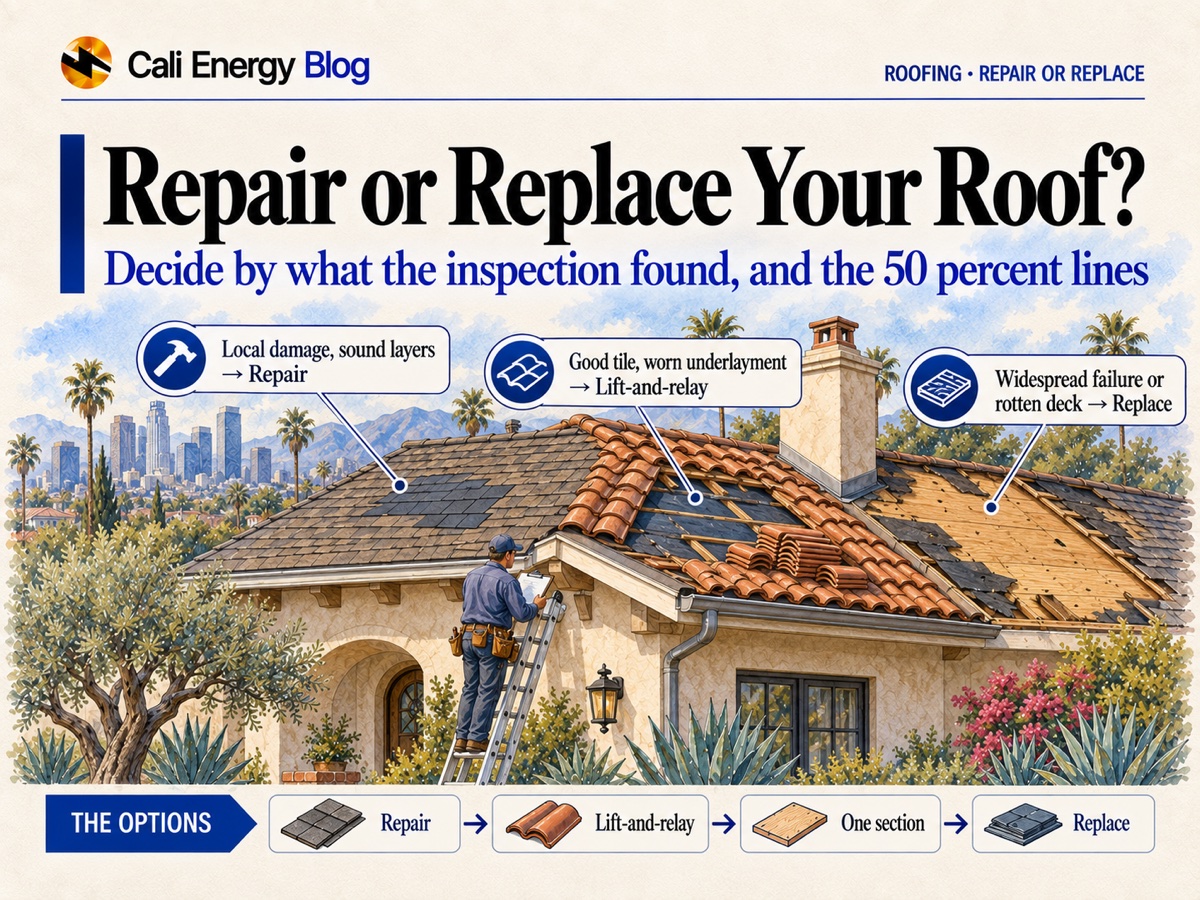
Match what the inspection found to the job
This page starts where the inspection ends, so it doesn't cover warning signs, costs or how long each material lasts; what sets the price of a repair is in roof repair cost. The rows below are the usual answers, not code rules: no California code sets a share of damage at which a roof must be replaced. The percentages that do appear in the code, covered further down, set requirements for the work, not the decision.
| What the inspection found | Usual answer | Why |
|---|---|---|
| A few shingles lifted or torn on one slope; the rest of the roof is sound | Repair | The damage has an edge. New shingles are worked into the courses around them, and nothing underneath needs work. |
| One cracked tile; the underlayment and deck under it are sound | Repair: replace the tile | Tile is the outer layer. With the layers under it intact, a matching tile closes the gap. |
| A leak traced to one flashing or pipe boot | Repair | Flashings and pipe boots are separate parts. The covering around one is opened, the part replaced, and the covering closed back up. |
| Tiles in good shape, but the underlayment is worn out across the roof | Lift-and-relay: tile off, new underlayment, same tile back | The failed layer is the one under the tile. CRC 2025, R908.5 allows existing clay or cement tile to be reinstalled, except damaged, cracked or broken pieces. |
| Wear or damage confined to one slope or one section | Replace that section | The failure stops at a ridge, valley or wall. Watch the size: at or past half the roof, the 50 percent rules below apply. |
| Shingles worn across the whole roof; one layer; no sign of deck damage | Replacement, or a recover where the code allows it | Wear everywhere isn't a repair. A recover over one layer can be permitted (CRC 2025, R908.4), but it leaves the deck unseen; a tear-off lets it be checked and fixed. |
| A second layer already on the roof, and leaks in several places | Full tear-off and replacement | A third layer isn't an option: CRC 2025, R908.4 does not permit a recover where the roof already has two or more applications of covering. Several leaks mean the problem isn't in one spot. |
| Soft or rotten deck in many places | Replacement | Deck is repaired from above, with the covering off it. The code's definition of a roof replacement includes "repairing any damaged substrate." On a tile roof with sound tile, the tile can be relaid over the new sheathing (CRC 2025, R908.5). |
| Low-slope roof with a worn surface; the layers under it dry and sound | A coating or a recover may be allowed | CRC 2025, R908.4 allows a new protective coating over built-up roofing, modified bitumen, single-ply membranes and other low-slope systems without tear-off. |
Re-roofing a low-slope roof, including under solar, is covered in solar on flat and low-slope roofs.
What the inspection has to establish first
Before anyone can call a job a repair or a replacement, the inspection has to answer five questions. The parts of a roof guide explains each term used here.
- What is the covering, and where is the damage? Shingle, tile, metal or a low-slope membrane, and whether the damage sits in one spot, on one slope or across the whole roof. On tile, how many pieces are cracked or broken.
- Is the underlayment sound? On a tile roof, intact tiles on top say nothing about the underlayment underneath. This is the layer that decides between replacing a few tiles and relaying the whole roof.
- What shape is the deck in? Soft spots underfoot, sagging between rafters, stains or rot seen from the attic. Some of it shows before the tear-off; the full picture doesn't.
- What about the flashings and penetrations? Chimneys, walls, valleys, skylights and pipe boots are where many leaks start. A ceiling stain can sit well away from the entry point, because water runs along the underlayment and framing before it drips.
- How many layers are already on the roof? One layer leaves a recover as a possibility; two or more rule it out (CRC 2025, R908.4). Layers can usually be counted at the roof edge or around a penetration.
The options between a patch and a new roof
The 2025 California Residential Code (CRC 2025, in force since January 1, 2026) defines each kind of roof work in Chapter 2, and the same terms appear on permits and on many quotes. Each option below starts with its definition and the section that allows it.
Repair
CRC 2025 defines roof repair as "Reconstruction or renewal of any part of an existing roof for the purposes of its maintenance." In practice: replacing torn shingles or cracked tiles, a flashing, a pipe boot, or a patch of deck under a leak. It fits when the damage has an edge; if the same wear shows up everywhere, repairs end up chasing one leak after another.
Whatever covering goes on in a repair has a fire-class floor. Outside Fire Hazard Severity Zones and wildland-urban interface areas, any roof covering applied in a repair must be at least Class C (CRC 2025, R902.1.2). In a Fire Hazard Severity Zone covered by the wildland-urban interface code (High and Very High zones in cities and county areas, including the City of Los Angeles, and every zone in a State Responsibility Area), any roof covering applied in a repair must be at least Class A (2025 California Wildland-Urban Interface Code, 507.1; in the City of Los Angeles, LADBS plan-check list PC/STR/Corr.Lst.116, revised March 27, 2026).
Tile lift-and-relay
On a clay or concrete tile roof, the tile itself can be in good shape while the underlayment under it has failed. A lift-and-relay, also called a tile reset, renews what is under the tile and keeps the tile: tile lifted and stacked, old underlayment stripped, deck checked and repaired where needed, new underlayment and flashings installed, and the same tile set back.
The code basis is CRC 2025, R908.5: existing slate, clay or cement tile may be reinstalled, except damaged, cracked or broken pieces, and existing flashings, edgings, outlets, vents and similar devices must be replaced where rusted, damaged or deteriorated. So a relay is not pure reuse: broken tile and worn metal get replaced as part of the job. It can cover one area, which makes it a repair, or the whole roof.
What you can't do with tile is cover it. CRC 2025, R908.4 does not permit a recover over existing slate, clay, cement or asbestos-cement tile. Tile roofs that carry solar are covered in the clay and concrete tile guide, and choosing between a tile repair, a relay and new tile in more depth is in tile roof repair, lift-and-relay or replacement.
Replacing one section
When the failure stops at a boundary (one slope, a wing of the house, a porch roof, a low-slope section), replacing just that section is a full replacement in miniature: covering off down to the deck, deck repaired, new underlayment and covering. Two things to settle first. New shingles rarely match weathered ones exactly, so a new section on the street side will show. And the section counts toward the 50 percent lines below.
Roof recover (overlay)
CRC 2025 defines roof recover as "The process of installing an additional roof covering over an existing roof covering without removing the existing roof covering." Roofers also call it an overlay. For this decision, what matters is when it is ruled out: CRC 2025, R908.4 does not permit a recover where the existing roof is water-soaked or deteriorated, where the existing covering is slate, clay, cement or asbestos-cement tile, or where the roof already has two or more layers.
Where a recover is allowed, it skips the tear-off, but it comes with trade-offs. The deck and underlayment stay unseen and unrepaired. The roof carries one more layer, and the structure has to be able to support it (CRC 2025, R908.2). And when that roof is eventually replaced, every layer comes off down to the deck (CRC 2025, R908.3).
Coating a low-slope roof
CRC 2025, R908.4 allows a new protective coating without tear-off over an existing coating and several low-slope systems (built-up roofing, modified bitumen, single-ply membranes and others). A coating renews the surface. It doesn't dry out wet layers or rebuild a failed membrane underneath, so it fits only when the layers under the surface are dry and sound.
One related rule for low-slope roofs: under CRC 2025, R908.1, on reroofing, a roof that provides positive drainage does not have to meet the ¼:12 minimum design slope.
Full replacement
CRC 2025 defines roof replacement as "The process of removing the existing roof covering, repairing any damaged substrate and installing a new roof covering." Under R908.3, it includes removing the existing layers of roof covering down to the roof deck, with narrow exceptions for an existing ice barrier or self-adhered underlayment. It is the only option that puts the whole deck in view and fixes what is found there. What a replacement involves, from the contract to the final inspection, is in the roof replacement process.
The umbrella term is reroofing, which CRC 2025 defines as "The process of recovering or replacing an existing roof covering." On its own, "reroof" doesn't say whether the old roof comes off. In the City of Los Angeles, re-roofing with a Class A or B covering under 6 pounds per square foot over solid sheathing is an express permit with no plan check; the LADBS roof permit guide covers the permit side, and choosing a roofing contractor the hiring side.
The 50 percent lines
Three rules that apply to Los Angeles houses change at half the roof. None of them tells you when to replace a roof. They are triggers: they say what the work has to meet once the replaced area crosses the line. Cross one, and a partial replacement carries the same requirement as a full replacement for that rule.
| Rule | Where it applies | What crossing it triggers |
|---|---|---|
| CRC 2025, R902.1.2 | Outside Fire Hazard Severity Zones and wildland-urban interface areas | More than 50 percent of the total roof area replaced within any one-year period: the entire roof covering must be a fire-retardant covering of at least Class C |
| 2025 California Wildland-Urban Interface Code, 507.1 (in the City of Los Angeles, checked as item D.8 of LADBS PC/STR/Corr.Lst.116, revised March 27, 2026) | Fire Hazard Severity Zones covered by the code: High and Very High zones in cities and county areas, including the City of Los Angeles, and every zone in a State Responsibility Area | Roof covering replaced, or 50 percent or more replaced in a 12-month period: the roof covering must meet the new-construction rules, a Class A roof assembly and the air-space rules (504.2 and 504.2.1) |
| California Energy Code (Title 24), cool-roof rule | By climate zone: for steep-slope roofs, zones 4 and 8–15; most of the Los Angeles basin and San Fernando Valley is zone 9. In the City of Los Angeles, the city's own rule (LAMC 99.04.106.5) applies in every climate zone, with no insulation or radiant-barrier alternative | More than 50 percent of the roof being replaced, including a new layer over the old one: the cool-roof requirement applies, with exceptions and alternatives set out in the cool-roof guide |
What the table means for a partial job:
- Read the exact wording. Outside fire zones and under the cool-roof rule the line is "more than 50 percent." In a Fire Hazard Severity Zone covered by the wildland-urban interface code it is "50 percent or more," so exactly half counts.
- The fire-class count runs over a year. R902.1.2 counts roof area replaced within any one-year period, and the wildland-urban interface rule within a 12-month period, so two partial jobs in the same year add up.
- It lands on the whole roof. Under R902.1.2, crossing the line puts the Class C requirement on the entire roof covering, not only the new section. In a fire zone, 507.1 is written about the roof covering as a whole: once 50 percent or more of it is replaced in 12 months, the covering is to be replaced to the new-construction rules. Plan and price a job past that line as if the whole roof must meet them, and confirm with the building department.
- Check the parcel, not the ZIP code. Look up the address on the official Fire Hazard Severity Zone map and on your city's parcel map, since a city can add zones the state map doesn't show.
When a job sits close to one of these lines, ask the roofer what share of the roof it covers and how the permit counts it. The fire class and WUI code guide covers how the 2025 maps changed and when a re-roof must be Class A, and the cool-roof rule on a re-roof covers the cool-roof details, exceptions and alternatives.
What else tips the decision
- Layers already on the roof. Two or more rule out a recover, and a replacement removes every layer down to the deck (CRC 2025, R908.4 and R908.3).
- The deck you haven't seen. The deck's condition isn't known until the covering comes off, and what turns up can change the scope. A replacement quote should say how deck repair is handled: what is included, and how further work is priced once its extent is known. Two of the jobs below went exactly that way.
- Solar in the plans. If panels are coming, make the roof decision before they go on; whether to replace the roof before installing solar covers the timing.
- How you'll pay. A replacement financed with a loan or a PACE assessment comes with its own rules and rights to cancel; see roof financing in California.
- A heavier covering. Moving to a heavier covering, or adding a layer in a recover, has to be checked against the framing: CRC 2025, R908.2 requires the structural roof components to support the roof covering system and the material and equipment loads during installation.
What we have done on real roofs
Our own roofing jobs around Los Angeles include a repair, a tile relay, a one-square section and full replacements. A roofing square is 100 square feet of roof surface.
- Burbank, 2023: repair. About 300 square feet of tile roof: the tile lifted and stacked, failed underlayment and flashings replaced, damaged sheathing replaced where it was found, and the same tile reset.
- Canoga Park, 2026: lift-and-relay. A full re-roof and a tile reset were priced side by side so the choice was made on numbers. Twenty-six squares of flat concrete tile came off, new underlayment went down, and the same tile went back, with replacement tile ordered in advance for pieces that break in handling.
- Studio City, 2026: section replacement, one square. About 100 square feet re-roofed under an existing solar array.
- Granada Hills, 2022: replacement. Thirty squares of covering replaced. Rotten wood found in the structure once the covering was off was replaced and priced as a separate line once its extent was known.
- Canoga Park, 2024: replacement. About 2,110 square feet torn off to the deck. The tear-off showed the deck needed replacing, so it was replaced and the scope was revised.
- Sylmar, 2020: replacement. The existing covering was assessed for asbestos before any tear-off began, then 25 squares of composition shingle went on.
More roofing projects are on our case studies page. Cali Energy holds California contractor license #1032379 with three classifications: C-39 Roofing, B General Building, and C-10 Electrical, which covers solar; you can check the license on the CSLB site. Roofing work on its own is on our roofing page.
Frequently asked
Is there a percentage of damage at which a roof has to be replaced?
Can I replace just the worst slopes?
Does replacing half my roof trigger code upgrades?
Can you tell if the deck is rotten before the tear-off?
Should I keep repairing an old roof?
Related reading
Sources & methodology
Code sections, rules and figures on this page come from the primary sources below. Codes, local requirements and product terms change; each was verified October 14, 2026.
- California Residential Code 2025, Chapter 9 Roof Assemblies, R902 and R908 (UpCodes)
- California Residential Code 2025, Chapter 2 Definitions (UpCodes)
- California Wildland-Urban Interface Code 2025, Chapter 5 (UpCodes)
- LADBS, Fire Hazard Severity Zone Supplemental Checklist (2025 CWUIC), revised March 27, 2026
- California Building Standards Commission, 2025 codes (effective January 1, 2026)
- California Energy Code (Title 24, Part 6) 2025, cool-roof requirements incl. §150.2 re-roofing (Cool Roof Rating Council summary)
- CAL FIRE Office of the State Fire Marshal, Fire Hazard Severity Zones
- Los Angeles Municipal Code, Section 99.04.106.5, Cool Roof for Reduction of Heat Island Effect (as amended by Ordinance 187,208)
We'll inspect the roof and tell you which job it needs
Call (323) 844-7777 and have a few photos of the roof ready, with roughly how old it is. We'll inspect it and tell you plainly whether it's a repair, a lift-and-relay or a replacement, and why. One thing nobody can tell you in advance: the condition of the deck under the covering isn't known until the covering comes off.
Prepared by Cali Energy, October 14, 2026. This article is for general educational purposes only and is not legal, tax, financial, engineering, or utility advice. Rates, incentives, codes, permit requirements, equipment specifications, prices, and program terms may change; figures and timelines are estimates, not guarantees. Confirm current requirements with the applicable utility, AHJ, program administrator, manufacturer, or a licensed professional. See our Content Disclaimer. Cali Energy · 19201 Parthenia St, Unit E, Northridge, CA 91324 · CSLB #1032379 (B, C-10, C-39)