

Flat Roof Repair, Coating or Replacement: How to Decide
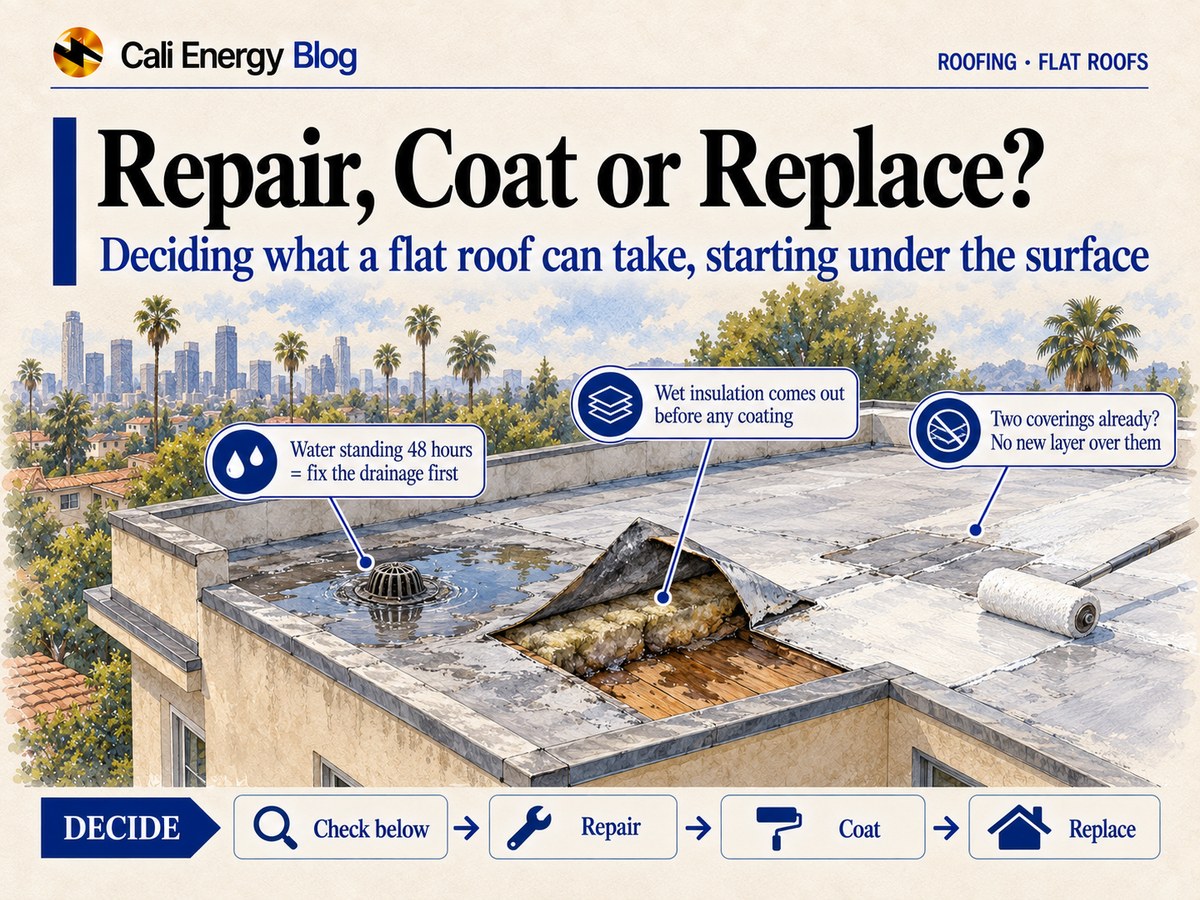
A flat roof can be repaired, coated, recovered with a new roof over the old one, or replaced down to the deck, and the deciding question is what's under the surface. A repair fits a single failed seam, flashing or penetration on a roof that's otherwise sound and dry. A coating fits a roof that's aging but still watertight, dry underneath and draining: the coating manufacturer GAF's own manual says a coating can slow a roof's aging but can't add life back to a roof already beyond its service life, and that all wet insulation has to be replaced first. Replacement is what's left when the insulation or deck is wet or deteriorated over a large share of the roof, when the roof already carries two coverings, or when the drainage has to be rebuilt. On a re-roof covering more than half of a low-sloped roof, California's 2025 Energy Code adds its own requirements, as of October 2026.
This page covers houses with flat or low-sloped roofs under the 2025 California codes, in force since January 1, 2026. It doesn't price the work or predict how long a coating or a roof will last, and it can't diagnose a leak at a distance. Which system to choose for a new flat roof is in flat roof options for Los Angeles homes; repair or replacement on a pitched roof is in roof repair or replacement, and the defects of a built-up roof, from blisters to slipping plies, in hot mop roof: repair or replace.
What the roof shows, and what it points to
The four choices differ in what they leave in place: a repair and a coating keep the whole roof, a recover keeps the old covering under a new one, and a replacement takes everything down to the deck. So the evidence that rules each one in or out is mostly about the layers below the surface.
| What the roof shows | What it points to | Why |
|---|---|---|
| One leak at a seam, flashing, drain or penetration; the membrane elsewhere sound; insulation and deck dry | Repair the detail | Under the Energy Code a repair is maintenance, not an alteration; a small repair may need no permit, depending on the city |
| The surface aging (chalking, crazing, worn granules) but no leaks; insulation and deck dry; drains working | Repair the defects, then coat | California's residential code allows a new coating over most existing low-slope roofs without a tear-off; the manufacturer's conditions below apply |
| Water standing more than 48 hours after rain | Fix the drainage first | GAF defines ponding as water that hasn't drained within 48 hours after precipitation ends and asks for ponding areas to be repaired before coating |
| Wet insulation or soft deck in places | Cut out and replace the wet areas, then coat or recover | GAF: all wet insulation must be removed and replaced before coating; the code rules out a recover over a water-soaked or deteriorated roof |
| Wet over 25% or more of the roof area, or a soft, rotten deck over a large part of it | Tear off and replace | GAF: if a moisture survey finds 25% or more of the roof area wet, a complete tear-off may be considered (and its coating guarantee then requires one) |
| Two or more roof coverings already on the roof | Tear off and replace | The code doesn't permit a recover over two or more existing applications of any roof covering |
| The membrane brittle, split or blistered across the roof | Replace | A coating can't add life back to a roof beyond its service life |
The rest of this page goes through each step, starting with the one most bids skip.
Look under the surface first
A flat roof that has leaked may be holding water you can't see, and it's the condition that decides between a coating and a tear-off. GAF's liquid-applied roofing manual (version 2.1, 2024) says a moisture survey reveals wet substrate that will need replacing, that some wet insulation can be noticed by walking on it but a survey is more accurate, and that a survey may use an infrared scan, a nuclear scan, core cuts, or portable devices that indicate moisture. Two ASTM standards describe the main non-destructive methods:
- Infrared imaging (ASTM C1153). A scan at night locates wet insulation in roofs that have insulation above the deck in contact with the waterproofing.
- Electronic leak detection (ASTM D7877). Electrical conductance methods locate leaks in exposed or covered roofing membranes.
Where a house's insulation sits below the deck, between the joists, rather than above it, the useful checks are a core cut or test opening through the roofing, and the ceiling below: a stain, a sag or a soft spot over the same area tells you where water has been. Ask what was checked and where. A bid for a coating that rests on a walk-over alone is a bid that hasn't looked.
When a repair is enough
A repair fits a defect that's local: a split seam, a failed flashing at a wall, a cracked boot at a vent, a drain that has pulled away from the membrane. The membrane around it has to be sound, and what's under it has to be dry; a patch over wet insulation keeps the water in.
Two rules follow a repair:
- The Energy Code doesn't treat it as a re-roof. California's 2025 Energy Code defines a repair as reconstruction or renewal for maintenance, and treats replacing a component that has energy requirements as an alteration instead. Its cool-roof and insulation rules for roofs apply when more than 50% of the roof is replaced.
- A permit depends on the city and the size. The City of Los Angeles draws the line by value (work of $2,500 or less may be exempt, with conditions), Long Beach exempts roofing repairs of up to 100 square feet in 12 months, and Santa Clarita up to 10% of the roof or 200 square feet, whichever is less, in a year. Unincorporated Los Angeles County and Burbank have no roofing item in their exemption lists. The details are in re-roof permit rules across LA-area cities.
What a coating can and can't do
A coating is a liquid-applied layer over the existing surface. California's residential code (CRC 2025, R908.4) allows a new protective coating over an existing coating, built-up roof, modified bitumen, single-ply membrane, spray foam roof, metal panels or mineral-surfaced roll roofing without a tear-off. GAF's manual sets out what a roof has to be for a coating to make sense:
- Not leaking. Coatings may seal some pinholes, but they generally won't find and repair existing leaks; those have to be found and fixed first, and the repairs allowed to dry.
- Draining. A coating goes only on a roof that drains properly; some coatings are adversely affected by ponding water, so ponding areas are repaired before coating.
- Dry underneath. All wet roof insulation is removed and replaced before coating.
- Holding the coating. An adhesion test confirms the coating will stick to the existing surface; a primer may be needed, and the surface has to be clean and completely dry.
- Not past its life. A coating can help a roof age more slowly, but it can't add life back to a roof already beyond its service life.
Two LA-specific rules apply as well. Under the 2025 Energy Code, the re-roof rule counts "adding a new surface layer on top of the existing exterior surface," so a coating over more than half of a low-sloped roof needs a reflective, CRRC-rated product in climate zones 4 and 6 through 15; whether the insulation part of the rule applies to a coating-only job is a question for the building department. And in the South Coast Air Quality Management District, Rule 1113 limits roof coatings to 50 grams of volatile organic compounds per liter. The coating types and the energy rules are compared in flat roof options for Los Angeles homes, and how acrylic and silicone differ on manufacturers' data sheets in silicone, acrylic or elastomeric roof coating.
Recover over the old roof, or tear off
The Energy Code's definitions separate the two: a roof recover installs an additional roof covering over a prepared existing roof covering without removing it, and a roof replacement removes the existing covering, repairs any damaged substrate and installs a new one. California's residential code (R908.3) defines a replacement as removing the existing layers down to the roof deck.
A recover is allowed under CRC R908.4 where the new covering's manufacturer allows it, and the same section lists a new coating over an existing low-slope roof among the recovers it permits. It rules a recover out where:
- the existing roof or covering is water-soaked or has deteriorated to the point that it isn't an adequate base;
- the existing covering is slate, clay, cement or asbestos-cement tile;
- the existing roof already has two or more applications of any type of roof covering.
Some agencies go further. Unincorporated Los Angeles County's re-roofing code manual lets the building official keep the old covering only when inspection shows no more than one layer of certain listed types, with a sound deck and framing able to carry the added weight; Long Beach requires a tear-off once a roof has two or more applications. If your roof already has two coverings on it, ask the building department before any bid that leaves them in place.
What a replacement brings with it
Taking a flat roof down to the deck is the moment to fix what a recover can't: wet insulation, rotten deck boards, and slope. It also brings in rules that a repair doesn't:
- The Energy Code, when more than half the roof is replaced. A low-sloped roof needs a reflective surface (aged solar reflectance 0.63 with thermal emittance 0.75, or SRI 75) in climate zones 4 and 6 through 15, unless insulation at the deck is used instead, and R-14 continuous insulation in zones 1, 2, 4 and 8 through 16, with exceptions for roofs already insulated. The details, the exceptions and the stricter local values in unincorporated LA County and Burbank are in flat roof options for Los Angeles homes.
- Insulation between the joists, once the cavities are open. The Energy Commission's 2025 compliance manual treats a roof as altered when the work opens up the space between the framing members, and the code's minimum for ceilings and rafter roofs in an alteration is R-19 between the framing, or an assembly U-factor of 0.054. On a flat roof where deck boards come off, ask whether the bid includes it.
- Slope. On a re-roof, CRC R908.1 doesn't require the 1/4-inch-per-foot minimum slope for a roof that drains positively. A roof that ponds doesn't get that exception, so correcting the slope, with tapered insulation or reframing, belongs in the scope.
- A permit with inspections. The agency, the permit type and the inspections are in re-roof permit rules across LA-area cities, and for the City of Los Angeles in roof permit in Los Angeles.
Ponding water
GAF's manual defines ponding as water that doesn't drain or dissipate from the roof surface within 48 hours after precipitation ends, and notes that it can also come from other sources, such as improperly piped air-conditioning condensate lines. In Los Angeles, where a roof can stay dry for months, a rooftop air conditioner's condensate line can keep water standing through the dry season.
Water that stands is a drainage problem first. Clear and check the drains, scuppers and overflow outlets, find where the condensate goes, and look at the slope toward the drains. A coating over ponding areas works against the manufacturer's own instruction; a recover or replacement over them carries the problem into the new roof. California's residential code requires a roof drain at each low point unless the roof drains over its edges, and, where a parapet would trap water if the drains back up, an emergency overflow (CRC R903.4 and R903.4.1). The causes of ponding and the fix for each are in ponding water on a flat roof: causes and fixes.
Solar on the roof
If panels are on the roof or planned, the roof decision comes first. A repair can usually be made around an array; a coating or a replacement means the panels come off and go back, under the permits each agency requires, and every mount through the membrane has to be flashed into the new surface. If the roof is near the end of its life, replacing it before an array goes up avoids paying to remove and reinstall the panels later. On a new house in Chatsworth with a flat roof behind a parapet, we scheduled the array after the roofers had finished. How arrays are mounted on flat roofs is in solar on flat and low-slope roofs, and taking one off for roof work in solar removal and reinstall.
Comparing the bids
Bids for the same flat roof can propose very different work. These questions put them side by side:
- What was checked under the surface? A moisture survey, core cuts or test openings, and the ceiling below, and where.
- What happens to wet areas? How much will be cut out and replaced, and what the bid does if more is found.
- Repair, coating, recover or replacement, and why? The reason should come from the roof's condition, not from what the company sells.
- For a coating: the product, its CRRC rating, the adhesion test, the primer if any, and how the leaks and ponding areas are fixed first.
- For a recover: how many coverings are there now, and whether the new one's manufacturer allows it over what's there.
- For a replacement: the insulation the Energy Code calls for at your climate zone, insulation between the joists if they're opened, how the slope and drains are corrected, and how the flashings are raised at parapets and doors.
- The permit, and who warrants what: the agency and permit type, the manufacturer's warranty and the roofer's workmanship warranty, each in writing; what each kind covers is in roof warranties explained.
Cali Energy holds California contractor license #1032379, with C-39 Roofing, B General Building and C-10 Electrical, the classification that covers solar. Our roofing work is on our roofing page.
Frequently asked
Can I coat a flat roof that's leaking?
How do I know if the insulation under my flat roof is wet?
What counts as ponding on a flat roof?
Does recoating a flat roof trigger the cool-roof rule?
When does a flat roof have to be torn off?
Do I need a permit to repair a flat roof?
Related reading
Sources & methodology
Code sections, rules and figures on this page come from the primary sources below. Codes, local requirements and product terms change; each was verified October 9, 2026.
- California Residential Code 2025, Chapter 9, Roof Assemblies (R903.4, R908.1, R908.3, R908.4, R909)
- California Energy Commission, 2025 Building Energy Efficiency Standards (Title 24, Part 6), CEC-400-2025-010, sections 100.1 (definitions),…
- California Energy Commission, Single-Family Residential Compliance Manual for the 2025 Standards, CEC-400-2025-005
- GAF, Liquid-Applied Roofing Manual, version 2.1 (2024)
- ASTM C1153, Location of Wet Insulation in Roofing Systems Using Infrared Imaging
- ASTM D7877, Electronic Methods for Detecting and Locating Leaks in Roofing and Waterproofing Membranes
- South Coast Air Quality Management District, Rule 1113, Architectural Coatings
We'll tell you what the flat roof can take, and why
Call (323) 844-7777. We look at the roof from above and, where we can, from below: the drains, seams, flashings and soft spots, and test cuts where the answer depends on what's under the surface. The estimate says whether the roof supports a repair, a coating, a recover or a replacement, and what the code and the energy rules add. Have ready the address, photos of the roof and of any ceiling stains, when the leaks show up (in the rain, or in air-conditioning season), and whether solar is on the roof or planned.
Prepared by Cali Energy, October 9, 2026. This article is for general educational purposes only and is not legal, tax, financial, engineering, or utility advice. Rates, incentives, codes, permit requirements, equipment specifications, prices, and program terms may change; figures and timelines are estimates, not guarantees. Confirm current requirements with the applicable utility, AHJ, program administrator, manufacturer, or a licensed professional. See our Content Disclaimer. Cali Energy · 19201 Parthenia St, Unit E, Northridge, CA 91324 · CSLB #1032379 (B, C-10, C-39)