

Torch-Down Roof: Pros, Fire Risks and Safer Options
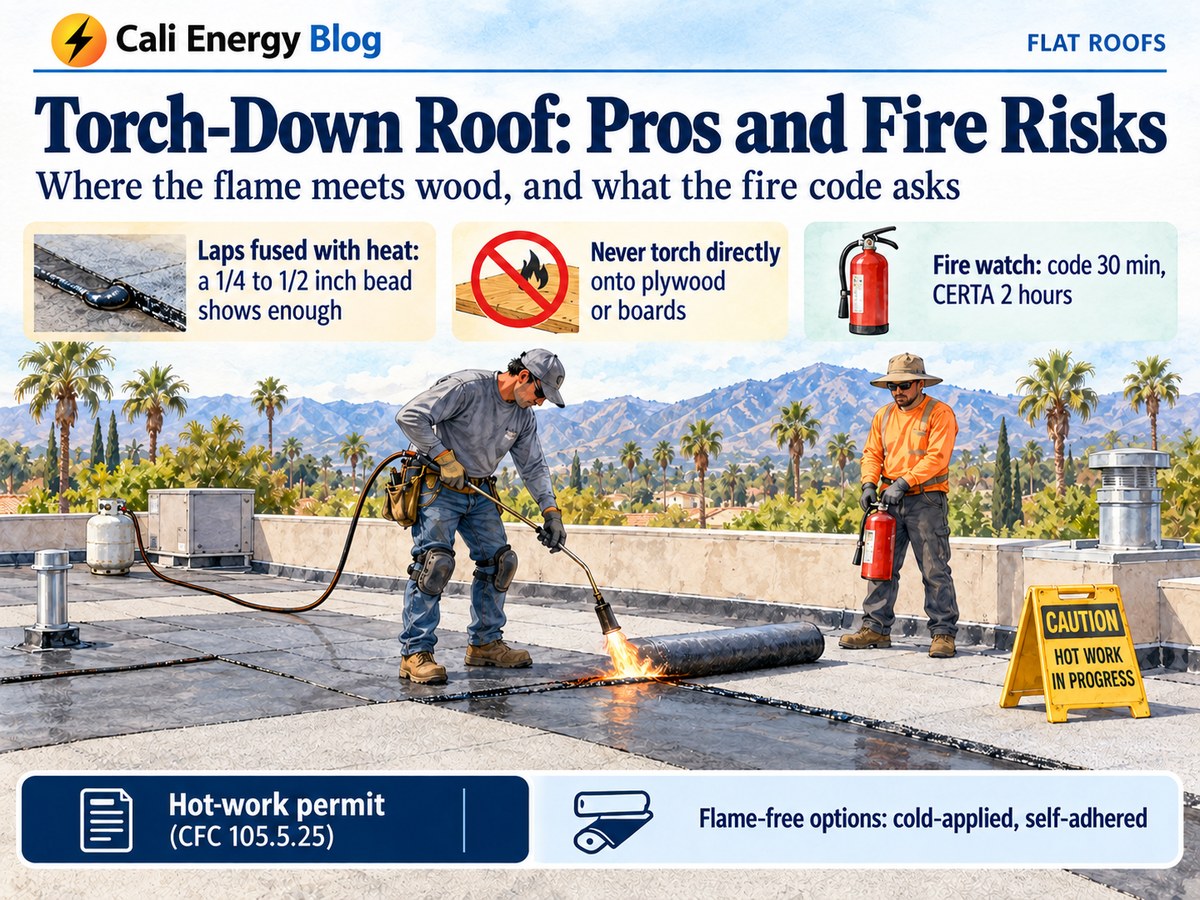
A torch-down roof is modified bitumen: factory-made asphalt sheets, modified with SBS rubber or APP plastic, whose backing is melted with a propane torch so each sheet bonds to the layer below and to its neighbor at the laps. Its strengths are real: no kettle of hot asphalt, laps fused into one continuous membrane, and a method the national roofing contractors' association, NRCA, says has been used successfully and safely in North America since the late 1970s. Its main risk is fire. California's fire code treats torch-applied roofing as hot work, with an operational permit from the fire department, a fire watch during the work and for at least 30 minutes after it, and extinguishers within reach and on the roof. Since 2019, NRCA no longer recommends torch-applied sheets over wood roof decks at all, and its torch-safety program says never to torch directly onto plywood, OSB or boards. Modified bitumen also comes in cold-applied, self-adhered and hot-mopped versions that put no torch on the roof. This page sets out the pros, the risks and the rules as of October 2026.
It covers houses with flat or low-sloped roofs under the 2025 California codes, in force since January 1, 2026. It doesn't price the work or predict how long a roof will last. All the flat-roof systems are compared in flat roof options for Los Angeles homes, and whether an existing built-up roof should be repaired or replaced is in hot mop roof: repair or replace.
What torch-down is
The 2025 California Fire Code defines a torch-applied roof system as bituminous roofing whose membranes are adhered by heating them with a torch and melting their asphalt back coating, instead of mopping hot asphalt for adhesion. In the California Residential Code (CRC 2025, section R905.11), it's one way of installing modified bitumen roofing, which:
- needs a design slope of at least 1/4 inch per foot (2%);
- is made to ASTM standards for SBS-modified sheets (D6162, D6163, D6164) and APP-modified sheets (D6222, D6223), among others;
- can go over a base sheet meeting ASTM D1970 or D4601;
- has its wind resistance tested to FM 4474, UL 580 or UL 1897, and is installed to the manufacturer's instructions.
Which sheets get a torch depends on the product. In CertainTeed's modified bitumen line, for example, the APP sheets are torch-applied, while the SBS sheets come in versions for hot asphalt, cold adhesive, self-adhering and torch application. In CertainTeed's handbook, every system starts with a base sheet over the substrate, mechanically fastened on a nailable deck, with the torched plies and the cap sheet above it.
What it does well
- No kettle. The asphalt that bonds each sheet is already on its back, so there's no hot-asphalt kettle on the ground and no mopping on the roof.
- Laps fused into one membrane. Heat melts both sheets at each lap. In CertainTeed's handbook, enough heat shows as a uniform bead of melted compound, 1/4 to 1/2 inch, along the edge of the lap; an unbonded area is lifted and torched again, never sealed by torching the top of the sheet.
- A long record. NRCA describes torch-applied sheets as used successfully and safely since the late 1970s, and safe when roof decks, membranes and details are designed and installed with fire safety in mind.
- Cool-rated cap sheets exist. On a low-sloped re-roof that has to meet California's cool-roof values, the cap sheet's own Cool Roof Rating Council rating, or a coating, carries the requirement.
Where the fire risk is
The risk sits in two places: wood under the flame, and the spots where the flame can't be seen.
- Wood decks. In its 2019 roofing manual, NRCA stopped recommending torch-applied sheets over combustible roof decks, even with a thermal-barrier insulation layer over the deck, and advised considering other methods, such as cold adhesive, instead. NRCA concluded that the fire risk of torching over wood decks outweighs the advantages. On a wood-framed house, the roof deck is plywood, OSB or boards.
- Flashings and penetrations. In a 2018 bulletin, the Ontario Industrial Roofing Contractors Association said most torch fires start at roof flashings and penetrations, fewer in the field of the roof.
- What insurers see. In a 2023 bulletin on the CERTA program, the insurer CNA wrote that most recent claims came from lapses in basic practice: an improper fire watch, torch use near HVAC equipment or open ducts, and not noticing a wood substrate.
CERTA, the Certified Roofing Torch Applicator program run by NRCA, sets the industry's own rules for those spots. Among them:
- never torch directly onto combustible material, and identify and protect plywood, OSB, wood, wood fiberboard and other combustible parts;
- never torch where the path of the flame can't be seen, including flashings, corners, curbs, voids, expansion joints and small penetrations; use torch-and-flop, an indirect method in which the sheet is heated away from the substrate and then laid in place, or cold adhesive or hot asphalt there instead;
- at flashings, a direct torch only with a single-burner detail torch of 105,000 Btu or less, over an air-impermeable backer layer;
- clean lint and grease out of exhaust vents before torching;
- where an owner insists on torching over a wood deck, at least 2 inches of stone wool insulation or a cement or gypsum board over the deck first, then an air-impermeable layer, before any torched sheet.
The code minimum and the industry's own rules
California's fire code sets the floor. The industry's safety program and manufacturers' handbooks ask for more, most visibly in how long someone watches the roof after the torches go out.
| 2025 California Fire Code | CERTA program | CertainTeed handbook | |
|---|---|---|---|
| Permit and notice | Operational permit from the fire code official for applying roof coverings with an open-flame device (105.5.25) | Comply with state and local fire and building ordinances | Written notice to the local fire department; any required permits |
| Fire watch after torching | During the work and at least 30 minutes after; the fire official can extend it (3504.2.1) | At least 2 hours after the torches are shut down, including the roof's underside where possible | A supervisor stays at least 4 hours, checking the roof, attic, crawl spaces and return-air ducts with infrared thermometers |
| Extinguishers | One rated at least 2-A:20-B:C within 30 feet of the hot work (3504.2.6), and one rated at least 3-A:40-B:C on the roof (3305.10.2) | Two rated 4-A:60-B:C within 10 feet of each lit torch | At least one ABC extinguisher, 20 pounds minimum, per operating torch |
| Combustibles | The hot work area clear of combustibles or shielded; exposed combustible construction protected, checked before the work (3504.1.1, 3504.3.1) | Never torch directly onto combustible material; not recommended over wood decks | Extra caution at exposed edges of insulation |
| Who holds the torch | People capable of doing the work safely (3503.4) | Only CERTA-certified applicators | Trained professional roofers; CERTA training recommended; never do-it-yourself |
The code's own checks are worth knowing as a homeowner: before the work starts, someone has to confirm the area is clear of combustibles or protected and that openings are covered (3504.3.1), and a "Caution: hot work in progress, stay clear" sign goes up where others can walk into the area (3503.6). CertainTeed's handbook also keeps propane tanks upright, secured and at least 10 feet from the torch flame, with tanks not in use stored on the ground.
Flame-free ways to get the same roof
The modified bitumen itself doesn't require a flame:
- Cold-applied. SBS sheets set in cold adhesive; NRCA names cold adhesive as the alternative to consider over wood decks.
- Self-adhered. SBS sheets with a self-adhering back, pressed into place with a roller.
- Hot-mopped. SBS sheets set in hot asphalt, which brings the kettle back under the fire code's kettle rules.
- At the edges. Where torched sheets are used in the field, CERTA's list for flashings: torch-and-flop, cold adhesive or hot asphalt.
Other flat-roof systems avoid a flame altogether: single-ply membranes welded with hot air, spray foam and coatings. They're compared in flat roof options for Los Angeles homes.
Color and the cool-roof rule
When more than half of a low-sloped roof is replaced, the 2025 California Energy Code asks for a reflective surface in climate zones 4 and 6 through 15, or insulation at the deck in its place, and LADBS's express re-roof permits in the City of Los Angeles call for a product labeled and certified by the Cool Roof Rating Council. For a torch-down roof, that's a question about the cap sheet: whether the exact product and color carry the rating. On a Canoga Park re-roof in 2024, the gray torch-down the owner wanted wasn't in the cool-rated line, so the membrane that qualified came in its own color, and the owner saw that before signing (the Canoga Park case). The rule and its local versions are in the cool-roof requirement on a re-roof.
What we've seen
On a new Calabasas house with a flat torch-down roof, the solar standoffs went in first, each set in a curb filled with sealant around the post; the roofer then laid a white coating over the roof around them, and the array went up once the coating had dried (the Calabasas case). On a Burbank tile roof repair in 2023, the junction with a wall was rebuilt with a torch-applied membrane carried up the wall and under the Z-bar flashing (the Burbank case).
Questions to ask before a torch-down job
1. Who holds the torch? Whether the applicators are CERTA-certified.
- Which permit? Whether the fire department's hot-work permit is in the job, along with the building permit.
- What's the deck, and what goes on it first? On wood, how the torched sheets are kept off it, or whether a cold-applied or self-adhered system is proposed instead.
- How are the edges done? Walls, curbs, vents, drains and corners: torch-and-flop, cold adhesive, self-adhered sheet, hot asphalt, or a detail torch over a backer.
- How long is the fire watch, and where? The code's 30 minutes, CERTA's 2 hours or more, and whether the attic is checked.
- Which cap sheet? The product, its CRRC rating if the cool-roof rule applies, and the manufacturer's warranty.
Frequently asked
Is torch-down roofing safe?
Does a torch-down roof need a fire permit?
How long should the fire watch last after torch-down?
What's the difference between APP and SBS torch-down?
Can torch-down go over a plywood roof deck?
Related reading
Sources & methodology
Code sections, rules and figures on this page come from the primary sources below. Codes, local requirements and product terms change; each was verified October 9, 2026.
- California Residential Code 2025, Chapter 9, Roof Assemblies (R905.11)
- California Fire Code 2025, Chapter 1 (105.5.25), Chapter 2 (definitions), Chapter 33 (3305.10) and Chapter 35 (3503, 3504)
- Mark S. Graham, "New torch-safety guidelines," Professional Roofing (NRCA), February 2019
- CNA and NRCA, CERTA – NRCA Certified Roofing Torch Applicator Program, risk control bulletin, 2023
- CertainTeed, Flintlastic Modified Bitumen Application Handbook, third edition (2016), copy published by a distributor
- California Energy Commission, 2025 Building Energy Efficiency Standards (Title 24, Part 6), CEC-400-2025-010, section 150.2(b)1I
We'll tell you whether your flat roof should be torched at all
Call (323) 844-7777. We check what the deck is made of, how the walls, curbs, vents and drains meet the roof, and whether a cool-rated cap sheet is needed, and the estimate names the system, how each part goes on, with or without a flame, and the permit it takes. Have ready the address, photos of the roof and its edges, and whether solar is on the roof or planned.
Prepared by Cali Energy, October 9, 2026. This article is for general educational purposes only and is not legal, tax, financial, engineering, or utility advice. Rates, incentives, codes, permit requirements, equipment specifications, prices, and program terms may change; figures and timelines are estimates, not guarantees. Confirm current requirements with the applicable utility, AHJ, program administrator, manufacturer, or a licensed professional. See our Content Disclaimer. Cali Energy · 19201 Parthenia St, Unit E, Northridge, CA 91324 · CSLB #1032379 (B, C-10, C-39)