

Re-Roofing in a Los Angeles HPOZ: What Needs Approval
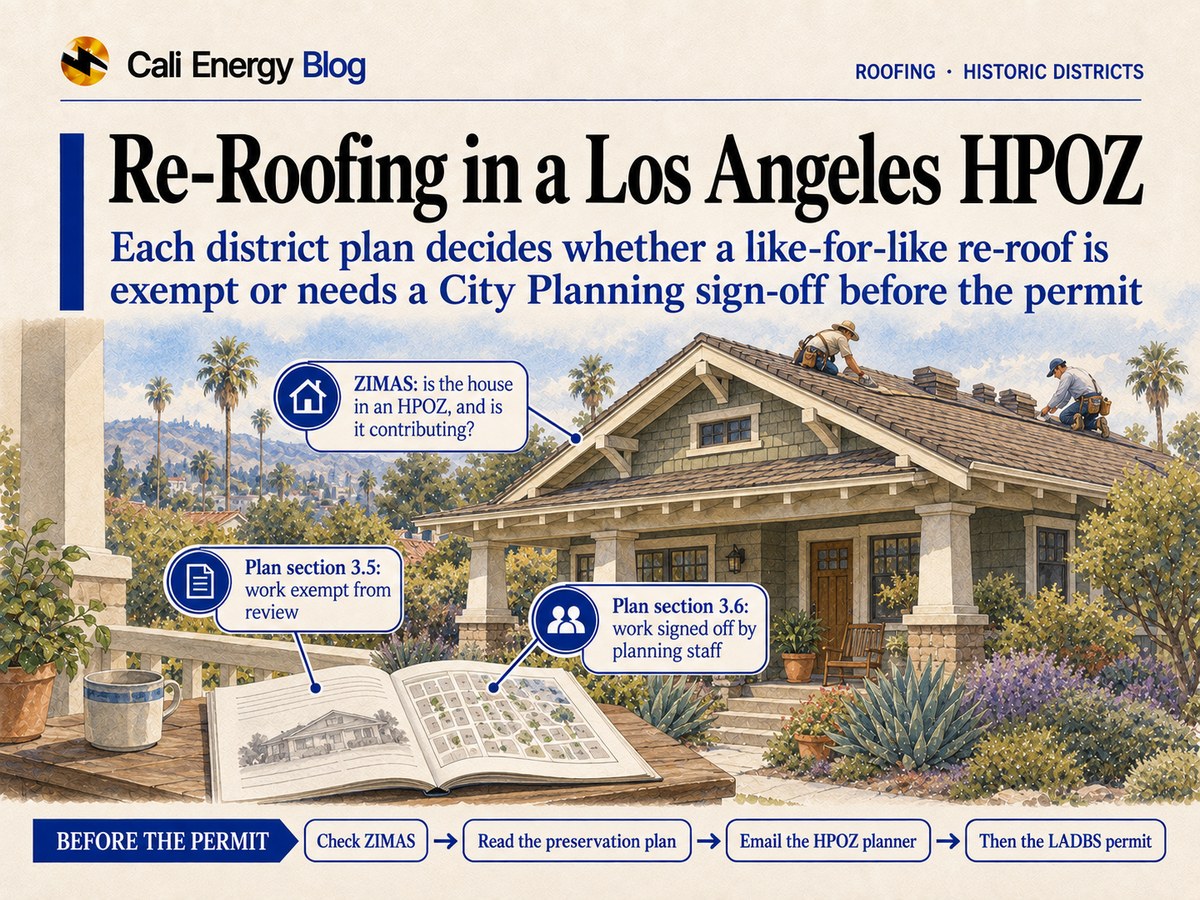
Usually a sign-off from City Planning before the building permit, and sometimes nothing extra at all. Under the City's HPOZ ordinance (LAMC 12.20.3), exterior work in a Historic Preservation Overlay Zone goes through City Planning, but each district's preservation plan lists work that's exempt from review (section 3.5) and work that planning staff can sign off without a board hearing (section 3.6), and a like-for-like re-roof lands in one or the other depending on the district. In Stonehurst, replacing a composition shingle roof with a substantially similar material is exempt; in Van Nuys and Balboa Highlands, an in-kind replacement of asphalt shingles is signed off by staff. A different material, a change to the roof's form or work on its historic details goes to review against the plan's guidelines. Work done without review can bring code enforcement and fines from the Department of Building and Safety (LADBS). This page covers the City of Los Angeles's HPOZs; other cities run their own historic programs.
First, check the address
City Planning's map, ZIMAS, shows whether a property is in an HPOZ and how the district's survey lists the building: Contributing, Contributing Altered or Non-Contributing. That status sets the paperwork. City Planning lists 35 adopted HPOZs, plus North University Park, a specific plan area that uses the HPOZ rules; three of them are in the San Fernando Valley: Balboa Highlands in Granada Hills, Stonehurst in Sun Valley, and Van Nuys. Each district's page has its preservation plan, boundary map and planner's contact.
Even work that doesn't need a building permit can need HPOZ approval, and City Planning advises consulting the district's planner before applying for permits at LADBS. Its FAQ suggests emailing the planner with the address and the district's name in the subject line, and gives "In-kind reroofing of the structure" as its example of a project description.
Which review a re-roof gets
The ordinance sets four procedures, and the district's plan decides which one a roof job falls under. For a contributing house, the paths run from no review to a Certificate of Appropriateness.
| Path | When it applies to a roof | Who signs off | Time and appeal |
|---|---|---|---|
| Exempt | Work the plan lists in section 3.5, such as Stonehurst's in-kind replacement of composition shingle with a substantially similar material that removes no historic material | No HPOZ review | — |
| Conforming Work, delegated to staff | Work the plan lists in section 3.6, such as in-kind replacement of asphalt roof shingles in Van Nuys and Balboa Highlands, where fascia, eaves and brackets aren't affected | Planning staff; the board is notified | 3 to 21 days by City Planning's estimate; not appealable |
| Conforming Work before the board | Other roof work that meets the plan's guidelines | The district's HPOZ board | The board acts within 21 days of a complete application; not appealable |
| Certificate of Appropriateness | Work that doesn't qualify as Conforming Work, and demolition, which the ordinance defines to include removing more than half the roof framing | The Director of Planning, with the board advising | Up to 75 days by City Planning's estimate; 15-day appeal period |
On a non-contributing house the same choice runs between Conforming Work on a Non-Contributing Structure and, for demolition or a new building, a Certificate of Compatibility; Van Nuys delegates alterations to non-contributing structures, other than additions, new construction, relocation or demolition, to staff. City Planning's FAQ says there's currently no fee for Minor Conforming Work, and the fees for the rest come from its fee estimator. Once the project is approved, and for a certificate once the appeal period passes, the planner signs off the LADBS permit; the permit itself is covered in roof permits with LADBS.
What the preservation plans ask of a roof
The roof guidelines in the three Valley plans, Stonehurst, Van Nuys and Balboa Highlands, run along the same lines:
- Keep the form and the details. Roof and eave details, such as rafter tails, vents, corbels and built-in gutters, are preserved or repaired in place, and matched in design and material if they have to be replaced; the same plan calls altering the basic form of a visible roof inappropriate (Stonehurst).
- Historic specialty materials stay. Historic specialty roofing such as tile, slate or gravel is preserved in place or replaced in kind; in Van Nuys, original tile goes on the most street-visible faces and new replacement pieces toward the rear.
- A replacement should look the same from the sidewalk. Where in-kind replacement isn't possible, the new material should be substantially similar in appearance, particularly from the public sidewalk, in scale, texture and color (Van Nuys, Balboa Highlands). The Balboa Highlands plan, for Joseph Eichler's 1960s tract, calls clay tile and slate inappropriate there.
- Color. Stonehurst calls light-colored asphalt shingle generally inappropriate and earth tones, such as rusty reds, greens and browns, generally appropriate.
- No wood. Wood roof shingles are no longer permissible in Los Angeles, as the Stonehurst plan notes; the city bans them under LABC 91.1505.1, and the Stonehurst plan asks for minimal repairs to a wood shingle roof rather than replacing it outright where possible. What can replace a shake roof is in replacing a wood shake roof in Los Angeles.
Color can run into the Energy Code's cool-roof rule, which applies when more than half a roof is replaced (2025 Energy Code, Section 150.2(b)1I). The Energy Code exempts qualified historic buildings regulated by the California Historical Building Code (Exception 1 to Section 100.0(a)); whether that covers a particular house is a question for LADBS, so ask before the color is chosen. The rule itself is in the cool-roof rule you meet when you re-roof, and rated colors in cool-roof shingles and CRRC ratings.
Solar and skylights in a district
Solar is reviewed like any exterior change. The Stonehurst plan asks for skylights and solar panels to be placed to minimize their impact, with side and rear locations preferred for skylights, and Van Nuys delegates solar and skylights on rear-facing roof surfaces not visible from the street to staff. On a 2021 Mid-City job inside a historic overlay zone, the overlay approval was already in hand when the project reached us, and the 18-module array went from intake to its inspection report in 17 days (the Mid-City case).
Frequently asked
Do I need HPOZ approval to replace my roof with the same material?
How long does HPOZ approval take for a roof?
Can I change from tile to shingles in an HPOZ?
What happens if the roof is replaced without HPOZ approval?
Does a Mills Act contract change the roof review?
Related reading
Sources & methodology
Code sections, rules and figures on this page come from the primary sources below. Codes, local requirements and product terms change; each was verified October 8, 2026.
- Los Angeles Municipal Code Section 12.20.3 (HPOZ), as amended by Ordinance No. 184903, effective 2017: definitions, subsections G–K
- Los Angeles City Planning, Local Historic Districts (HPOZs)
- Los Angeles City Planning, Historic District Project Review
- Los Angeles City Planning, Office of Historic Resources, Info Brief: HPOZ FAQs
- Los Angeles City Planning, Office of Historic Resources, Info Brief: HPOZ Definitions
- Stonehurst HPOZ Preservation Plan (sections 3.5, 3.6 and roof guidelines)
- Van Nuys HPOZ Preservation Plan (sections 3.5, 3.6 and roof guidelines)
- Balboa Highlands HPOZ Preservation Plan (sections 3.5, 3.6 and roof guidelines)
- California Energy Commission, 2025 Building Energy Efficiency Standards (Title 24, Part 6), CEC-400-2025-010, Section 100.0(a) Exception 1 and…
We read your district's plan before we quote the roof
Call (323) 844-7777. We read your district's preservation plan for roof work, inspect and photograph the roof and its details, and put the scope in writing so your HPOZ planner can review it before the permit. Have ready the address and photos of the house from the street.
Prepared by Cali Energy, October 8, 2026. This article is for general educational purposes only and is not legal, tax, financial, engineering, or utility advice. Rates, incentives, codes, permit requirements, equipment specifications, prices, and program terms may change; figures and timelines are estimates, not guarantees. Confirm current requirements with the applicable utility, AHJ, program administrator, manufacturer, or a licensed professional. See our Content Disclaimer. Cali Energy · 19201 Parthenia St, Unit E, Northridge, CA 91324 · CSLB #1032379 (B, C-10, C-39)