

Cracked or Slipped Roof Tiles: How They're Repaired
A cracked or broken roof tile is replaced, not glued. TRI Alliance, the tile industry's association, allows adhesive for a small broken corner, about 1 to 2 inches, and says a tile broken across its full width or length should be replaced. A slipped tile is slid back into its course and fastened, with a nail, wire, hook, clip or approved adhesive, so it can't slide again, and whatever let it slip, often a fastener that rusted or pulled out, is fixed with it. Both repairs leave the tiles around them in place, which is the advantage of tile: the roof comes apart one piece at a time. Don't leave either for long. The tile sheds water and shields the underlayment beneath it, and a gap leaves that layer exposed.
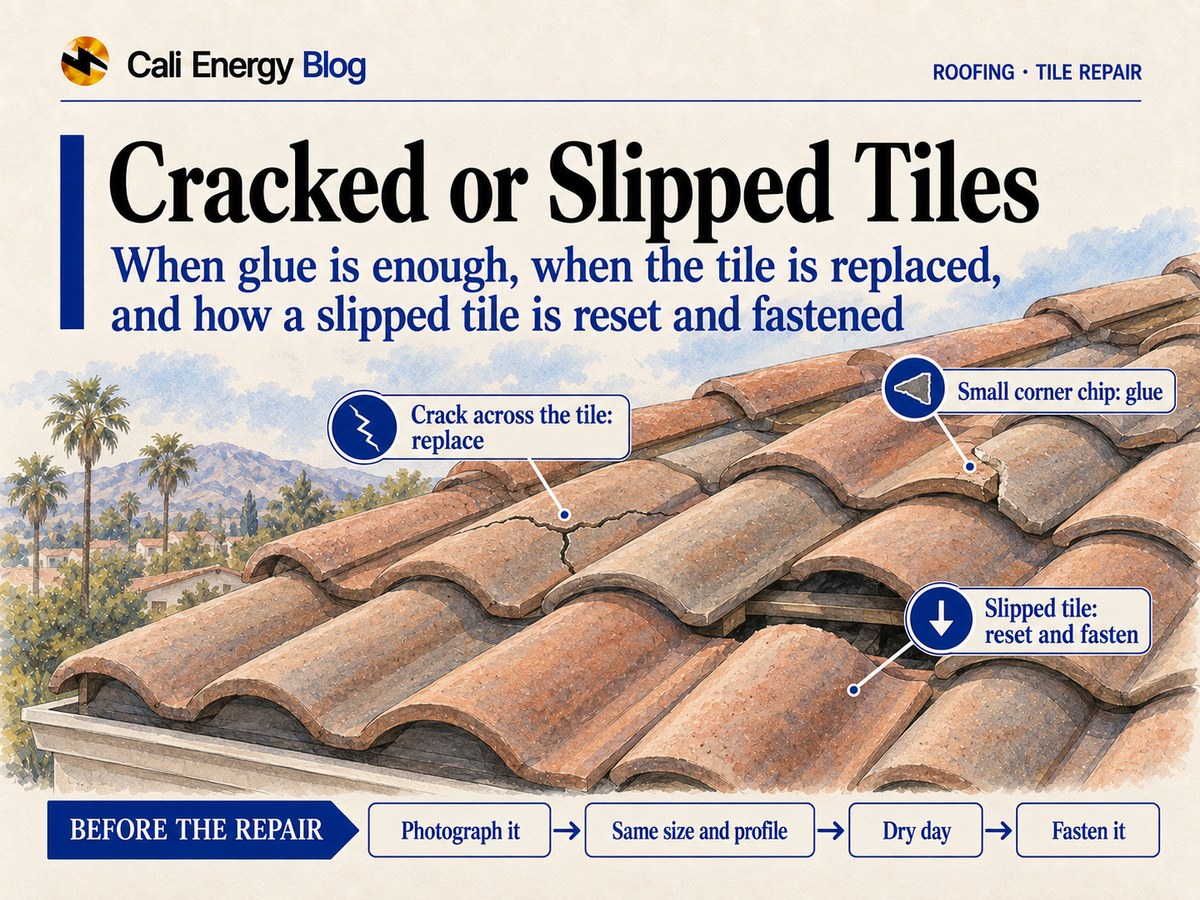
This page is about individual cracked, broken and slipped tiles. If the roof leaks while the tiles look fine, the problem is usually underneath: see why a tile roof leaks when the tiles look fine. Whether a whole roof needs a repair, a lift-and-relay or new tile is decided in tile roof: repair, lift-and-relay or replacement. What to check after an earthquake, and how the code wants tile fastened, is in tile roofs and earthquakes.
Glue or replace?
The rule of thumb depends on what broke and how, and on whether something else is holding water against the tile.
| Damage | What the sources say | The repair |
|---|---|---|
| A small corner broken off, about 1 to 2 inches | A concrete-compatible adhesive may be used; adhesive or wire holds small pieces | Glue the piece back, or replace the tile |
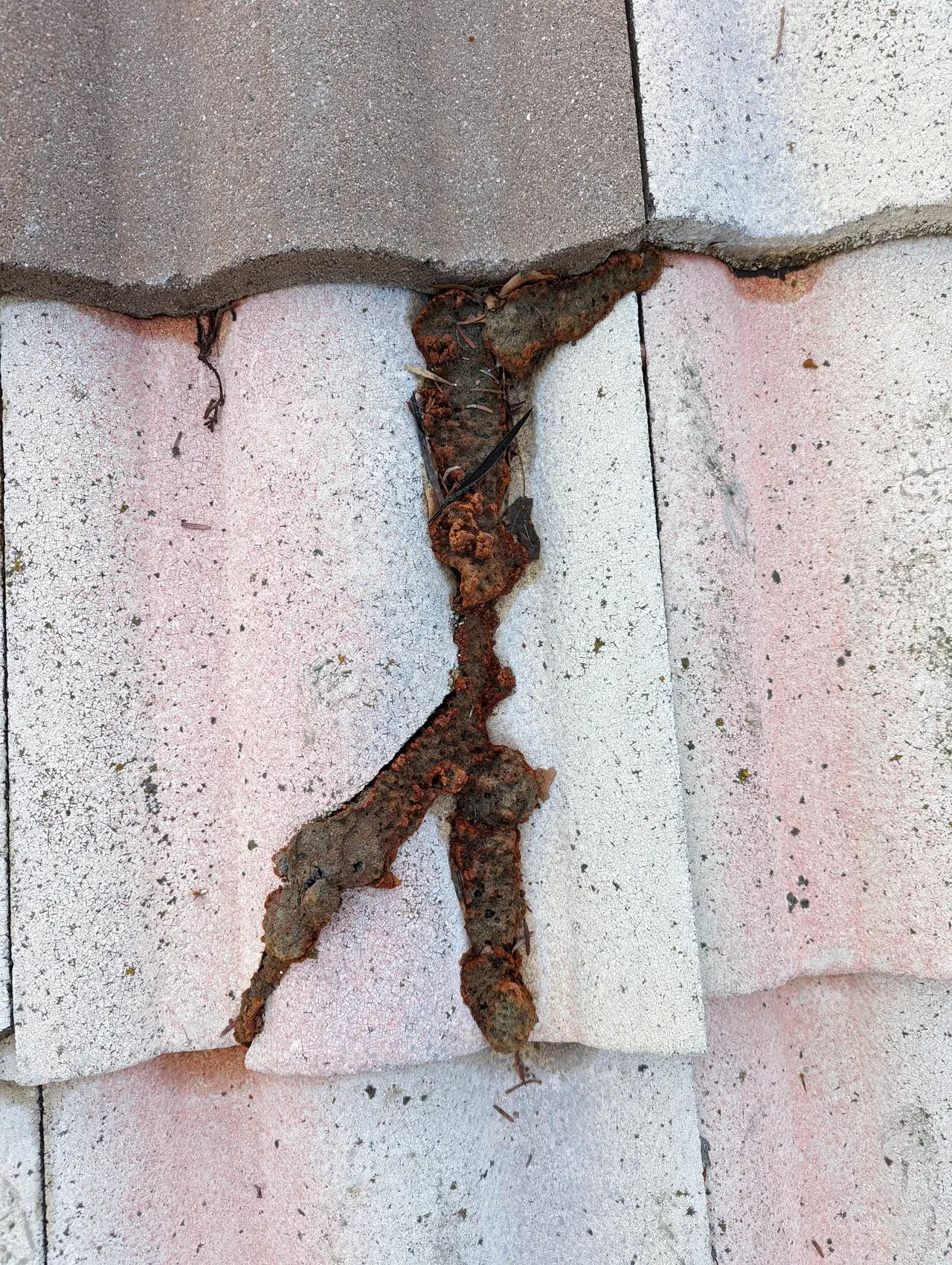
| A crack or break across the full width or length of the tile, from a load or an impact | Adhesive isn't recommended | Replace the tile |
| A tile that has slipped down out of its course, otherwise whole | TRI's nose clips hold a tile's lower end against uplift and sliding | Slide it back into place and fasten it |
| Cut pieces at valleys, hips and walls coming loose | Cut pieces are secured with adhesive, wire ties, batten extensions or clips | Re-secure the piece |
| A crack covered with roofing cement, caulk or tar | Patches like these let water collect behind them | Replace the tile |
When in doubt, replace. Tile is made to be swapped one piece at a time, and on many batten roofs only the tiles around the edges are fastened at all, so a broken tile in the field can come out by sliding the course above it, TRI notes. Under the 2025 California Residential Code, tile on battens at a slope under 5:12 doesn't need a fastener per tile; on solid sheathing without battens, every tile gets one (R905.3.8).
How a broken tile is replaced
TRI's installation manual and Eagle Roofing, a concrete tile maker, describe the same steps:
- Pick a dry day. Eagle advises against taking broken tiles off when it's raining or rain is forecast, and against removing more tiles than can be replaced that day.
- Take the broken tile out in pieces. Breaking it into smaller pieces, Eagle says, disturbs the tiles around it less. Its nails or screws are pulled or cut with a slate ripper or a hacksaw blade slipped under the tile.
- Patch the underlayment. Any holes left in the underlayment are cleaned and patched before the new tile goes in.
- Slide in the replacement. The tiles above are wedged up, and the new tile slides in under them. It has to be the same size and profile as the old ones: Eagle warns that mixing tile sizes on a roof can lead to breakage and failure.
- Secure it. The course above covers the nail holes, so the new tile is held another way: on an L- or S-shaped hook over the tile below, by 12-gauge copper wire fastened to the deck and bent over it, with a copper strip, or with a code-approved roof tile adhesive. TRI places the adhesive where it touches the neighboring tiles without blocking the water's path; on an interlocking water channel it goes above the headlap, so it can't dam water.
- Check the neighbors. The wedges come out, and the tiles around the new one have to sit properly before the job is done.
Finding a tile that matches, from current production, salvage or a blend set out of sight, is covered in matching and spares. On two-piece barrel roofs, where it's usually the covers that break, see Spanish S-tile and barrel roofs.
Slipped tiles: put back and fastened
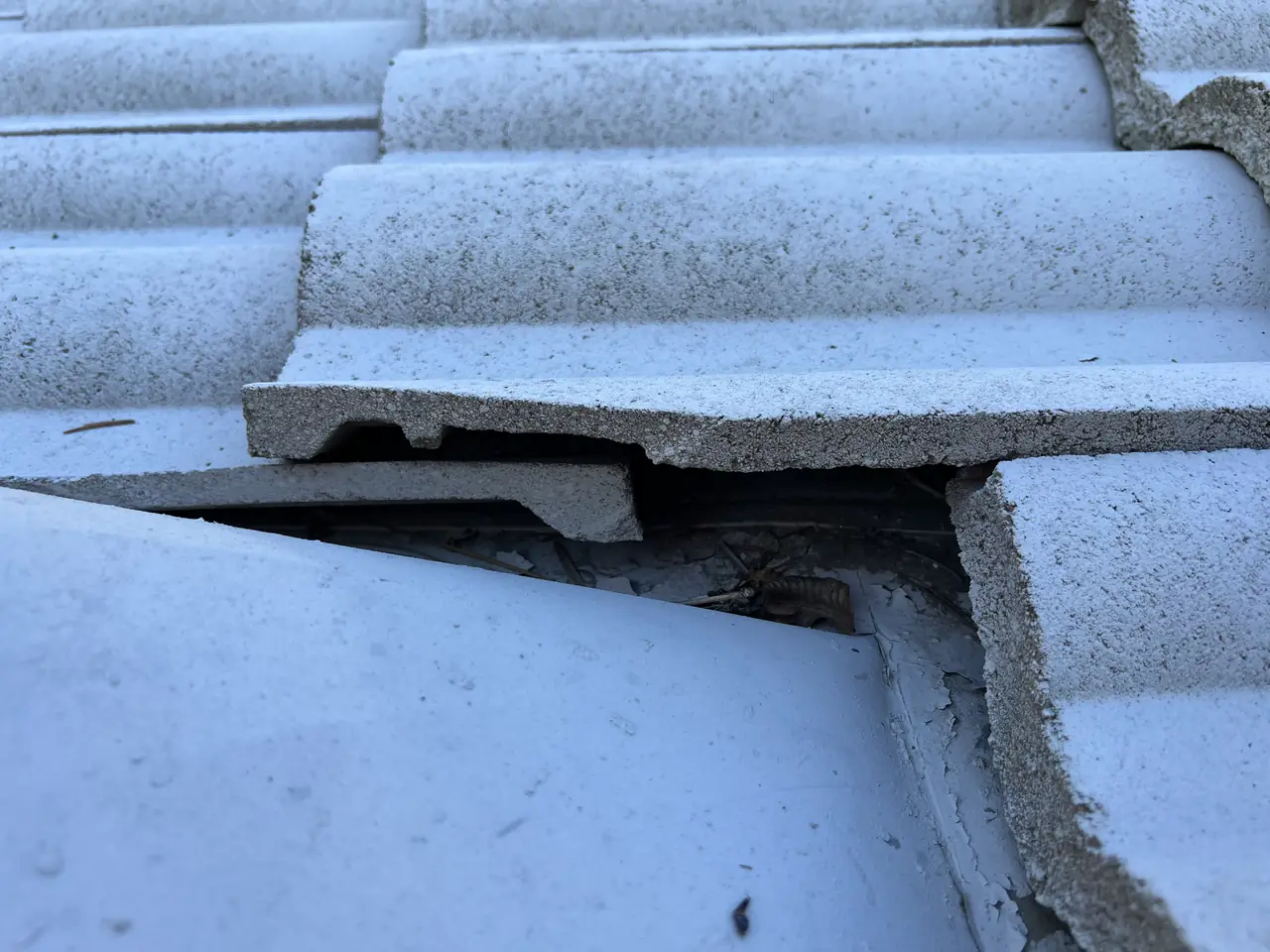
A slipped tile sits lower than its neighbors, breaks the line of its course and leaves a gap at its head, where water and debris can get under the tiles. Tile often outlasts what holds it. The National Park Service's guide to clay tile roofs notes that nails rust, even copper nails pull out when they weren't driven properly, and roofing battens deteriorate where clogged gutters back water up under the tile. Once the fastening fails, a tile can work its way down the slope.
The repair is to slide the tile back into its course and fasten it so it stays: with a new nail where the hole is reachable, wire, a hook, or a nose clip, a fastening device TRI describes as holding the lower end of the tile against uplift or sliding down the slope. Cut pieces along valleys, hips and walls need their own fastening: TRI calls for adhesive, wire ties, batten extensions or a cut-tile clip. In earthquake country, NPS notes, every tile may be secured with both a nail and a clip, often with a dab of mastic or mortar as well.
One slipped tile is a repair. Many slipped tiles across a slope point to the fastenings or the battens giving out, and that's a lift-and-relay with new fastening, not a string of spot repairs.
Don't make it worse
- Stay off the tile. Eagle names foot traffic done wrong and severe impacts as causes of cracks and breaks. TRI's rule for anyone who must walk on tile is to step only on the lower 3 to 4 inches of each tile, where it rests on the one below; Spanish S-tile and barrel roofs covers how roofers spread their weight.
- Don't glue a cracked tile back together. Adhesive is for a small broken corner. Over a crack, roofing cement, caulk or tar is a patch, and NPS notes that water can collect behind patches like these, speeding the decay of the sheathing and fastenings underneath.
- Photograph before anyone goes up. Before a solar crew, a painter or an HVAC tech works on a tile roof, photograph the tiles that are already cracked. On a Northridge job of ours, every cracked tile was photographed and marked before anything was lifted, so the damage that was already there and anything broken during the work stayed two separate lists.
- Keep spares. A few tiles from the original order, kept in the garage, make the next repair simple; NPS suggests ordering extras for exactly this.
If water is already coming in during a storm, see what to do when the roof leaks in a storm first.
Los Angeles rules for a tile repair
- The permit. In the City of Los Angeles, work valued at $2,500 or less may be exempt from a permit under LABC 91.106.2, unless it affects the building's structural stability or public safety, is done under a Department order or changes the use. A tile repair that reaches the deck or the framing is the case to raise with LADBS first; do you need a permit covers the routes, including the express permit for a lift-and-relay.
- Fire zones. In a High or Very High Fire Hazard Severity Zone, LADBS applies the wildland-urban interface code, under which any covering added in a repair has to be at least Class A, so ask the roofer to confirm the replacement tile's rating. The rules for the eaves, hips and ridges are in California's WUI roofing requirements.
- High Wind Velocity Areas. In the parts of the San Fernando Valley that LADBS bulletin P/BC 2026-016 lists as High Wind Velocity Areas, tile along the eaves, hips, ridges and rakes is nailed with 11-gauge nails or approved ties and also bonded with roofer's mastic, and every field tile is attached.
- Reusing tile. When tiles come off for a relay, cracked or broken ones can't go back on (CRC R908.5).
Frequently asked
Can I glue a cracked roof tile?
Does a cracked tile mean my roof is leaking?
Why do roof tiles slip?
Can I replace a broken tile myself?
What if I can't find a matching tile?
Do I need a permit to replace a few tiles in Los Angeles?
Related reading
Sources & methodology
Code sections, rules and figures on this page come from the primary sources below. Codes, local requirements and product terms change; each was verified October 8, 2026.
- Tile Roofing Industry Alliance, Concrete and Clay Roof Tile Installation Manual, 2024 edition (Uniform ES ER-2015, revised May 2025): tile repair…
- Ask a TRI Alliance Expert: Cracked Tiles (Eagle Roofing, September 2016)
- Eagle Roofing, How to Properly Replace Damaged Concrete Roof Tiles (April 2019)
- Eagle Roofing, Replacing Roof Tiles (July 2017)
- National Park Service, Preservation Brief 30: The Preservation and Repair of Historic Clay Tile Roofs (1992)
- California Residential Code 2025, Chapter 9: R905.3.8 and R908.5 (UpCodes)
- LADBS, Dwellings in High Wind Velocity Areas (HWA), Information Bulletin P/BC 2026-016, effective January 1, 2026, revised April 24, 2026
- Los Angeles Building Code 2026, Chapter 1, Administration: 91.106.2 (UpCodes)
We'll replace the broken tiles and find out why they broke
Call (323) 844-7777. We photograph the damage before we touch anything, replace cracked tile with tile of the same size and profile, and reset and fasten slipped tile. Have ready the address, a few photos from the ground and, if you have them, spare tiles left over from when the roof was laid. Some breakage when tile is lifted is normal, and we plan for it. If the underlayment under the broken tile has failed, that's a bigger job, and we'll say so.
Prepared by Cali Energy, October 8, 2026. This article is for general educational purposes only and is not legal, tax, financial, engineering, or utility advice. Rates, incentives, codes, permit requirements, equipment specifications, prices, and program terms may change; figures and timelines are estimates, not guarantees. Confirm current requirements with the applicable utility, AHJ, program administrator, manufacturer, or a licensed professional. See our Content Disclaimer. Cali Energy · 19201 Parthenia St, Unit E, Northridge, CA 91324 · CSLB #1032379 (B, C-10, C-39)