

Clay vs Concrete Roof Tile: What's the Difference?
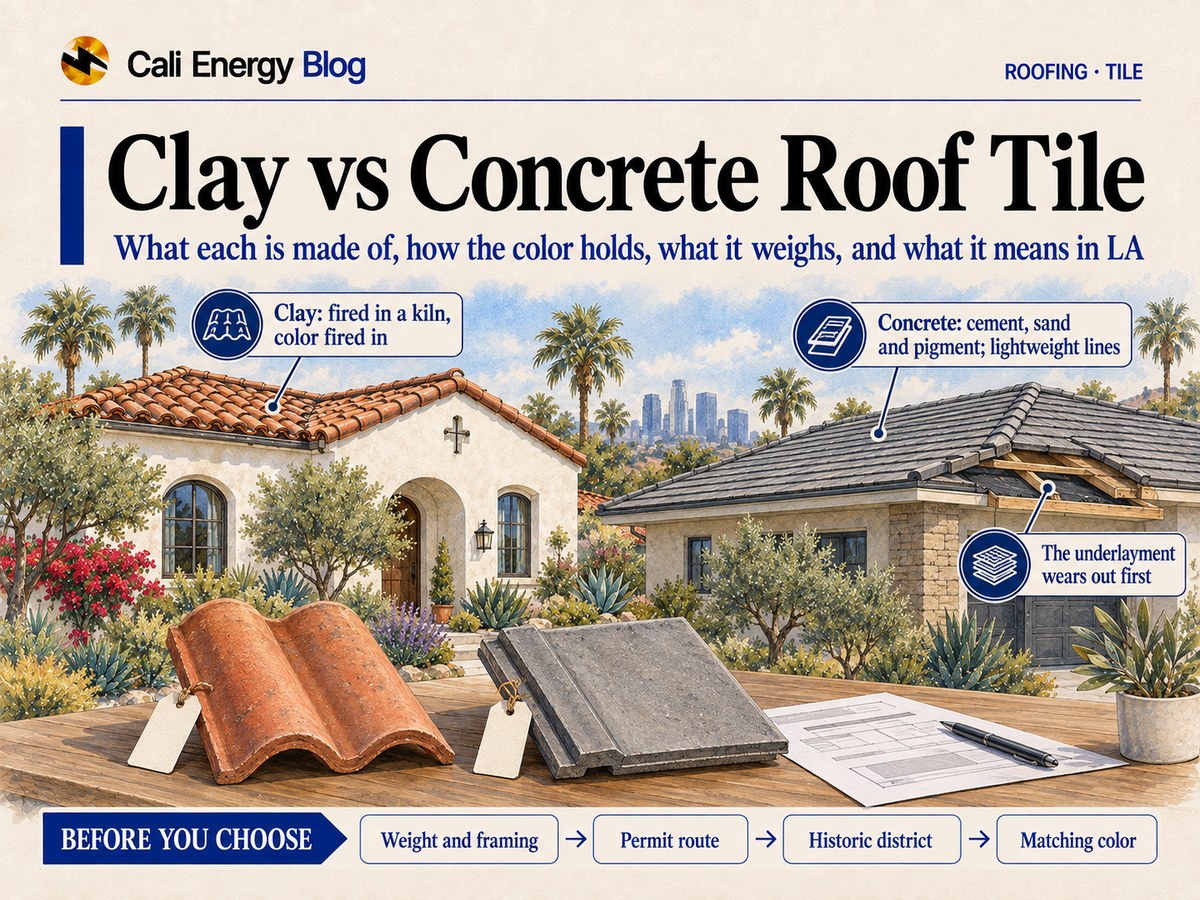
Clay tile is natural clay or shale fired in a kiln; concrete tile is portland cement, sand and aggregate, colored with pigment and pressed into shape. On a roof they can look alike, and both are made to their own standards under the same tile section of California's residential code. The differences that matter: clay's color is fired in and holds, while the National Park Service notes that concrete tends to lack clay's color permanence and subtle variation; weight depends more on the profile than on the material, and of the tiles compared here only concrete comes in a lightweight line; and the tile of either kind usually outlasts the underlayment beneath it, which is what a tile roof's life really hangs on. In Los Angeles, weight also decides how the re-roof is permitted, and in a historic district the plan may require clay to be replaced with clay.
How they compare
The table sets the two side by side, with weights from two makers that sell both flat and S-shaped profiles in California.
| Clay tile | Concrete tile | |
|---|---|---|
| What it's made of | Clay, shale or similar natural material, fired at high temperature (TRI Alliance) | Portland cement and other cementitious materials, sand and aggregates (TRI Alliance), with pigment (National Park Service) |
| Standard required by the code | ASTM C1167 (CRC 2025, R905.3.4) | ASTM C1492 (CRC 2025, R905.3.5) |
| Color | Fired into the tile, or glazed | Pigmented; tends to lack clay's color permanence (National Park Service) |
| Surface changes | Can lighten somewhat with weathering (TRI Alliance) | Can lighten; may also show efflorescence, a temporary white bloom common to concrete tile (TRI Alliance) |
| Flat profile, weight per square | 879 lb (MCA MF108 Flat) | 970 lb standard, 720 lb lightweight (Eagle flat profiles) |
| S-tile, weight per square | 788 lb (MCA One Piece "S" Mission) | 900 lb standard, 570 lb lightweight (Eagle Capistrano) |
| Maker's warranty, example | 50-year limited (MCA), replacement tiles only | Limited lifetime (Eagle), transferable if registered within 18 months |
A square is 100 square feet of roof, so 900 pounds per square is 9 pounds per square foot. Eagle sells its lightweight Eaglelite tile in California and the Southwest; other makers and profiles weigh differently, so the figure that counts is the one for the exact tile on your estimate.
Color and how it ages
Clay is colored by the clay itself and the firing, or by a glaze fused onto it in the kiln. Concrete is colored with pigment in the mix, and the National Park Service's guidance on historic clay roofs notes that concrete tends to lack the color permanence and the subtle color variations of natural clay. A figure caption in the same brief adds that concrete tiles are generally thicker than clay and tend to fade. The tile industry's installation manual adds two things owners notice on concrete: efflorescence, a white, chalky bloom from the lime in cement, which it describes as temporary, harmless to the tile and usually washed off by rain over time; and slight color shading from natural variation in the sand, cement and color oxides, which is why tiles are spread across the whole roof as they're loaded rather than laid from one stack. Both kinds can lighten somewhat with long exposure without losing their ability to shed water.
Matching matters when tiles break. On our 2026 Canoga Park job, a 26-square roof of flat concrete tile, the replacement tile, ridge and rake pieces were ordered with the color matched from physical samples, not from a brochure (the Canoga Park case).
Weight, the framing and the permit
The figures in the table show that the shape of the tile drives its weight as much as the material: a clay flat tile can weigh less than a standard concrete flat tile, while two-piece clay barrel, at 1,008 pounds per square for MCA's Classic Tapered Mission, is heavier than any of them. What concrete offers here that clay doesn't is a lightweight line.
That matters in two ways. The roof structure has to carry whatever goes on it (CRC 2025, R908.2), so moving to a heavier covering, such as from shingles or lightweight concrete to clay barrel, means showing the framing can carry more; see the framing section of the best roofing materials for Southern California. Going the other way, off tile altogether, is covered in replacing a tile roof with something lighter. And in the City of Los Angeles, the express re-roof permit, issued without plan check, covers a Class A or B covering weighing less than 6 pounds per square foot. By the makers' figures above, only Eagle's lightweight S-tile, at about 5.7 pounds per square foot, comes in under that line; the other tiles here run from about 7.2 to 10.1 pounds, which takes a new tile roof off the express list, so expect plan check and confirm the route with LADBS before the job is priced. A lift-and-relay that reuses the existing tile is on the list, as the LADBS permit guide explains.
How long each lasts
The tile itself isn't usually what fails. The National Park Service puts clay tile among the longest-lived roofing materials, generally about 100 years, and published planning tables give clay and concrete tile 40 to 60 years or a lifetime; the comparison is in roof lifespan by material. What wears out first is the underlayment under either kind, and when it fails, the tile can usually be lifted, the underlayment replaced and the same tile reset; how to tell when that time has come is in when to replace tile roof underlayment.
Frost, which the Park Service names as the main threat to clay tile itself, is all but absent near the coast and in the central Los Angeles basin. Both kinds share the other weak point: walking on them. The tile industry's manual says walking on tile should be avoided, and when it can't be, pressure should go on the lower 3 to 4 inches of the tile, where it bears on the one below.
Which to choose
- Keep what the house was built with, if it's sound. Matching color and profile is simplest within the same material, and reusing sound tile on new underlayment is often an option; see repair, relay or new tile.
- In a historic district, check the preservation plan first. Plans such as South Carthay's call for clay tile to be replaced with natural clay of a similar shape and color; see Spanish tile roof care and replacement.
- If weight is a concern, compare the exact profiles. A lightweight concrete line is the lightest tile option above; any change of material calls for a look at the framing.
- If solar is planned, the mounts go in with the new underlayment, before the tile is reset; see solar on clay and concrete tile.
Frequently asked
How can I tell clay tile from concrete tile?
Is clay tile heavier than concrete?
Does concrete tile fade?
Can I replace clay tile with concrete?
Which lasts longer?
Related reading
Sources & methodology
Code sections, rules and figures on this page come from the primary sources below. Codes, local requirements and product terms change; each was verified October 7, 2026.
- Tile Roofing Industry Alliance, Concrete and Clay Roof Tile Installation Manual, 2024 edition (Uniform ES ER-2015, revised May 2025)
- National Park Service, Preservation Brief 30: The Preservation and Repair of Historic Clay Tile Roofs (Anne E. Grimmer and Paul K. Williams, 1992)
- California Residential Code 2025, Chapter 9 Roof Assemblies, R905.3 (UpCodes)
- Eagle Roofing, Technical Specifications
- Eagle Roofing Products, Transferable Limited Lifetime Product and Limited 10 Year Replacement Cost Warranty, revised March 4, 2025
- MCA Clay Tile, MF108 Interlocking Flat (specifications)
- MCA Clay Tile, One Piece "S" Mission (specifications)
- MCA Clay Tile, Classic Tapered Mission (specifications)
- Maruhachi Ceramics of America (MCA), 50-Year Limited Warranty (sample)
We'll tell you what your tile is and what it takes to keep it
Call (323) 844-7777. We identify the tile on your roof, check the underlayment beneath it and tell you whether it can be reset, matched or needs replacing. Have ready the address, a photo of the roof, and any spare tiles left from the original job.
Prepared by Cali Energy, October 7, 2026. This article is for general educational purposes only and is not legal, tax, financial, engineering, or utility advice. Rates, incentives, codes, permit requirements, equipment specifications, prices, and program terms may change; figures and timelines are estimates, not guarantees. Confirm current requirements with the applicable utility, AHJ, program administrator, manufacturer, or a licensed professional. See our Content Disclaimer. Cali Energy · 19201 Parthenia St, Unit E, Northridge, CA 91324 · CSLB #1032379 (B, C-10, C-39)