

Roofing Over Old Shingles vs. Tear-Off in California
Once, and only over a sound roof. California's residential code allows a new roof covering over an existing one when the new covering's manufacturer allows it, but not over a roof that's water-soaked or has deteriorated to the point it isn't an adequate base, not over slate, clay, cement or asbestos-cement tile, and not where the roof already has two or more layers (CRC 2025, R908.4); the City of Los Angeles's residential code repeats that section word for word. A replacement removes the existing layers of roof covering down to the deck (R908.3). Whether an overlay makes sense is a separate question: it leaves the deck and the old underlayment out of sight, adds weight, can rule out a shingle maker's top warranty, and means the next re-roof has to take off both layers. This page is about pitched roofs with shingles; flat roofs are covered in flat roof repair, coating or replacement.
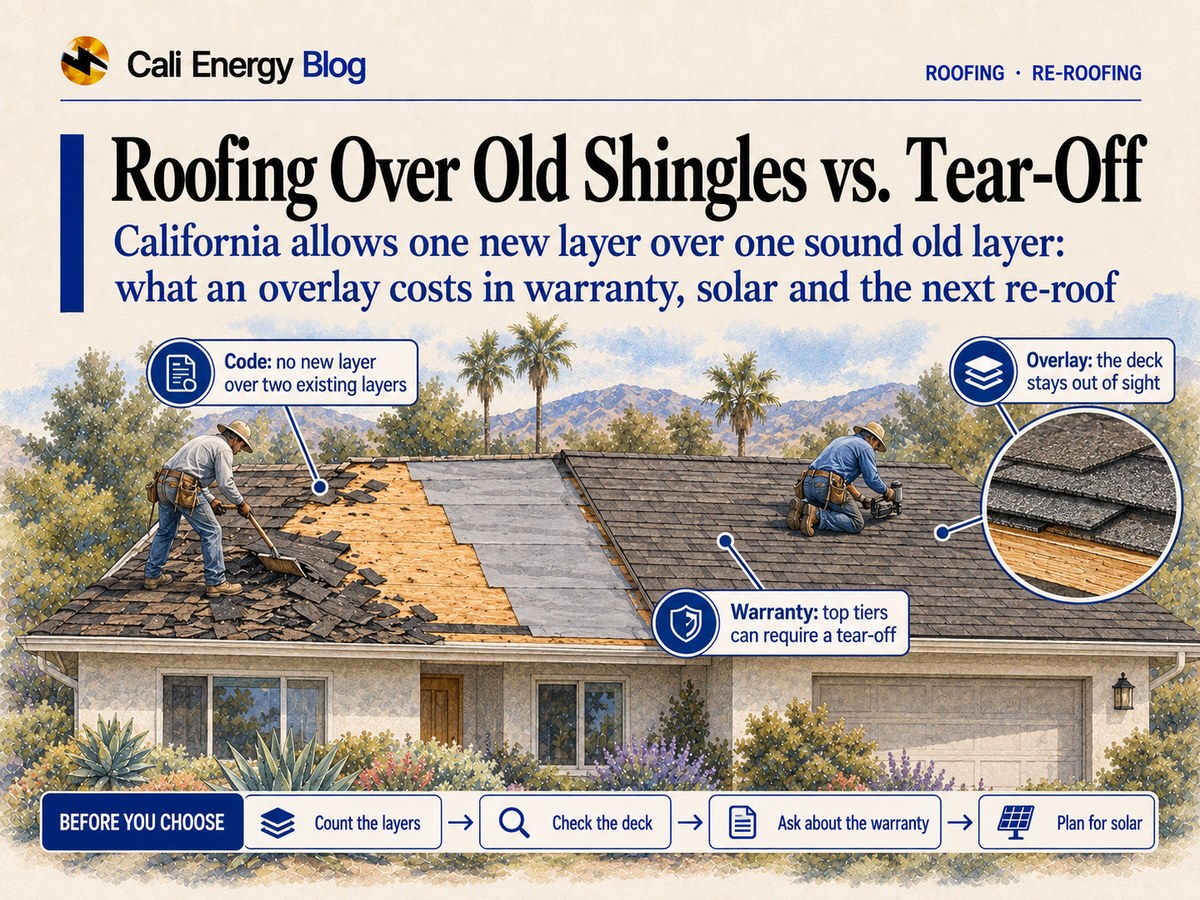
What California's code allows over an existing roof
The rules are in Section R908 of the 2025 California Residential Code, in effect since January 1, 2026.
| Existing roof | A new layer on top? | Section |
|---|---|---|
| One layer of asphalt shingles, dry and sound | Allowed where the new covering's manufacturer allows it | R908.4 |
| Two or more layers of any kind | Not allowed; the re-roof becomes a tear-off to the deck | R908.4, R908.3 |
| Water-soaked, or deteriorated so it isn't an adequate base | Not allowed | R908.4 |
| Slate, clay, cement or asbestos-cement tile | Not allowed | R908.4 |
| Wood shingles or shakes | Only metal panels, metal shingles, or concrete or clay tile, with the old surface covered first where a concealed combustible space is created | R908.4, R908.4.1 |
| Metal, roll roofing, built-up, modified bitumen, single-ply or spray foam | A new protective coating can go on without a tear-off | R908.4 |
Two more lines in the same section apply to any re-roof. The structure has to carry the roof covering and the loads of installing it (R908.2), and existing flashings, edgings, vents and similar parts are replaced where they're rusted, damaged or deteriorated (R908.5). A separate standing-seam metal system that carries its loads to the framing rather than resting on the old roof doesn't require removing the old covering (R908.4). In the City of Los Angeles, no wood shake or wood shingle roof covering is allowed anywhere (LABC 2026, 91.1505.1); what can replace one is in replacing a wood shake roof in Los Angeles. The rest of what the code asks of a re-roof is in California re-roof code requirements.
What the shingle makers say
The code defers to the new shingle's manufacturer, and the industry's own manual is cautious. The Asphalt Roofing Manufacturers Association's residential manual (2014 edition) says three-tab shingles and roll roofing can generally be left in place, but that most manufacturers don't recommend installing over laminated shingles: laminated over laminated is uneven enough that the new shingles may not seal properly, while laminated over three-tab is acceptable. The same chapter says shingles curled or weathered too badly to give a level surface, holes, and depressions or sagging that point to structural trouble mean the old roof comes off, and that tile, slate, wood shingles and shakes are removed down to the deck before asphalt shingles go on. The differences between the two shingle types are in architectural vs. 3-tab shingles.
Warranties are where an overlay can cost the most. Owens Corning's System Protection, Preferred Protection and Platinum Protection warranties (August 2026 editions) require the roof to go over a clean deck with all existing roofing removed, including the felt, ice-and-water membrane, raised nails and the old flashing at chimneys, skylights, pipe boots and vents. CertainTeed's 15-year wind warranty of up to 160 mph on the shingles it lists, including its Landmark line, applies only if they aren't applied over existing roof shingles; its sell sheet says roof-overs aren't permitted. Before agreeing to an overlay, ask which warranty the new roof will carry and whether that warranty allows one; how the tiers differ is in roofing warranties explained.
What an overlay leaves unseen
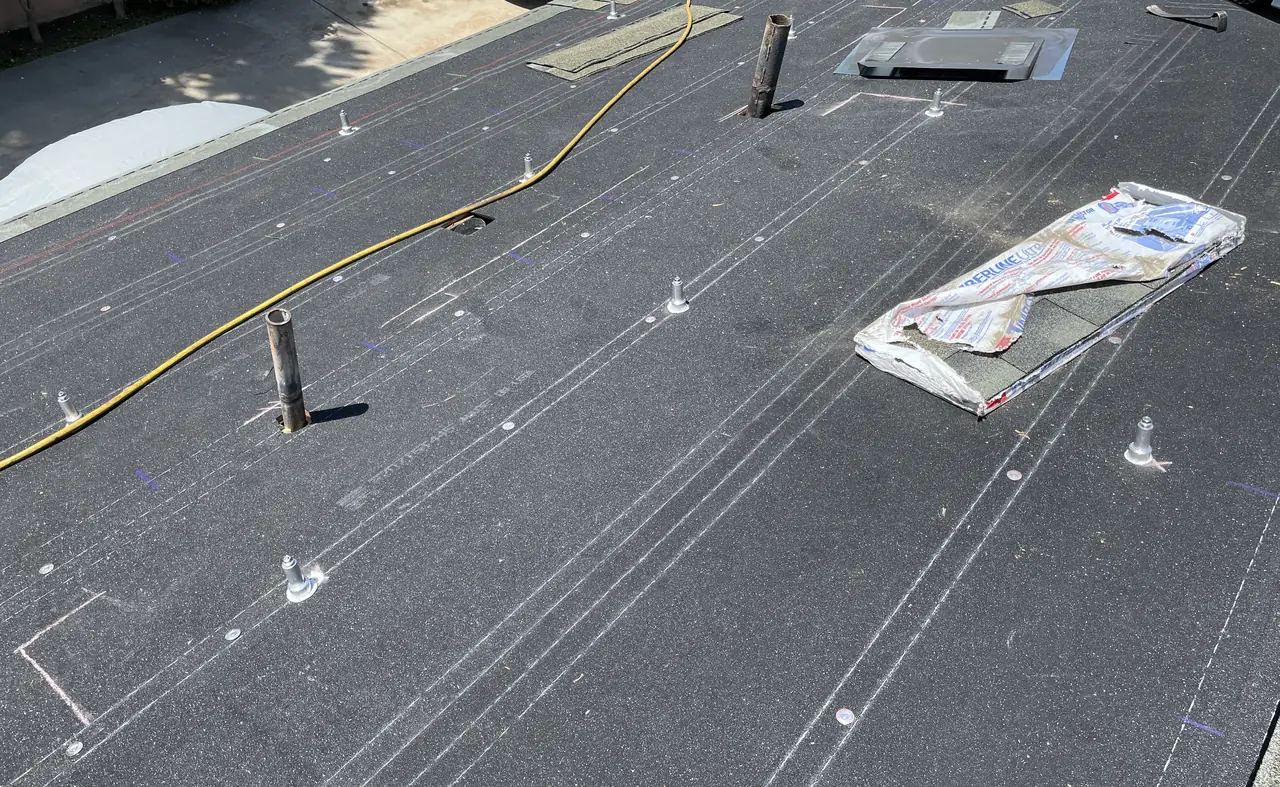
A tear-off is the one time the deck is open. On a Woodland Hills house we re-roofed in 2023 ahead of solar, the full tear-off put new synthetic underlayment, step flashing, a starter strip, ridge cap and four low-profile vents over about 1,600 square feet of deck (the Woodland Hills case). An overlay keeps the old shingles as the base for the new ones, so the questions a tear-off answers stay open:
- The deck. Damaged sheathing, at the eaves or under an old leak, often isn't known until the old roof comes off; how to find its edges is in dry rot in fascia, eaves and roof sheathing, and how a contract handles it is in rotted roof decking and the change order.
- The underlayment. A tear-off replaces it; an overlay leaves the old one under the old shingles.
- The weight. The second layer stays on the framing, which has to carry it along with the materials and equipment of the job (R908.2). If the roof already sags, start with why a roof sags.
- The edges and valleys. Worn drip edges, vents and flashing still have to be replaced (R908.5), and ARMA's manual has open valleys built up level with the old roofing before the new layer goes on.
Solar and the next re-roof
An overlay also decides the next re-roof. With two layers on, the code allows no third (R908.4), so the next roof is a tear-off of both, and any panels installed in between come off first. On a 2025 Agoura Hills job, our site inspection found two layers of shingles, a newer layer laid over the original, with roughly five to six years of life left; with solar and a battery planned, we re-quoted with a re-roof first, and the re-roof passed its final inspection on September 2, 2025 (the Agoura Hills case). On a 2021 Long Beach house re-roofed in the same project as its solar, the open deck let the array's flashed mounting feet go on before the new shingles were laid over them (the Long Beach case). When to replace a roof before panels go on is covered in replace your roof before installing solar?
Permits and the cool-roof rule
An overlay is a re-roof, and some cities write the layer limit into the permit itself. Long Beach's express re-roof permit covers composition shingles installed over solid sheathing or over no more than one existing layer of composition shingles that was installed over solid sheathing, at 6 pounds per square foot or less (Information Bulletin IB-058, revised July 9, 2025). How permits work city by city is in re-roof permits across Los Angeles County, and in the City of Los Angeles in roof permits with LADBS.
The Energy Code counts an overlay too. Its rule for replacing the surface of an existing roof includes adding a new surface layer on top of the old one; where more than half the roof is being replaced, new steep-slope roofing in climate zones 4 and 8 through 15 needs an aged solar reflectance of at least 0.20 and a thermal emittance of at least 0.75, or an SRI of at least 16, unless an exception applies (2025 Energy Code, Section 150.2(b)1I). Which zones and colors qualify is in the cool-roof rule you meet when you re-roof.
How to tell what's on your roof now
Ask the roofer to count the layers at the roof's edge or under a lifted shingle, to photograph them, and to look at the deck from the attic. The permit history can show an earlier re-roof: in the City of Los Angeles, the building department's records show when a re-roof permit was issued and finaled, as covered in checking a re-roof permit. A quote should then say which it is, a tear-off to the deck or a layer over the existing roof; the lines a roofing scope should name are in hidden costs in a roofing quote.
Frequently asked
How many layers of shingles are allowed in California?
Can architectural shingles go over 3-tab shingles?
Is an overlay cheaper than a tear-off?
Can a new roof go over wood shakes?
Can a new roof go over old tile?
Related reading
Sources & methodology
Code sections, rules and figures on this page come from the primary sources below. Codes, local requirements and product terms change; each was verified October 8, 2026.
- California Residential Code 2025, Chapter 9, Roof Assemblies, sections R908.2–R908.5 (UpCodes)
- Los Angeles City Residential Code 2026, Chapter 9, Roof Assemblies, section R908.4 (UpCodes)
- Los Angeles Building Code 2026, Chapter 15, 91.1505.1 (UpCodes)
- Asphalt Roofing Manufacturers Association, Residential Asphalt Roofing Manual: Design and Application Methods, 2014 edition (Chapter 13, Reroofing)
- Owens Corning, System Protection Limited Lifetime Warranty, Pub. No. 10020610-P, August 2026
- Owens Corning, Preferred Protection Limited Lifetime Warranty, Pub. No. 10020609-P, August 2026
- Owens Corning, Platinum Protection Limited Lifetime Warranty, Pub. No. 10020608-O, August 2026
- CertainTeed, Wind Warranty sell sheet (04/26)
- City of Long Beach, Information Bulletin IB-058, Express Permit Service, revised July 9, 2025
- California Energy Commission, 2025 Building Energy Efficiency Standards (Title 24, Part 6), CEC-400-2025-010, Section 150.2(b)1I
We check what's under your roof before you choose
Call (323) 844-7777. We count the layers, look at the deck from the attic and at the roof's edges, photograph what we find, and tell you in writing whether an overlay is allowed on your roof and what a tear-off would replace. Have ready the roof's age and any papers from the last re-roof.
Prepared by Cali Energy, October 8, 2026. This article is for general educational purposes only and is not legal, tax, financial, engineering, or utility advice. Rates, incentives, codes, permit requirements, equipment specifications, prices, and program terms may change; figures and timelines are estimates, not guarantees. Confirm current requirements with the applicable utility, AHJ, program administrator, manufacturer, or a licensed professional. See our Content Disclaimer. Cali Energy · 19201 Parthenia St, Unit E, Northridge, CA 91324 · CSLB #1032379 (B, C-10, C-39)