

Dry Rot in Fascia, Eaves and Roof Sheathing
Find where the water comes from, cut out the wood that has lost its strength, and keep the rest dry. "Dry rot" is a misleading name: the U.S. Forest Products Laboratory explains that serious decay happens only when wood gets wet enough, above about 30% moisture, from rain, condensation or wet ground, and that wood kept air dry, at 20% or less, doesn't decay, and decay already in it stops progressing. At the roof edge, the water typically comes from runoff the roof doesn't throw clear of the wood: a missing drip edge, an overflowing gutter, a leak at the eave or a painted joint that has opened. How far the decay goes is found by probing the wood, and under the roofing, often only once the covering is off. In Southern California, not every damaged board is rot; drywood termites don't need wet wood, and they leave six-sided pellets.
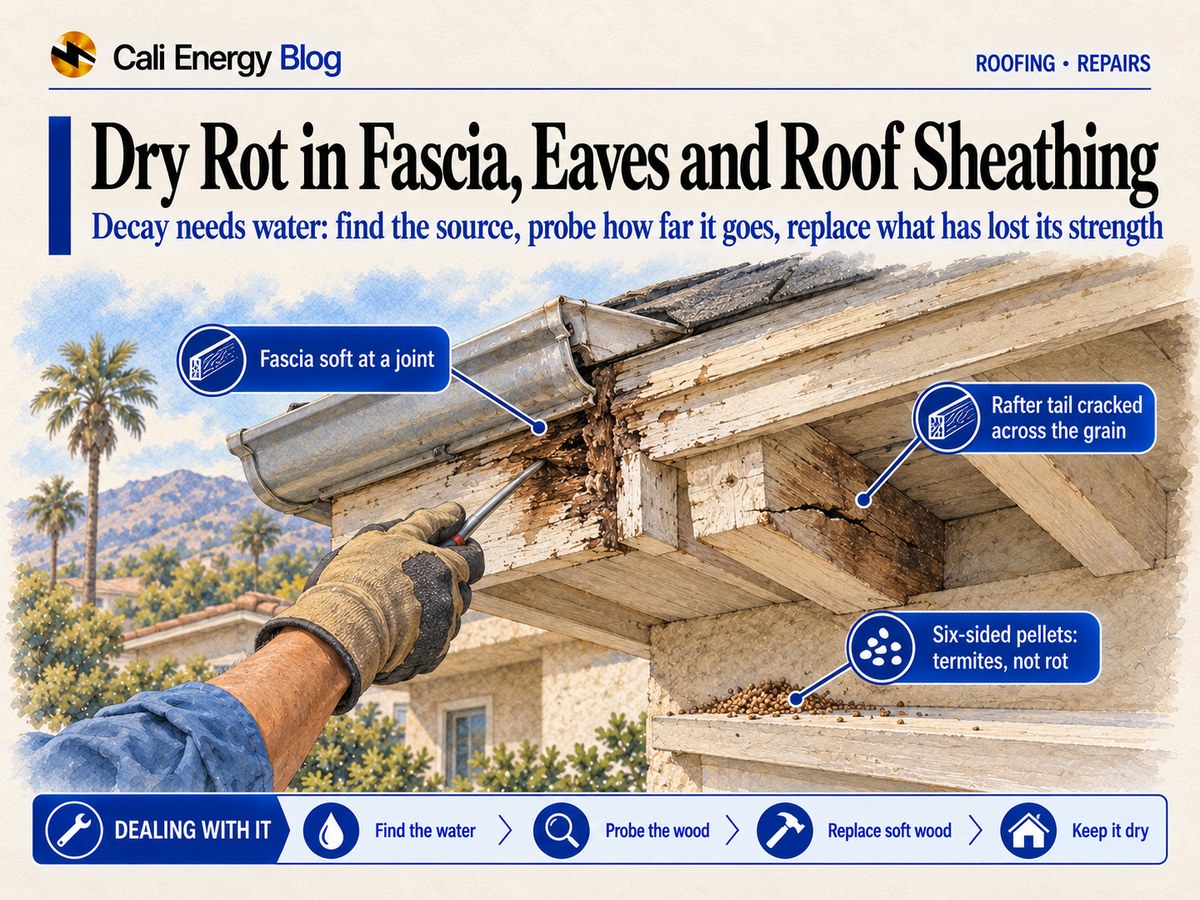
Where roof-edge rot comes from
The Forest Products Laboratory's guide to protecting wood buildings puts roof edges at the top of its list: the greatest danger from rain seepage is to roof edges, porches and exposed structural members, and one of its examples is sheathing that decayed at the roof edge because it had no metal flashing. The usual sources at a Los Angeles roof edge:
- No drip edge, or one that's too short. California's code now requires a drip edge at the eaves and rakes of a shingle roof, reaching at least 1/4 inch below the sheathing and 2 inches back onto the deck, with the underlayment over it at the eaves and under it at the rakes (CRC R905.2.8.5). An older roof may have none, so water runs down the face of the fascia or wicks into the sheathing edge.
- Gutters. A clogged gutter overflows at the eave, and a downspout from an upper roof that empties onto a lower one, which the asphalt roofing industry's manual says should never happen, keeps one stretch of edge wet; how to keep them running is in preparing a roof for the rainy season.
- Leaks at the eave. A failed flashing where a roof meets a wall, a valley that overflows, or worn underlayment near the edge sends water down into the eave framing.
- Open joints in paint. The laboratory notes that a painted joint rarely stays tight, that water gets in through hairline checks in the paint, and that end grain, where boards butt together, soaks it up fastest.
Finding how far it goes
Early decay is hard to see, the Forest Products Laboratory notes, so the soft spot you can see may not be all of it.
| What you find | What it points to | What to do |
|---|---|---|
| Fascia that's soft, swollen or peeling at a joint or below a gutter end | Water running down or soaking in at that spot | Probe along the board both ways until the wood is firm |
| Rafter tails or eave boards that are dark, cracked across the grain or crumbly | Brown rot, the kind usually called dry rot | Probe each tail; look at the sheathing above from the attic or the eave |
| Stains or soft spots on the underside of the eave sheathing | Water getting under the roofing at the edge | Check the drip edge and underlayment above; expect more under the roofing |
| A sag or soft spot in the roof near the edge | Decayed sheathing under the covering | Only a roofer opening that section shows the extent |
| Small piles of tiny six-sided pellets under the wood, or holes smaller than 2 mm | Drywood termites, not rot | A licensed pest control professional |
The laboratory's simple check is the pick test, most reliable on wet wood: jab an ice pick, small chisel or sharpened screwdriver a short way into the wood and pry out a sliver. Sound wood comes out as a long sliver that splinters; decayed wood lifts in short pieces that break straight across the grain. Under the roofing, a probe can't reach, and rot in the deck often shows only once the old covering is off, which is why a quote should say how replaced wood will be counted, as covered in rotted roof decking and your estimate.
Rot or termites?
In California, drywood termites are the other common cause of damaged wood at the eaves. UC's Integrated Pest Management program says the western drywood termite is common along the Pacific coast and into the deserts of Southern California, lives deep inside wood without needing soil or wet wood, unlike dampwood termites, and pushes out fecal pellets with six flat sides through holes smaller than 2 millimeters. Pellets alone don't show whether an infestation is still active or how far it goes, and UC IPM recommends a pest control professional rather than do-it-yourself treatment. A board can have both; the rot is repaired by replacing wood and stopping the water, the termites by a pest control company. Gnawed edges and holes at the eaves point to rodents instead, covered in roof rats and the roof openings they use.
What gets replaced
- Fascia. Rotted sections are cut back to sound wood and replaced. Before new fascia goes up, fix whatever wetted the old one: the drip edge, the gutter or the leak.
- Rafter tails. A decayed tail is cut back and repaired or replaced depending on how far the decay reaches toward the wall; that's a carpentry judgment made once the tail is opened up.
- Eave and roof sheathing. Decayed sheathing is cut out back to sound wood and replaced before new roofing goes on. California's code doesn't allow a new roof to be laid over an existing one that's water-soaked or has deteriorated to the point it isn't an adequate base (CRC R908.4), and a replacement removes the old layers down to the deck anyway (CRC R908.3).
- In a fire hazard severity zone. New eaves and fascia fall under the wildfire code's list of protected materials where it applies, as covered in California's WUI roofing requirements.
Once the wood is replaced and the water stopped, the rest of it stays sound: decay can't progress in wood kept air dry.
What we've seen on our jobs
On a North Hollywood house in 2023, the re-roof scope turned up rot that had to come out before the new roof went on: 170 feet of 1×4 fascia board and twelve sheets of half-inch plywood on the main house, priced when they were found (the North Hollywood case). On a Granada Hills roof in 2022, 30 squares of covering came off and the wood under the planned array was rotten; it was cut out and replaced before a single mount went down, and priced as its own line once the extent was known (the Granada Hills case).
Frequently asked
Is dry rot actually dry?
Will the rot spread if I leave it?
Can I just fill or paint over soft fascia?
How do I know if it's termites instead?
Does rot in the fascia mean the roof needs replacing?
Related reading
Sources & methodology
Code sections, rules and figures on this page come from the primary sources below. Codes, local requirements and product terms change; each was verified October 9, 2026.
- U.S. Forest Products Laboratory, Wood Handbook: Wood as an Engineering Material (FPL-GTR-282, 2021), Chapter 14, Biodeterioration of Wood
- T. C. Scheffer and A. F. Verrall, Principles for Protecting Wood Buildings from Decay, U.S. Forest Service Research Paper FPL 190 (1973)
- California Residential Code 2025, Chapter 9, Roof Assemblies (R905.2.8.5, R908.3, R908.4)
- University of California Statewide Integrated Pest Management Program, Pest Notes: Drywood Termites (January 25, 2022)
- Asphalt Roofing Manufacturers Association, Residential Asphalt Roofing Manual: Design and Application Methods, 2014 edition (Chapter 17, Roof Care…
We check how far the rot goes and stop the water that caused it
Call (323) 844-7777. We probe the fascia, rafter tails and eave sheathing, look at the roof edge, drip edge and gutters that wet them, and state the wood we replace as a quantity. Have ready photos of the soft or stained spots and of the gutters in a rain.
Prepared by Cali Energy, October 9, 2026. This article is for general educational purposes only and is not legal, tax, financial, engineering, or utility advice. Rates, incentives, codes, permit requirements, equipment specifications, prices, and program terms may change; figures and timelines are estimates, not guarantees. Confirm current requirements with the applicable utility, AHJ, program administrator, manufacturer, or a licensed professional. See our Content Disclaimer. Cali Energy · 19201 Parthenia St, Unit E, Northridge, CA 91324 · CSLB #1032379 (B, C-10, C-39)