

Solar Battery vs Generator for Backup in California
Short answer: for outages that last hours to a couple of days — a storm outage or a PSPS shutoff — a home battery that solar can refill covers the essentials automatically, quietly and with nothing to refuel. A generator is the tool for running central air or other heavy loads for days on end. Below, one house and one outage are worked through all three options using manufacturers’ spec sheets, California fuel prices and state rules.
Get a free estimate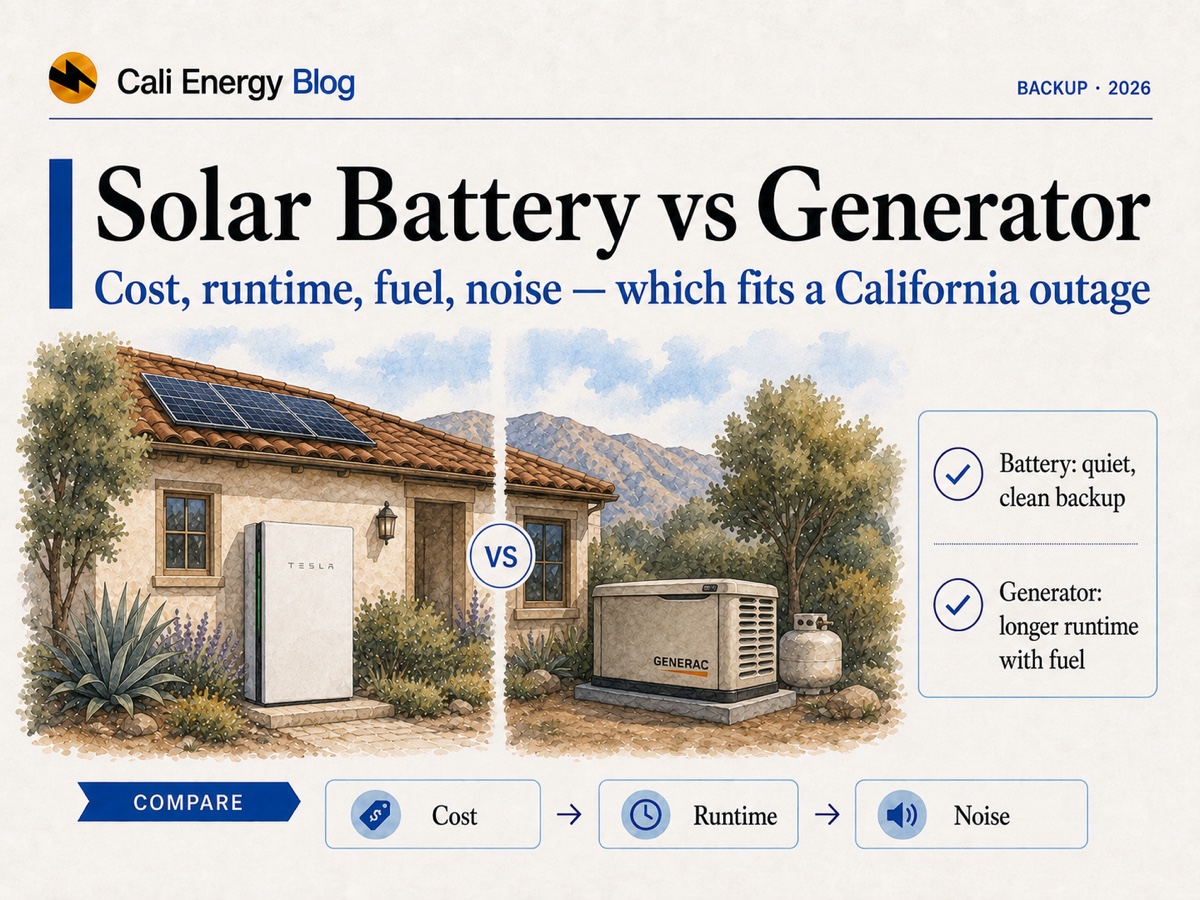
- One 13.5 kWh battery runs 7.2 kWh a day of critical loads for about 1.7 days with no sun. A solar system built to keep running off-grid refills it on sunny days — and during an outage that solar has nowhere else to go.
- A CARB-compliant 2,600 W portable generator burns up to 3.35 gallons a day at essentials loads — about $20 at the state’s $6.00 average — from a 1.2-gallon tank that lasts about 8.6 hours at quarter load.
- A 24 kW standby generator on natural gas carries central air for as long as gas flows: about 2 therms an hour at half load, roughly $3.85 an hour at SoCalGas’s September 2026 rate.
- In 2026, SGIP excludes emergency-only backup systems and its general-market battery budget is closed, while SCE (up to $800) and PG&E (up to $300, +$200 for CARE/FERA) rebate portable generators in PSPS and fire-risk areas.
The short answer
Match the tool to the outage you actually face:
- Hours to a few days, essentials only — a battery. One 13.5 kWh unit runs a fridge, lights, Wi-Fi, a furnace fan, a medical device and a small pump (about 7.2 kWh a day) for about 1.7 days with no sun, and solar refills it on every sunny day if the system is designed to run when the grid is down. That recharge costs nothing while the grid is out.
- Several days with central air or other heavy loads — a standby generator. A 24 kW unit on natural gas runs a 10.5 kW load, central air included, for as long as gas flows, at roughly $3.85 an hour. One battery lasts about an hour at that load.
- Lowest upfront cost — a portable generator, if you accept refueling, extension cords and strict carbon-monoxide precautions.
Many homes combine them: a battery for the frequent short outages and a generator for the rare long one. Whether the two can be connected depends on the battery system — see below.
| Factor | Home battery (1 × 13.5 kWh) | Portable generator (CARB-compliant) | Standby generator (24 kW) |
|---|---|---|---|
| Upfront cost | About $9,700 more than solar alone on a 5.7 kW system (LBNL’s 2024 median premium of $1.70 per watt) | $2,899 (Honda EU3200iAC, 2,600 W) to $4,999 (EU7000iSNAC, 5,500 W) list price; wiring to house circuits is extra | $8,000–$16,000 installed, generator included (Generacinstalled, generator included (Generac average)rsquo;s U.S. average) |
| Power at once | 11.5 kW continuous (Powerwall 3); 3.84 kVA per Enphase IQ Battery 5P | 2,600 W at 120 V only (EU3200iAC); 5,500 W at 120/240 V (EU7000iS) | 21 kW on natural gas, 24 kW on propane |
| Fuel during an outage | Solar, if the system can run off-grid — nothing to buy while the grid is down | Gasoline: up to 3.35 gal a day at quarter load or less — about $20 at $6.00/gal | Natural gas: 2.03 therms an hour at half load — about $3.85/hr; or propane at 2.53 gal/hr |
| What limits runtime | Stored energy: about 1.7 days at 7.2 kWh/day, 18 hours at an average home’s 16.5 kWh/day, 1.2 hours at 10.5 kW | The tank: 1.2 gal lasts 8.6 hours at quarter load, 3.3 hours at full load | Gas service — or a propane tank drawn down about 61 gal a day at half load |
| Switchover | Automatic, through the system’s backup switch or gateway | Manual; feeding house wiring requires isolating the home from the grid first | Automatic transfer switch |
| Noise | Under 30 dBA at 1 m (Enphase 5P, fanless); under 50 dB(A) typical at 1 m (Powerwall 3) | 54–58 dB(A) (Honda EU3200i) | 67 dB(A) at 23 ft under load; 57 during its 5-minute test run |
| Exhaust | None | Carbon monoxide: run it at least 20 ft from the house | Carbon monoxide, from a fixed outdoor spot |
| Upkeep | No fuel or oil | Stored fuel, oil changes, periodic runs | Automatic weekly-to-monthly exercise; oil-change interval up to 2 years or 200 hours |
| 2026 incentives | SGIP general-market budget closed; income-qualified budgets only. Federal credit ended in 2025 | SCE up to $800; PG&E up to $300 (+$200 CARE/FERA) in PSPS and fire-risk areas | The SCE and PG&E rebates are written for portable units; SGIP excludes emergency-only backup |
Sources: Tesla Powerwall 3 datasheet · Enphase IQ Battery 5P datasheet · LBNL distributed solar & storage 2025 update · Honda EU3200i · Honda EU7000iS · Generac 20/22/24 kW spec sheet · Generac installation cost · EIA California gasoline, week of Sept. 21, 2026 · SoCalGas Schedule GR, Sept. 1, 2026 · CPSC · SCE · PG&E. Prices and programs change; each was checked in September 2026.
The same outage, three ways
Comparisons often give each option its own flattering scenario. Here every column gets the same house and the same two loads: (A) critical loads of 7.2 kWh a day through a three-day shutoff — the profile our multi-day PSPS battery model uses — and (B) a hot afternoon with central air pushing the house to about 10.5 kW. Three days is a planning case, not a worst case: SCE ran 13 PSPS events in 2025, and in ten of them more than a day passed between the first and the last circuits coming back (SCE post-season report).
| Load | Battery (1 × 13.5 kWh) | Portable (Honda EU3200iAC) | Standby (Generac 24 kW, natural gas) |
|---|---|---|---|
| A. Critical loads, 7.2 kWh/day, three days | About 1.7 days with no sun. With solar that can run off-grid, even a 2.5 kW array on an average December day makes more than this load uses — $0 fuel | Up to about 10 gallons and $60 of gasoline; each 1.2-gallon tank lasts 8.6 hours or more at this load — up to eight refills | Runs all three days on utility gas. Generac publishes no light-load figure; at most the half-load rate, about $93 a day |
| B. Central air running, about 10.5 kW | About 1.2 hours per charge — and only if the battery can deliver 10.5 kW | Can’t carry it: 2,600 W rated, 120 V only | 2.03 therms an hour — about $3.85 an hour, $93 a day |
| Fuel cost per kWh delivered | $0 during the outage | $1.29 at quarter load; 84¢ at full load | 37¢ at half load; 28¢ at full load |
Method. Battery: 13.5 kWh less a 10% reserve (12.15 kWh) divided by the load; an average California home used 503 kWh a month in 2024, about 16.5 kWh a day (EIA). Portable: Honda’s 1.2-gallon tank runs 8.6 hours at quarter load (650 W) and 3.3 hours at its rated 2,600 W; a lighter load burns no more fuel per hour than the quarter-load rate. Gasoline is $6.003 a gallon, EIA’s California average for the week of September 21, 2026. Standby: Generac lists 203 ft³ of natural gas an hour at half load and 306 at full load, converted at its own 1,000 BTU per cubic foot, priced at SoCalGas’s non-baseline residential rate of 189.892¢ a therm from September 1, 2026 (baseline 142.208¢, which gives about $69 a day). Load B is set at 10.5 kW because that is the half-load point where Generac publishes fuel use. Both generator spec sheets show the pattern behind the last row: the lighter the load, the more fuel each kilowatt-hour takes. Solar recharge needs equipment built to keep running when the grid is down — a standard grid-tied system shuts off (why solar goes dark in an outage). To model your own loads, array and month, use the PSPS battery model or the battery sizing calculator.
A battery keeps working on normal days; a generator waits
On SCE’s Solar Billing Plan, a system that started in 2026 earns about 6¢ for a summer-midday export plus a 1.6¢ bonus credit, while a kilowatt-hour bought back in the 4–9 p.m. summer peak costs about 58¢ (SCE export values, Schedule NBT, SCE sample bill). Storing midday solar for the evening is how a battery earns its keep under NEM 3.0. LADWP still runs net metering, which credits exports against later use, so there a battery is mainly backup. A generator does nothing until the power goes out.
Rebates and incentives in 2026
- SGIP does not pay for generators. The 2026 SGIP Handbook lists “backup systems intended solely for emergency purposes” as ineligible equipment, and its storage incentives require a battery that runs in parallel with the grid (SGIP Handbook, Table 5). For batteries, SGIP’s ratepayer-funded budgets — including the general-market residential rebate — closed at the end of 2025; what remains are income-qualified Residential Solar and Storage Equity budgets, several on a waitlist (SGIP program metrics). Details in our SGIP guide.
- SCE offers up to $800 toward a qualifying portable generator and up to $200 toward a portable power station if you live in a PSPS-affected area; the larger generator amounts go to Medical Baseline, CARE and FERA customers (SCE backup power).
- PG&E pays up to $300 per account, plus up to $200 for CARE or FERA customers, toward a CARB-compliant portable generator on its qualified list or a 290–1,000 Wh portable battery, for customers in Tier 2 or 3 fire-threat districts, high-fire-risk areas or on EPSS circuits; apply within 12 months of purchase or by December 31, 2026 (PG&E rebate).
- Federal: the 30% Residential Clean Energy Credit ended for expenditures after December 31, 2025 (what changed).
- LADWP, Glendale, Burbank and Pasadena customers are outside the SCE and PG&E programs — check your own utility (LADWP incentives).
California rules: CARB, air permits and hooking up to the house
CARB. Under California’s small off-road engine rules, new portable-generator engines (spark-ignition, 25 hp or less) face zero smog-forming-emission standards from model year 2028, although manufacturers may keep certifying gasoline engines with emission credits through 2032. The rules do not touch generators already sold and in use, and larger portables and stationary standby units are outside them (CARB fact sheet, CARB FAQ). Buy a CARB-compliant (50-state) model: some popular ones are not sold here — Honda lists its EU2200i as “not for sale in California” (Honda) — and PG&E’s rebate requires CARB compliance. U.S. EPA authorized the rules in January 2025 and in June 2026 sent that authorization to Congress for review, so the federal status may change.
Air permits. Stationary engines fall to local air districts. In the South Coast AQMD, which covers most of the Los Angeles area, an engine with a manufacturer’s rating of 50 brake horsepower or less is exempt from an air permit (Rule 219) — ask the installer for the engine’s bhp rating. Your city’s building, electrical and gas-piping permits still apply.
Connecting to the house. State law allows a portable generator onto house wiring only after the main switch has isolated the home from the grid, and a permanently connected one only through a double-throw (transfer) switch; anyone running a generator connected to a home’s wiring must tell the utility where it is. Violations are misdemeanors, with fines up to $500 (Health & Safety Code §119075, §119085, §119090). SCE’s advice is to plug appliances into a portable unit with heavy-duty outdoor cords and to have a licensed electrician install a transfer switch for anything wired in (SCE generator safety). A battery needs an electrical permit and utility interconnection like any solar-plus-storage install.
Carbon monoxide: the generator risk that matters most
About 100 people die in the U.S. each year from carbon monoxide produced by portable generators, according to the Consumer Product Safety Commission. Its rules: run a generator outside only, at least 20 feet from the house, with the exhaust pointed away; never inside a home, garage, basement, crawlspace or shed; put battery-backed CO alarms on every level; and choose a generator with a CO shut-off (Honda’s CO-MINDER is one). A battery has no exhaust — its safety questions are listing, location and code, covered in home battery safety.
Using a battery and a generator together
It works when the system is designed for it. Some battery systems are built to manage a generator alongside solar and the grid — FranklinWH’s aGate is one (battery comparison) — while others have no generator input. Get generator support confirmed in writing before you buy, and do not improvise the connection: the transfer-switch law above still applies.
So which should you get?
Choose a battery if your outages are PSPS-style events measured in hours to a few days, you have or plan to add solar, and you want backup that switches on by itself and also trims your bill. Choose a standby generator if you must keep central air, a well pump or other heavy loads running through multi-day outages. Choose a portable generator if the budget is tight and you can refuel it safely outdoors. For whole-house versus essential-circuit backup, see whole-home vs critical-loads backup; for battery models, Powerwall vs Enphase vs FranklinWH; for prices, what a home battery costs.
Frequently asked
Is a solar battery or a generator better for California outages?
It depends on how long your outages run and what you must power. For outages of hours to a couple of days, a battery wins on convenience: one 13.5 kWh unit runs about 7.2 kWh a day of critical loads for about 1.7 days with no sun, and solar that can run off-grid refills it. For several days of central air or other heavy loads, a standby generator is the practical choice: a 24 kW unit on natural gas burns about 2 therms an hour at half load, roughly $3.85 an hour at SoCalGas’s September 2026 rate.
Does SGIP cover backup generators?
No. The 2026 SGIP Handbook lists “backup systems intended solely for emergency purposes” as ineligible equipment, and its storage incentives require a battery that operates in parallel with the grid. For batteries, only SGIP’s income-qualified equity budgets still take applications in 2026, several on a waitlist — see our SGIP guide.
Are there rebates for backup generators in California?
For portable generators, yes, from two utilities. SCE offers up to $800 toward a qualifying portable generator for customers in PSPS-affected areas, with the larger amounts for Medical Baseline, CARE and FERA customers. PG&E pays up to $300, plus up to $200 for CARE or FERA customers, in high fire-threat and high-fire-risk areas or on EPSS circuits, for a CARB-compliant model on its list; apply by December 31, 2026. Both programs are written for portable units, not permanently installed standby generators, and the 30% federal credit ended in 2025.
How long will a home battery run during a power outage?
Divide the energy you can use by the load. Holding back a 10% reserve, a 13.5 kWh battery gives about 12.15 kWh: about 1.7 days at 7.2 kWh a day of critical loads, about 18 hours at an average California home’s 16.5 kWh a day, and about 1.2 hours with central air pushing the house to 10.5 kW. Solar that can run off-grid extends that every sunny day — model it with our PSPS battery model.
How much does it cost to run a generator during an outage?
A CARB-compliant Honda EU3200iAC burns up to 3.35 gallons a day at quarter load or less — about $20 a day at the state’s $6.00-a-gallon average in September 2026. A 24 kW Generac standby unit on natural gas uses 2.03 therms an hour at half load: about $3.85 an hour, or $93 a day, at SoCalGas’s non-baseline rate. A solar-charged battery costs nothing to run while the grid is down.
Can I plug a generator into my house?
Not by improvising. California law allows a portable generator onto house wiring only after the main switch isolates the home from the grid, requires a transfer switch for a permanently connected one, and requires you to tell the utility where a connected generator is (Health & Safety Code §§119075 and 119085). The safe routes are heavy-duty outdoor extension cords to individual appliances, or an electrician-installed transfer switch. Keep the generator outside, at least 20 feet from the house.
Is California banning gas generators?
Not the ones people own. CARB’s small off-road engine rules set zero smog-forming-emission standards for new portable-generator engines from model year 2028, with emission credits allowing gasoline models to be certified through 2032. Generators already sold can be used and repaired for their full life, and stationary standby generators and larger portables are outside the rules. The federal authorization went to Congress for review in June 2026, so the timeline could change.
Related reading
Sources & methodology
Figures on this page come from the primary sources below and, where noted, from Cali Energy calculations using the stated assumptions. Rates, incentives, and program terms change; each was verified September 28, 2026.
- Generac — Guardian 20/22/24 kW spec sheet (fuel use at half and full load, sound levels, exercise, oil interval)
- Generac — Backup generator installation (average installed cost $8,000–16,000 including the generator)
- Honda — EU3200i specifications (MSRP, 1.2 gal tank, run time, noise, 50-state model)
- Honda — EU7000iS specifications (MSRP, 5,500 W rated, 120/240 V)
- Honda — EU2200i specifications ("not for sale in California")
- Tesla — Powerwall 3 datasheet (13.5 kWh, 11.5 kW, operating noise)
- Enphase — IQ Battery 5P datasheet (3.84 kVA, natural convection, noise)
- Lawrence Berkeley National Laboratory — U.S. Distributed Solar and Storage 2025 Data Update (paired-storage price premium, median battery size)
- EIA — Weekly California regular gasoline retail price
- EIA — 2024 average monthly residential consumption by state (Table 5A)
- SoCalGas — Schedule GR residential rates effective September 1, 2026 (tariff book update)
- SCE — Solar Billing Plan export values by start year
- SCE — Schedule NBT (Energy Export Bonus Credit by vintage)
- SCE — Solar Billing Plan sample bill (June–July 2026)
- SCE — Backup power solutions (portable generator and power station rebates)
- SCE — Emergency preparedness and generator safety
- PG&E — Generator & Battery Rebate Program
- SCE — 2025 PSPS Post-Season Report (CPUC R.18-12-005)
- SGIP — 2026 Handbook, Table 5 equipment eligibility (resources page)
- SGIP — Program metrics (budget status)
- SGIP — Public announcements (ratepayer-budget deadline, AB 209 budgets)
- CARB — Authorization of the Small Off-Road Engine regulations (fact sheet, August 2026)
- CARB — Small Off-Road Engine regulations FAQ
- CPSC — Carbon monoxide safety tips for portable generators
- California Health and Safety Code §119075 (generator connection)
- California Health and Safety Code §119085 (notify the utility)
- California Health and Safety Code §119090 (penalty)
- South Coast AQMD — Rule 219, equipment not requiring a written permit
- IRS — Residential Clean Energy Credit
Battery, generator or both?
Tell us how long your outages run, which loads you can't lose and whether you have solar. As a licensed installer in Northridge (CSLB #1032379), we'll size the battery — or tell you when a generator is the better fit. No pressure.
Get a free estimatePrepared by Cali Energy, September 28, 2026. This article is for general educational purposes only and is not legal, tax, financial, engineering, or utility advice. Rates, incentives, codes, permit requirements, equipment specifications, prices, and program terms may change; figures and timelines are estimates, not guarantees. Confirm current requirements with the applicable utility, AHJ, program administrator, manufacturer, or a licensed professional. See our Content Disclaimer. Cali Energy · 19201 Parthenia St, Unit E, Northridge, CA 91324 · CSLB #1032379 (B, C-10, C-39)