

Are Home Batteries Safe? What California Code Requires in 2026
Straight answer: a home battery is designed to be safe when it is a listed system (UL 9540) installed under permit in a place the code allows. California’s Residential Code, the 2025 edition in force since January 1, 2026, caps a single battery at 20 kWh, keeps batteries out of bedrooms and the closets that open into them, and limits the total in each spot — 40 kWh in a utility closet or basement, 80 kWh in an attached garage, more outdoors. In the City of Los Angeles, an outdoor battery that meets the Fire Department’s conditions — 3 feet from doors, windows and the main panel, 5 feet clear on each side — goes through LADBS electrical plan check without a separate fire review; a battery indoors or in the garage needs the Fire Department’s approval.
Get a free estimate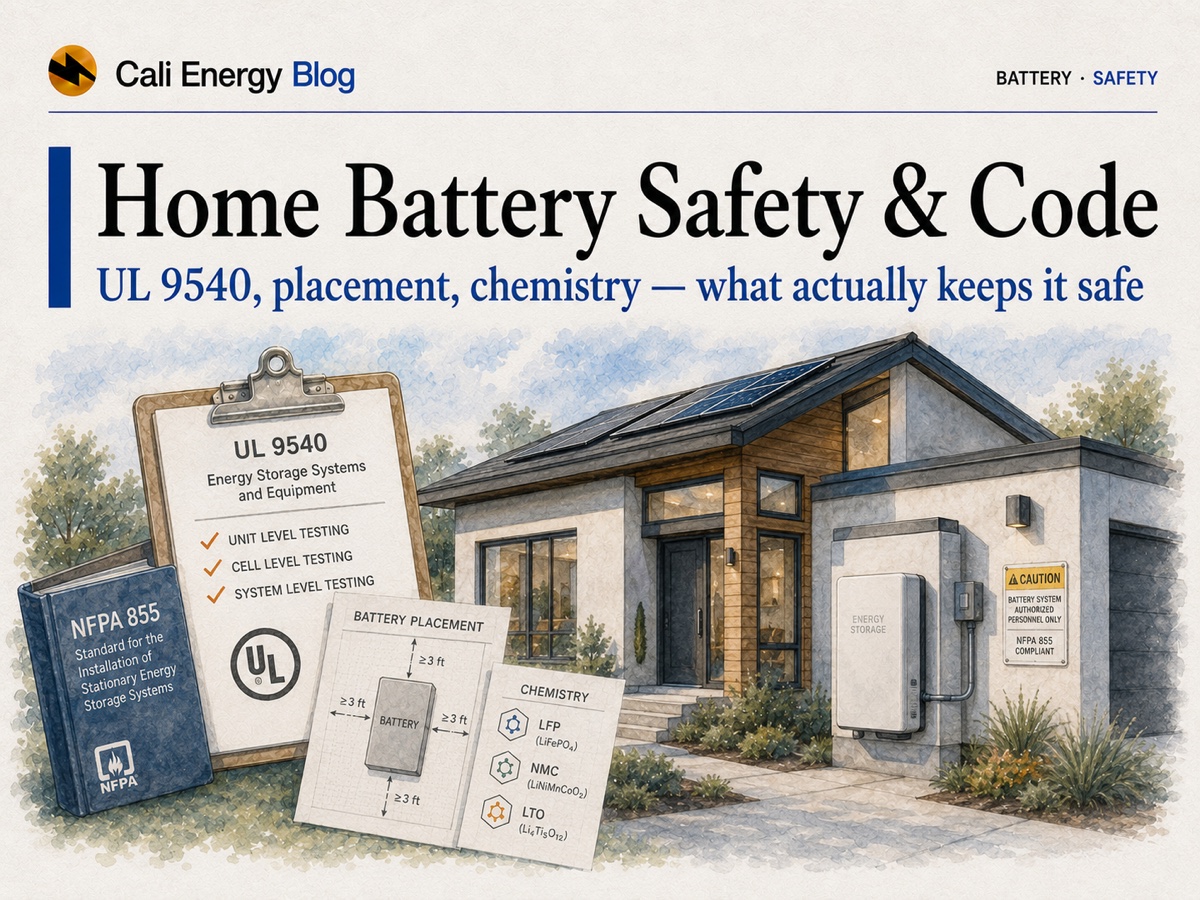
- Listing: California requires a home battery system to be listed and labeled to UL 9540. UL 9540A is a fire-test method, not a pass mark; its data can justify closer spacing.
- Where: garages, accessory buildings, outdoors at least 3 feet from doors and windows, or a utility closet or basement with fire-resistant walls and a self-closing door — never a bedroom or a closet opening into one.
- How much: 20 kWh per unit; 40 kWh in a utility closet or basement, 80 in an attached garage, 100–200 on an exterior wall, 200–600 in a detached building or on the ground; 600 kWh per property. Three 13.5 kWh Powerwalls fit a garage but not a utility closet.
- Protection: smoke alarms, with an interconnected heat alarm where a smoke alarm can’t be installed; bollards or wheel stops if a car could hit the unit; and 3 feet between units unless the listing allows less.
- Los Angeles: an outdoor battery that meets every LAFD condition skips a separate fire review; one inside the house or garage goes to the Fire Department for approval.
The short answer: listed, placed where the code allows, permitted
The rules exist because a battery stores a lot of energy; they work by controlling what is installed, where, and how much.
A home battery that is listed as a complete system, installed by a licensed contractor under permit, in a location the code allows, is designed and tested to be safe. The risk that remains depends on the product, its condition, where it sits and how well it was installed — which is exactly what the listing, the residential code and the inspection check. This page is about safety and code. To choose a model, see the best home battery for backup and Powerwall vs Enphase vs FranklinWH.
Chemistry: what the lab data shows about LFP
Not every lithium-ion cell behaves the same when it is abused.
Sandia National Laboratories heated commercial cells of three chemistries to the point of thermal runaway. The lithium iron phosphate (LFP) cathode stayed stable above 500 °C even when fully charged, and a fully charged LFP cell heated itself at a peak of about 4 °C per minute per amp-hour, against about 7,400 for a nickel-cobalt-aluminum (NCA) cell — the researchers found LFP generates minimal thermal runaway (Sandia).
Enphase’s IQ Battery 5P and FranklinWH’s aPower 2 specify LFP cells; Tesla’s Powerwall 3 datasheet does not state the cell chemistry (Enphase, FranklinWH, Tesla). Chemistry is margin, not permission: the code treats every home battery the same way — it must carry the UL 9540 listing and follow the location and energy limits below.
The listing: UL 9540 and UL 9540A
Two names that sound alike and do different jobs.
UL 9540 is the Standard for Energy Storage Systems and Equipment — the listing for the battery, inverter and controls as one system. California’s Residential Code requires a home battery to be listed and labeled to UL 9540, with its inverter listed to UL 1741 or covered by the UL 9540 listing (2025 CRC §R330.2, R330.6).
UL 9540A is a test method, not a pass mark. It runs in sequence — cell, then module, then unit, then installation — to see whether a failing cell spreads fire, and the data tells code officials what protection an installation needs (UL Solutions). Under the 2025 code, units must sit 3 feet apart unless the listing and the manufacturer’s instructions specify another distance, and the building official may reduce the location distances in the table below on the strength of large-scale fire testing. The Enphase IQ Battery 5P and Tesla Powerwall 3 datasheets list both UL 9540 and UL 9540A.
Where a battery can go, and how much energy each place may hold
The 2025 California Residential Code sets both the location and the total kilowatt-hours allowed there.
| Location | Max total | Conditions |
|---|---|---|
| Sleeping rooms, and closets or spaces opening directly into them | Not allowed | — |
| Utility closet, basement, storage or utility space inside the home | 40 kWh | Finished or noncombustible walls and ceilings; unfinished wood framing gets 5/8-inch Type X drywall; a solid-core, steel or 20-minute door that self-latches and self-closes |
| Attached garage | 80 kWh | Garage separated from the living space as the code requires; alarms and impact protection below |
| On or within 3 feet of an exterior wall of the home or attached garage | 100 kWh (200 with noncombustible wall and eaves) | At least 3 feet from doors and windows into the home, unless the listing allows less |
| Detached garage or accessory building | 200 kWh (600 if 10 ft from property lines and the house) | — |
| Outdoors on the ground | 200 kWh at 3 ft, 600 at 10 ft from property lines and the house | — |
| Any one battery unit / the whole property | 20 kWh / 600 kWh | Larger systems follow the Fire Code’s general battery rules (§1207) |
Source: 2025 California Residential Code, Section R330 and Table R330.5 (Title 24, Part 2.5; effective January 1, 2026 per the California Building Standards Commission). The noncombustible wall surface must extend 5 feet to each side, 1 foot below and 8 feet above the unit, or up to a noncombustible eave. Batteries listed and labeled for use in living spaces are exempt from the section when installed per their listing. Cities can amend the code; your building department has the final word.
Three Powerwalls in the utility closet?
A Powerwall 3 is rated 13.5 kWh (Tesla), under the 20 kWh unit limit. Two make 27 kWh and fit any allowed location. Three make 40.5 kWh — over the 40 kWh limit for a utility closet or basement, so the third has to go to the garage (80 kWh), an exterior wall (100) or outside. The same arithmetic works for any brand: add up the rated kWh in each location.
Spacing, alarms, impact and ventilation
The rest of the residential code’s battery section.
Alarms
Rooms, basements and attached garages with a battery need smoke-alarm protection; where a smoke alarm can’t be installed under its listing, the code calls for a listed heat alarm interconnected with the smoke alarms.
Impact protection
In a garage, a battery in the car’s path — from the door to the back wall, up to 48 inches high and the width of the door, or near its edges — needs bollards, wheel barriers or an approved barrier. A battery mounted 36 inches up is exempt when the garage door opening is 7 feet 6 inches or lower.
Ventilation
Only batteries that give off hydrogen or other flammable gas while charging need mechanical ventilation indoors, and batteries that can release toxic gas are not allowed in homes at all.
Paperwork
The owner gets the manufacturer’s installation, operation, maintenance and decommissioning instructions, and the system carries a label with service contacts. Using an EV to power the home must follow the vehicle maker’s instructions.
Source: 2025 California Residential Code §R330.7–R330.12.
In the City of Los Angeles: the Fire Department’s conditions
Los Angeles adds its own checklist on top of the state code.
Under a Los Angeles Fire Department memo in effect since May 10, 2023, a battery at a one- or two-family home goes through LADBS electrical plan check without separate Fire Department review when it meets every condition:
- Installed outdoors.
- More than 3 feet from windows, doors, attic, dryer and kitchen vents and underfloor openings (metal dampers, louvers or panels can stand in for some).
- At least 3 feet from the main electrical panel, with 5 feet clear on each side to anything sticking out 18 inches from the wall — AC units, water heaters, sheds, rain barrels — so firefighters can reach it.
- A disconnect at least 3 feet away, labeled “ENERGY STORAGE SYSTEM AC DISCONNECT”.
- One clear 3-foot pathway to the unit, or two 30-inch pathways from opposite sides.
- Bollards or another approved barrier wherever a vehicle could hit it.
A battery inside the house or garage, or one that misses a condition, is submitted to the Fire Department for approval (LADBS conditions of approval and LAFD memo). LADBS’s online express route covers an AC-coupled battery of up to 10 kW AC paired with a rooftop solar system, and its bulletin sends that battery to the Fire Department for plan check (LADBS IB P/GI 2026-003). Glendale, Burbank, Pasadena and other cities run their own building and fire departments.
- The datasheet shows a UL 9540 listing for the system.
- The plan names the location and its kWh total, within the limits above.
- Alarms, clearances and any bollards are on the plan, not left for later.
- The contractor pulls the permit and books the final inspection; in Los Angeles, the plan shows the LAFD conditions.
- You get the manufacturer’s manuals and the warranty terms in writing.
Where to go next
Once you know a battery can go where you want it, the questions are about fit: how much of the house to back up (whole-home vs critical loads), sizing for outages (solar and batteries for PSPS shutoffs), and incentives (SGIP in 2026). Cali Energy is a licensed Los Angeles solar, battery and electrical contractor (CSLB #1032379); we install listed batteries on permit, with the location, clearances and inspection planned in. This is general information, not code advice — your building department applies the code to your home. Call +1-323-844-7777 or ask about a permitted battery install.
Frequently asked
Are home batteries safe?
A home battery is designed to be safe when it is listed as a system to UL 9540, installed by a licensed contractor under permit and placed where the code allows. California’s 2025 Residential Code limits where batteries go and how much energy each location may hold, and requires alarms and impact protection.
Can I put a home battery in my garage in California?
Yes. An attached garage separated from the living space may hold up to 80 kWh of batteries, a detached garage up to 200 (600 if 10 feet from property lines and the house). The garage needs smoke-alarm protection, with an interconnected heat alarm where a smoke alarm can’t be installed, and bollards or wheel barriers if the unit is in the car’s path. In the City of Los Angeles, a garage install goes to the Fire Department for approval.
Can a home battery go inside the house?
Only in a utility closet, basement, storage or utility space with finished or noncombustible walls and a self-closing, self-latching door, up to 40 kWh in total — never in a bedroom or a closet that opens into one. Batteries listed and labeled for living spaces follow their own listing.
How many batteries can I install at home?
Any one unit may be up to 20 kWh, and the total depends on the location: 40 kWh in a utility closet or basement, 80 in an attached garage, 100–200 on an exterior wall, 200–600 in a detached building or on the ground, and 600 for the whole property. Three 13.5 kWh Powerwall 3 units (40.5 kWh) are too many for a utility closet but fit a garage.
Is LFP safer than other lithium-ion chemistries?
In Sandia National Laboratories’ tests, the LFP cathode stayed stable above 500 °C even when fully charged, and an LFP cell’s peak self-heating rate was about 4 °C per minute per amp-hour against about 7,400 for a nickel-based NCA cell. The code still applies the same listing and location rules to every chemistry.
What is the difference between UL 9540 and UL 9540A?
UL 9540 is the safety standard a battery system is listed to, and California requires it. UL 9540A is a test method that checks, cell by cell up to a full installation, whether a failure spreads fire; its data can justify closer spacing than the code’s default 3 feet.
Do I need a permit for a home battery in Los Angeles?
Yes. A battery needs an electrical permit from LADBS and a final inspection. An outdoor battery that meets all of the Fire Department’s conditions — 3 feet from openings and the main panel, 5 feet clear on each side, a 3-foot pathway, a labeled disconnect, bollards where needed — avoids a separate fire review; indoor and garage installs go to the Fire Department for approval.
Related reading
Sources & methodology
Figures on this page come from the primary sources below and, where noted, from Cali Energy calculations using the stated assumptions. Rates, incentives, and program terms change; each was verified October 2, 2026.
- 2025 California Residential Code (Title 24, Part 2.5), Section R330 Energy Storage Systems and Table R330.5
- California Building Standards Commission — 2025 Title 24 codes effective January 1, 2026
- LADBS — ESS Conditions of Approval (Ver 2.1) and LAFD memo on ESS at R-3 buildings (effective May 10, 2023)
- LADBS — Information Bulletin P/GI 2026-003, Express Permits (energy storage with PV)
- UL Solutions — Understanding UL 9540A, NFPA 855 and large-scale fire testing
- Sandia National Laboratories — Multi-scale thermal stability study of commercial lithium-ion batteries (SAND2019-7237J)
- Enphase — IQ Battery 5P datasheet
- Tesla — Powerwall 3 datasheet
- FranklinWH — aPower 2 datasheet
Thinking about a home battery? Let’s place it right
We install listed batteries on permit, to the 2025 California code and LA Fire Department conditions, with the location, clearances and inspection planned in. Tell us about your home and we’ll walk you through it.
Get a free estimatePrepared by Cali Energy, October 2, 2026. This article is for general educational purposes only and is not legal, tax, financial, engineering, or utility advice. Rates, incentives, codes, permit requirements, equipment specifications, prices, and program terms may change; figures and timelines are estimates, not guarantees. Confirm current requirements with the applicable utility, AHJ, program administrator, manufacturer, or a licensed professional. See our Content Disclaimer. Cali Energy · 19201 Parthenia St, Unit E, Northridge, CA 91324 · CSLB #1032379 (B, C-10, C-39)