

LADWP Net Metering, Explained for Solar Homeowners (2026)
Straight answer: LADWP nets the kilowatt-hours your solar sends to the grid against the kilowatt-hours you draw over each billing period — usually two months — so an exported kWh cancels a purchased one at the full retail price. If you export more than you use, the excess becomes a dollar credit that never expires but is never paid out, and it cannot cover taxes or, on the standard R-1A rate, the $10-a-month minimum charge. These are LADWP’s own rules: it is not on NEM 3.0, and California’s net-metering statute does not apply to it.
Get a free estimate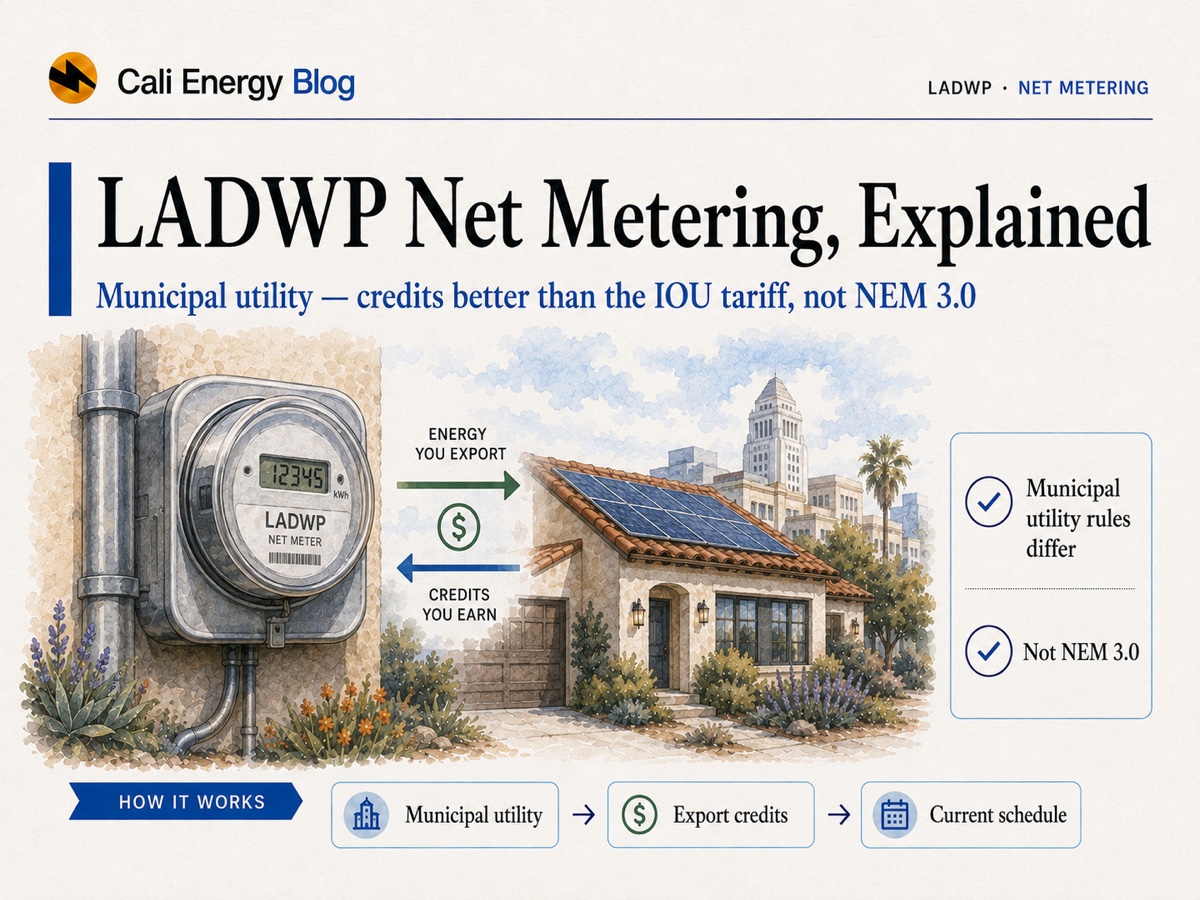
- Netting is kWh for kWh over each billing period (most homes are billed every two months), at your rate’s retail prices — 26–41¢ a kWh on the standard rate in summer 2026.
- A period with more exports than use leaves a dollar credit. It carries forward with no time limit, but LADWP pays nothing for it and zeroes it when the account closes — including when you sell the house.
- On R-1A, credits pay only the energy charge above the $10-a-month minimum. On the time-of-use R-1B, they pay every LADWP charge except taxes, and each export is credited at the price of the time block it happens in. LADWP itself points solar customers who keep banking credits to R-1B.
- The rules are LADWP’s own net-metering rider, dated September 1, 2008 — not state law, which exempts LADWP. The City can change them; the rider LADWP publishes today is unchanged.
- Leases qualify, power-purchase agreements do not: LADWP prohibits anyone else from selling you energy.
How LADWP nets your solar, step by step
Everything below comes from LADWP’s Net Energy Metering rider and its published answers to solar customers.
1. Your home uses solar first. Power the house uses while the panels produce it never reaches the meter. The two-way net meter LADWP installs records only what flows in from the grid and what flows out to it.
2. Imports and exports are netted over the billing period. If you drew more than you sent back, you are billed for the difference at your normal rate, through the same tiers or time-of-use blocks as any other customer (LADWP NEM rider, section 3.a).
3. A net-export period leaves a credit. If you sent back more than you drew, LADWP bills only the charges that are not based on kilowatt-hours and calculates a credit for the extra energy using your rate schedule’s energy pricing (section 3.b).
4. The credit is banked. LADWP applies it to later bills, except taxes and minimum charges, until it is used up. It covers only the bill for the meter that earned it, it has no time limit, and if you close the account the balance goes to zero with no payment (sections 3.c–3.d; LADWP rates FAQ). You cannot move credits to a new home.
LADWP bills water, City sanitation charges and electricity together; everything on this page concerns the electric charges.
What an exported kilowatt-hour is worth in 2026
Because netting happens at retail prices, an exported kWh is worth the price of the kWh it cancels. These are LADWP’s 2026 residential prices, including the quarterly adjustment factors, before tax.
| Billing months | R-1A Tier 1 | R-1A Tier 2 | R-1A Tier 3 | R-1B High Peak | R-1B Low Peak | R-1B Base |
|---|---|---|---|---|---|---|
| January–March | 24.77 | 30.63 | 30.63 | 27.65 | 27.65 | 25.29 |
| April–May | 24.36 | 30.22 | 30.22 | 27.24 | 27.24 | 24.88 |
| June | 24.36 | 30.22 | 38.92 | 33.08 | 27.24 | 24.49 |
| July–September | 26.41 | 32.27 | 40.97 | 35.12 | 29.28 | 26.54 |
| October–December | 27.29 | 33.15 | 33.15 | 30.17 | 30.17 | 27.81 |
Source: LADWP Residential Rates, “Total Consumption Charge” for 2026 (October–December as published in September 2026). Tier sizes, zones and time-of-use hours: LADWP Residential Electric Rates. Taxes and fixed charges are extra.
On the standard R-1A rate, tiers apply to your net usage, so the first exports cancel your most expensive kilowatt-hours. For a two-month bill, Tier 1 is the first 700 kWh in Zone 1 and the first 1,000 in Zone 2 (LADWP’s warmer zone); Tier 2 is the next 1,400 or 2,000; Tier 3 is everything above. A Zone 2 home that would otherwise use 3,200 kWh in July and August saves 40.97¢ on each of its first 200 exported kWh, 32.27¢ on the next 2,000 and 26.41¢ on the rest, down to zero net use.
On the time-of-use R-1B rate, LADWP credits an export at the price of the block it happens in (LADWP FAQ). High Peak is 1–5 p.m. on weekdays, Low Peak 10 a.m.–1 p.m. and 5–8 p.m. on weekdays, and Base is every other hour, including all weekend. In summer 2026 an exported High Peak kWh (35.12¢) pays for 1.32 kWh bought back at night (26.54¢); from October the gap narrows to 1.08.
For contrast, SCE credits a system that starts in 2026 about 6¢ per exported kWh on a summer day and 21¢ on a summer evening (SCE) — see NEM 3.0 explained.
What your credits can and can’t pay
The rate you are on decides how much of the bill a credit can reach.
| Part of the electric bill | Standard rate R-1A | Time-of-use rate R-1B |
|---|---|---|
| Energy charges | Yes, but only above the minimum charge | Yes, including every adjustment factor |
| Fixed monthly charge | No (Power Access Charge, $2.30–$22.70 a month) | Yes ($12 a month service charge) |
| Minimum charge | No — $10 a month always remains | R-1B has no minimum charge |
| Taxes (City tax, state surcharge) | No | No |
| Balance when you close the account | Zeroed, no payment | Zeroed, no payment |
LADWP’s own example: an R-1A customer with credits in the bank who took no net power still receives a two-month bill of $22 — the $10 monthly minimum for two months plus $2 of city tax — and LADWP suggests such customers consider R-1B (LADWP rates FAQ). When the minimum applies, the Power Access Charge is not billed on top of it (rate ordinance). The Power Access Charge itself is set each October 1 from your highest month of the past year.
R-1A or R-1B? One summer bill, both ways
The same meter readings for July and August 2026, priced on each rate. The kilowatt-hours are illustrative; the prices and rules are LADWP’s.
| Line | From grid | To grid | Net | Price | Amount |
|---|---|---|---|---|---|
| High Peak (weekdays 1–5 p.m.) | 120 kWh | 480 kWh | −360 kWh | 35.124¢ | −$126.45 |
| Low Peak | 260 kWh | 340 kWh | −80 kWh | 29.284¢ | −$23.43 |
| Base (nights and weekends) | 980 kWh | 420 kWh | +560 kWh | 26.540¢ | +$148.62 |
| Service charge, 2 months | $12.00 | +$24.00 | |||
| LADWP charges before tax | 1,360 kWh | 1,240 kWh | +120 kWh | $22.74 |
The same readings on R-1A: 120 kWh net, all in Tier 1 at 26.408¢, is $31.69 — above the $20 two-month minimum — plus a Power Access Charge of at least $4.60 for the two months: $36.29 or more before tax. For these summer months R-1B is about $13.55 lower, because most exports land in the pricier weekday blocks and earn more than the night-time power they replace.
Winter narrows or reverses that gap. In January–March 2026 the R-1B Base price (25.29¢) sits above R-1A’s Tier 1 (24.77¢), and the $12 service charge above the Tier 1 Power Access Charge ($2.30). Price a full year of your own usage on both rates before switching, and note that after leaving R-1B for R-1A you cannot return for 12 months (rate ordinance). To switch, use LADWP’s time-of-use application or call its Rates group at (213) 367-4718 (LADWP).
No payout for surplus: size to your usage
California’s net-metering law, Public Utilities Code §2827, makes utilities offer net surplus compensation — a payment for power you over-produce across a year. But the statute states that it does not apply to a municipal utility serving more than 750,000 customers that also delivers water, which describes LADWP (PUC §2827(b)(3)). LADWP’s rider simply banks the credit and zeroes it when the account closes.
That has two practical consequences. Size the system to about your yearly usage, not beyond it: a surplus you never use is worth nothing. And a large credit bank is lost when you sell — the buyer opens a new account, and credits cannot move with you (LADWP FAQ). Our panel calculator sizes a system from your bills.
Who qualifies, and what it takes
- Systems up to 1 MW (AC, CEC rating) on your own premises, built mainly to offset your own use; residential R-1 customers qualify (LADWP NEM Guidelines).
- Owned or leased, not a PPA. A lease must run at least 10 years, offer an ownership option by its end, and have payments that are not based on the energy produced. LADWP prohibits the sale of energy by anyone other than LADWP, so a power-purchase agreement priced per kWh does not qualify. For the trade-offs, see cash vs loan vs lease.
- A faster track under 10 kW: projects below 10 kW AC without a service upgrade or battery may qualify for LADWP’s fast-tracked process.
- Locked until inspected: the system may not operate until the City permit inspection and LADWP’s inspections pass and LADWP installs the net meter. The permit side is covered in LA solar permits.
LADWP vs SCE at a glance
| Feature | LADWP (municipal) | SCE (NEM 3.0) |
|---|---|---|
| Who sets the rules | LADWP’s own rider under City ordinances | The CPUC’s Net Billing Tariff |
| Value of an exported kWh | The retail price it cancels: 26–41¢ on R-1A in summer 2026 | Hourly export values: about 3–21¢ for a 2026 system |
| Billing | Usually every two months | Monthly, with a yearly true-up |
| Unused surplus | Banked with no time limit; never paid out | Settled at the yearly true-up |
| A battery’s main job | Mostly backup | Bill savings as well as backup |
Sources: LADWP NEM rider, LADWP 2026 rates, SCE Solar Billing Plan, CPUC Net Billing Tariff. Battery economics: do you need a battery?
Could LADWP change the rules?
Yes. Because the state statute does not cover LADWP, its net metering exists at the City’s discretion, like any LADWP rate. The rider LADWP publishes still carries its September 1, 2008 effective date, while prices move every quarter through adjustment factors. In February 2026 the City’s Office of Public Accountability noted that LADWP’s fixed charges are low and that net-metered solar customers pay fewer usage-based charges — the kind of question a future rate action could take up (OPA benchmark analysis). No change has been adopted; check the rider on LADWP’s site before you sign. For the full rate structure, see LADWP electric rates explained, and for rebates, LADWP solar and battery incentives.
An LADWP system that uses every credit
Cali Energy (CSLB #1032379) designs solar across LADWP territory from our base in Northridge. Send us your last twelve months of LADWP bills and we will size the system to your usage rather than beyond it and walk you through the R-1A versus R-1B choice. See our Northridge projects.
Get a free LADWP solar estimateFrequently asked
Is LADWP on NEM 3.0?
No. NEM 3.0, the CPUC’s Net Billing Tariff, covers SCE, PG&E and SDG&E. LADWP is a municipal utility with its own net-metering rider, and California’s net-metering statute, Public Utilities Code §2827, states that it does not apply to a municipal utility serving more than 750,000 customers that also delivers water — which is LADWP.
How does LADWP credit my solar exports?
By netting kilowatt-hours. Over each billing period, usually two months, LADWP subtracts what you sent to the grid from what you drew and bills the difference at your normal rate, so each export cancels a purchased kWh at retail — 26–41¢ on the standard rate in summer 2026. If you export more than you use, the excess becomes a dollar credit based on your rate’s energy prices; on the time-of-use rate R-1B it is valued at the price of the time block when you exported.
Do LADWP solar credits expire?
No. LADWP says banked credits have no time limit. But they are not refunded when you close the account or move out, and they cannot be transferred to another home.
Does LADWP pay for extra solar at the end of the year?
No. Unlike the utilities covered by state net-metering law, LADWP has no net surplus compensation. Surplus stays in the credit bank until used and is zeroed when the account closes, so a system sized beyond your yearly usage earns nothing for the extra.
Why do I still get an LADWP bill when I have solar credits?
On the standard R-1A rate, credits pay only the energy charge above a $10-a-month minimum, and no credit pays taxes. LADWP’s own example is a $22 two-month bill for a customer with credits in the bank: $20 of minimum charge plus $2 of city tax. On R-1B, credits also pay the service charge and there is no minimum, so only taxes remain once the bank is large enough.
Should I switch to LADWP’s time-of-use rate R-1B after going solar?
Often worth checking. LADWP suggests R-1B to solar customers who keep banking credits, because exports in the weekday peak blocks are credited at higher prices than the night and weekend power you buy back. In our illustrative July–August 2026 bill, R-1B came out about $13.55 lower. Winter narrows the gap, so price a full year on both rates first — after leaving R-1B for R-1A you cannot return for 12 months.
Can I get a solar PPA with LADWP?
No. LADWP’s net-metering guidelines prohibit the sale of energy by anyone other than LADWP, so a power-purchase agreement priced per kWh does not qualify. A lease can, if it runs at least 10 years, includes an ownership option by its end, and has payments not based on the energy produced.
How often does LADWP bill solar customers?
Most LADWP residential customers are billed every two months, and the tier allowances double to match: on a two-month bill, Tier 1 is the first 700 kWh in Zone 1 and the first 1,000 kWh in Zone 2. Solar imports and exports are netted across the whole billing period.
Related reading
Sources & methodology
Figures on this page come from the primary sources below and, where noted, from Cali Energy calculations using the stated assumptions. Rates, incentives, and program terms change; each was verified September 28, 2026.
- LADWP — Service Rider NEM, Net Energy Metering (effective September 1, 2008)
- LADWP — Net Energy Metering Guidelines (revised August 28, 2019; modified April 28, 2021)
- LADWP — Residential Rates, R-1A and R-1B (2026 prices)
- LADWP — Residential Electric Rates: tiers by zone, Power Access Charge, time-of-use hours
- LADWP — Rates FAQ, Residential Solar Rate (archived May 19, 2024)
- LADWP — Electric Rate Ordinance, Schedule R-1 (minimum charge, Rate B)
- LADWP — Final Incremental Electric Rate Ordinance (2016): Power Access Charge, rate selection
- California Public Utilities Code §2827 (net energy metering; exemption in (b)(3))
- City of Los Angeles Office of Public Accountability — Ratepayer Advocate Benchmark Analysis of LADWP Electric Rates (February 2026)
- SCE — Solar Billing Plan (Energy Export Credit values)
- CPUC — Net Billing Tariff
Get an LADWP solar estimate sized to your bills
Send us your last year of LADWP bills and your roof, and we'll size a system to your usage — not beyond it, since LADWP never pays for surplus — with an itemized price.
Get a free estimatePrepared by Cali Energy, September 28, 2026. This article is for general educational purposes only and is not legal, tax, financial, engineering, or utility advice. Rates, incentives, codes, permit requirements, equipment specifications, prices, and program terms may change; figures and timelines are estimates, not guarantees. Confirm current requirements with the applicable utility, AHJ, program administrator, manufacturer, or a licensed professional. See our Content Disclaimer. Cali Energy · 19201 Parthenia St, Unit E, Northridge, CA 91324 · CSLB #1032379 (B, C-10, C-39)