

Do Solar Panels Work in a Power Outage?
Straight answer: not on their own. A grid-tied solar system without backup equipment shuts off when the grid goes down, even at noon — on SCE the interconnection rule requires it to stop energizing the grid within two seconds, so it cannot feed lines that crews may be repairing. To keep power you need a battery with backup equipment, a battery-free sunlight backup setup for a few daytime circuits, or a generator connected through a transfer switch.
Get a free estimate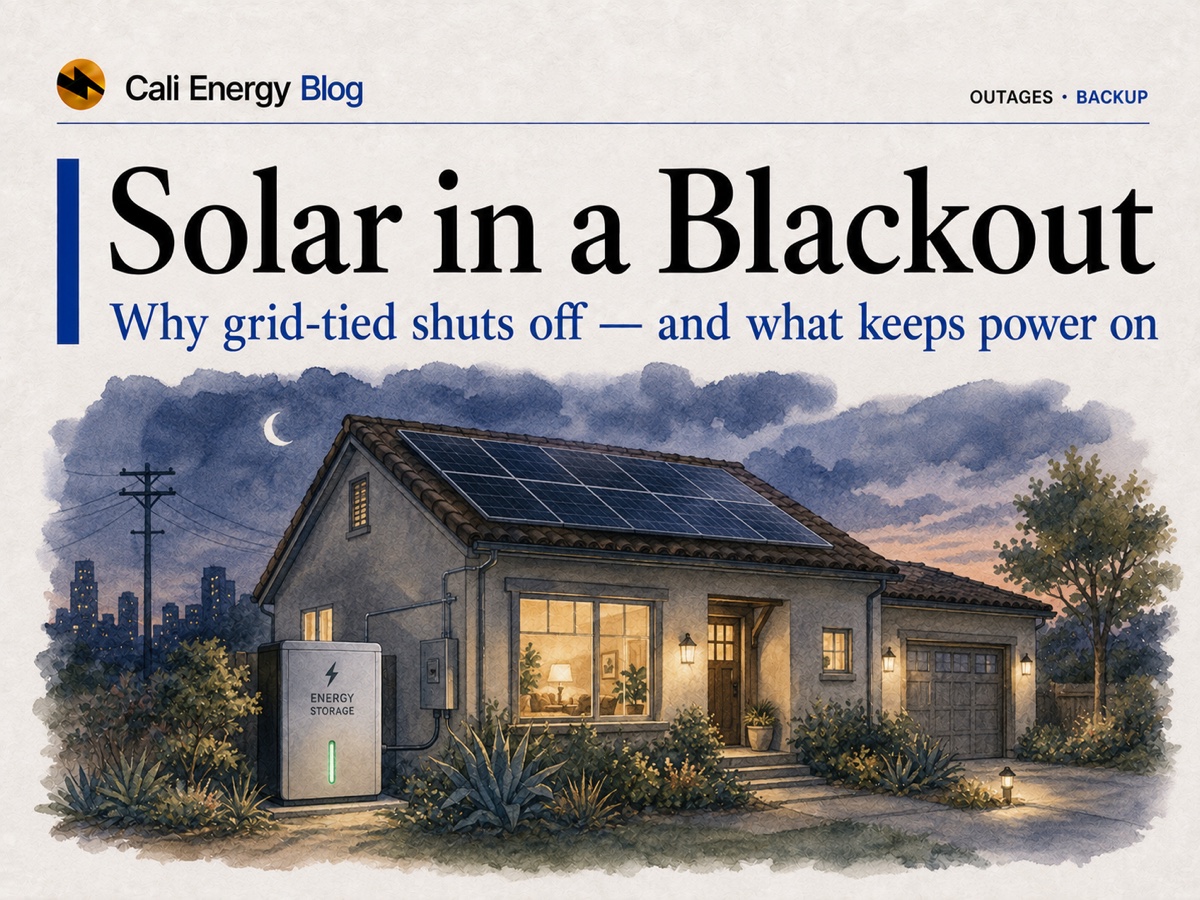
- Solar alone goes dark. Grid-tied systems must stop energizing the grid within two seconds of an outage and stay off until the grid is back and stable.
- A battery with backup equipment separates the house from the grid and runs it as its own small grid; the panels keep recharging the battery by day.
- Sunlight backup without a battery powers a few essential circuits while the sun is up, and nothing at night.
- A generator needs a transfer switch installed by a licensed electrician, and SCE must be told before it is permanently wired in.
- Outages here are not just flickers: SCE ran 13 safety shutoffs in 2025, and several stretched across days.
Why solar shuts off in a blackout — even at noon
A safety rule built into the inverter.
On SCE, PG&E and SDG&E a home solar system connects to the grid under Rule 21. Its general protection requirements say the system must not energize a dead circuit; it must stop energizing the utility’s lines within two seconds after an outage leaves it running as an “island”; it must stop for faults and before the utility re-closes a line; and it must not reconnect until the grid’s voltage and frequency are back in the normal range and stable (SCE Rule 21, section H.1.a, citing IEEE 1547-2018). The reason is people: a rooftop system pushing power into a line that crews believe is dead could electrocute them, and could damage equipment when the line is switched back on. LADWP and the city utilities have their own interconnection rules, but the inverters are the same kind of listed equipment and shut down the same way.
So the panels can be in full sun and the house still dark, because the inverter has nowhere safe to send the power. When the grid returns and settles, the system restarts by itself; you don’t need to do anything. If it stays off long after the power is back, see solar not producing.
| Setup | Daytime power | Night power | What it covers |
|---|---|---|---|
| Grid-tied solar only | No | No | Nothing — shuts off by design |
| Battery installed without backup equipment | No | No | Bill savings only; it cannot run the house when the grid is down |
| Solar + battery with backup equipment | Yes | Yes, from the battery | The circuits it was wired to back up, within the battery’s power and energy ratings; solar recharges it by day |
| Sunlight backup, no battery (Enphase IQ8) | Yes, essential circuits | No | Up to four 240-volt or eight 120-volt circuits; output follows the sun |
| Portable power station | Yes, from its own battery; small portable panels can recharge it | Yes, until it runs down | A few devices plugged into it, not the house wiring |
| EV with bidirectional charging (V2H) | Yes | Yes, from the car’s battery | Backed-up circuits, only if the car, the charger and the home’s transfer equipment all support it; see bidirectional EV charging |
| Generator on a transfer switch | Yes | Yes, while it has fuel | Whatever the generator and switch are sized for |
Sources: SCE Rule 21 · Enphase Sunlight Backup user guide · SCE generator safety. Whether a battery backs up the house depends on how it was installed — check the single-line diagram in your permit set or ask the installer.
How a battery keeps the lights on
The house becomes its own small grid.
A backup-capable battery system includes equipment that senses the outage, disconnects the home from the utility, and lets the battery set the voltage and frequency inside the house. Because the house is no longer connected, the inverter can run again: solar covers daytime load and recharges the battery, and the battery carries the evening and night. Two ratings set the limits: usable energy in kilowatt-hours decides how long, and continuous power in kilowatts decides how much can run at the same moment.
Our outage model puts one battery of about 13.5 kWh, holding back a 10% reserve, at about 1.7 days on 7.2 kWh a day of essentials — refrigerator, lights, internet, a furnace fan, a medical device and a pump — with no sun at all; with a modest array recharging it, it can last far longer, though storm days produce less. Central air, an electric water heater or EV charging change the math entirely. The day-by-day model is in solar and battery for a multi-day PSPS, and the wiring choice in whole-home vs critical-loads backup.
Sunlight backup without a battery
Useful, but small and daytime-only.
Enphase’s IQ8 microinverters can form a grid themselves, so with extra equipment they keep a few circuits running during a daytime outage. The setup adds an IQ System Controller 2, an IQ Combiner 4C and at least one IQ Load Controller, and backs up at most four 240-volt or eight 120-volt circuits. Enphase says it is for essential loads only, that backing up the whole home is not supported, and that backed-up loads should not exceed 30% of the microinverters’ rated output. Scheduled circuits run 9 a.m. to 4 p.m. by default, adjustable within 7 a.m. to 8 p.m. (Enphase). When a cloud passes, output drops; after sunset, it stops. Enphase asks that the internet router and modem get the highest-priority circuit, so the family stays connected while the sun is up.
Only through a transfer switch
SCE’s rule is plain: never power a house by plugging a generator into a wall outlet or temporarily wiring it into the panel — that backfeeds the grid and can electrocute you, your neighbors or utility workers. A permanently wired generator should be connected through a transfer switch installed by a licensed electrician, and California law requires notifying SCE first (SCE). Some battery systems can also start a standby generator automatically and use it only when solar and battery fall short (Enphase). Trade-offs are in solar battery vs generator.
Outages in Los Angeles: why backup comes up
Beyond storms, heat waves and equipment failures, SCE turns off power to high fire-risk circuits during dangerous wind and dry weather. It ran 13 of these Public Safety Power Shutoff events in 2025, in January, June, July, August, September, October and November, and on ten of them more than a day passed between the first and the last circuit being restored (SCE 2025 PSPS post-season report). What triggers them is in PSPS shutoffs explained.
If someone at home depends on an electric medical device, SCE’s Critical Care Backup Battery program provides a battery at no cost to customers who use such a device, live in a high fire-risk area and are enrolled in Medical Baseline; others can find rebates on portable power stations and generators in the SCE Marketplace (SCE). Home batteries may also qualify for state incentives; see SGIP battery incentives.
Questions to ask before you buy backup
Does it back up at all?
Ask whether the quote includes the backup equipment, or only a battery for bill savings.
Which circuits?
Get the list of backed-up circuits in writing: whole home, or a critical-loads panel.
How much at once?
Compare the battery’s continuous kW with the loads you expect to run together, including motor start-up.
How long?
Usable kWh against your essential daily use, and whether solar recharges it during an outage.
Automatic switch-over?
Backup systems switch on their own; confirm how the house reconnects when the grid returns.
Is it worth it on your bill?
On SCE a battery also earns its keep in the evening; see do I need a battery.
Where to go next
Cali Energy is a licensed Los Angeles solar, battery and electrical contractor (CSLB #1032379). Tell us which loads you need in an outage and we will show which setup covers them. Call +1-323-844-7777 or ask about backup for your home.
Frequently asked
Do solar panels work during a power outage in California?
Not on their own. A grid-tied system must stop energizing the grid within two seconds of an outage under Rule 21, the interconnection rule for SCE, PG&E and SDG&E, so the house goes dark even in full sun; systems on LADWP shut down the same way. A battery with backup equipment, a battery-free sunlight backup setup or a generator on a transfer switch keeps power on.
Why does my solar shut off when the power goes out even though it's sunny?
Because it is required to. With the grid down, the inverter has no safe place to send power: feeding a line that crews think is dead could electrocute them. The system waits until the grid is back and stable, then restarts by itself.
What is anti-islanding, and why is it required?
An “island” is part of the grid kept energized by local generation after the utility supply is lost. Anti-islanding protection detects it and stops the system from energizing the grid within two seconds, as SCE’s Rule 21 requires, to protect line workers and equipment.
Will a battery keep my solar running in an outage?
Yes, if it was installed with backup equipment. The system disconnects the home from the grid, the battery runs the backed-up circuits, and solar recharges it by day. A battery installed only for bill savings does not keep the lights on. One ~13.5 kWh battery runs about 1.7 days of essential loads with no sun.
Does solar work during a PSPS?
Only with backup. A Public Safety Power Shutoff is a grid outage like any other for your inverter. SCE ran 13 such events in 2025, several lasting across days, which is why a battery that solar can recharge matters more than one sized for a few hours.
Can I get daytime backup without a battery?
Yes, on a limited scale. Enphase IQ8 systems with Sunlight Backup equipment can run up to four 240-volt or eight 120-volt essential circuits while the sun is up, with nothing at night. Enphase does not support backing up the whole home this way.
Related reading
Sources & methodology
Figures on this page come from the primary sources below and, where noted, from Cali Energy calculations using the stated assumptions. Rates, incentives, and program terms change; each was verified October 5, 2026.
- SCE — Rule 21, Generating Facility Interconnections (section H.1.a: protective functions, two-second anti-islanding, reconnection)
- Enphase — Understanding the Sunlight Backup system (homeowner user guide)
- Enphase — Sunlight Backup installation support (IQ8, IQ Load Controller requirement)
- SCE — Generator safety and outage preparedness (transfer switch, notice to SCE, backfeed, Critical Care Backup Battery)
- SCE — 2025 PSPS Post-Season Report (CPUC R.18-12-005)
- CPUC — Public Safety Power Shutoffs
Want your solar to keep the essentials on?
Tell us what you need running in an outage — refrigerator, internet, a medical device, AC — and we’ll show which setup covers it, with or without a battery. Estimates, not guarantees.
Get a free estimatePrepared by Cali Energy, October 5, 2026. This article is for general educational purposes only and is not legal, tax, financial, engineering, or utility advice. Rates, incentives, codes, permit requirements, equipment specifications, prices, and program terms may change; figures and timelines are estimates, not guarantees. Confirm current requirements with the applicable utility, AHJ, program administrator, manufacturer, or a licensed professional. See our Content Disclaimer. Cali Energy · 19201 Parthenia St, Unit E, Northridge, CA 91324 · CSLB #1032379 (B, C-10, C-39)