

What Triggers a PSPS Power Shutoff in California
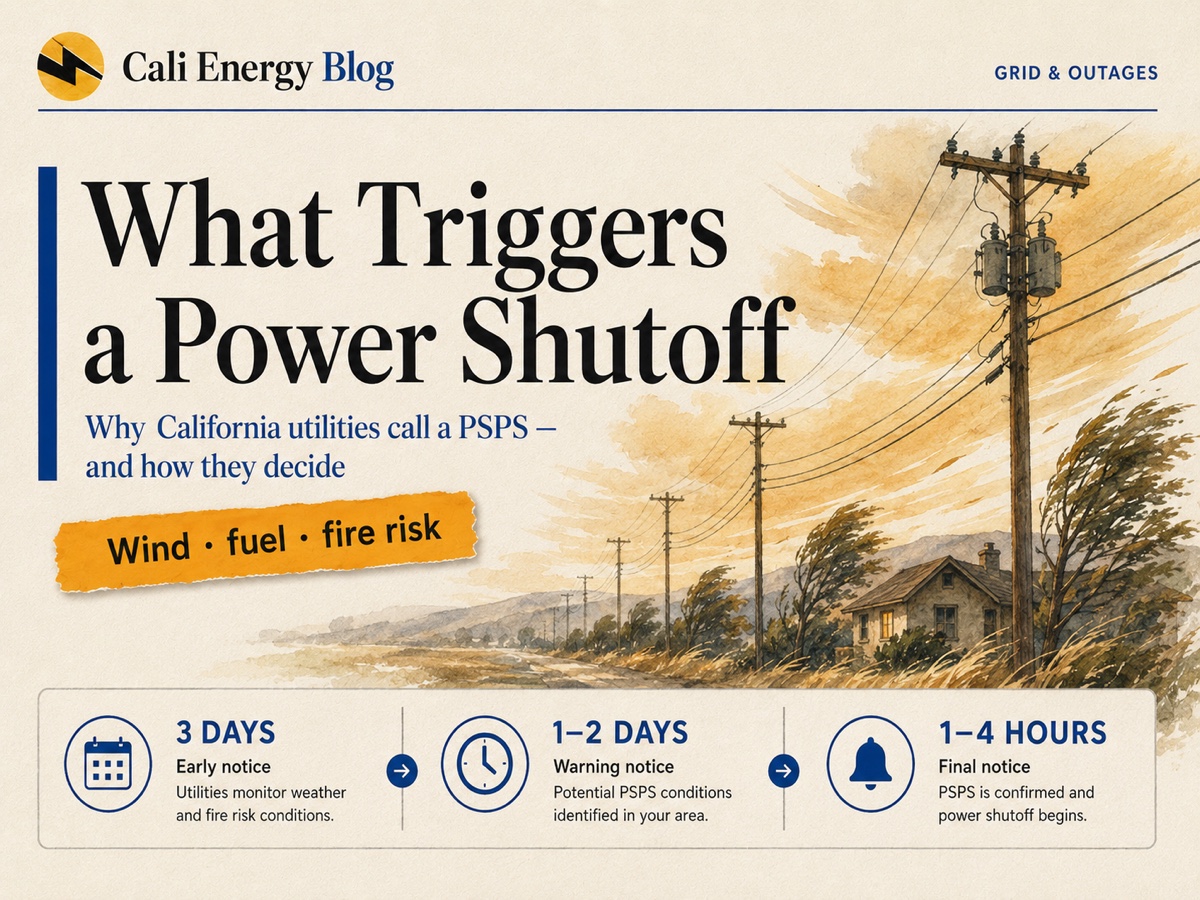
A Public Safety Power Shutoff (PSPS) is when a utility proactively cuts power during dangerous fire weather so its own equipment can’t spark a wildfire. This guide explains why shutoffs are called — the legal basis, the fire-threat maps, the wind and fuel criteria, and the notification timeline — and why Los Angeles’s municipal utility handles it differently.
- This page is not a PSPS forecast, an evacuation notice, or a guarantee of service. Conditions and utility decisions change quickly — always follow the current notices from your own utility and local emergency officials.
- A PSPS is a deliberate, temporary shutoff during high fire risk. It is different from a rotating outage caused by a grid-supply shortage.
- Standard grid-tied solar shuts down during any outage. Keeping power on requires a properly configured battery/islanding system.
- Last resort: the CPUC allows a shutoff when a utility reasonably believes strong winds pose an imminent, significant risk of toppling lines or vegetation contact.
- SCE called 13 PSPS events in 2025, from January to November; in several, the last circuits came back more than a week after the first.
- Restoration takes inspection: SCE says it often begins within eight hours of the all-clear, longer when crews need daylight or aerial patrols.
- LADWP customers follow LADWP’s own wildfire plan, not the CPUC’s PSPS rules.
What a PSPS is, and who authorizes it
A Public Safety Power Shutoff — also called de-energization — is when an electric utility turns off power to specific lines during extreme fire weather, so a wind-damaged line or piece of equipment cannot ignite a wildfire. It is a preventive measure, not a response to an outage that has already happened.
The legal basis in California goes back to a 2012 California Public Utilities Commission (CPUC) ruling that Public Utilities Code §451 and §399.2(a) authorize investor-owned utilities to de-energize lines for public safety. Today six investor-owned utilities run PSPS programs: Pacific Gas & Electric, Southern California Edison (SCE), San Diego Gas & Electric, Liberty Utilities, Bear Valley Electric Service, and PacifiCorp.
Why utilities accept the disruption: although electrical infrastructure causes well under 10% of California wildfires by count, those fires account for roughly half of the most destructive wildfires in state history. Shutting off a small number of high-risk circuits during a wind event is meant to remove that ignition source at the worst moments.
Does LADWP do PSPS? Not the way the big utilities do
This is a common point of confusion for Los Angeles residents. LADWP has publicly stated, in its cited guidance, that it does not proactively shut off customer power before or during wind events the way the investor-owned utilities do. Because LADWP is a municipal (publicly owned) utility, it is not under the CPUC’s PSPS rules; instead it operates under SB 1028 (effective January 1, 2017), which requires each publicly owned utility to assess wildfire risk and adopt a Wildfire Mitigation Plan.
LADWP’s territory is heavily urbanized with comparatively few wildfire-prone areas, so its plan leans on construction standards, vegetation management, and inspections rather than customer shutoffs. This is a description of stated policy, not a promise about any future event — LADWP customers should still check current LADWP outage and emergency information during major wind events.
What actually triggers a shutoff
There is no single public wind number that automatically triggers a PSPS. The decision combines fire-weather data, fuel conditions, and circuit-specific engineering. For SCE, the main inputs are:
| Factor | What it captures |
|---|---|
| Fire Potential Index (FPI) | SCE’s daily rating combining weather, fuel conditions, and vegetation moisture across the region |
| Wind speed & gusts | Sustained wind and gusts, weighed against circuit design and historical wind for that location |
| Humidity & fuel moisture | Low relative humidity and dry/dead fuels raise ignition and spread risk |
| Red Flag Warnings | National Weather Service fire-weather alerts feed the assessment |
| Real-time field data | Weather stations and observers can shift the decision as an event unfolds |
Utilities publish wind reference levels — for example, covered-conductor criteria have referenced roughly a 40 mph sustained / 58 mph gust level, and the National Weather Service wind-advisory levels (about 31 mph sustained / 46 mph gusts) are commonly cited. These are references reported in utility materials, not a guarantee that power will or will not be shut off at a stated wind speed. In large events, thresholds may be lowered so the highest-risk circuits shut off first.
Sources: CPUC Public Safety Power Shutoffs · SCE PSPS FAQ · verified August 4, 2026.
HFTD: the High Fire-Threat District map
Only circuits in higher-risk areas are normally candidates for a PSPS. The CPUC’s High Fire-Threat District (HFTD) map classifies areas as:
- Zone 1 — USFS/CAL FIRE Tree Mortality High Hazard Zones.
- Tier 2 — elevated utility wildfire risk.
- Tier 3 — extreme utility wildfire risk.
About one-quarter of SCE’s service area sits in a high fire-risk area. You can look up an address on the utility’s or CPUC’s HFTD map to see whether it falls in Tier 2 or Tier 3. An HFTD result is general wildfire-risk information only — it is not an insurance determination, a property disclosure, an engineering assessment, or a guarantee that a specific address will experience a PSPS.
The notification timeline
When forecasts allow, SCE works down a sequence of notifications. Exact lead times vary with how confident and how sudden the forecast is:
| Lead time | What happens |
|---|---|
| Up to ~3 days | Early alerts may begin when forecasting permits; government and critical-infrastructure partners are notified first |
| ~2 days | Standard target for the initial customer notification |
| ~1 day | Updated forecast and circuit refinement |
| 1–4 hours | “Expected shutoff” notice; power may go off at any time after this |
| During / after | Updates during the event, and a final notice when power is restored |
Notifications go out by text, email, or voice call, using the contact method on file. Fast-onset winds can leave little to no notice — SCE warns that advance forecasts may not capture the real-time onset of dangerous conditions.
Source: SCE — what to expect before a PSPS · verified August 4, 2026.
SCE’s 2025 season, event by event
Every year each utility files a post-season report with the CPUC. SCE’s report for 2025 lists thirteen PSPS events and when the first and last de-energized circuits were restored:
| Event (incident date) | First circuit restored | Last circuit restored |
|---|---|---|
| January 3 | Jan 5 | Feb 6 |
| January 20 | Jan 20 | Jan 27 |
| June 10 | Jun 11 | Jun 22 |
| June 30 | Jul 1 | Jul 11 |
| July 15 | Jul 15 | Same day (single restoration) |
| July 20 | Jul 24 | Same day (single restoration) |
| August 1 | Aug 2 | Aug 8 |
| August 11 | Aug 11 | Aug 24 |
| September 2 | Sep 2 | Sep 10 |
| October 8 | Oct 12 | Oct 14 |
| October 28 | Oct 28 | Oct 29 |
| November 5 | Nov 5 | Nov 6 |
| November 9 | Nov 10 | Same day (single restoration) |
Source: SCE 2025 PSPS Post-Season Report (CPUC R.18-12-005), table of aggregate restoration times. The spread between first and last restoration is not how long any one customer was without power; circuits are switched off and back on at different times.
Shutoffs happen in every season, not only in fall Santa Ana weather. The same report notes that in 2025 earlier notification was sometimes not feasible because of rapidly changing conditions, which matches SCE’s own warning that a fast-onset wind event can bring little or no notice.
How long it lasts — and why restoration isn’t instant
A PSPS may last more than 24 hours; there is no fixed length. Power does not come back the moment the wind drops. Before re-energizing, crews must patrol every de-energized line for damage. Restoration inspections typically take up to eight hours, and longer when daylight is required for ground or aerial (helicopter or drone) patrols. That is why a wind event can mean one to three days without power even after the weather calms.
PSPS is not a rotating outage
These two events are often confused, but they have completely different causes:
- PSPS — utility-initiated, for fire safety, targeted to specific high-risk circuits during wind events.
- Rotating outages / Flex Alerts — initiated by the grid operator (CAISO) when there is a supply shortage (typically heat waves with not enough generation). They are supply-driven load shedding, not tied to wildfire-threat circuits.
Rules, reporting, and enforcement
PSPS programs operate under active CPUC oversight:
- 2018: CPUC Resolution ESRB-8 requires a post-event report within 10 days of each de-energization.
- 2019–2021: a three-phase rulemaking set notification, communication, and infrastructure guidelines.
- 2023: the CPUC established a citation program to enforce compliance.
- November 2024: SCE paid $2,339,690 and PG&E paid $1,753,100 in penalties for 2021 PSPS violations.
Source: CPUC — PSPS rules, reporting & enforcement · verified August 4, 2026.
Reducing future shutoffs: grid hardening
Utilities are investing to make PSPS narrower and rarer:
- Covered conductor (insulated wire) can reduce ignition risk and may allow a utility to apply less restrictive shutoff criteria on some circuits.
- Sectionalizing switches let a utility de-energize a small segment instead of a whole circuit.
- Weather stations and cameras give finer real-time data to avoid over-broad shutoffs.
- Undergrounding is the permanent fix in the highest-risk spans, but it is expensive.
What a PSPS means for solar and batteries
Standard grid-tied solar shuts down during any outage, including a PSPS. This is a required anti-islanding safety behavior — panels must not back-feed a line that crews may be working on. Keeping a home powered requires a correctly permitted and configured islanding system, which may supply selected loads within its power, energy, and operating limits — usually solar plus a battery, although some specialized systems (for example, Enphase IQ8 “Sunlight Backup”) can support limited daytime loads without a battery.
If you or someone in your home relies on electrically powered medical equipment, do not depend on a residential backup estimate. Maintain an emergency plan and follow current utility and emergency-agency guidance. For how to size and prepare a backup system, see our companion guide on solar + battery backup for outages and PSPS.
How long a battery lasts: essentials — fridge, lights, Wi-Fi, a furnace fan — use about 7.2 kWh a day, so one 13.5 kWh battery such as a Powerwall 3 (datasheet) covers them for about 1.9 days with no sun. With panels recharging it, the same battery can run much longer, and some 2025 events stretched over a week from first to last restoration, so plan for more than one night. A battery without solar runs down and waits for the grid; see batteries without solar.
Frequently asked
What triggers a PSPS in California?
Does LADWP do Public Safety Power Shutoffs?
How much warning do you get before a PSPS?
How long does a PSPS last?
Is a PSPS the same as a rolling blackout?
Will my solar keep the lights on during a PSPS?
How do I know if my address is in a high fire-threat area?
Related reading
Sources & methodology
Figures on this page come from the primary sources below and, where noted, from Cali Energy calculations using the stated assumptions. Rates, incentives, and program terms change; each was verified October 6, 2026.
About this guide
This reference is maintained by the Cali Energy research team to explain how PSPS decisions work in Southern California. It is educational information, not a forecast or emergency notice. For current conditions, always follow your utility and local emergency officials.
Prepared by Cali Energy, October 6, 2026. This article is for general educational purposes only and is not legal, tax, financial, engineering, or utility advice. Rates, incentives, codes, permit requirements, equipment specifications, prices, and program terms may change; figures and timelines are estimates, not guarantees. Confirm current requirements with the applicable utility, AHJ, program administrator, manufacturer, or a licensed professional. See our Content Disclaimer. Cali Energy · 19201 Parthenia St, Unit E, Northridge, CA 91324 · CSLB #1032379 (B, C-10, C-39)