

The 30% Residential Solar Tax Credit Ended — What LA Homeowners Need to Know in 2026
For four years, a 30% federal tax credit was the single biggest discount on a home solar system. As of January 1, 2026 it is gone for homeowner-owned systems. Here is exactly what changed, who could still claim it, and which California and utility incentives are still on the table — every number tied to a primary source.
Get a free estimate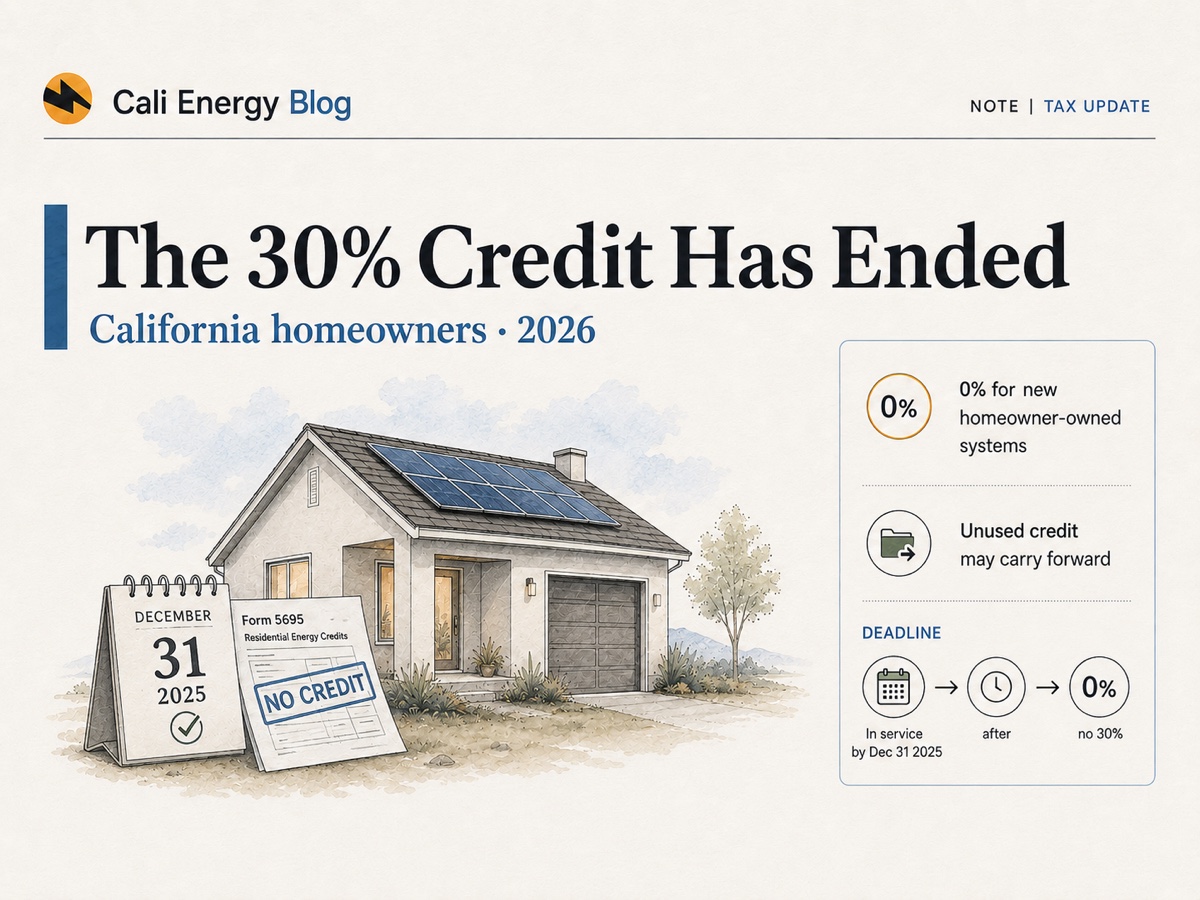
The short version
What ended, what did not, and what it means for a home in LADWP or SCE territory.
The federal Residential Clean Energy Credit — the Section 25D credit most people just call "the 30% solar tax credit" — was worth 30% of the cost of a qualifying home solar (and battery) system. Under the law passed in July 2025 (the reconciliation act commonly called the One Big Beautiful Bill Act, P.L. 119-21), that credit is not available for any property placed in service after December 31, 2025. The IRS states this directly on its Residential Clean Energy Credit page (irs.gov).
Two nuances matter for LA homeowners. First, "placed in service" means the installation is completed — not the day you signed a contract or made a deposit. Second, the credit is nonrefundable but carries forward: if you finished a system in 2025 and could not use the full credit against your tax bill, the IRS lets you apply the leftover to future years (irs.gov).
The credit's end does not change the economics that drove most LA solar decisions in the first place. California residential electricity averaged 35.25¢/kWh in April 2026 — nearly double the U.S. average of 18.83¢ (EIA). In Los Angeles the published LADWP and SCE schedules run higher still — the current numbers, taken from each utility’s own tariff, are in our Los Angeles electricity rates breakdown. High bills, not the tax credit, are what make solar pencil out here. The credit made a good deal better; losing it makes it a slower payback, not a bad one.
Timeline & who could claim it
How the 30% credit rose and expired — and, by ownership type, who was ever eligible to claim it.
30% restored
The Inflation Reduction Act set the Residential Clean Energy Credit at 30% for systems placed in service 2022 through 2032.
Last eligible day
The law moved the finish line up. A homeowner-owned system had to be fully installed (placed in service) on or before this date to claim 30%.
0% federal (homeowner-owned)
No federal residential credit for owner-occupied systems completed in 2026 or later. Unused 2025 credit still carries forward.
Educational tool, not tax advice. Eligibility turns on your specific facts and tax situation — confirm with a tax professional and the IRS.
Ownership decides who could claim it
The credit follows the owner of the equipment — that single fact explains every scenario below.
Owned outright (cash)
You own the panels, so you were the taxpayer who could claim the 30% credit — if the system was placed in service by December 31, 2025. Completed in 2026? No federal residential credit. A financing choice never mattered here; ownership did.
Owned with a solar loan
A loan does not change ownership — you still own the system, so the same rule applied: 30% if placed in service by the deadline, nothing federal if finished in 2026. Watch for lender "dealer fees" baked into loan pricing, which raise your real cost.
Lease or PPA (third-party owned)
Here a company owns the equipment, so you never claimed the residential credit — the provider claimed the business version (Section 48E) and, in theory, passed savings through your rate. These business credits are also tightening under the 2025 law, so ask any provider in writing how (and whether) that value reaches you.
Same system, two finish dates
A homeowner in the San Fernando Valley signs for a $24,000 owned system. If crews completed and commissioned it on, say, December 20, 2025, it was placed in service in 2025 and the owner could claim a $7,200 federal credit (30%), carrying forward any unused portion. The identical system finished on January 10, 2026 gets $0 federal residential credit.
Illustrative only; your credit depends on qualified costs and your tax liability. "Placed in service" is when installation is completed, per the IRS.
What still exists in 2026
The federal residential credit is gone, but several California and utility incentives are not. Verify current status before you count on any of them — funding and rules shift.
SGIP battery rebates (program continues, but residential budgets are tight). California's Self-Generation Incentive Program pays for home battery storage and is unrelated to the federal tax credit. It is not one flat rebate — it steps down as funds are used and varies by category. Checked on 8 September 2026, the general-market small residential storage step sits at $0.15/Wh and is closed to new applications, Equity Resiliency at $1.00/Wh is closed as well, and the income-qualified RSSE tier at $1.10/Wh is the one still taking applications. RSSE is not a single queue: it runs as several categories whose status ranges from open to waitlisted to closed depending on your administrator, so check which one applies to you rather than assuming the programme is shut (SelfGenCA).
California property-tax exclusion (through 2026 completions). Adding solar normally raises your home's assessed value; California's active solar energy system exclusion means a qualifying system is not reassessed. That exclusion is currently scheduled to sunset — it applies to systems completed before January 1, 2027 (CA BOE). Systems already installed keep the benefit until the property next changes ownership.
Your utility's billing rules still drive savings. For SCE (and PG&E, SDG&E) customers, exports are credited under NEM 3.0 — the CPUC Net Billing Tariff — for interconnection applications submitted on or after April 15, 2023, which pays far less for exported power and makes a battery more valuable (CPUC). LADWP is a municipal utility and is not under NEM 3.0; it runs its own net-metering and rate rules. That distinction matters: an SCE home in Pasadena and an LADWP home in the Valley have different solar math even on the same roof.
| Incentive | Through Dec 31, 2025 | 2026 |
|---|---|---|
| Federal Residential Clean Energy Credit (25D) | 30% of cost | Not available (homeowner-owned) |
| Unused 25D credit from a 2025 system | — | Still carries forward |
| SGIP battery rebate | Active steps | Program continues; residential budgets currently closed/waitlisted (~$0.15/Wh general, ~$1.00–1.10/Wh equity — verify) |
| CA active-solar property-tax exclusion | Applies | Applies to systems completed before Jan 1, 2027 |
| SCE/PG&E/SDG&E export billing | NEM 3.0 (Net Billing Tariff) | NEM 3.0 (unchanged) |
| LADWP net metering (municipal) | LADWP rules | LADWP rules (not NEM 3.0) |
Sources: IRS, SelfGenCA, CA BOE, CPUC.
Does solar still make sense without the credit?
For most LA homes, the answer is still yes — for reasons that have nothing to do with the IRS.
Payback stretches out without the 30% credit, but California's rates do the heavy lifting. LADWP's residential R-1A rate runs roughly 24–26¢/kWh in Tier 1 and about 39–41¢ in summer Tier 3, billed most homes every two months (LADWP). SCE's time-of-use plans push weekday peak power to roughly 58¢/kWh on TOU-D-4-9PM and about 74¢ on TOU-D-5-8PM, with off-peak near 34¢ in summer (SCE). Offsetting power at those prices — and, with a battery, avoiding the most expensive peak hours — is where the return comes from now.
The practical takeaway: the decision in 2026 is less about a federal deadline and more about your utility, your roof, and whether a battery makes sense on your rate plan. If you completed a system in 2025, make sure your tax preparer captures the 30% credit (Form 5695) and any carryforward.
Questions about how the end of the federal credit changes the math on your specific LADWP or SCE home? Cali Energy runs in-house crews across LADWP, SCE, and the Burbank/Glendale municipal areas and can walk you through what still applies. Call +1 (323) 844-7777.
Frequently asked
Did the 30% federal solar tax credit really end?
I finished my system in 2025 but couldn't use the whole credit. Is it lost?
What does "placed in service" mean for the deadline?
Are there any solar incentives left in California in 2026?
Does a solar lease or PPA still get the credit in 2026?
Related reading
Sources & methodology
Figures on this page come from the primary sources below and, where noted, from Cali Energy calculations using the stated assumptions. Rates, incentives, and program terms change; each was verified September 8, 2026.
- IRS — Residential Clean Energy Credit
- Congressional Research Service — Expiration and Carryforward Rules for the Residential Clean Energy Credit
- California BOE — Active Solar Energy System Exclusion
- SelfGenCA — SGIP Program Metrics
- CPUC — Net Billing Tariff (NEM 3.0)
- EIA — Average Price of Electricity by State
- LADWP — Residential Electric Rates
- SCE — Time-of-Use Residential Rate Plans
Not sure how the credit's end changes your numbers?
Cali Energy runs in-house crews across LADWP, SCE, and the Burbank and Glendale municipal utilities. We'll walk you through what still applies to your specific home and rate plan — no tax advice, just honest math. Call +1 (323) 844-7777.
Get a free estimatePrepared by Cali Energy, September 8, 2026. This article is for general educational purposes only and is not legal, tax, financial, engineering, or utility advice. Rates, incentives, codes, permit requirements, equipment specifications, prices, and program terms may change; figures and timelines are estimates, not guarantees. Confirm current requirements with the applicable utility, AHJ, program administrator, manufacturer, or a licensed professional. See our Content Disclaimer. Cali Energy · 19201 Parthenia St, Unit E, Northridge, CA 91324 · CSLB #1032379 (B, C-10, C-39)