

SGIP Battery Incentives in California: Tiers, Eligibility & Funding Status (2026)
There is no single SGIP battery rebate — and in 2026, most of the program is closed to new applicants. California's Self-Generation Incentive Program pays in tiers that step down as money runs out, from roughly $0.15/Wh for a standard home battery up to about $1.10/Wh for income-qualified households installing paired solar + storage. But as of December 31, 2025, the General Market, Equity, and Equity Resiliency budgets stopped taking new applications; the income-qualified RSSE budget is the one still taking applications — and it is not a single queue: its categories run from open to waitlisted to closed, depending on your administrator. Here is how the tiers actually work in 2026, and how to check whether any money is really available.
Get a free estimate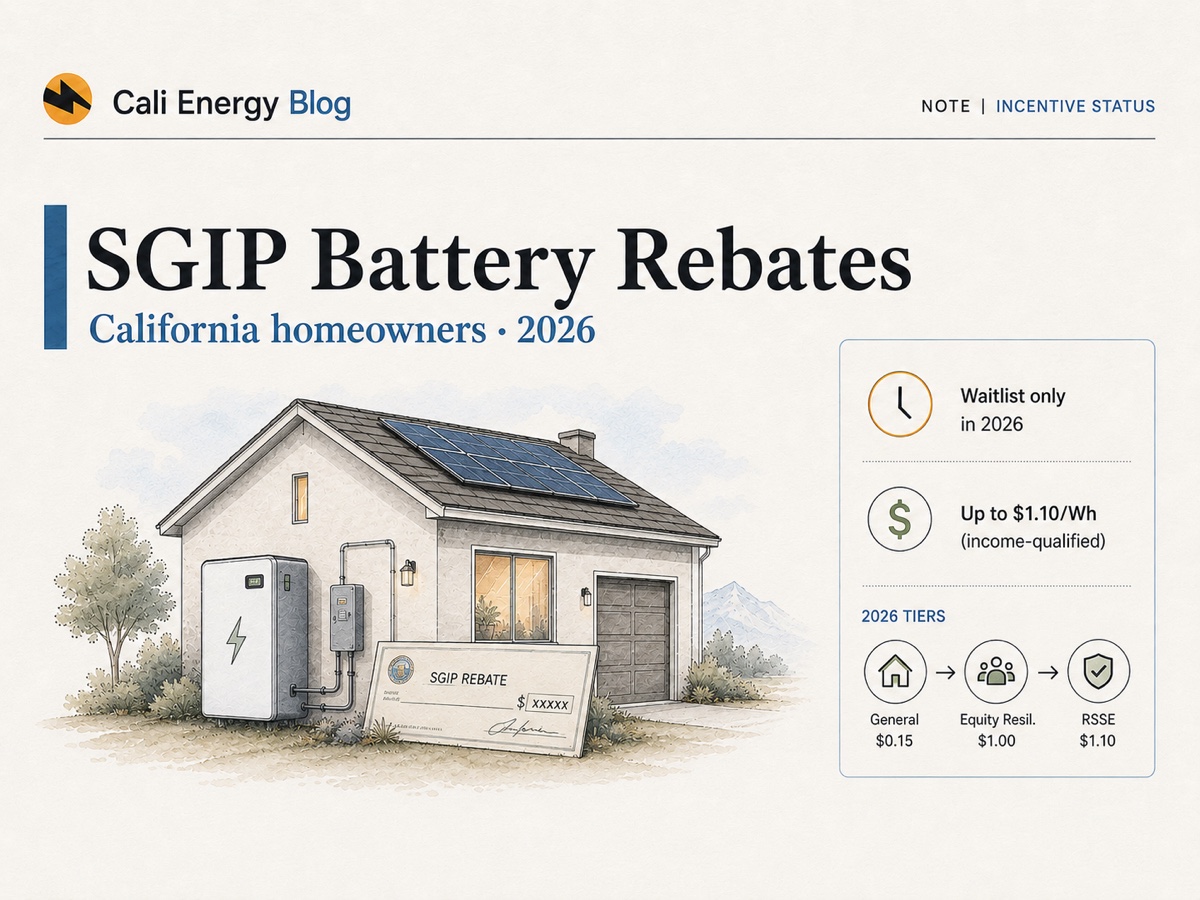
SGIP is not one rebate — it's a stack of tiers
And in 2026, most of those tiers are closed to new applicants.
The Self-Generation Incentive Program (SGIP) is California's rebate for behind-the-meter energy storage — home and business batteries. It is overseen by the California Public Utilities Commission (CPUC) and administered by the utilities in their own territories — Pacific Gas & Electric, Southern California Edison, SoCalGas, and the Center for Sustainable Energy (for SDG&E territory).
Here's the part the ads leave out: SGIP does not pay everyone the same amount. It is divided into separate budget categories, and inside each category the incentive drops in steps as the money is claimed. A standard-income household and a low-income household in a wildfire zone can install the exact same battery and receive wildly different rebates — because they draw from different buckets. And critically for 2026: most of those buckets are now closed to new applications. Rates below are approximate and change with each step-down and each new appropriation, so always verify the live number and status before you count on it.
The 2026 SGIP incentive tiers — and their status
Rates are quoted per watt-hour of usable storage (Wh). A 13.5 kWh battery = 13,500 Wh.
| Category | Who it targets | Approx. rate | 2026 status |
|---|---|---|---|
| RSSE — Residential Solar & Storage Equity (AB 209), four categories: Ratepayer, AB 209, AB 209 POU, AB 209 Non-POU | Income-qualified households installing new paired solar + storage | $1.10/Wh (+ ~$3.10/W solar) | Still taking applications — status differs by category and administrator |
| Equity Resiliency | Income/vulnerability qualifier + fire/PSPS trigger | $1.00/Wh | Closed to new applications (Dec 31, 2025) |
| Equity — Residential Storage | Income-qualified households | $0.85/Wh | Closed to new applications |
| General Market — Small Residential Storage | Standard-income homeowners | ~$0.15/Wh | Closed to new applications |
| General Market — Large-Scale Storage | Larger / commercial systems | ~$0.25/Wh | Closed to new applications |
Sources: SelfGenCA — SGIP Program Metrics, CPUC — SGIP. Rates are approximate, vary by step and administrator, and step down as budgets fill. Budgets can reopen with new appropriations, so always confirm live status.
Notice the spread and the status column. The General Market rate for a standard home battery — about $0.15/Wh — is a fraction of the roughly $1.10/Wh RSSE rate. But in 2026 that spread is largely academic for new applicants: the General Market, Equity, and Equity Resiliency budgets all stopped accepting new applications on December 31, 2025 (SelfGenCA). The one residential pathway still taking applications is the income-qualified RSSE budget — and it is worth knowing that RSSE is not a single queue. It runs as several separate categories — Ratepayer, AB 209, AB 209 POU and AB 209 Non-POU — and their statuses differ. Checked on 8 September 2026, the Ratepayer category was closed, the POU category open, the Non-POU category waitlisted, and AB 209 varied between administrators. Which applies to you depends on who administers your territory, so read the live status rather than assuming the programme is shut.
Which tier are you likely in?
Answer three questions. This is guidance, not a determination — final eligibility and current availability are set by your program administrator.
1. Who is your electric utility?
2. Are you income-qualified?
3. Do you have a resiliency risk?
Check current funding status before you rely on any rate
Checked on 8 September 2026: the General Market, Equity and Equity Resiliency budgets were closed to new applications, while the income-qualified RSSE budget was still taking them — with status differing across its categories and administrators, from open to waitlisted to closed. Budgets can reopen with new appropriations — confirm the live step, status, and available funds for your administrator on the official dashboard.
Open the SelfGenCA program-metrics dashboard →
Rates and status in this tool last verified against SelfGenCA: July 13, 2026.
The residential buckets, plainly
RSSE — the path still taking applications
The highest tier and the only residential budget still accepting applicants in 2026 — through several categories whose status ranges from open to waitlisted. Roughly $1.10/Wh for storage plus about $3.10/W for the solar it requires — you must install new solar and battery together. Income-qualified only (≤80% AMI or CARE/FERA/ESA/DAC-SASH, etc.). State-funded under AB 209, launched June 2025 with $280M (SelfGenCA).
Equity & Equity Resiliency
For income/vulnerability-qualified households — about $0.85/Wh (Equity) and $1.00/Wh (Equity Resiliency, which adds a fire-district, medical-baseline, or PSPS trigger). Both closed to new applications as of December 31, 2025 (SelfGenCA).
General Market
The old default tier for standard-income homeowners — about $0.15/Wh for small residential storage, small on purpose and stepped down over years. Closed to new applications; treat it as unavailable in 2026 unless a new appropriation reopens it.
LADWP vs. SCE: a critical distinction
Where you live decides whether SGIP is even on the table.
Standard SGIP is funded by charges on investor-owned utility ratepayers. If you are an SCE customer (most of our service area outside the City of Los Angeles), you’re inside the program — though, as noted above, RSSE is the only pathway currently taking new applicants, and which of its categories is open to you depends on your administrator.
If you're on a municipal utility — LADWP, Burbank Water & Power, or Glendale Water & Power — you are generally not eligible for standard SGIP, because your utility doesn't collect the ratepayer surcharge that funds it. RSSE is state-funded (AB 209) rather than purely IOU-ratepayer funded, so its eligibility rules differ; if you're a municipal-utility customer, don't assume SGIP — check directly whether you can access RSSE, and look at your own utility's storage programs first.
Same battery, very different outcome
Two income situations, two very different results. A standard-income SCE customer adding just a 13.5 kWh battery would once have drawn the General Market tier — about $0.15/Wh, or roughly $2,025 — but that budget is closed to new applications in 2026. An income-qualified SCE customer installing new paired solar + storage can pursue RSSE at about $1.10/Wh — roughly $14,850 on a 13.5 kWh battery — the one residential tier still accepting applicants, though the category open to you depends on your administrator.
Illustrative math (rate × 13,500 Wh) using SelfGenCA rates checked on 8 September 2026. General Market, Equity and Equity Resiliency were closed to new applications; RSSE was still taking them, with status varying by category and administrator. Actual awards depend on live status, equipment, paired-solar requirements, and administrator review.
How SGIP fits with other 2026 incentives
Two timing facts matter this year. First, the 30% federal Residential Clean Energy Credit is gone for homeowner-owned systems placed in service after December 31, 2025 (IRS) — so for most 2026 residential projects there is no federal credit to stack SGIP on top of. Second, under the Net Billing Tariff (NEM 3.0), which applies to SCE, PG&E, and SDG&E for interconnection applications submitted on or after April 15, 2023 (CPUC), a battery is now central to solar economics — which is why the SGIP storage rebate is worth chasing when you qualify for a higher tier and it's actually open.
The hard truth for 2026: with the federal credit expired and most SGIP budgets closed, a standard-income homeowner installing storage this year may have no cash incentive at all beyond bill savings. That's exactly why battery economics now lean on avoided-cost math. With California residential power averaging about 35.25¢/kWh as of April 2026 versus a U.S. average near 18.83¢ (EIA), storage that shifts you off expensive peak windows already pays off here — the rebate, when available, just accelerates it.
Frequently asked
Is there one flat SGIP rebate amount for a home battery?
No. SGIP is split into separate budget categories that each step down as funds are claimed. In 2026 the tiers range from about $0.15/Wh (General Market) up to $1.10/Wh for the income-qualified RSSE budget, with Equity at ~$0.85/Wh and Equity Resiliency at ~$1.00/Wh. Just as important: only RSSE is still accepting applicants (by waitlist) — the others closed to new applications on December 31, 2025 per SelfGenCA.
Can LADWP customers get SGIP?
Generally no. Standard SGIP is funded by investor-owned-utility ratepayers (SCE, PG&E, SDG&E, SoCalGas), so municipal-utility customers like LADWP, Burbank, and Glendale are usually excluded. The income-qualified RSSE budget is state-funded (AB 209), so its rules differ — verify directly with your own utility whether you can access it, and check your utility's own storage programs.
Who qualifies for the Equity Resiliency tier?
You generally need both an equity/vulnerability qualifier and a resiliency trigger: living in a Tier 2 or Tier 3 High Fire-Threat District, being on a medical baseline plan, or having experienced two or more PSPS shutoffs (or one PSPS plus a wildfire outage since 2017). Note that in 2026 the Equity Resiliency budget is closed to new applications. See the CPUC eligibility matrix.
Is SGIP money still available in 2026?
Barely, and only for one tier. As of the end of 2025, the General Market, Equity, and Equity Resiliency budgets closed to new applications. The only pathway still accepting applicants is the income-qualified RSSE budget — and it runs as several categories whose status differs: checked on 8 September 2026 one was open, one waitlisted, one closed, and one varied by administrator. Budgets can reopen with new state appropriations, so always check the live status on the SelfGenCA program-metrics dashboard before relying on any rate.
Can I combine SGIP with the federal tax credit?
For most 2026 residential projects, no — the 30% federal Residential Clean Energy Credit is not available for homeowner-owned systems placed in service after December 31, 2025 (IRS). With the federal credit gone and most SGIP budgets closed, a standard-income battery project this year may have no cash incentive at all beyond bill savings.
Related reading
Sources & methodology
Figures on this page come from the primary sources below and, where noted, from Cali Energy calculations using the stated assumptions. Rates, incentives, and program terms change; each was verified September 8, 2026.
- SelfGenCA — SGIP Program Metrics (live incentive rates & funding status)
- CPUC — Self-Generation Incentive Program (SGIP)
- CPUC — SGIP Fact Sheet: Residential Solar and Storage Equity (RSSE)
- CPUC — SGIP Equity Resiliency Eligibility Matrix (residential)
- CPUC — Net Billing Tariff (NEM 3.0)
- IRS — Residential Clean Energy Credit
- EIA — Average Price of Electricity (Table 5.6.A)
Find out which SGIP tier you actually qualify for — and whether it's funded
Cali Energy installs solar + storage across LADWP, SCE, and Burbank/Glendale territories and handles the SGIP paperwork. With most budgets closed for 2026 and only the RSSE tier still open (waitlist), we'll tell you honestly which tier you realistically qualify for and whether money is actually available — before you commit. Call (323) 844-7777.
Get a free estimatePrepared by Cali Energy, September 8, 2026. This article is for general educational purposes only and is not legal, tax, financial, engineering, or utility advice. Rates, incentives, codes, permit requirements, equipment specifications, prices, and program terms may change; figures and timelines are estimates, not guarantees. Confirm current requirements with the applicable utility, AHJ, program administrator, manufacturer, or a licensed professional. See our Content Disclaimer. Cali Energy · 19201 Parthenia St, Unit E, Northridge, CA 91324 · CSLB #1032379 (B, C-10, C-39)