

How Do Solar Panels Work? A Plain-English Guide
Short answer: sunlight knocks electrons loose in the silicon cells of a panel, producing direct current (DC). An inverter converts that DC into the alternating current (AC) your home uses. Your appliances take what they need first; any extra flows to the grid for a credit, or into a battery, and at night you draw power back. On a south-facing Los Angeles roof, each kilowatt of panels delivers about 1,630–1,700 kWh a year. Here is the whole chain, step by step.
Get a free estimate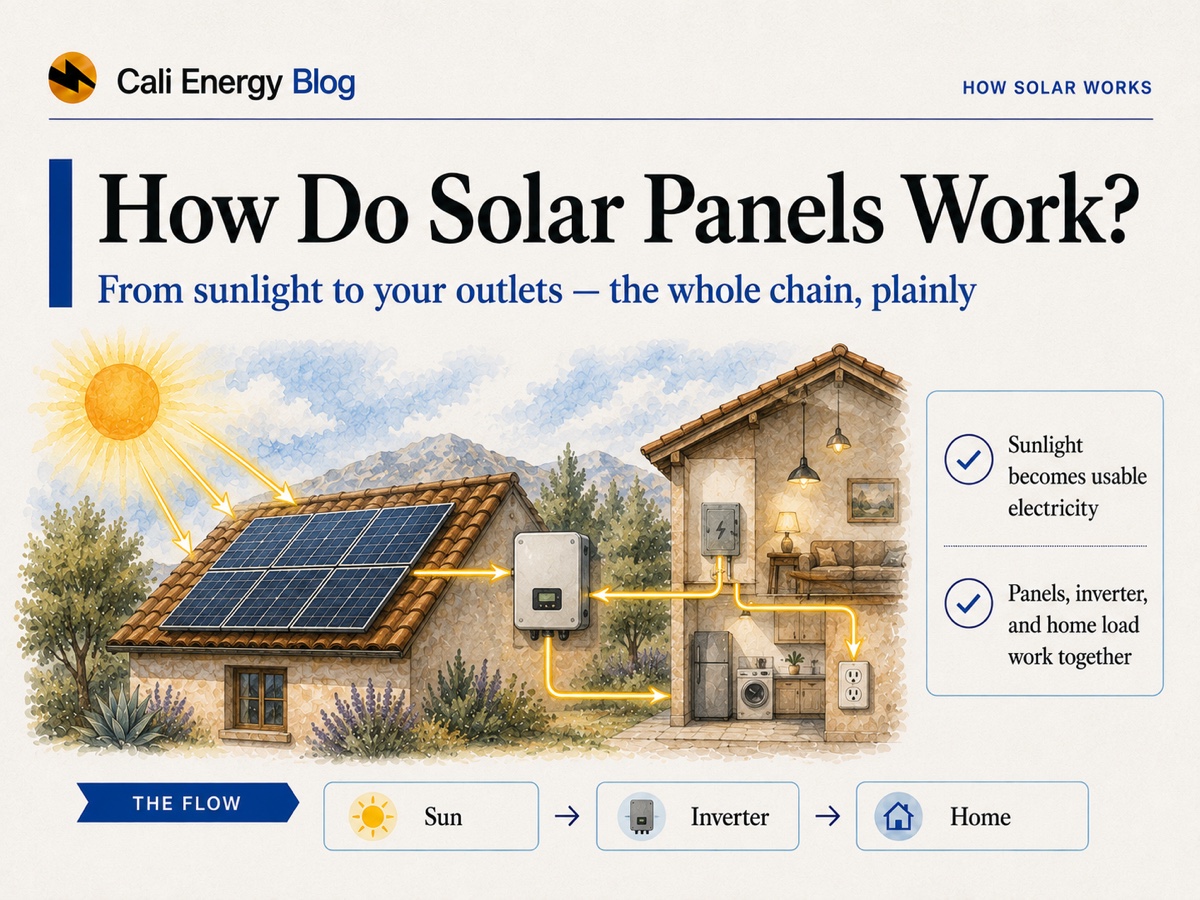
- Solar panels use the photovoltaic effect: sunlight frees electric charges in silicon cells, and the cell’s built-in electric field turns them into DC electricity.
- An inverter converts DC into the AC your home and the grid use.
- Your home uses solar power first; extra is exported to the grid for a credit or stored in a battery. At night you draw power back.
- Panels on California’s approved list since 2024 convert a median 21.8% of the sunlight that hits them (400–470 W models). After real-world losses, about 76% of what the panels are rated for reaches your outlets.
- A panel’s rating is kW, what you are billed for is kWh: in LA each kW of panels makes about 1,630–1,700 kWh a year.
The 30-second version
A home solar system is a chain that moves energy from the sun to your outlets. Follow it once and the rest of this guide clicks into place.
Sun → panels → inverter → your home → grid or battery. The panels turn sunlight into DC electricity. The inverter turns that DC into the AC your lights, fridge and air conditioner run on. Your home takes what it needs in real time. Whatever is left over flows out to the utility grid for a credit, or into a home battery for later. When the panels aren’t producing — at night, or on a dark storm day — you draw power back from the grid or the battery.
Step 1: The photovoltaic effect (sunlight becomes electricity)
It happens inside the panel, with no moving parts at all.
A solar panel is made of dozens of photovoltaic cells, mostly silicon. When sunlight is absorbed by a cell, the energy creates electrical charges that move in response to an internal electric field in the cell, causing electricity to flow — direct current (DC), flowing one way (U.S. Department of Energy).
Two things worth being clear about. First, panels make electricity, not heat; solar panels (PV) are different from solar thermal water heaters. Second, a panel converts only part of the sunlight that lands on it. Among 400–470 W modules added to the California Energy Commission’s approved list since 2024, the median efficiency is 21.8%, and the middle half of models fall between 21.1% and 22.6%; for 2019–2021 listings the median was 20.1% (CEC PV Module List). Research cells in the lab go much higher (national lab efficiency chart). Higher efficiency mostly means more watts per square foot — useful on a small roof, not free energy.
Step 2: The inverter (DC becomes usable AC)
Your panels make DC; your house runs on AC. The inverter is the translator between them.
Grid electricity and your home’s wiring use alternating current (AC), which reverses direction many times a second. An inverter converts the panels’ DC into AC at the right voltage and frequency for your home and the grid (U.S. Department of Energy).
There are two common designs. A string inverter is one central box that the panels feed together, often with an optimizer under each panel; microinverters sit under each panel and convert its power on the roof. Both give panel-level control, and on the same roof they make almost the same energy — see Enphase vs SolarEdge.
Step 3: Your home uses what it needs
Once the inverter has made AC, that power feeds your electrical panel, and your appliances use it before anything else happens.
Solar power is used on-site first. When the panels are producing and the fridge, air conditioner or EV charger is running, they draw on the solar directly; only what the house isn’t using at that moment goes anywhere else. SCE describes it the same way: your home uses your solar power first (SCE). On a sunny afternoon a home often makes more than it uses; at 7 p.m. with the oven on, it uses more than it makes. The system balances that second by second, automatically.
Step 4: Extra power goes to the grid — or a battery
What the surplus is worth depends on your utility.
Power your home doesn’t use flows back through the meter onto the grid, and you earn a credit. On SCE, systems that applied from April 15, 2023 are on the Solar Billing Plan (NEM 3.0), where an export’s value depends on the hour: for a system starting in 2026, SCE’s published averages are about 6¢/kWh on a summer day and 21¢ on a summer evening — far below what you pay to buy power back. That is why NEM 3.0 rewards using or storing your own solar; see NEM 3.0 explained. On LADWP, which is not on NEM 3.0, exports are netted against your purchases kilowatt-hour for kilowatt-hour at retail over each billing period (LADWP) — details in LADWP net metering.
The alternative to exporting is a home battery: it stores the afternoon surplus and runs the house in the evening, when usage and SCE’s prices peak. Under NEM 3.0, energy you store and use yourself is usually worth far more than the export credit would have been.
Step 5: At night, the flow reverses
Panels make nothing in the dark, which is why nearly every home system stays connected to the grid.
After sunset your home draws from the battery, if you have one, and then from the grid. That is also why going solar rarely erases the electric bill: fixed charges and night-time power remain — see why you still have a bill after solar.
A safety note: a standard grid-tied system shuts off during a blackout, even in daylight, so it can’t send power into lines that crews may be repairing. Keeping the lights on takes a battery with backup equipment; a narrow exception is Enphase’s daytime-only Sunlight Backup on IQ8 systems. See do solar panels work in a power outage?
The whole chain, step by step
The entire energy path in one place, with an everyday analogy for each step.
| Step | What happens | Everyday analogy |
|---|---|---|
| 1. Panels | Sunlight frees charges in silicon cells, making DC electricity. | A water wheel that only turns one way |
| 2. Inverter | Converts DC into AC at the right voltage for your home and the grid. | A translator between two languages |
| 3. Your home | Appliances use the solar AC first, in real time. | Eating what is on your plate before saving leftovers |
| 4a. Export | Surplus flows to the grid for a credit. | Putting change into a shared jar |
| 4b. Battery | Surplus is stored to use in the evening. | Saving leftovers in the fridge for dinner |
| 5. Night | Home draws from the battery, then the grid. | Spending the change you saved |
Sources: U.S. Department of Energy — How Does Solar Work? · DOE — inverters and grid services
Where the energy goes on an LA roof
A panel’s kW rating is measured with 1,000 W of sunlight per square meter and the cell at 25°C. A roof never matches that all year, so here is what happens to one kilowatt of panels over a typical year.
| Stage | Northridge, kWh | Santa Monica, kWh | Lost at this stage (Northridge) |
|---|---|---|---|
| Sunlight on the panels, at the panels’ rating | 2,245 | 2,147 | — |
| After dirt, shade, wiring, mismatch, reflection and other losses | 1,895 | 1,815 | 15.6% |
| After heat (cells warmer than 25°C) | 1,780 | 1,708 | 6.1% |
| After the inverter: AC to your home | 1,700 | 1,630 | 4.5% |
Our calculation from NREL PVWatts version 8 hourly output (typical-year weather; defaults of 14% system losses, 96% inverter efficiency and a 1.2 DC-to-AC ratio; loss categories in the PVWatts manual). The heat step is worked through in how heat affects solar output in LA.
About 76% of the rated energy reaches your outlets — normal, and already in any honest production estimate. Orientation and tilt move the starting number: a flat roof collects less than a 20° south-facing one. One of our published LA projects, an 8.28 kW array flush on a flat roof, was estimated at 10,918 kWh for its first year — about 1,320 kWh per kW (see the project). How direction changes output is covered in which way solar panels should face.
kW vs. kWh: the one thing worth understanding
Almost every solar mix-up traces back to these two units.
| kW (kilowatt) | kWh (kilowatt-hour) | |
|---|---|---|
| What it measures | Power — the rate right now | Energy — the total amount over time |
| Everyday analogy | Speed on the speedometer | Miles actually driven |
| On your system | System size, such as a “7 kW system” | What it produces, such as “30 kWh today” |
| On your bill | — | You are billed per kWh |
| The link in LA | Each kW of south-facing panels makes about 1,630–1,700 kWh a year: a 7 kW system about 11,400–11,900 kWh, or 31–33 kWh a day on average. | |
A “7 kW system” is the panels’ rated power, not what comes out of the wall. In the PVWatts model with the usual 1.2 DC-to-AC ratio, a 7 kW array in the Valley tops out near 5.8 kW of AC in its best hours, which is the inverter’s limit. Sizing a system is really matching the kWh it makes in a year to the kWh your home uses — see how many solar panels you need in California.
Why real-world output changes day to day
Sun angle & season
Long summer days and a high sun mean more production; short winter days mean less. In the Valley, August is the most productive month.
Shade & dirt
Trees, chimneys and dust cut output; soiling commonly costs 2–3% a year and rain or a rinse brings it back. See solar and shade.
Roof direction
South-facing roofs collect the most over a day; east and west shift production toward morning or evening.
Heat
Hot cells make less power — about 6% of a year’s output in the Valley with a standard panel. See how heat affects output in LA.
Clouds & weather
Panels still make some power on overcast days, just less.
System age
Output declines slowly — about 0.5% a year for modules and 0.75% for whole systems. See solar panel degradation.
What solar panels do — and don’t — do
Solar panels turn sunlight into DC electricity, an inverter turns it into the AC your home runs on, your appliances use it first, and the rest is exported for a credit or stored for the evening. They don’t heat your water, they don’t work in the dark, and a standard grid-tied system doesn’t keep the lights on in an outage without a battery. What they do is shift where your daytime power comes from — from the utility to your own roof. Cali Energy (CSLB #1032379) designs and installs solar across Los Angeles and the San Fernando Valley; see our Northridge projects.
Frequently asked
How do solar panels actually make electricity?
Through the photovoltaic effect. When sunlight is absorbed by a panel’s silicon cells, it creates electrical charges that move in response to an internal electric field, so electricity flows — as direct current (DC). An inverter then converts the DC into the AC your home uses. There are no moving parts in the panel itself.
What does the inverter do?
It converts the DC electricity your panels produce into the AC electricity your home and the grid run on, at the right voltage and frequency. It comes as one central string inverter, often with an optimizer under each panel, or as microinverters under each panel — compared in Enphase vs SolarEdge.
Do solar panels work at night or on cloudy days?
Not at night — panels need light, so after dark your home draws from a battery or the grid. On cloudy days they still work, at reduced output. That is why most homes stay grid-connected, and part of why you can still have a bill after going solar.
How much electricity does a solar panel system make in Los Angeles?
In NREL’s PVWatts model, each kW of south-facing panels at a 20° tilt makes about 1,700 kWh a year in Northridge and 1,630 in Santa Monica, so a 7 kW system makes about 11,400–11,900 kWh, or 31–33 kWh a day on average. Flat, east- or west-facing and shaded roofs make less.
What is the difference between kW and kWh?
kW measures power, the rate at a moment, and describes system size (a “7 kW system”). kWh measures energy over time, and is what your bill charges for. A 7 kW array rarely delivers 7 kW: with a typical inverter it tops out near 5.8 kW of AC in its best hours in the Valley.
What happens to the extra electricity my panels make?
Your home uses solar first; any surplus is exported to the grid for a credit or stored in a battery. On SCE’s Solar Billing Plan (NEM 3.0) an export for a 2026 system earns about 6¢/kWh on a summer day and 21¢ on a summer evening, which favors using or storing your own power. LADWP nets exports against purchases at retail over each billing period. See NEM 3.0 explained.
How efficient are solar panels?
Among 400–470 W panels added to California’s approved list since 2024, the median converts 21.8% of the sunlight hitting it into electricity, and the middle half fall between 21.1% and 22.6%. Higher efficiency means more watts per square foot, useful on a small roof. After real-world losses, about 76% of the energy the panels are rated for reaches your outlets.
Related reading
Sources & methodology
Figures on this page come from the primary sources below and, where noted, from Cali Energy calculations using the stated assumptions. Rates, incentives, and program terms change; each was verified September 28, 2026.
- U.S. Department of Energy — How Does Solar Work?
- U.S. Department of Energy — Solar Integration: Inverters and Grid Services Basics
- California Energy Commission — PV Module List (data as of September 21, 2026)
- NLR (formerly NREL) — PVWatts Calculator
- NLR — PVWatts Version 5 Manual (default loss categories)
- NLR — Best Research-Cell Efficiency Chart
- SCE — How the Solar Billing Plan works
- LADWP — Service Rider NEM, Net Energy Metering
See what solar would do on your roof
We'll look at your roof direction, shade and recent bills and explain in plain English what a system would produce and save — no pressure, no jargon.
Get a free estimatePrepared by Cali Energy, September 28, 2026. This article is for general educational purposes only and is not legal, tax, financial, engineering, or utility advice. Rates, incentives, codes, permit requirements, equipment specifications, prices, and program terms may change; figures and timelines are estimates, not guarantees. Confirm current requirements with the applicable utility, AHJ, program administrator, manufacturer, or a licensed professional. See our Content Disclaimer. Cali Energy · 19201 Parthenia St, Unit E, Northridge, CA 91324 · CSLB #1032379 (B, C-10, C-39)