

Enphase vs SolarEdge: Which Inverter Is Right for Your Home?
Short answer: on the same roof they make almost the same energy and handle shade the same way, so the choice comes down to warranty terms, batteries and backup, and how you might expand. Enphase puts a microinverter under each panel, covered for 25 years. SolarEdge puts an optimizer under each panel (25 years) and one inverter on the wall — 12 years, or 10 for its new Nexis model, with paid extensions on its Home Hub and Home Wave inverters. Below: the 2026 lineups side by side, a same-roof output test for Los Angeles, and what each warranty actually covers.
Get a free estimate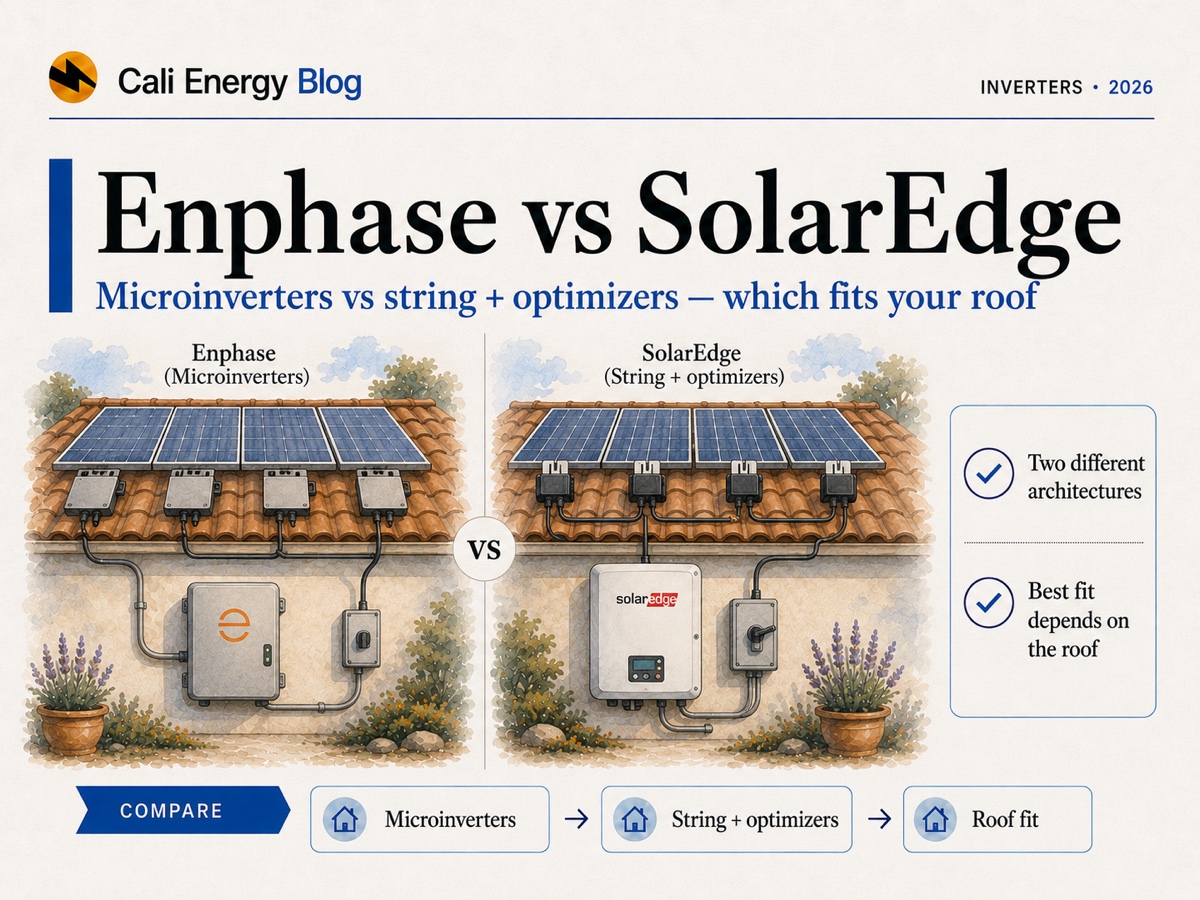
- Both put one electronic device under every panel: Enphase a microinverter, SolarEdge a DC optimizer that feeds one inverter on the wall. Both give panel-level monitoring and are listed for NEC 690.12 rapid shutdown.
- Energy is a near-tie. On one Northridge roof of 20 × 430 W panels, an Enphase IQ8H and a SolarEdge SE7600H design, both 7.6 kW, came out 0.4% apart over a year. Undersized electronics mattered more: clipping cost 0.6% with IQ8M microinverters and 2.5% with a 6 kW SolarEdge inverter.
- Shade is a tie too: in NREL’s side-by-side test, Enphase recovered 23% of shading losses and SolarEdge 25%.
- Warranties differ most. Enphase microinverters: 25 years. SolarEdge: 25 on optimizers, 12 on the Home Hub inverter, 10 on Nexis; extending a Home Hub inverter to 25 years cost $170–$225 on SolarEdge’s early-2026 price list. Neither pays for the labor to swap a failed part, apart from Enphase’s two-year installer reimbursement, and both expect the system to stay online.
- Batteries and backup: Enphase pairs with AC-coupled IQ Batteries and can run daytime Sunlight Backup with no battery; SolarEdge backup needs its own battery — the Home Battery or the new modular Nexis Battery.
What each system puts on your roof
Both are module-level systems: there is one small electronic box under every panel. With Enphase that box is a microinverter, which turns the panel’s DC into AC right on the roof; a gateway and combiner near your electrical panel link the microinverters and connect them to the internet. With SolarEdge the box is a DC optimizer, which tunes each panel’s output and drops it to about 1 V whenever the inverter is off; the optimizers feed one inverter on the wall that makes AC for the whole array (SolarEdge optimizer datasheet).
So the roof carries the same number of devices either way. The difference is the extra box: a failed SolarEdge inverter stops the whole array until it is replaced, but it hangs on a wall where it is easy to reach; a failed microinverter or optimizer usually takes out one panel, and swapping it means roof work. Both are certified for rapid shutdown under NEC 690.12, 2014 through 2023 editions (Enphase, SolarEdge). For the plain string inverters both replace, see what a solar inverter does.
The 2026 lineups side by side
Every row below comes from the manufacturers’ current US warranties and datasheets or from the California Energy Commission’s inverter list.
| Feature | Enphase | SolarEdge |
|---|---|---|
| Under each panel | Microinverter: IQ8 series, or the new IQ9N (US launch June 2026) | DC optimizer: S440, S500B or S650B |
| On the wall | IQ Gateway or IQ Combiner (monitoring and controls) | One inverter: Home Hub (3–11.4 kW) or the new Nexis (3.8–13 kW, US orders from July 2026) |
| AC rating | Per panel: IQ8M 325 VA, IQ8A 349, IQ8H 380, IQ9N 427 | Set by the inverter size; Nexis takes up to twice its AC rating in panels (preliminary datasheet) |
| CEC weighted efficiency | 97–97.5% (IQ8 series), 97.5% (IQ9N) | Inverter 99% (Home Hub; Nexis 98.5–99%) × optimizer 98.6% ≈ 97.1–97.6% |
| Standard warranty | Microinverters 25 years from activation; gateway and combiner 5; IQ System Controller 10 | Optimizers 25 years; Home Hub and Home Wave inverters 12; Nexis inverter 10; communication devices 5 |
| Longer inverter coverage | Not needed for the microinverters | Extension to 20 or 25 years for a one-time fee, bought within a set window after shipment; Home Hub to 25 years: $170 (up to 6 kW) or $225 (7.6–11.4 kW) |
| Labor to replace a failed unit | Not covered; Enphase pays installers $200 per visit plus $25 per microinverter in the first two years | Not covered unless SolarEdge agrees in writing in advance |
| Conditions | Registered within 45 days, usually by the installer (waived for California residents); stay online; a new owner files a transfer form and pays a fee | Stay connected to SolarEdge monitoring; transfers to a new owner in the same country |
| Batteries | IQ Battery 5P (5 kWh) and 10C (10 kWh), AC-coupled | Home Battery with the Home Hub; Nexis Battery in 5 kWh blocks, DC- or AC-coupled |
| Outage power without a battery | Yes, daytime only, on IQ8 systems with Enphase’s controllers (Sunlight Backup) | No — backup needs the battery plus a Backup Interface (Home Hub) or IslandDER (Nexis) |
| Adding panels later | Panel by panel, within branch-circuit limits; IQ9N can join an IQ8 or IQ7 system, not the reverse | Needs spare inverter capacity; a single-phase string holds 8–25 S440 optimizers and up to 5,700 W |
Sources: Enphase US limited warranty (systems activated on or after May 2, 2026), labor reimbursement policy (February 2026), IQ8 and IQ9N datasheets; SolarEdge limited product warranty (effective January 1, 2026), warranty extension terms, North America extension price list (as posted in early 2026), S-series optimizer and Nexis inverter datasheets, Nexis product page; efficiencies from the CEC Grid Support Inverter List (data as of September 21, 2026). Terms change — check the documents in force on your install date.
Same roof, same panels: how much energy each makes
To compare like with like, we wired one Los Angeles roof seven ways and ran every design through the same hour-by-hour weather.
The roof: 20 panels of 430 W (8.6 kW) facing south at a 20° tilt in Northridge. The panels’ hourly output comes from NREL’s PVWatts, version 8, on typical-year weather. Following NREL’s method for module-level electronics, we set mismatch loss to zero for every design, applied each device’s part-load efficiency from the California Energy Commission’s list — for SolarEdge, the optimizer’s 98.6% times the inverter’s curve — and cut off output above each device’s continuous rating. That cut-off is clipping; the DC-to-AC ratio — panel watts divided by the electronics’ AC rating — shows how much of it to expect.
| Design | AC rating | DC-to-AC ratio | Yearly output | Lost to clipping |
|---|---|---|---|---|
| Enphase IQ9N × 20 | 8.54 kW | 1.01 | 15,236 kWh | 0% |
| SolarEdge Nexis NX7600T + 20 S440 | 7.68 kW | 1.12 | 15,229 kWh | 0% |
| SolarEdge Home Hub SE7600H + 20 S440 | 7.62 kW | 1.13 | 15,228 kWh | 0% |
| Enphase IQ8H × 20 | 7.60 kW | 1.13 | 15,171 kWh | 0% |
| Enphase IQ8A × 20 | 6.98 kW | 1.23 | 15,143 kWh | 0.1% |
| Enphase IQ8M × 20 | 6.50 kW | 1.32 | 15,077 kWh | 0.6% |
| SolarEdge Home Hub SE6000H + 20 S440 | 6.05 kW | 1.42 | 14,844 kWh | 2.5% |
Our calculation. Hourly DC output: NREL PVWatts version 8 (API; typical-year NSRDB weather, roof mount, standard module, 14% system losses less the 2% mismatch loss, per NREL’s guidance for microinverters and optimizers). Efficiency curves and continuous ratings: CEC inverter list; optimizer weighted efficiency 98.6% from SolarEdge’s datasheet. Night-time standby use is ignored. Hourly weather smooths brief bright spikes, so real clipping runs somewhat higher than shown.
The five designs sized at a DC-to-AC ratio of 1.23 or less land within about 0.6% of each other, and the SolarEdge SE7600H and Enphase IQ8H, both 7.6 kW, are 0.4% apart — 57 kWh in a year. The bigger gaps come from sizing, not brand. Enphase lists 260–460 W panels as common pairings for the IQ8M and enforces no DC-to-AC ratio (IQ8 datasheet), so a 430 W panel on an IQ8M is a legitimate design; it simply runs at 1.32 and clips in the brightest hours. A 6 kW SolarEdge inverter on the same 8.6 kW array does the same thing at 1.42. On the coast, in Santa Monica, the order is the same and the gaps are slightly smaller (clipping 0.4% and 2.0%). A cheaper, smaller inverter or microinverter can still be the right trade — as long as the quote shows the ratio. How heat enters the same model is covered in how heat affects solar output in LA.
Shade: a tie in the national lab’s side-by-side test
Module-level electronics help a shaded roof by stopping one dim panel from dragging down the rest; they cannot bring back light the shade actually blocks. NREL measured exactly this, running an Enphase array (M215 microinverters) and a SolarEdge array (OP250 optimizers) beside a plain string-inverter array under the same 22 shading patterns. The two module-level arrays were closely matched: weighted to a year of light, moderate and heavy shade, Enphase recovered 23% and SolarEdge 25% of the energy the string array lost to shade. Across its tests NREL puts the typical recovery at 25–35%, driven more by how many strings the array had than by which equipment was installed (NREL, 2016).
Those units are older generations, but the physics has not changed: on a shaded roof either brand beats a plain string inverter by a similar margin, and neither makes shade go away. Designing around the shade matters more — see solar panels, shade and trees.
Warranty: what the 2026 documents actually say
Enphase covers IQ8 and IQ9N microinverters for 25 years from activation. The gateway and combiner that connect them carry 5 years, and the IQ System Controller used for backup 10 (Enphase US warranty, May 2026). Enphase asks for registration within 45 days, usually done by the installer at setup, though the warranty waives that condition for California residents; a buyer of your home keeps the coverage only by filing Enphase’s change-of-ownership form and paying its transfer fee within 30 days of the sale.
SolarEdge covers optimizers for 25 years and its Home Hub and Home Wave inverters for 12; the new Nexis inverter is limited to 10 (SolarEdge warranty, January 2026). The inverter term can be extended to 20 or 25 years for a one-time fee, bought within a limited window after the inverter ships — 24 months on SolarEdge’s price list, 36 on its warranty page, so have it bought at installation. On the North America price list as posted in early 2026, extending a Home Hub inverter to 25 years cost $170 up to 6 kW and $225 for 7.6–11.4 kW; Nexis was not on that list yet. The warranty passes to a new owner as long as the equipment stays in the same country.
What neither covers: the labor to remove and replace a failed part. SolarEdge excludes labor unless it agrees in writing in advance. Enphase excludes it too, but separately pays installers $200 per visit plus $25 per microinverter for replacements made in the first two years (Enphase labor reimbursement). After that, labor is between you and your installer’s workmanship warranty. Both makers also expect the system to stay online: Enphase’s warranty says its products should stay connected to the internet, and its IQ9N datasheet ties the 25-year term to an internet-connected gateway; SolarEdge says it cannot honor the warranty on products left disconnected from its monitoring. For how the four layers of a solar warranty fit together, see solar warranties explained.
Batteries and outage backup
If you want a battery now or later, choose the battery family first, because each platform works with its own. Enphase batteries are AC-coupled — the IQ Battery 5P (5 kWh) and 10C (10 kWh) — and work with IQ8 and IQ9N microinverters (IQ9N datasheet). SolarEdge pairs the Home Hub inverter with its Home Battery, and the new Nexis inverter with a modular battery built from 5 kWh blocks, up to 20 kWh per stack; SolarEdge says the system scales to 80 kWh once support for a fourth stack arrives, expected in the first quarter of 2027 (SolarEdge, July 2026). A DC-coupled battery stores solar power before it is converted to AC, saving one conversion step. Each maker defines battery efficiency its own way, so compare those figures only on the same basis.
Backup without a battery is where the platforms truly differ. IQ8 microinverters can form their own small grid, so with Enphase’s system controller and load controller they can run a few essential circuits during a daytime outage with no battery at all — Enphase calls it Sunlight Backup, and it stops when the sun does (how solar behaves in an outage). SolarEdge’s backup is built around its battery: a Home Hub system needs a battery and a Backup Interface (SolarEdge application note), and Nexis needs its battery and an IslandDER meter collar; with those, it supports up to 14.5 kW of whole-home backup (SolarEdge). A Tesla Powerwall 3 is a third path with its own built-in solar inverter — compared in Powerwall vs Enphase vs FranklinWH.
Adding panels later
Enphase grows one panel at a time: each new panel brings its own microinverter, limited mainly by the branch circuit — Enphase allows 11 IQ8M or 10 IQ8H per 20 A branch, subject to local rules (IQ8 datasheet). IQ9N microinverters can be added to an existing IQ8 or IQ7 system, but not the reverse: IQ7 or IQ8 units cannot join a site already running IQ9N on the same gateway (IQ9N datasheet).
SolarEdge additions need room on the existing inverter and must fit its string rules: on a single-phase inverter a string runs 8 to 25 S440 optimizers (at least 6 with S500B or S650B) and delivers up to 5,700 W (optimizer datasheet). A few extra panels usually extend an existing string; past the inverter’s headroom you need a larger or second inverter. The Nexis inverter accepts up to twice its AC rating in panels, per its preliminary datasheet. More in adding panels to an existing system.
Which one fits your situation
There is no universal winner. Match the platform to what you need.
You want a battery
Choose the battery first. IQ Batteries go with Enphase; the Home Battery or Nexis Battery with SolarEdge. For a Powerwall 3, the inverter is Tesla’s.
Daytime backup, no battery
Only Enphase offers it, on IQ8 systems with its controllers. It keeps a few essential circuits running while the sun is up.
Longest standard warranty
Enphase: 25 years on the microinverters with nothing to add. With SolarEdge, ask for the 25-year inverter extension to be included — inexpensive, but time-limited.
You may add panels
Enphase adds panel by panel. SolarEdge works too if the inverter has headroom, so ask for it to be sized with room to grow.
Shaded or complex roof
A tie. In NREL’s test both recovered about a quarter of shading losses. Decide on the other factors.
Most energy for the money
Brand barely moves output; sizing does. Compare price per watt alongside the DC-to-AC ratio and the warranty terms.
Six lines that decide Enphase vs SolarEdge
- Exact models: IQ8M, IQ8H or IQ9N; Home Hub or Nexis, and the SolarEdge inverter’s size.
- DC-to-AC ratio: panel watts divided by the AC rating. In our Northridge model, 1.01–1.23 clipped almost nothing; 1.32 lost 0.6% of the year and 1.42 lost 2.5%.
- Inverter warranty: SolarEdge’s is 12 years (Nexis 10) unless an extension is included — ask whether it is, and in whose name it is registered.
- Labor after year two: who pays to replace a failed microinverter, optimizer or inverter. The installer’s workmanship warranty should say.
- Internet link: both warranties expect the system to stay online. Ask how it connects (Wi-Fi, Ethernet or cellular) and whether cellular service costs extra.
- Battery path: which battery the design supports now and later, and what extra equipment backup needs.
For the rest of the proposal, use our checklist for comparing solar quotes.
What we install — and why it depends
Cali Energy (CSLB #1032379) designs and installs both Enphase and SolarEdge systems across Los Angeles and the San Fernando Valley. We don’t push one brand for everyone — we look at your roof’s orientations and shading, whether you want a battery or daytime backup now or later, and your budget, then recommend the platform that fits and explain why. Curious how many panels you’d need first? Start with how many solar panels do I need in California, then let’s talk through the inverter choice for your roof.
Get a free system recommendationFrequently asked
Is Enphase or SolarEdge better?
Neither across the board. On the same roof they make nearly the same energy — in our Northridge model, 7.6 kW designs from each came out 0.4% apart over a year — and NREL found them evenly matched in shade. Enphase has the longer standard warranty (25 years on the microinverters) and can offer daytime backup without a battery. SolarEdge covers its optimizers for 25 years but its inverter for 12 (10 on Nexis), extendable for a fee, and pairs with DC-coupled batteries. Choose by battery plans, backup needs and the terms in your quote.
Which produces more energy, Enphase or SolarEdge?
About the same. California’s inverter list rates SolarEdge’s Home Hub inverters at 99% (Nexis 98.5–99%), and with the optimizer’s 98.6% that makes about 97.1–97.6%; Enphase microinverters are rated 97–97.5%. In our model of one 8.6 kW roof in Northridge, designs sized at a DC-to-AC ratio of 1.23 or less were within about 0.6% of each other over a year. Undersized electronics cost more: clipping took 0.6% of the year with IQ8M microinverters on 430 W panels and 2.5% with a 6 kW SolarEdge inverter.
Which is better for a shaded roof?
Neither, in NREL’s side-by-side test: under the same 22 shading patterns, the Enphase array recovered 23% of the energy a string-inverter array lost to shade, and the SolarEdge array 25%. NREL puts typical recovery at 25–35%. Both stop a shaded panel from dragging down the others; neither recovers light the shade actually blocks.
Which has the better warranty, Enphase or SolarEdge?
On paper, Enphase: its IQ8 and IQ9N microinverters carry 25 years from activation. SolarEdge covers optimizers for 25 years but its Home Hub inverter for 12 and the new Nexis inverter for 10. A 25-year extension on a Home Hub inverter was $170–$225 on SolarEdge’s early-2026 price list, and it has to be bought within a limited window after shipment. Neither warranty pays for the labor to swap a failed part, except Enphase’s reimbursement to installers during the first two years.
Do Enphase and SolarEdge warranties require an internet connection?
In practice, yes. Enphase’s warranty asks that its products stay connected to the internet, and its IQ9N datasheet ties the 25-year term to an internet-connected gateway. SolarEdge’s says it cannot honor the warranty on products that are not connected to its monitoring platform. Keep the system’s Wi-Fi, Ethernet or cellular link working.
Can I get backup power without a battery?
Only with Enphase, and only in daylight. IQ8 microinverters with Enphase’s system controller and load controller can run a few essential circuits during an outage while the sun is up — Enphase calls it Sunlight Backup. SolarEdge backup is built around its battery: a Home Hub system needs a battery and a Backup Interface, and the new Nexis system its battery and an IslandDER meter collar.
What are the Enphase IQ9N and SolarEdge Nexis?
The newest US residential products from each. Enphase launched the IQ9N microinverter for US homes on June 23, 2026: 427 VA continuous output, 97.5% CEC weighted efficiency, a 25-year warranty and pairing with 340–580 W panels. SolarEdge opened US orders for Nexis on July 13, 2026: one inverter from 3.8 to 13 kW, still working with SolarEdge optimizers, plus a battery built from 5 kWh blocks. The Nexis inverter’s warranty is 10 years.
How much does Enphase cost compared to SolarEdge?
There is no neutral published price comparison, and the gap depends on the exact parts: a higher-rated microinverter or a larger SolarEdge inverter costs more, and so does a battery-ready design. The one price SolarEdge does publish is its warranty extension — $170–$225 for 25 years on a Home Hub inverter on its early-2026 list. Compare itemized quotes by price per watt, with the models, DC-to-AC ratio and warranty terms side by side.
Related reading
Sources & methodology
Figures on this page come from the primary sources below and, where noted, from Cali Energy calculations using the stated assumptions. Rates, incentives, and program terms change; each was verified September 29, 2026.
- Enphase — US Limited Warranty, IQ Microinverters (systems activated on or after May 2, 2026)
- Enphase — Labor reimbursement for warranty service, North America (effective February 1, 2026)
- Enphase — IQ8 Series Microinverters data sheet (DSH-00378, August 2025)
- Enphase — IQ9N Microinverters data sheet (DSH-00799, December 2025)
- Enphase — IQ9N launch for US residential solar (June 23, 2026)
- SolarEdge — Limited Product Warranty (effective January 1, 2026)
- SolarEdge — Inverter warranty extension (US)
- SolarEdge — North America warranty extension price list
- SolarEdge — Residential Power Optimizer S440 / S500B / S650B datasheet (North America)
- SolarEdge — Nexis Inverter for North America, preliminary datasheet (DS-000268)
- SolarEdge — Nexis US order availability (July 13, 2026)
- SolarEdge — Nexis for installers (US)
- SolarEdge — Home Hub Single Phase Inverter: supported use cases for storage and backup installations (application note, November 2023)
- California Energy Commission — Grid Support Inverter List (data as of September 21, 2026)
- NREL — Photovoltaic Shading Testbed for Module-Level Power Electronics: 2016 Performance Data Update (NREL/TP-5J00-62471)
- NREL — Modeling Microinverters and DC Power Optimizers in PVWatts (NREL/TP-5J00-63463)
- NLR (formerly NREL) — PVWatts V8 API
Not sure which inverter fits your roof?
Tell us about your roof, shading, and whether you want a battery, and we'll recommend Enphase or SolarEdge for your home — with an itemized price and no brand-pushing.
Get a free estimatePrepared by Cali Energy, September 29, 2026. This article is for general educational purposes only and is not legal, tax, financial, engineering, or utility advice. Rates, incentives, codes, permit requirements, equipment specifications, prices, and program terms may change; figures and timelines are estimates, not guarantees. Confirm current requirements with the applicable utility, AHJ, program administrator, manufacturer, or a licensed professional. See our Content Disclaimer. Cali Energy · 19201 Parthenia St, Unit E, Northridge, CA 91324 · CSLB #1032379 (B, C-10, C-39)