

Which Way Should Solar Panels Face in California?
Straight answer: south makes the most energy. In NREL’s PVWatts model a Northridge roof at a 20° pitch produces about 1,700 kWh per installed kilowatt a year facing south, 97% of that facing southwest and about 87% facing west. On SCE, timing adds value: a southwest or west array makes 16–20% of its output in the 4–9 p.m. window, against 11% for south, and that is when exports earn the most and bought power costs the most. On LADWP, where exports offset the kilowatt-hours you buy, total output matters most, so south leads. A battery shrinks the difference.
Get a free estimate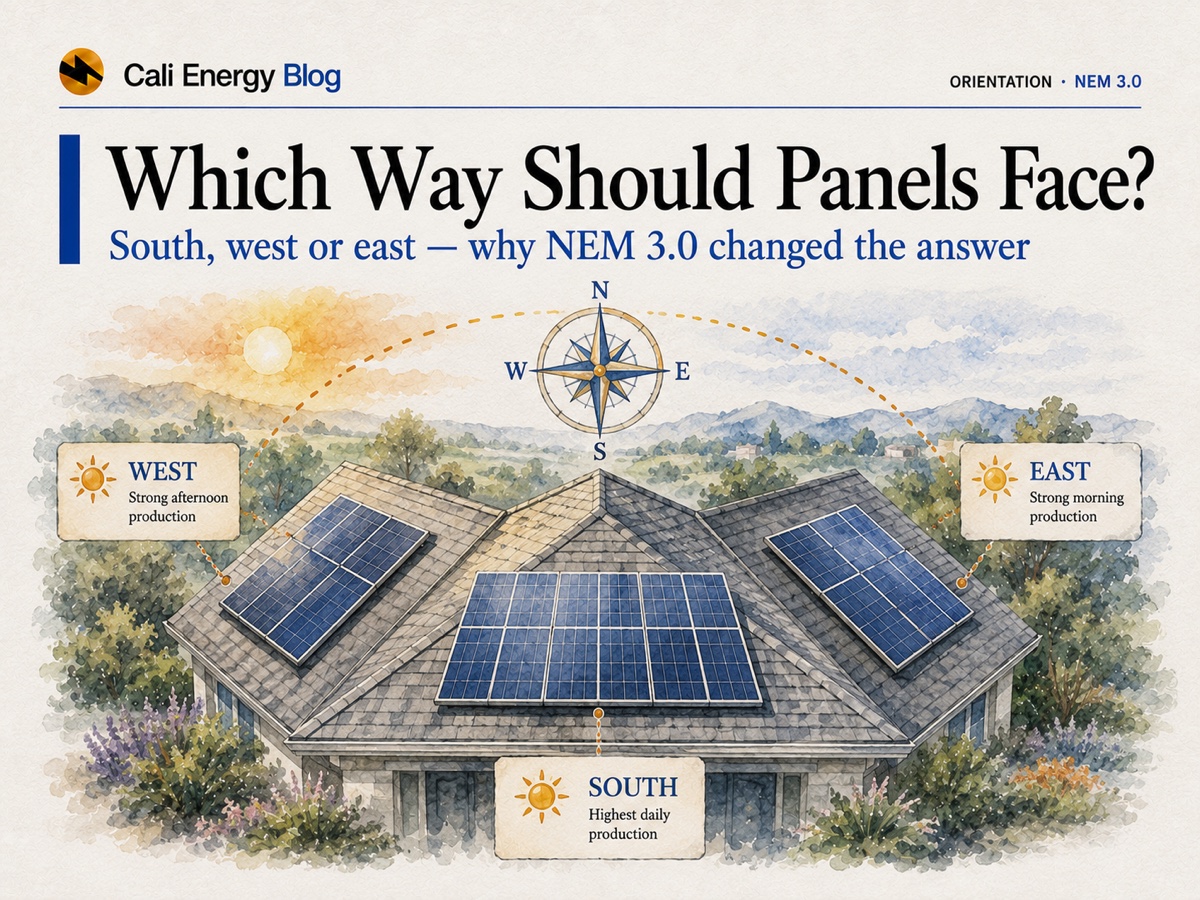
- South makes the most kilowatt-hours: about 1,700 per kW a year in Northridge at a 20° pitch. Southwest makes 97% of that, southeast 95%, west 87%, east 85% and north 69% (NREL PVWatts, our runs).
- Timing differs more than output. Southwest and west arrays make 16% and 20% of their energy between 4 and 9 p.m.; south makes 11%, east 5%.
- On SCE’s Solar Billing Plan, a 2026 system’s exports average 6¢/kWh on a summer day and 21¢ on a summer evening, while TOU-D-PRIME charges 61¢ for a summer weekday peak kWh. Late-day output is worth more, whether exported or used at home.
- On LADWP’s standard R-1A rate, an exported kWh offsets a purchased kWh whatever the hour, so total output decides — face south.
- Tilt matters less: 30–34° is best for a south roof, and against that 20° gives up under 2% and 10° about 6%. A battery moves midday energy into the evening and makes direction matter less.
The short answer
For the most kilowatt-hours, face panels south. For the most bill value on SCE, southwest gives up little energy and shifts more of it into the evening. Most roofs offer one or two usable faces, so the real question is how to use the faces you have.
Two things decide what an array is worth: how much energy it makes and when it makes it. Under the old net metering an exported kWh earned close to the retail price of its hour, so the amount mattered far more than the timing. Under the CPUC’s Net Billing Tariff for SCE, PG&E and SDG&E, the hour carries real money (CPUC), so orientation deserves a second look before you approve a design. The figures below come from NREL’s PVWatts model for one location and set of assumptions; your roof, shading, usage and utility set the real numbers.
Solar output by direction in Los Angeles
The same 20° roof in Northridge, turned to six directions and run through NREL’s PVWatts calculator hour by hour.
| Direction | kWh per kW | vs south | Made 4–9 p.m. | SCE export value, per kWh · per kW-year | Best for |
|---|---|---|---|---|---|
| South (180°) | 1,700 | 100% | 11% | 5.4¢ · $92 | Most total energy; LADWP homes; homes adding a battery |
| Southwest (225°) | 1,647 | 97% | 16% | 6.1¢ · $101 | Nearly south’s output with more of it late in the day |
| Southeast (135°) | 1,619 | 95% | 6% | 4.9¢ · $80 | Nearly south’s output, weighted to the morning |
| West (270°) | 1,487 | 87% | 20% | 6.7¢ · $99 | Late-afternoon output for homes that use power 4–9 p.m. |
| East (90°) | 1,447 | 85% | 5% | 4.9¢ · $71 | Morning use — pre-cooling, early EV charging |
| North (0°) | 1,181 | 69% | 14% | 6.3¢ · $74 | Generally avoid; last-resort fill on a crowded roof |
Our calculation from NREL PVWatts version 8: 4 kW, fixed roof mount, standard module, 20° tilt, the default 14% system losses (PVWatts manual), typical-year NSRDB weather for Northridge. Export values apply SCE’s published average export credits for a 2026 system (summer day 6¢, evening 21¢, overnight 12¢; winter 3¢, 10¢, 10¢) to each hour, on clock time with daylight saving; they leave out the export bonus credit and assume nothing is used at home, which understates every row (SCE).
Read the table in two directions. Down the kWh column, south wins and the drop to southwest or southeast is only 3–5%; east and west give up 13–15%. Across to the timing columns, the order flips: southwest makes half again as much of its output in the 4–9 p.m. window as south does, and if everything were exported it would earn about 10% more per kW a year despite making 3% less energy. West earns about as much as southwest on fewer kWh; east earns the least. North is last on energy and has no timing edge worth its losses.
Why south still makes the most energy
North of the tropics the sun crosses the southern sky, so a south-facing roof (about 180°) faces it for the most hours and collects the most over a year. Turn the same roof to the southeast or southwest and the loss in Northridge is 3–5%; turn it due east or west and it is 13–15%. If your rate values every kilowatt-hour about the same — as LADWP’s standard rate does — south is the answer.
Why timing matters on SCE
On SCE’s Solar Billing Plan, a kilowatt-hour you use at home avoids the price you would have paid for it, and one you export earns an Energy Export Credit that depends on the hour. Both are worth more late in the day:
| Summer day | Summer 4–9 p.m. | Winter day | Winter 4–9 p.m. | |
|---|---|---|---|---|
| Used at home | 26¢ | 61¢ weekdays, 39¢ weekends | 24¢ (8 a.m.–4 p.m.) | 45¢ |
| Exported | 6¢ | 21¢ | 3¢ | 10¢ |
Sources: SCE TOU-D-PRIME prices, the plan Solar Billing Plan customers must be on; SCE average export credits for a 2026 system (daytime 6 a.m.–4 p.m.). Summer is June through September. Prices include delivery and generation from SCE; checked September 30, 2026.
So a kWh made at 5 p.m. on a July weekday is worth two to three and a half times one made at noon, whichever way it goes. A southwest or west array puts more of its output into those hours, which is why it can come out ahead of south on the bill even though it makes less energy. How much depends on your household: a home that is empty all day and busy in the evening gains the most from a west-leaning array; a home that runs air conditioning or charges an EV at midday uses south’s bigger midday output itself.
East-facing panels cover the morning
An east roof makes its power early and only about 5% of it between 4 and 9 p.m. If your household runs hard in the morning — pre-cooling on a hot day, an EV topping off, breakfast loads — that output is used at home instead of exported. Many homes combine faces, such as east plus west, which spreads production across the day.
What about tilt?
Direction matters more than tilt. On a south roof in Northridge, PVWatts puts the best annual tilt around 30–34°, but the curve is flat: 1,729 kWh per kW at 30°, 1,727 at 34°, 1,712 at 40°, 1,700 at 20° and 1,627 at 10°. For reference, a 4-in-12 roof is about 18°, 6-in-12 about 27° and 9-in-12 about 37°. On an east or west face a flatter pitch is slightly better: a west array makes 1,512 kWh per kW at 10° against 1,487 at 20°. Tilting panels up off the roof plane adds cost and wind load for a few percent at most. A steeper face does help in winter; see solar panels in winter.
What actually moves the needle
Shading
An afternoon shadow from a tree or a neighbor’s roofline can erase a west array’s timing advantage. Measure shade before choosing faces — see solar panels and shade.
Your usage pattern
A house that is empty until 6 p.m. favors southwest or west (and a battery). A household that uses power all day cares less about direction.
A battery
Storage lets a south array make its big midday total and save it for the evening, which largely settles the orientation question. See whole-home vs. critical-loads backup.
Roof planes available
Most homes can’t pick a direction; you work with the faces you have. Splitting panels across two planes spreads output through the day.
System size
A less productive face needs more panels for the same output — about 14% more facing west than south. Our panel-count guide walks through sizing.
Your utility
SCE’s Solar Billing Plan rewards late-day output; LADWP’s net metering rewards total kilowatt-hours. The right answer follows your rate.
Add storage and orientation matters less
On SCE the orientation debate exists because midday exports earn little and evening power is dear. A battery sidesteps it: face panels south for the most energy, store the midday surplus, and use it in the 4–9 p.m. peak. With storage you are optimizing when you use your own power rather than the roof’s direction.
In the City of Los Angeles, total output decides
LADWP is a municipal utility and runs its own net metering, not the CPUC’s Net Billing Tariff. On the standard R-1A rate, imports and exports are netted over the billing period, so a kWh exported at noon offsets a kWh bought in the evening at the full retail price — timing barely matters and south’s extra output wins. On the time-of-use R-1B rate each export is credited at the price of its time block, and the spread is modest: in July–September 2026 High Peak (1–5 p.m. weekdays) is 35.12¢ against 26.54¢ for Base (LADWP net metering rider, LADWP rates). Details in LADWP net metering in 2026.
How we approach it on a real roof
We model each usable roof face against your utility, rate plan and usage before deciding where panels go. Splitting an array across two faces is common when one face can’t hold it all or when it evens out production through the day. There is no single best direction that beats a design matched to your roof, shading, usage and utility. Whether the whole project pencils out is a separate question, covered in is solar still worth it in California?
Get a free layout & savings estimateFrequently asked
Which way should solar panels face in California?
For the most energy, south: about 1,700 kWh per kW a year on a 20° Northridge roof in NREL’s PVWatts model. On SCE, a southwest roof makes 97% of that but puts more of it into the 4–9 p.m. window, when both exports and self-used power are worth the most, so it can come out ahead on the bill. On LADWP’s standard rate, south is the answer. A battery makes the choice matter less.
Do west-facing solar panels really produce less than south?
Yes. On the same 20° Northridge roof, west makes about 87% of south’s annual output — 1,487 against 1,700 kWh per kW. But 20% of the west array’s output lands between 4 and 9 p.m., against 11% for south, which is why it can still pay off on SCE’s Solar Billing Plan.
Is east or west better for solar panels?
They make similar totals — east 85% and west 87% of south in Northridge — but at different times. West makes about 20% of its output in the 4–9 p.m. peak; east about 5%. On SCE that gives west the edge unless your home uses most of its power in the morning. Many homes use both faces to spread production across the day.
What is the best tilt angle for solar panels in Los Angeles?
For a south roof, about 30–34° in PVWatts, but the difference is small: against that, 20° gives up under 2% and 10° about 6% of annual output. On east and west faces a flatter pitch is slightly better. Direction matters more than tilt.
Does panel direction matter if I have a battery?
Much less. With storage you can face panels south for the most energy, bank the midday surplus, and use it during the 4–9 p.m. peak. See whole-home vs. critical-loads backup for sizing.
Does orientation work differently on LADWP?
Yes. LADWP runs its own net metering: on the standard R-1A rate, imports and exports are netted over the billing period at the retail price, so the hour barely matters and total output decides — face south. On the time-of-use R-1B rate exports are credited by time block, but the summer spread between High Peak and Base is only about 35¢ against 27¢. More in LADWP net metering in 2026.
Related reading
Sources & methodology
Figures on this page come from the primary sources below and, where noted, from Cali Energy calculations using the stated assumptions. Rates, incentives, and program terms change; each was verified September 30, 2026.
- NREL PVWatts Calculator (version 8) — hourly runs for Northridge, six azimuths and five tilts
- NREL — PVWatts Version 5 Manual (default 14% system losses)
- SCE — Solar Billing Plan (average Energy Export Credit values by season and time)
- SCE — Time-of-Use residential rate plans (TOU-D-PRIME prices; required for Solar Billing Plan)
- SCE — Schedule NBT, Net Billing Tariff
- CPUC — Net Billing Tariff
- LADWP — Service Rider NEM, Net Energy Metering
- LADWP — Residential Rates, R-1A and R-1B (2026 prices)
Not sure which way your roof faces?
Send us your address and a recent bill and we’ll model each roof face against your utility’s rate and your usage, then show which layout pays off. Estimates, not guarantees.
Get a free estimatePrepared by Cali Energy, September 30, 2026. This article is for general educational purposes only and is not legal, tax, financial, engineering, or utility advice. Rates, incentives, codes, permit requirements, equipment specifications, prices, and program terms may change; figures and timelines are estimates, not guarantees. Confirm current requirements with the applicable utility, AHJ, program administrator, manufacturer, or a licensed professional. See our Content Disclaimer. Cali Energy · 19201 Parthenia St, Unit E, Northridge, CA 91324 · CSLB #1032379 (B, C-10, C-39)