

Why Do I Still Have an Electric Bill After Solar?
Short answer: a bill after solar is normal, and in 2026 it has a floor you can predict. On SCE, every solar customer pays the Base Services Charge — $24.15 a month for most homes — plus taxes and a few cents of non-bypassable fees on each kWh drawn from the grid — export credits cannot pay any of them. On LADWP’s standard rate the floor is a $10-a-month minimum plus taxes. Above that floor, what you pay is mostly the power you buy after sunset, plus, on SCE, a yearly settlement. Here is how to tell a normal bill from a problem.
Get a free estimate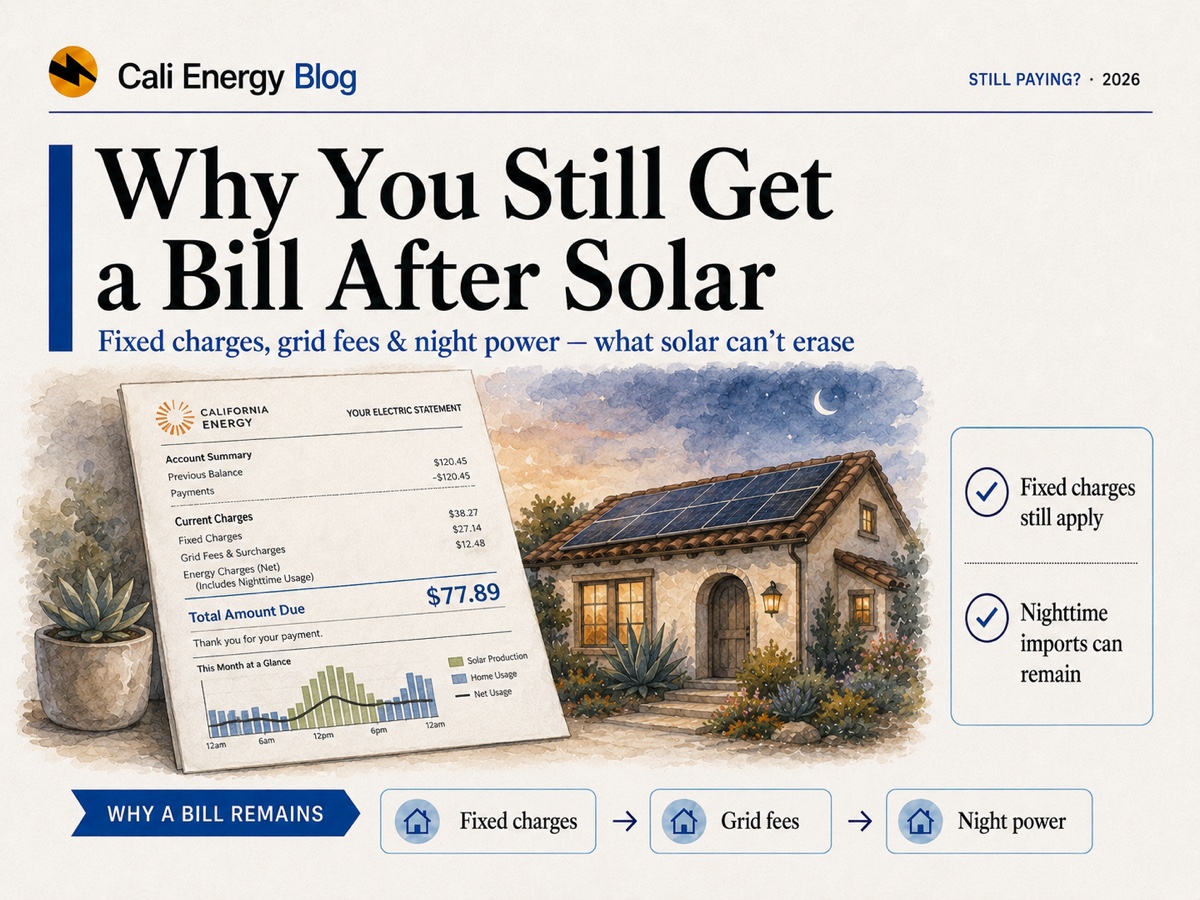
- A bill after solar is normal. What stays: fixed charges, fees that credits cannot offset, taxes, and the power you buy after sunset.
- SCE: since November 2025 the $24.15 Base Services Charge (about 80¢ a day) has replaced the old minimum charge. Export credits cannot pay it, the non-bypassable fees or taxes.
- SCE Solar Billing Plan (NEM 3.0): exports earn a few cents while 4–9 p.m. power costs far more. In SCE’s own July 2026 sample bill, 442 exported kWh earned $36.81 and 160 evening kWh cost $93.92.
- Once a year comes a settlement: NEM 2.0 customers on SCE’s default annual option pay a year of energy charges at once, and Solar Billing Plan customers who export more than they use see credits reduced as an “EEC Adjustment.”
- LADWP: a $10-a-month minimum on the standard R-1A rate, plus taxes; the water and sanitation lines on the same bill are not electricity at all.
- Not normal: a bill higher than before solar, bills that should have stopped after permission to operate, or falling production. The checklist below sorts them out.
What stays on the bill, utility by utility
Los Angeles homes are on SCE or LADWP, and the leftover bill looks different on each. SCE customers who applied to connect solar before April 15, 2023 are usually on NEM 2.0; later ones are on the Solar Billing Plan, SCE’s name for NEM 3.0.
| Part of the bill | SCE, NEM 2.0 | SCE, Solar Billing Plan | LADWP |
|---|---|---|---|
| Fixed monthly charge | Base Services Charge, $24.15 ($12.08 FERA, $6 CARE); solar cannot offset it | Same $24.15; export credits cannot pay it | R-1A: $10 minimum or a $2.30–$22.70 Power Access Charge; R-1B: $12 service charge, payable with credits |
| Fees on every imported kWh | Non-bypassable charges, due monthly | Non-bypassable charges, about 4¢/kWh in SCE’s sample; export credits don’t offset them | No separate category; netting is kWh for kWh |
| Taxes | City utility tax (varies by city) and state tax | Same | 10% city tax in LADWP’s example, plus state surcharge; credits never pay taxes |
| Power bought after sunset | Netted against exports at retail over a 12-month cycle | Billed monthly at TOU-D-PRIME prices; exports credited at lower hourly values | Netted kWh for kWh at retail over each two-month bill |
| Once a year | Settlement: a year of net energy charges comes due on the default Annual Billing Option | Settlement: credits for exports above your use are reduced (“EEC Adjustment”); surplus earns about 2¢/kWh | No true-up; credits bank with no time limit and are never paid out |
| Other services on the bill | — | — | Water and City sanitation charges, which solar does not reduce |
Sources: SCE Base Services Charge, Solar Billing Plan, solar glossary and NEM bill guide; LADWP net-metering rider, 2026 residential rates and rates FAQ. SCE’s minimum charge no longer applies since the Base Services Charge began.
One real SCE solar bill, line by line
SCE publishes a sample bill for a Solar Billing Plan customer on its TOU-D-PRIME rate. It is the clearest picture of where a leftover bill comes from.
| Line | Detail | Amount | Can export credits reduce it? |
|---|---|---|---|
| Base Services Charge | 30 days × $0.769 | $23.07 | No |
| On-peak power (4–9 p.m. weekdays) | 160 kWh × 58.7¢ | $93.92 | Yes, except the non-bypassable part |
| Mid-peak power (4–9 p.m. weekends) | 56 kWh × 39.6¢ | $22.17 | Yes, except the non-bypassable part |
| Off-peak power | 144 kWh × 26.1¢ | $37.59 | Yes, except the non-bypassable part |
| Wildfire fund and fixed recovery charges | 360 kWh × 1.21¢ | $4.36 | No |
| Export credits, including the bonus credit | 442 kWh | −$36.81 | — |
| City utility tax (6% in this sample) and state tax | $8.77 | No | |
| Amount due | $153.07 |
Source: SCE Solar Billing Plan sample bill (prices include delivery and generation). Our grouping: the public-purpose charge ($10.81, inside the energy lines), the wildfire fund charge ($2.13) and the fixed recovery charge ($2.23) come to about 4.2¢ per imported kWh. SCE says its export credits do not offset non-bypassable charges.
This home sent more energy to the grid than it took — 442 kWh out, 360 in — and still owes $153.07. The reason is timing. The 160 kWh it bought between 4 and 9 p.m. cost 58.7¢ each, while each exported kWh earned about 8.3¢. Weekday 4–9 p.m. power alone is 61% of its energy charges. Under the Solar Billing Plan, more exports than imports does not mean a small bill; using your own solar in the evening does — which is what a battery is for. How export values are set is in NEM 3.0 explained, and sizing a battery for that evening load in the battery sizing calculator.
The same sample shows 1,704 kWh of surplus so far in the year. At the yearly settlement, SCE reduces the credits it gave for exports above your own use and pays about 2¢/kWh for net surplus (SCE) — one reason an oversized system can still end the year with a bill.
LADWP: a $10 floor and a two-month bill
LADWP nets the energy you send out against the energy you draw over each billing period, usually two months, at your rate’s retail prices. On the standard R-1A rate the bill cannot fall below a $10-a-month minimum, and banked credits pay neither the minimum nor taxes. LADWP’s own example is a two-month bill of $22 for a customer with credits in the bank: $20 of minimum charge plus $2 of city tax (LADWP rates FAQ). On the time-of-use R-1B rate there is no minimum and credits also cover the $12 monthly service charge, so a customer with enough banked credit pays only taxes.
An LADWP bill also carries water and City sanitation charges. They are not electricity, so solar does not lower them — check the electric section when you judge what solar is doing. The full rules and a worked bill on both rates are in LADWP net metering.
Normal or a problem? Check these in order
Most leftover bills are the floor above plus evening power. These checks catch the ones that are not.
- Is the system actually approved to run? Until the utility gives permission to operate — on LADWP, until it installs the net meter — the system must stay off and your bill is an ordinary one. See solar installed but waiting on the meter.
- Is this the first bill after installation? LADWP notes that the first bill includes usage recorded on your previous meter.
- Is it a settlement month? On SCE, NEM 2.0 customers on the default Annual Billing Option owe a whole year of net energy charges at once; switching to the Monthly Billing Option spreads them out (SCE). Solar Billing Plan customers may see an “EEC Adjustment.”
- Is the system producing what it should? Compare your monitoring app with the estimate in your proposal. A sudden drop points to shade, soiling or a fault — see solar not producing.
- Did your usage change? An EV, a new air conditioner, a pool pump or more people can outgrow a system sized for the old bills.
- Was the system sized for partial offset? If the proposal covered, say, 85% of your use, the remaining 15% is billed by design.
- Did it start in the fall? A system switched on in autumn starts with no banked credit, so its first winter bills are usually its highest.
- Is the bill higher than before solar? That is a different problem, with its own causes: why a bill goes up after solar.
Diagnose your leftover bill
Tick what matches your bill. The tool ranks the three most likely reasons you still pay, and whether each is normal.
Leftover-bill diagnostic
Why do I still have an electric bill after solar?
General guidance for SCE and LADWP residential customers in 2026; your exact charges depend on your rate plan and system. Not a bill audit.
How far down can the bill go?
Not to zero on SCE: the $24.15 Base Services Charge and taxes remain even in a month with no grid power at all, and the non-bypassable fees ride on every kWh you import. What you can shrink is the evening power. Shift dishwashers, laundry and EV charging into sunny hours, and consider a battery that carries the house from 4 to 9 p.m.; in SCE’s sample, that window was $93.92 of the $153.68 in energy charges.
On LADWP the floor is lower: $10 a month plus taxes on R-1A, and only taxes on R-1B once the credit bank covers the rest. A battery there is mostly for backup, because exports already offset purchases at retail. Size the system to your yearly use on either utility: SCE pays about 2¢ for surplus, LADWP nothing.
Normal leftover, or something to fix?
Send us your latest SCE or LADWP statement and your monitoring data. Cali Energy (CSLB #1032379) will go through it line by line — what is the normal floor, what is evening power, and whether production, sizing or the rate plan is costing you.
Have us read your post-solar billFrequently asked
Why do I still get an electric bill if I have solar panels?
Because some charges don’t depend on how much energy you buy, and solar credits can’t pay them. On SCE, every solar customer pays the $24.15-a-month Base Services Charge, taxes and non-bypassable fees on each imported kWh — about 4¢ in SCE’s July 2026 sample bill. On LADWP’s standard R-1A rate there is a $10-a-month minimum plus taxes. Above that floor you pay for power bought after sunset, which on SCE’s Solar Billing Plan costs much more than midday exports earn.
What is the fixed charge I still pay with solar?
On SCE it is the Base Services Charge: $24.15 a month (about 80¢ a day), $12.08 for FERA and qualifying affordable housing, $6 for CARE. It began in November 2025, replaced the old minimum charge, and applies to solar customers; export credits cannot pay it, though remaining Net Surplus Compensation or bonus credits can. On LADWP, the standard R-1A rate has a $10-a-month minimum or a Power Access Charge of $2.30–$22.70 a month; the time-of-use R-1B rate has a $12 service charge that banked credits can pay.
What are non-bypassable charges?
Per-kWh fees that all SCE customers pay on the electricity they draw from the grid, funding public programs and the state wildfire fund. SCE says its Energy Export Credits don’t offset them (its bonus credit can). They aren’t listed separately on the bill; in SCE’s July 2026 sample the public-purpose, wildfire-fund and bond-recovery charges came to about 4¢ per imported kWh.
Can solar ever get my bill to $0?
Not on SCE: the $24.15 Base Services Charge and taxes stay even in a month with no grid power. On LADWP’s R-1A rate the floor is the $10-a-month minimum plus taxes; on R-1B, a large enough credit bank can leave only taxes. A realistic goal is a bill near that floor, which on SCE means using more of your own solar in the evening, usually with a battery.
Why is my yearly true-up bill so large?
On SCE NEM 2.0, the default Annual Billing Option collects set fees monthly but all net energy charges once a year, so a year of winter and evening usage arrives on one bill; the Monthly Billing Option spreads it out. On the Solar Billing Plan, if you exported more than you used over the year, SCE reduces the credits for the extra (an “EEC Adjustment”) and pays about 2¢/kWh for net surplus. LADWP has no true-up.
Does the leftover bill come every month or once a year?
On SCE, fixed and non-bypassable charges come every month; NEM 2.0 energy charges come monthly or once a year depending on your billing option, and Solar Billing Plan energy charges come monthly with a yearly settlement. LADWP bills most homes every two months and nets imports and exports within each bill.
Is a bill after solar the same as my bill going up after solar?
No. A small leftover bill is normal — fixed charges, fees and evening power. A bill higher than before solar usually has a specific cause, such as a true-up, new load, a rate change or low production. See why did my bill go up after solar?
Related reading
Sources & methodology
Figures on this page come from the primary sources below and, where noted, from Cali Energy calculations using the stated assumptions. Rates, incentives, and program terms change; each was verified September 28, 2026.
- SCE — Base Services Charge (amounts, November 2025 start, solar customers, minimum charge)
- SCE — How the Solar Billing Plan works (credits, TOU-D-PRIME, settlement bill, EEC Adjustment, NSC)
- SCE — Solar Billing Plan sample bill (June 22–July 21, 2026)
- SCE — Solar glossary (non-bypassable charges; charges not eligible for reduction)
- SCE — Guide to your Net Energy Metering bill (Annual and Monthly Billing Options)
- LADWP — Service Rider NEM, Net Energy Metering
- LADWP — Residential Rates, R-1A and R-1B (2026)
- LADWP — Rates FAQ, Residential Solar Rate (archived May 19, 2024)
Not sure your post-solar bill is right?
Send us your latest SCE or LADWP statement and we'll walk through it line by line — what's the normal floor, what's evening power, and whether a battery or a rate change would actually save you money.
Get a free estimatePrepared by Cali Energy, September 28, 2026. This article is for general educational purposes only and is not legal, tax, financial, engineering, or utility advice. Rates, incentives, codes, permit requirements, equipment specifications, prices, and program terms may change; figures and timelines are estimates, not guarantees. Confirm current requirements with the applicable utility, AHJ, program administrator, manufacturer, or a licensed professional. See our Content Disclaimer. Cali Energy · 19201 Parthenia St, Unit E, Northridge, CA 91324 · CSLB #1032379 (B, C-10, C-39)